I came up with a pretty good mathematical structure for a twist with a discontinuity. It essentially weights neighboring connections less for bigger steps between lattice elements, or in other words, it rewards continuity but doesn’t break on discontinuities. After a number of rounds getting the model right and verifying, I got some pretty clear results–the static twist model dissipates. The only way this twist can sustain itself is by moving at speed c, that’s my next step. Here are some pictures:
Twist boundary initial state:

Initialize entire field, including boundary initial state
Here I fix the boundary state but let the rest of the field absorb the impact of the boundary initial state:
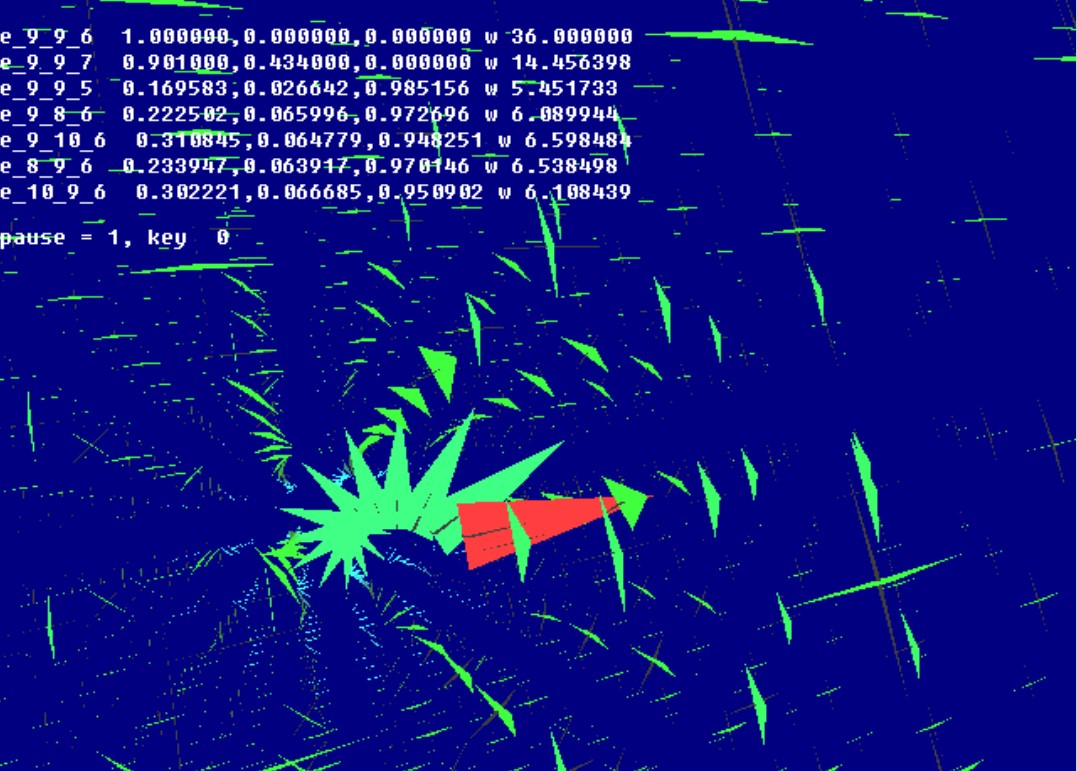
Fixed initial twist state, but field is released
After a while, I see the field settling into a more or less stable state, so now I release the boundary initial state (the twist itself). Here you can see how the twist dissipates into the axial dimension (I actually had proposed this as a means of getting into a twist without a discontinuity, but discovered that there is no possible way to do that. This shows how the twist could emerge from a stable state with no discontinuities, but eventually there has to be a discontinuity. I actually don’t see the discontinuity in this dissipated sim, but that’s going to be pretty hard to see in this 3D picture. I’ll add some code that will show discontinuous regions overlaid onto this sim view. Here are three pics showing how the twist dissipated.
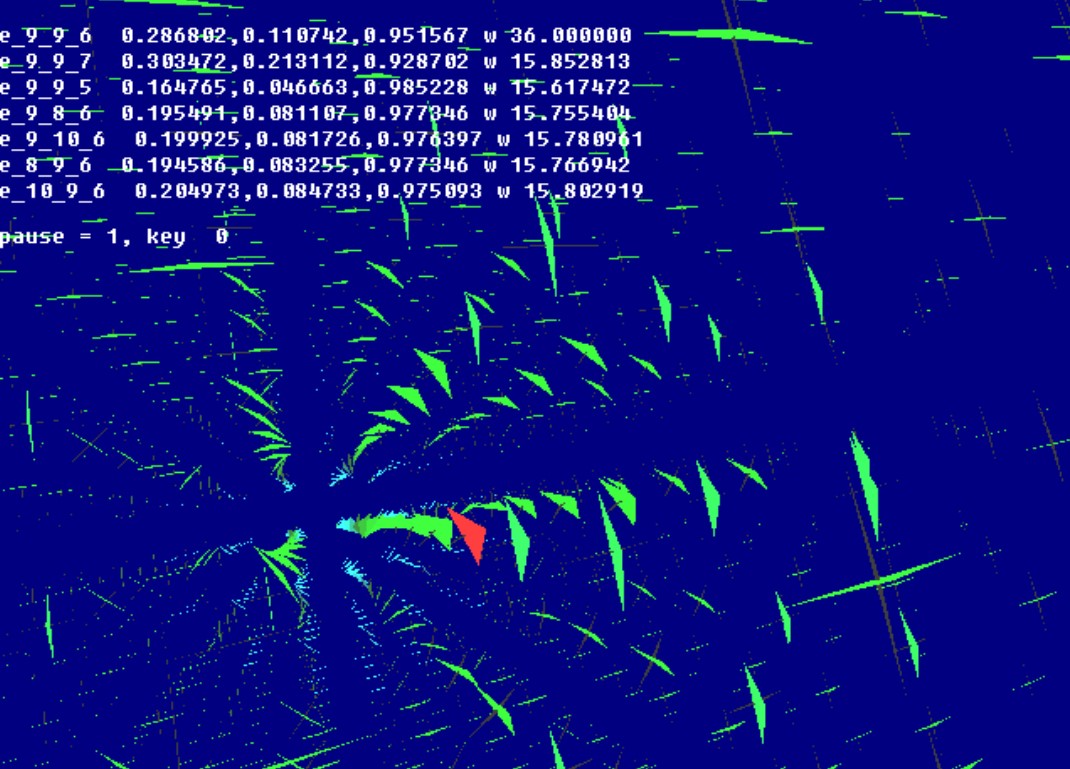
Twist starting to dissipate, view along the twist axis

Twist starting to dissipate, view about 45 degrees off the twist axis

Twist starting to dissipate, view normal to the twist axis
So, it’s pretty clear–twist can’t work unless it’s moving along the axis at a speed such that nothing can get ahead of the twist, otherwise it will dissipate. I’ll do another round of pics when I get that sim working.
Agemoz
Tags: twist simulation field
 Agemoz's Physics Blog
Leave a comment