Archive for December, 2017

First Unitary Twist Field Sim Output–It’s a Three Ring Circus! (Update)

December 24, 2017

UPDATE:  errors in the sim calculations are distorting the expected output–it’s too early to make any conclusions yet.  Corrected results coming soon–the CUDA calculations work in 3D blocks over the image, including overlap borders.  As you might expect, the 4D computation gets complex when accounting for the overlap elements.  I had the blocks overlapping incorrectly, which left holes in the computation that caused the soliton image to be substantially distorted.  I still see strong indications that there will be stable solitons in the results, but need to correct a variety of issues in the sim before drawing any conclusions.  Stay tuned…

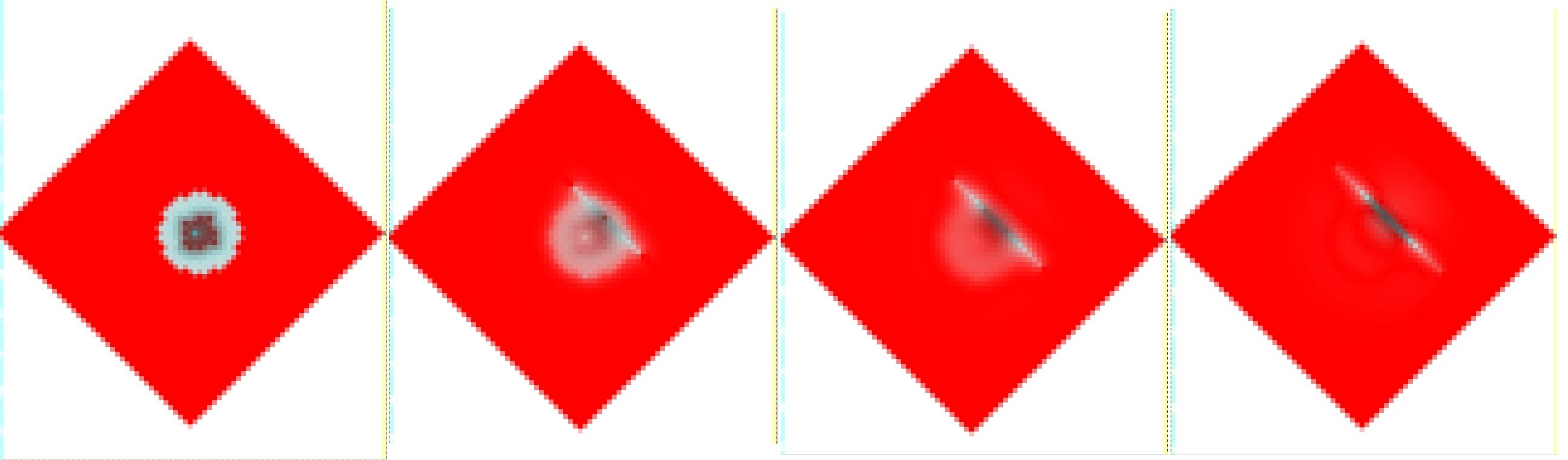
The first results from the Unitary Twist Field Theory are in, and they are showing a three ring circus! Here are the sim output pictures. The exciting news is that the field does produce a stable particle configuration that is very independent of the initial boundary conditions and strength of the background state and the neighborhood connection force–the same particle emerges from a wide variety of startup configurations. Convergence appears visible after about 20 iterations, and remains stable and unchanging after 200000 steps. So–no question that this non-linear field produces stable solitons, thus validating my hypothesis that there ought to be some field that can produce the particle zoo. Will this particular field survive investigation into relativistic behavior, quantum mechanics and produce the diversity of particles we see in the real world? I created this theory based on the E=hv constraint that implies a magnitude-free field and a background state, a rotation vector field that includes the +/-I direction, and many other things discussed in previous posts, so I think this field is a really good guess. However, it wouldn’t surprise me at all that I don’t have this right and that changes to the hypothetical field will be necessary.  As usual, as in any new line of research work, it’s quite possible I’m doing something stupid or this is the result of some artifact of how I am doing the simulation–it doesn’t look like it to me, but that’s always something to watch out for.  However, here I am seeing good evidence I have validated this line of inquiry–looking for a non-linear precursor field that produces the particles and force-exchange particles of the Standard Model.

It’s very hard to visualize even with the 4D to 2D projected slices I show here. I color coded the +I (background state) dimension as red, -I direction as black, and combined all three real dimensions to blue-green. Note there is no magnitude in a unitary twist field (mathematicians probably would prefer I call this a R3+I rotation unitary vector field), so intensity here simply indicates the angular proximity to the basis vector (Rx, Ry, Rz, or +/-I). For now, you’ll have to imagine these images all stacked on top of each other, but I’ll see if I can get clever with Mathematica to process the output in a 3D plot.

Studying these pictures shows a composite structure of two parallel R3 rings and an orthogonal interlocking -I ring, and something I can’t quite identify, kind of a bridge in the center between the two rings, from these images. These pictures are the 200000 step outputs.  You can ignore the image circles cursors in some of the screen capture shots, I should have removed those!

More investigation results to come, stay tuned!

Agemoz

Unitary Twist Field Sim Update

December 3, 2017

I have been developing and refining CUDA code that runs a simulation of the Unitary Twist Field theory. This theory essentially says that all particles and exchange particles have an underlying “precursor” field. Put another way, I’m positing that U(1) x SU(2) x SU(3) will emerge from a single unitary rotation field in R3 + I. The proposed field is non-linear because it also has a background state rotation vector potential. This quantizes twists in the field, and provides a mechanism for twist propagation to curve, thus enabling closed loop twists. The work on the simulation is designed to allow observation of the behavior of such a field in a variety of boundary condition situations.

This work is very much in its infancy, but has already yielded some very interesting insights. The crucial question I want to answer at this point is whether this field can yield stable closed loop twists. The background state potential is crucial for distinguishing this theory from any that are based on linear equations such as Maxwell’s field equations. The background state concept emerged from the need to quantize field behavior geometrically via unit twists in the field. Conceptualizing the behavior of a rotation space in two or even three dimensions appears to show that it should be possible to create stable solitons, but is this true in four dimensions over time–the R3 of our existence plus the +/- I dimension needed for the background state orientation.

I have been working hard to work out the rules for the R3 + I field, but four dimensions is very hard to visualize and work out a geometry of theorems. The simulation environment is designed to assist with this effort.

The sim work has already exposed some pretty critical understanding of what a twist ring would look like. I had originally envisioned a ring of twisting vectors surrounded by the background rotation state +I. However, it turns out things are a lot more complicated than that. If the twisting vectors are in R3 and not in I (the current hypothesis for the simplest closed loop particle), this cannot be stable unless the center of the ring is pointing to -I. The surprising result was that both the +I and -I are stable states when a +I potential is applied! By itself, the -I state would be metastable but any neighborhood connection would make both +I and -I stable–in 2 dimensions and possibly in 3 dimensions–still thinking through the latter case. But the theory requires 4 dimensions, is the ring stable in that case? My mind cannot swallow the 4 dimensional case, but the sim work showed some fascinating elaboration of the R3 + I case.

The -I center must be surrounded by a shell of real (R3) rotations (see illustration below). There must be a transition from +I to R3 to -I and back again, but in all dimensions of R3. There is only one possible way to create a surface of contiguous R3 vectors. I was able to rule out the normal vectors on the surface, because there appears to be no way to transition contiguously to +I or internally to -I without creating a discontinuity. But a surface of tangental vectors would work, provided that the tangental vectors at the equator of the sphere point in the same circumerential (eg, x-y) direction, gradually pointing up to the normal direction, which would be -I at the center, +/- Z at the poles of the surface, and +I outside of the surface. In essence, this work is showing there is only one possible way to form a ring and it actually is enclosing the -I center with a surface of real vectors. Essentially the ring looks like a complementary pair of vortexes with the ring being the common top of the vortexes. It should be possible to create more complex structures with multiple -I poles, but right now the important question is this: is this construct stable. I’m hoping that the sim will verify if this rotation vector model of the ring dissipates in some way. I can envision that the -I core cannot unwind, that it is locked and stable, but it is really hard to prove that in my mind in four dimensions. The sim should show it, I’ll keep you posted.

Agemoz