Archive for January, 2018

Unitary Twist Field Model for the Weak Force

January 31, 2018

The Unitary Twist Field theory posits that the particle zoo and corresponding exchange particles could form from a rotation (unitary magnitude) vector field.  I have put together a simulation of this field and appear to have confirmed it can form stable particles of various sorts, including a qualitative model using linked closed loops for quarks and the strong force.  Now I see a possible mechanism for the weak force in this theory.
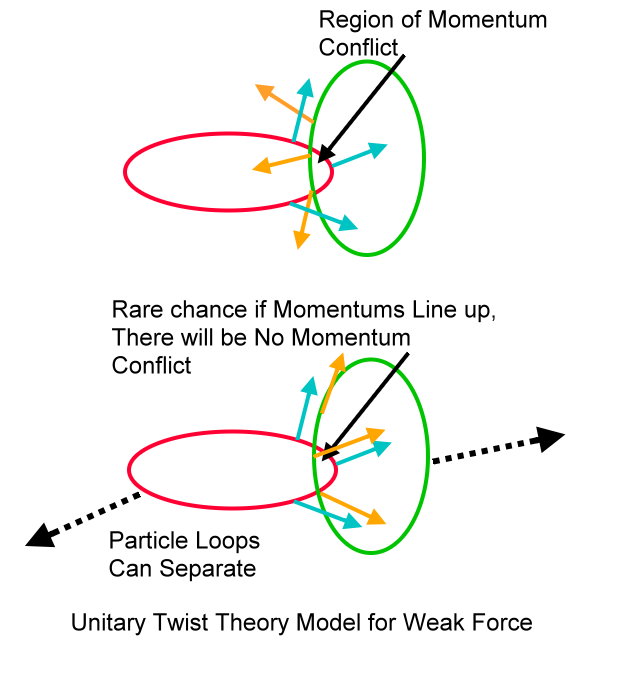
The sim work clearly shows that if two closed loops such as rings are pulled apart to the point where the twists of each ring approach each other, there are dramatic effects on the rings that will separate or destroy both rings.  I was hoping to have the sim show that such linked rings will try to avoid (ie, push away from each other) what might be called a momentum collision as the twists approach each other, but right now I am running into a problem with the sim code.  I call this problem “momentum splitting”, and it results from the lattice computation of momentum progression in the sim.  Since momentum almost never transfers exactly into an adjacent sim cell, either the conserved momentum must be split between two or more cells, or all of it must be sent to one of the adjacent cells, with the result that some of the momentum location information is lost or rapidly spreads throughout the array.  In both cases, the sim results go badly awry from actual expected results.  I am working on a solution that enforces conservation of momentum by using the second option, but keeping a separate array of momentum parameters such as exact location in each cell.

So–a roadblock to getting good sim results, but often working out details of the sim yield insights to the actual model.  One thing I noticed about the twist field model (not the sim of the model) is that there is a very small probability that two twist rings will collide in such a way that the twist rotation angle happens to be identical.  If this happens, there is sort of a quantum tunneling effect where the two rings can separate if a random jiggling of the rings hits this coinciding angle rotation.  At that point, the rings would have to disintegrate or form other loop combinations (my hypothesis) because the ring energies are not correct for stability on their own.  I originally thought this was a fatal flaw in the linked ring idea for quarks–but then I realized that the vast majority of quark combinations are not stable, they decay via the weak force.  Up to now, I couldn’t see any way to get the Unitary Twist Field to model the random effect of the weak force, but this is a great solution, I think!  The random thermal motion of our existence would be constantly pulling and pushing the linked rings in a very chaotic way, and every once in a while the ring rotations at the point of collision would line up and cause a dramatic breakup of the linked structure.  Just about all of the linked quark combinations experience decay in varying amounts of time, and this model of the unitary twist field provides a means for this to happen.

So–how do I explain the stability of the proton?  And why does the nearby presence of a proton make a neutron stable?  I suspect that in the case of the proton, even if this ring tunneling happens, the decay must result in something else that the separated rings can decay into (to conserve momentum, among other things).  If there isn’t something to decay into, the proton component tunneling of quark rings won’t occur even if the rotations at the collision point line up correctly.

The neutron case is a lot more interesting, I don’t have an answer but I continue to think about it.  My leading hypothesis is that the proton-neutron combination is actually some unique combination of linked rings that can decay into separate particles (free neutron and proton).

Agemoz

Details of the Linear Twist Sim

January 9, 2018

(Updates 1 and 2 below)

It’s been an amazing week working on the unitary twist field sim.  Most of the kinks in the sim coding are fixed, and what I’m finding in the sim results I think are astonishing.  Here’s what I’m finding:

a. There is now little doubt in my mind that there is a class of precursor fields based on a rotation (unitary) vector field that produces stable linearly propagating twist particles.  I’ve attempted a geometric proof, and within the limits of the assumptions I am making, the particles appear to have to be able to exist in this type of field and are stable, and so far the sim results are confirming this.

b.  An unexpected result from the sim–the particles have to move as a single rotation at the limiting speed of the sim.  This is exciting because photons cannot exist unless they move at the speed of light, and this sim shows linear twists match this behavior.  As I concluded in my last post, I realized that special relativity has to have a part to play here and in the sim it shows up as only one possible speed for the linear twist.

c.  You cannot form a stable linear twist unless you do one full rotation as defined by the local background state.  Any other partial twist dissipates (or has to be absorbed by something, e.g, virtual particles).  There is an asymmetry in the leading and trailing edge angular momentum of any linear twist–the only way to resolve this is if both ends have the same change of momentum (leading edge incurs a momentum in the next cell, the trailing edge cancels out that momentum).  This property prohibits a twist from being stable unless it completes a rotation, in which case the same change in momentum happens on both the leading and trailing edge.

d.  It is looking probable (but not proven yet) that you can curve the twist path depending on the change of rotation vectors in the path of the linear twist.  As mentioned in one my prior posts, a closed loop will create a changing tilt of rotation vectors internal and external to the loop, thus (in theory) sustaining the closed loop.  This is a big difference between this precursor field and attempts to create stable particles out of an EM field.  You cannot change the path of a photon with some EM field.  However, for the unitary twist field, I’ve already shown that this should be possible geometrically (see back a few posts), but now I need to confirm it with a sim.

UPDATE 1:  here is a picture–probably the most unimpressive picture ever produced by a GPU graphics card!  Nevertheless, there’s a lot of computing that was done to generate it, and clearly shows both propagation and preservation of the emitted twist.  The junk to the upper left is left over from the initial conditions that emitted the twist, I’ll fix the startup code shortly, but I thought you’d like to see the early results that I thought were exciting…

UPDATE 2:  Better pictures coming.  Just like with real photons, I can make these particles any length, modeling the continuous range of frequencies available.  What is shown above is a fairly short “photon”, but I now have pictures of much lower frequency, hence longer, photon wave rotations.  I am still getting perfect reproduction of the photon model as it travels, thus solidifying the conclusion that this field yields stable solitons.  Next up–geometrically I can see that I should be able to get two parallel photons to lase–that is, phase lock.  I’ll start the sim with two out-of-phase photons near each other and see if they lock.  Stay tuned!

end of UPDATE 1 and 2

My biggest concern with thinking I have found something interesting as opposed to “not even wrong” or trivial is that I would have expected at least a few thousand real physicists would have already found this field behavior, perhaps fleshed this out a lot more than I have, and found it wanting as a theory underlying the formation of real-world particles.  This thing is simple enough that I just cannot believe that a lot of people haven’t already been here. I also still have a ton of unanswered questions (for example, issues with the background state concept, whether the +/-I state is necessary, and so on).

So–other than having a lot of fun exploring this, I don’t see anything yet that means I should write a paper or something.  I’ll keep plowing away.  As an uncredentialed amateur, I know it’s more likely I’ll win the lottery than being taken seriously by a professional researcher, and I’m fine with that.

One thing that’s going to be really fun is setting up a sim of a major collision of some sort–I hope I don’t induce a cybernetic singularity and wipe out the universe…. 🙂

Agemoz

Sim Works for Linear Twists

January 1, 2018

Happy New Year with hope for peace and prosperity for all!

I now have the sim working for one class of particles, the linear twist.  I fixed various problems in the code and now am getting reasonable pictures for both the ring and the linear twist.  Something is still not right on the ring, but the linear twist is definitely stable with one class of test parameters.  This is an important finding because my previous work seemed to be unable to create a model of a photon (linear twist), so I had focused on the ring case.  However, last night (New Year’s Eve, what a great way to start the New Year!) I realized the problem was my assumptions on how to set up the linear twist initial conditions.

Discrete photons are always depicted as a spiral rotation of orthogonal field vectors in a quantized lump.  I could not make my sim do this, both ends of the lump would not dissipate correctly no matter how I set up the initial conditions and test parameters–the clump always eventually disappeared.  I suddenly realized this picture of a photon is not correct–you have to go to the frame of reference of the photon motion to see what’s really going on.  The correct picture in the photon’s frame of reference is not a clump nor a spiral, but simply a column of vectors all in phase from start to finish (emission and absorption).  It’s the moving frame of reference at light speed that makes the photon ends appear to start and stop in transit.  The sim easily simulates the column case indefinitely.  It also should correctly simulate the ring case for the same reason–and in this case since the frame of reference goes around the ring, the spiral nature of the twist becomes apparent in the sim.  It should also create an effective momentum (wants to move in a straight line) to counteract the natural tendency to shrink into non-existence, but I don’t have the correct test parameters that that is happening yet.

One thing that should please some of you–all of you?  🙂   The background state so far is not necessary to produce these results!  That concept was necessary to produce a quantized lump for the linear photon, but as I noted, that’s not how photons work in their frame of reference.  That simplifies the theory–and the sim computation.  And, most importantly as I suggested in the previous post, seems to validate the concept of assuming that a precursor rotation (twist) vector field can form particles.

Agemoz