In my last post, I described a quantum interpretation based on group waves with an instantaneous wave phase property, and showed how it derives a constant speed regardless of an observer’s frame of reference, setting the stage for special relativity. I also showed how it would resolve the EPR (Einstein-Podolsky-Rosen) paradox for entangled particles in the Aspect experiment cleanly without adding some unknown force. This is a flaw with the Bohm interpretation, among others, since it means that work is done and energy expended, causing a conservation of energy violation. We do not need to believe in multiple parallel universes (Everett interpretation) or try unsuccessfully to create a logically consistent causality using the Copenhagen interpretation.
I then showed how a instantaneous phase group wave particle could self-interfere in the two-slit experiment to logically explain the target interference pattern distribution. In this explanation, I show the very nature of the group wave will cause particle displacement due to the summation of interfering wave components. No pilot wave guiding, with its implied force and consequent work and energy expended, is needed.
I suddenly realized that the group wave quantum interpretation provides a possible approach for creating a soliton–a particle could form in a system based on this quantum interpretation.
For over a century, theoretical researchers have guessed that the particle zoo (the list of subatomic particles that make up protons, atoms, exchange forces, and so on) could form from a continuous field (lattices, i.e., discrete fields, have been ruled out at this time both experimentally and theoretically). DeBroglie was one of the earliest well known scientists that worked with this idea, but Compton and others also came up with proposals. Early efforts assumed that solitons might form from an electromagnetic field via some selected arrangement of charge distribution, but EM fields and particles have the central force property F = c_0 q_1 q_2/(r^2), and by Maxwell’s field equations behave linearly, so basing particle existence on an EM field was disproved–particles would dissipate. If there is a field underlying formation of particles, it cannot be electromagnetic, but rather an underlying “precursor” field from which EM fields could emerge. Dirac’s work led the way to the modern quantum field theory, which further ruled out an EM field creating solitons–EM fields consist entirely of collections of real and virtual photons that travel in straight lines (ignoring space curvature from general relativity at quantum scales).
But instantaneous phase group wave theory can form solitons. No matter what quantum interpretation you believe in, you have to face the fact that a single particle going through two slits is going to experience redirection when you open one of the slits. The fact that this redirection happens means that at some scale, a particle will curve in on its path–it must follow the interference pattern. I have found a variety of ways that a moving interference pattern will circulate or follow more complex loop variations. For the same reason that the two-slit setup forms an interference patterned domain of existence for a particle, the appropriate pair (or more) of particles will self interfere to form stable loops. Follow the interference and you will describe a variety of possible particle paths.
Does this reflect reality–dunno, but work is ongoing. I’m coming up with a mathematical toolset that will describe various interference path constructions. I will follow the yellow brick road and see where it leads…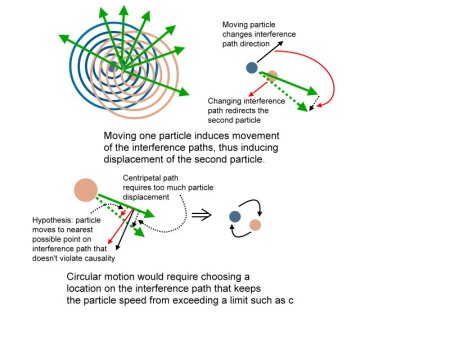
Agemoz
Tags: interference, interpretation, physics, quantum, quantum theory
 Agemoz's Physics Blog
Leave a comment