In physics I fully understand the need to filter out the crackpots and their onslaught of verbiage, whether wrong, vague, incomplete, or meaningless. Real science is built on a very large collection of proven concepts–if any component is wrong but makes it into the collection, trust in the system as a whole is damaged. If you look at Arxiv.com, there’s some junk that somehow got in there, and that means you need some system of qualifying what you see so you can trust what you use in your own work. To avoid this, new papers submitted to journals always require verification by qualified reviewers.
The problem I am having is that I tried very hard not to be a crackpot, I think i proved something important, wrote a paper that got good qualified pre-reviews, and submitted 5 times and got 5 rejections. Nobody looked at the proof and said I did something wrong, and nobody showed me why my conclusion was wrong. Two of the journals were probably not the right target for the paper (this), but the other three did not see value in what I did. The trouble is–I still think the idea is important, and that the proof is valid (confirmed by the pre-reviews).
Basically, in the paper, I proved that if a classical Newtonian particle is formed by a Fourier composition of a specific class of waves, the particle must obey the principles of special relativity. The class of waves is simple–a phase change across any wave component is noncausal, that is, instantaneous across the length of the wave, but the rate of change of that phase is causal, or limited to some maximum change per unit of time such as the speed of light.
To me, this is incredibly important because it suggests the converse–if something obeys the principles of special relativity, it must *only* be composed of instantaneous phase waves. I haven’t proven the converse–working on it–but if this is true, then this opens a big door into what causes the existence of subatomic particles. A logical analysis of the two-slit experiment and the entangled particle decoherence behavior comes from the paper’s derivation (discussed in previous posts). It also shows how a soliton (stable construct) could emerge due to quantum interference (see the last two posts). And now, it shows specifically how the waves have to exist in the first place–very specifically showing what oscillations form the waves and where causality comes from. From this, I see how the concepts of space and time might emerge out of something like the Big Bang.
You see, if a delta function of some sort is present in 3D space, and it is composed of these instantaneous phase waves, you *cannot* see the delta function do this:
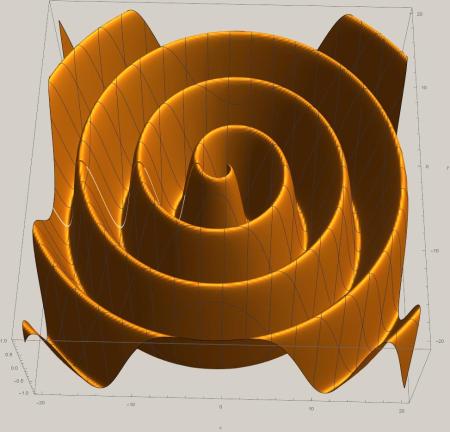
The waves are instantaneous! Here you see variations in space (and time, if you were to make a movie of the particle). But that’s not possible with one delta function–it does not oscillate. Oh, ok, no problem, handwave it and make it oscillate from a + to – peak and back again. You *still* would not see this first figure–the wave phases are instantaneous, but this picture has variations in space and time. Even if you put two of these delta functions near each other, one that is Pi/2 out of phase with the other, you would see something like this, where the two delta functions oscillate up and down out of phase with each other (this shows the Pi/4 halfway point): There are no waves here, because the sum of the delta functions can never produce anything but a plane, no matter how fast they oscillate in time. I realized that now I think I know why electrons are not deBroglie circular waves with a Compton radius size–they have to be infinitely small. The waves shown in the first figure have to result from a non-causal sum of a rotating and infinitesimally spaced, oscillating pair (or more) of delta functions. Space and time for a particle emerge in a non-causal way from the orbiting pair of oscillating delta functions to produce the spiral waves shown in the first figure. Only then could you see non-causal spiral waves emerge. There’s other work I’ve done that shows that the delta functions must reflect some sort of twisting vector field in R3 + I (NOT an EM field vector, those are photons). Along the same lines, I’m sure you’ve seen the recent experimental observation of twist momentum found in photons. Can you see why I see so much exciting work emerging from the simple theorem proof I describe in the paper? Frustrating not to be able to publish it–I think I have something there, but can’t convince anybody else of it! And until someone else sees the validity of what I’ve done, there’s no science here.
Auuggh!
Agemoz
Tags: interference, particles, quantum, subatomic, twist ring physics
 Agemoz's Physics Blog
Leave a comment