Edit update 190719: Addendum added see below–another possible experiment
Every subatomic fermion (non exchange particle such as an electron) has a specific mass and hence wavelength, and thus will produce quantum interference with another particle of the same type or with itself. This quantum interference will cause particle motion to be redirected, for example to specific locations (interference pattern) on a target detector in the two slit experiment. It seems logical that studying the quantum interference effects of a particle will lead to insights about the particle structure.
In the previous post, I showed how the quantum interference pattern could be used to make a guess about particle internal structure. It could form a soliton if the particle were a loop whose radius matched the wavelength of the particle. But, if the particle radius is much smaller than its characteristic wavelength, this doesn’t work and the particle cannot be constructed using quantum interference. I showed how a ring structure could produce the tiny point collision signature but still produce waves with the particle’s characteristic wavelength. If we were able to determine if quantum interference forms electron structure, we could answer the size and topology question for once and for all.
But there’s more we can get from quantum interference. If an electron is truly infinitesimally small, much smaller than the electron characteristic wavelength, we will have no way to determine internal structure by experimental observation. But we can use its quantum interference pattern, whose characteristic wavelength scale is much much larger, to indirectly figure some things out.
For example, one great question to ask is whether the electron is a monopole oscillating or twisting in place– or consists of two nodes, a positive and a negative node spinning in a dipole orbit. As far as I know, there is no experimental or theoretical work that determines which is reality for any subatomic particle. There is no possible way to distinguish these two cases directly if the electron is infinitely small, which is the current physicist consensus. But these two cases will have different characteristic wave patterns! The monopole case will produce waves as concentric circles about the center. The dipole will produce a spiral and will have a radiating peak and zero path.

monopole oscillates in place
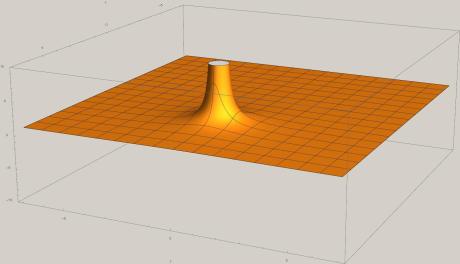
monopole oscillates in place
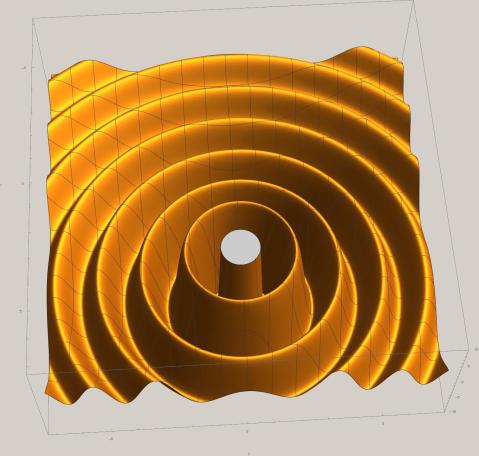
monopoles produce a concentric circle pattern
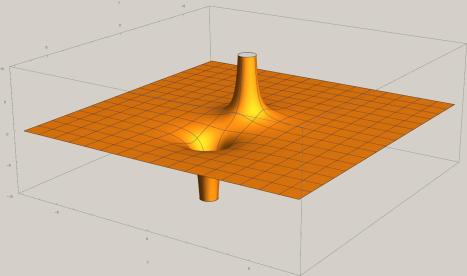
dipole structure in orbit
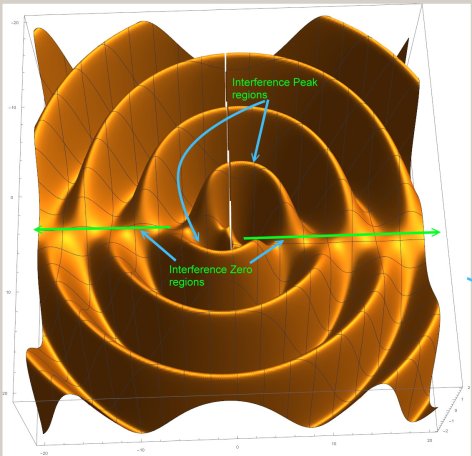
dipole spiral interference pattern
Admittedly, conducting an experiment that observes quantum interference in this distance range will be problematic at best. But there’s one more important difference between the patterns generated by monopoles and dipoles that should help: in a monopole particle, the phase of waves emitted both toward and away from the particle will be the same–but the phase of of spiral waves will be different by Pi/2 (90 degrees).
This characteristic wavelength should be in reach of (very) sophisticated observation apparatus–the electron wavelength, called the deBroglie wavelength, is 1.22 e^-9 meters. The wavelength of visible light is in the range of 400 to 700 e^-9 meters, but energetic X-rays fall into range of this characteristic wavelength. If we could match the characteristic wavelength with an X-ray emitter (using electron-positron annhiliation, perhaps?), we would see observable interference that would either be the same or different on the leading and trailing particle wave paths, leading to either a monopole or dipole determination. If such an experiment could be made practical, we should be able to get a significant clue of the internal electron structure even if the electron is infinitesimally tiny!
Do you see why I think quantum interference could be as powerful a measuring tool for science as, perhaps, the LIGO experiment?
Agemoz
Edit Addendum: It occurred to me that there might be a better way to detect whether electrons have a monopole or dipole structure using a diffraction grating. Silicon processes for fabricating computer chips are at 7 nanometers–the width of 6 or 7 electron wavelengths, so we are within reach of fabricating an experimental setup for electron emitters. When computing the expected interference pattern in a two-slit experiment, Huygen’s principle is used. This principle conforms to the concentric circle pattern that comes from a monopole. Unfortunately, the current typical two-slit experiment has the barrier device (with two slits) oriented perpendicular to the emitted electron’s path and will not be able to determine which interference pattern is present. The dipole structure will give the same answer as the monopole case, because the wave pattern is sampled by the two-slit apparatus at the same phase point for either of the slits.
However, if the two-slit apparatus is tilted from the normal to the electron trajectory, you will have one of the slits slightly time and space delayed from the other, and now the resulting interference pattern will be dependent on the phase shift that occurs when you encircle the particle. In other words, the spiral will be distinguishable from the concentric structure, and this experimental setup should point to either the monopole or dipole structure.
Tags: electron, interference, physics, quantum, quantum theory
 Agemoz's Physics Blog
Leave a comment