The unitary rotation vector field is a promising candidate for an underlying field that theoretically should produce solitons, quantum effects, and special relativity. In order to see if the field really could work or is just snake oil, I wrote a simulator. That has taken a while to get working, but now I’m starting to get results that have been truly fascinating.
I’ve posted a ton of stuff about this field in previous posts. I’ll go over a summary: E=hv is true for all particles, and has led to a realization that a precursor field underlying our existence would have to have one degree of freedom per field element. In contrast, an electromagnetic field has at least two: vector direction and vector magnitude. This precursor field must have vector direction, so I posited that existence must be based on a unitary magnitude rotation vector field. Years of thinking have led to all kinds of insights, including that such a field has to obey special relativity–a conclusion significant enough that I wrote a paper on it. As I worked with this field, I came to the conclusion that such a field would support formation of solitons. I also discovered that such a field would produce quantum effects such as the two-slit experiment interference pattern.
I have found a vast gold-mine of interesting consequences resulting from such a field to the extent that I felt a deeper dive into writing a simulator was worth the trouble. After a long period of time, I now have initial results, and the very first pictures that were output made me realize what a very unique animal the unitary rotation vector field is. Usually when we see interference effects between two oscillating sources (or the wave interference pattern that emerges from a two slit experiment barrier, we see something like this:
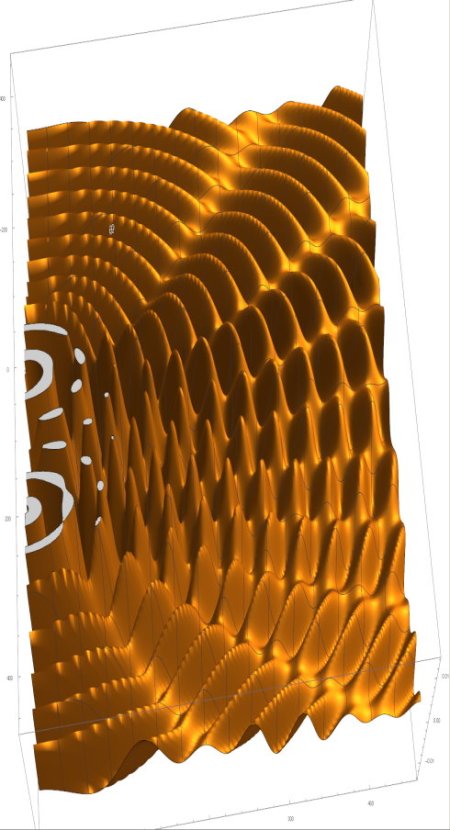
But when I set up two sources using the unitary rotation vector field, I was so surprised that I thought there was something wrong with the simulator. But then I thought about it for a while and realized–a unitary rotation field is a very different critter than what we are used to when we study EM theory or quantum mechanics.
Here is a picture of two identical (same wavelength) particles separated by a substantial distance. It should be really clear that between these two particles the interference of rotation waves disappears. The two particles are effectively entangled, and in this vector field the waves interfere along the path between them.
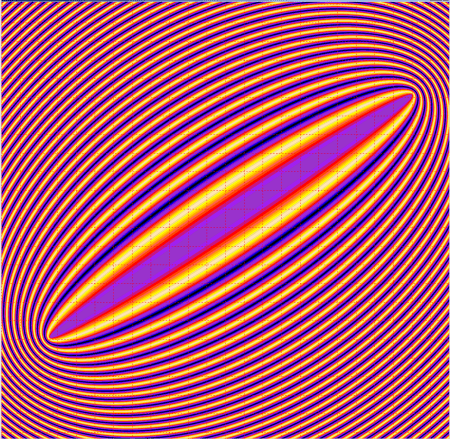
Removing one of the two particles instantly removes the interference and the stable path between them.
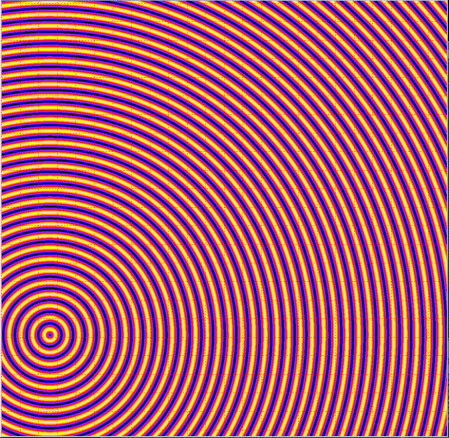
Now this is where things get bizarre beyond belief: add a *third* particle nearby in space, and the wave pattern of the first two completely *disappear*!! Going to four or more particles, the wave pattern causes a single new entity to appear in the center. This aint your Gramma’s EM field here!

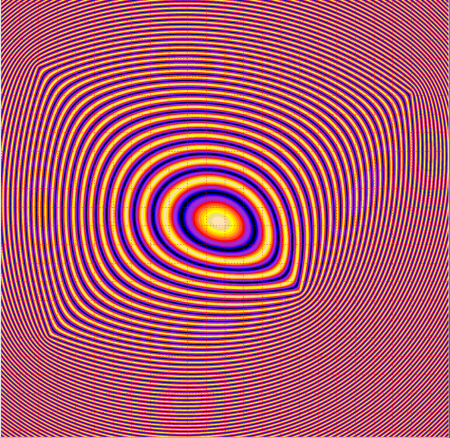
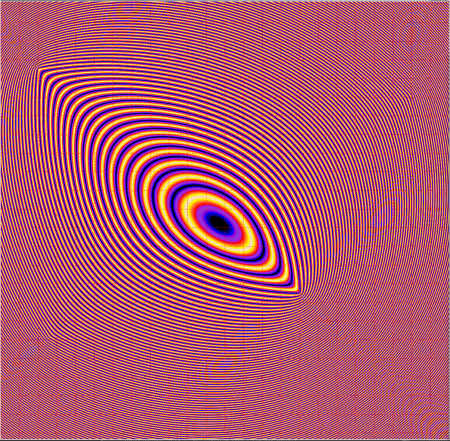
I will stop here, but I haven’t even begun–this is a 5D sim, I’m just testing 2D configurations to test it. I am just capturing a single slice, but 3D configurations will be fascinating to uncover. And–we are talking static configurations–wait until you see how these things move!
You may be completely skeptical that any of this connects with reality, or passes that ultimate test of new physics, that it predicts something new. However, I am fascinated by the potential of this new tool, the unitary rotation vector field simulator, to lead to new insights about the theory I’ve worked on for so long.
Agemoz
Tags: interference, physics, quantum, quantum theory, simulation
 Agemoz's Physics Blog
Leave a comment