I apologize for overposting here–I’m definitely going to be overdoing it–but I just felt like I had one more result to post (UPDATE below).
Most three pole solutions just produce the infinite wave results that are not sustainable as a real representation of particles, I just see the infinite series of wave rings. But I thought, what if I tried to duplicate the three quark up/down configurations? I place three poles in a triangle, and gave them all the same energy. Nope, infinite rings. Next, gave one of the poles half the frequency like an up quark. Nope, still infinite rings. Now, give it an antipole rotation: voila! a stable particle configuration:
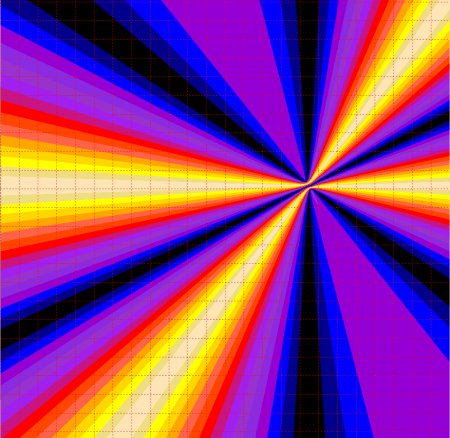
In fact, I tried all combinations of “up” particles and “down” particles, and guess what–only two produced particles, the anti-up, down, down and the up, anti-down,anti-down configuration! Yow–that was exciting.
However, Feynman’s ghost is here, and he says: be skeptical. This may just have a stupidly simple reason, not a physics breakthrough. It could just simply be the fact that 1 + 1 – 2 = 0, and -1 -1 + 2 = 0.
{update}: quark sets have extremely complicated interactions and I now doubt that this configuration directly represents them (for example, where is the mass of the gluons). It might give a clue of internal details of a quark set, but there has to be more to it.
Something much more significant is showing up with these sim results–the hypothesis that a testable principle exists. It is this:
Quantum interference is responsible for redirecting particles along wave interference peaks–and also for creating those particles.
It doesn’t matter that we are talking wave functions (probability distributions) rather than actual waves, the redirection still happens.
It’s becoming very clear from these sim results that at certain wave frequencies, the effect of quantum interference must control the motion of poles because in the unitary rotation vector field, every field location is single valued (only one possible rotation at each point). As a result, the quantum interference redirection that occurs in the two-slit experiment can also cause poles to encircle each other in a stable pattern. I’m about to set up an experiment to directly test this principle.
More pictures to come…
Agemoz
Tags: interference, physics, quantum, quantum theory, simulation, theory
 Agemoz's Physics Blog
Leave a comment