Archive for August, 2020

Photon Interactions in Charge Forces and Radiation Pressure

August 31, 2020

In the previous post, I described an asymmetry between two types of photon interactions–the fact that radiation pressure and electron level changes in atoms are repulsive only, but charged interactions can be attractive or repulsive. I hope you will take a moment to read it–it really is an interesting question. Quantum field theory addresses this issue mathematically, but does not answer why this asymmetry exists.

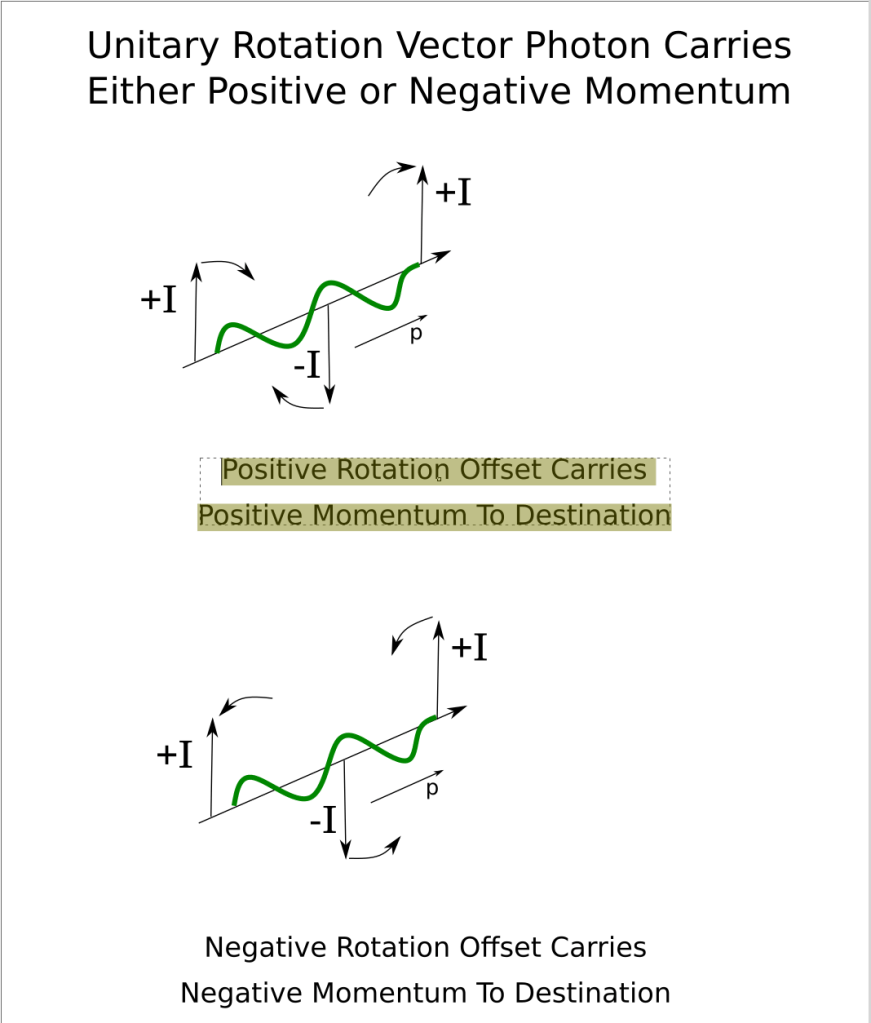
I will summarize that post as follows: Charge forces can be either attractive or repulsive, but radiation pressure is only observed to be repulsive, away from the emitter. The unitary rotation vector field theory (for which I’ve been writing a simulator) posits that there should be attractive radiation pressure via a new particle, antiphotons. I discussed in that post several other justifications for antiphotons that do not rely on believing in the validity of the unitary rotation vector field approach. These justifications essentially state that charge attraction requires that negative momentum be transported from source to destination via particles or field entities that have no momentum of their own.

The unitary rotation vector field describes specifically how this works, using the premise that electron/photon interactions are exchanges of angular momentum, either negative or positive.

However, there is no experimental evidence for antiphotons other than electrostatic attraction, so I became concerned that this is not the real reason for the force directional asymmetry. This post continues that line of thought with an examination of what the unitary rotation vector field idea says about the two types of photon mediated forces. While the theory does allow for negative momentum carrying particles called antiphotons, further investigation hints that this is not the cause for the force asymmetry. Rather, the two photon interaction forces are fundamentally different–one results from photon angular momentum exchange and the other is caused by quantum interference.

Both forces (charge and radiation pressure/electron level transitions) are said to result from photon exchanges and/or photon creation/annihilator operators. Radiation pressure and atomic electron level shifting clearly result from quantized photon packets and are observed to exchange only positive momentum (i.e., are repulsive forces). Energy is conserved as quantized exchanges in these cases.

Charge is different. There is no momentum or energy exchange. Imagine a single positron surrounded by a vast quantity of electrons in all possible directions. Computing the electrostatic force on each electron includes a full charge attraction contribution from the positron (along with a vast quantity of repulsive contributions from all the other electrons). This thought experiment seems to show that there cannot be energy flow in charged interactions, since there would have to be photon exchanges from the positron to each electron simultaneously, an energy flow that easily could vastly exceed the rest mass energy of the positron.

So what is really going on in charged interactions? One possible answer comes from the unitary rotation vector field theory–it is quantum interference between the source and the destination particles. This theory posits that particles form in a single-valued, unitary magnitude rotation field with a background state in a direction orthogonal to R3, the I dimension. Particles are group wave constructs composed of one or more “poles”, quantized single twist rotations from +I and back again. As a group wave, the particle is defined as a peak amplitude magnitude region and its location can be affected by waves from other sources without an expenditure of energy (for example, the relocation caused by quantum interference in the two-slit experiment). The simplest such particle is the one pole photon, a linearly propagating twist; two pole systems can form closed loops, because the waves from each pole form interference patterns (quantum interference) that reposition the pole location. A single pole photon has been demonstrated (see many previous posts) to momentarily shift–via quantum interference–the location of an intercepting two pole closed loop (an “electron”). I hope you will go back several posts and look at my simulation results that beautifully demonstrate this group wave position shifting behavior:

https://wordpress.com/block-editor/post/agemoz.wordpress.com/1295

In this theory, an answer to the asymmetry of charge force bidirectionality versus observed unidirectional radiation pressure or atomic electron level change emerges. Simulations show that the twist is a stable state that forms R3 waves around it. Radiation pressure energy transfer (exchange of angular momentum) exerts repulsive forces only when a closed loop set of twists intercept a single pole photon. But charge interactions don’t work this way–instead, the spherical wave surrounding the twist photon form an interference pattern just like that of the two pole closed loop. Like other quantum interference scenarios, no energy exchange happens, instead the interference pattern forces the destination particle to exist in a nearby position either toward or away from the source emitter. Both attraction and repulsion are possible depending on the relative phase of the waves to the destination.

Further work here is needed to ensure that charge is relativistically invariant in this model.

So, to summarize what the unitary rotation vector field is telling us–radiation pressure and electron level changes are caused directly by angular momentum exchanges, and the photon is created or destroyed in the process. Charge forces are caused by quantum interference between the source and destination particles and no momentum is exchanged! The two types of forces are both the result of photon characteristics, the former due to the angular momentum of the photon, the latter due to the quantum interference wave pattern radiating from the photon. The unitary rotation vector field shows that antiphotons should be possible, but are not necessary to explain the directional asymmetry of charge and radiation pressure forces.

Agemoz
Antiphotons and Charge Force

August 29, 2020

One of the interesting asymmetries in physics involve photons and charged forces. Photons have been observed to carry positive momentum from an atom to a detector (for example, another atom with electrons that can be knocked free, forming an electric current that can be measured). We can also measure the radiation pressure of photons, always exerting force away from the source. Finally, we can observe photon interactions in the form of electromagnetic forces between particles.

Charged forces are attributed to photons, both real and virtual, and are measured to be either attractive or repulsive. By symmetry, I would expect photons could also carry negative momentum, observable in antimatter atoms emitting antiphotons or as negative radiation pressure toward the source emitter.

We see negative momentum via charge attraction forces, but we don’t see attractive radiation pressure. Hence, I thought it logical to assume the existence of negative momentum photons–antiphotons.

I actually arrived at this conclusion from a different path–the photon model in the unitary rotation vector field theory has neither mass or momentum of its own but can carry either positive or negative momentum from a source to a destination. For this reason, I predicted the existence of antiphotons, but shortly thereafter realized that even if you don’t believe the unitary rotation vector field theory, antiphotons should exist by symmetry.

That was a daring statement to make–and it makes me nervous, because we’ve done enough high-energy particle collisions with antiparticles that I would have suspected we would have seen evidence of antiphotons. Both the asymmetry of the photon mediating charged interactions and the promising studies of the unitary rotation vector field suggest that antiphotons should be common in antiparticle interactions. In addition, the lack of antimatter in the universe strongly suggests an asymmetry in how gravity and radiation pressure affect formation of stars. Stars cannot exist without a balance of radiation pressure and gravity–if radiation pressure is negative, it will not form a stable state with gravity to form stars.

So, lots of good evidence that antiphotons should exist–so why don’t we see them? Either they are really hard to distinguish from photons, or are really hard to generate, or they don’t exist. I’ve put a lot of thought into this, and realized that studying charge forces using the unitary rotation vector field might suggest the correct answer.

According to quantum field theory, electric and magnetic forces are mediated by photons. Looking at the LaGrange equations of motion for electron/photon interactions, you can get both positive and negative momentum solutions for the photon wave equation, and in the standard model, attractive forces are interpreted to be photons interacting with an EM field via constructor/annihilator operators. In addition, virtual photons can exist for bounded spacetime neighborhoods that don’t conserve momentum.

The crucial question here is–why the asymmetry? Why couldn’t you interpret this in a symmetric way simply by saying the negative LaGrange solutions are simply photons carrying negative momentum–antiphotons? As mentioned previously, there’s many good reasons to think antiphotons should exist. But we don’t! Why not? We have negative momentum charge (attractive forces), but no observed negative radiation pressure, even though both are mediated by photons. We see no antimatter stars in astronomy, strongly suggesting that such stars do have negative radiation pressure, yet we see no evidence of an antimatter protostar cloud collapsing rather than assuming a stable state in the form of a star.

One answer is that antiphotons are hard to detect. An experiment to observe an anti-atom emit an antiphoton is going to be difficult to set up. You would have to have a detector that could tell the difference between an antiphoton and a photon. As I suggested in a previous post, this might be a positron brehmstrallung experiment that measures the tiny radiation pressure from antiphotons generated by positrons travelling through a magnetic field. Maybe the reason has simply been that no one has looked for an antiphoton, after all, we’ve been taught for so long that photons are their own antiparticle, there is no such thing.

Although I thought the derivation of antiphotons from the unitary rotation vector field was clever, I really have doubts. I think we would have seen antiphotons in high energy collisions creating a negative momentum collision track. There’s good reason to believe that antiphotons should exist, yet there has to be a reason why we don’t see negative momentum carrying photons, but do see negative carrying charge forces.

For this to make sense, the answer may be much more controversial: that photon mediated charge forces and photon radiation pressure forces involve photon particles that are different in some way. If photons cannot carry negative momentum, we are forced to conclude that charge forces are not mediated by the same particles as radiation particles–a theory that goes against the well tested Standard Model. Alternatively, we could decide the issue has to do with the difference between photons and virtual photons (or similarly, quantized photons versus the quantized EM field), but it is very clear to me that neither case can explain the observed asymmetry in photon mediated interactions.

I think insight into the question of antiphoton existence and the charge force asymmetry question can be found by looking at the way the unitary rotation vector field addresses these photon interactions. Since this post is already long, I’ll present my observations in my next post.

Agemoz

Linear Momentum Doesn’t Exist

August 19, 2020

That should be a controversial title and garner an immediate rejection from every physicist (I have lots of practice with that). However, it appears to be true as a model for our real world! Let me see if I can explain why I think this way.

I have been working on a simulator which models reality using a unitary vector rotation field with instantaneous quantum interference waves (not an EM field, a failed approach tried by many researchers in the past and even recently–reference DeBroglie, Compton, etc). Because this field has a background state, rotations are quantized, and these rotations generate waves mathematically identical to quantum interference components. By default, rotations propagate in R3 on a linear path and are modelled as photons, but two or more rotations can generate interference patterns that can form closed loops. These closed loops are modelled to be stable or unstable elementary particles. For more information on the details of these conclusions, you can reference previous posts on this website.

Two of the most important derivations from this work are the emergence of the constant speed of light from any wave based model of reality (see this paper: group_wave_constant_speed) , and the prediction for negative momentum carrying photons labelled antiphotons, which have yet to be discovered. Linearly propagating field rotations acting as photons (or antiphotons) carry momentum at speed c from source to destination, but being intrinsically massless, do not have any momentum of their own.

It is well known that photons emerge from atoms when bound electrons change state, that is, fall to a lower energy state. Alternatively, the atom can capture an incoming photon by raising the energy level of a bound electron. In the unitary rotation vector field theory, the electron emits a photon as a full field rotation with a specific angular momentum. At first glance, I concluded that the linear momentum of the electron gets converted to angular momentum to a linearly propagating rotation–a photon. When the photon is absorbed, the photon’s angular momentum gets converted to linear momentum in the target particle.

However, I ran into problems trying to incorporate this exchange in my simulation. Essentially, a photon interacting with a target electron (linear momentum exchange) or vice versa, was getting too much energy and not matching reality. I finally figured out what was wrong–the concept of linear momentum gets in the way of reality. There can be no such thing as linear momentum! It is an illusion caused by a particle that consists of closed loop field rotations, that is, it has angular momentum confined inside a finite region.

What actually happens when a particle is observed to have linear momentum is that the particle rotations are waves, and increasing the relative velocity of the particle does not add linear momentum. Instead, it causes the particle component composite waves to Doppler shift (note that in all cases in this post, I refer to classical Doppler shifting, not relativistic). When this Doppler shifted wave strikes some other object, the object receives an energy proportionate to the Doppler shifting, which is directly proportionate to the relative velocity of the particle. The Doppler shifting of the angular momentum of the particle is sufficient to explain the momentum change of the target particle, so the standard physics principle of linear momentum cannot actually exist.

The fundamental discovery here is this: The transfer of momentum from photon to electron or vice versa is entirely a transfer of angular momentum that can get Doppler shifted into higher or lower frequencies and hence higher or lower levels of angular momentum (and hence kinetic energy). Our reality, at least in this model of the universe, does not provide for the existence of linear momentum of objects!

Agemoz