As discussed in my previous post, I see that there are multiple statically stable charged elementary particle configurations. There obviously are static configurations for configurations that are based on a massive center set of particles and orbiting light particles (e.g., the hydrogen atom). There is no static configuration for two elementary particles (thus strongly suggesting that the electron cannot be a dipole at the Compton radius, an idea I pursued for a long time). However, as indicated in the previous post, there are static solutions of three and four elementary particles. I just found a 3D solution that allows a static 5 particle solution with three + charged particles and 2 – charged particles.
Some of these solutions have required charges that appear to match relative quark configurations, so I wondered if Schroedinger solutions for these configurations would reveal anything useful. I set up the u,u,d configuration of a proton and see a quantum well similar to the massive center potential energy configuration of the hydrogen atom (see previous post for the computed potential energy along the u,u,d configuration axis). The equation I want to use is this:
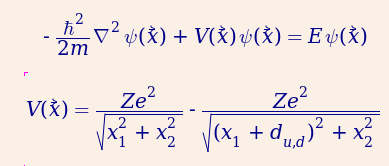
where d_u,d is the statically stable spacing required and Z is the number of charge particles in the interaction configuration. In the three particle case u,d,u, Z = 1. I want to see if this quantizes like the hydrogen atom, and if so, what are the energy eigenstates.
Since I’m pretty sure that analytic solutions are not going to be found, I am going to take advantage of computing horsepower to attempt a brute-force Schroedinger solver engine that could come up with eigenstates for any Schroedinger equation I choose such as this. I do recognize that this equation is symmetric about the inline axis of the u,u,d static configuration, so choosing a cylindrical LaPlacian is probably a good idea. I’m sure there are a variety of iterative solvers out there, but I thought I would first try some of my own ideas. Since this Schroedinger equation is similar to the hydrogen atom case, I’m going to iterate through a chosen range of energies E by step, and in each case compute an array of second-order derivative constants for each x,y position (that is, x_1 and x_2), or radius r and angle phi if I use cylindrical coordinates. Once I have that, I’ll use boundary conditions to set the first derivative starting points and try to reconstruct the amplitude Psi from that. We know Psi has to go to zero at infinite distance (otherwise we would not have bound states), and it must also go to zero at the quantum well and the poles of the u particle positions (on either side of the center d particle). Psi continuity requires that the first derivative must not have discontinuous steps, so this forms another boundary condition on the iteration process.
I’m guessing that non-eigenstate energies will fail to converge in the iteration process, so I’m hoping eigenstates will fall out of this solver and then lead to some interesting information about required masses of the u,d,u particles. It would be great if I get some information that shows why the quarks or the proton as a whole have the masses they have. There is nothing in this model about the strong force or gluons or Higgs bosons, so I admit I’m skeptical I will get anything out of this effort–but there’s no question that there will be some kind of Psi probability distribution for three particles u,d, and u, and I want to see what that looks like.
Agemoz
Tags: physics, quantum, quantum theory, special relativity
 Agemoz's Physics Blog
Leave a comment