A while ago, I discovered that there are a few stable charged elementary particle configurations, the most basic one happens to match the charge configuration of a proton– +2/3, -1/3, +2/3 is stable if placed in a line. There are only a few other solutions, which got me interested in finding the Schroedinger equation probability distribution for this configuration. It turns out that the result is actually pretty interesting, although I’ll state right up front that without accounting for the strong force, weak force, and Higgs boson effects, this work likely isn’t going to be a useful addition to quark chromodynamics.
Nevertheless, there’s some pretty interesting stuff that came out of this investigation. This three-particle configuration is closely related to the classic hydrogen atom two-particle solution, but with an in-line third particle added and without the heavy center particle. At first I thought we would get roughly the same probability distribution we get for the hydrogen atom electron shells, but this is not at all the case and here is why.
The hydrogen atom electron potential energy is a function only of the radius, so the Schroedinger probability distribution Psi equation can be broken down into three independent wave equations multiplied together. Because the hydrogen atom has a potential well, each of these independent wave equations solves sinusoidally for part of the region, and boundary conditions set independent integer wave multiples that form eigenstates for the wave equation in each of three dimensions (either cartesian or more appropriately, polar coordinate solutions). This results in the well known set of 3D probability distribution shapes that constitute the various ground-state or excited states of the electron about an atomic nucleus.
When we try the same process with the charged u,d,u quark particle configuration, I got a totally different situation. To see this, it’s best to work in cylindrical coordinates, with z axis angular symmetry about the in-line axis, and a relatively complex x-y axis potential V. The potential in the x-y potential is related to both x and y, so no reduction to r can be done and the resulting Schroedinger probability distribution Psi is the product of two independent wave equations rather than three. Here is the equation:
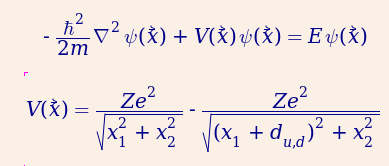
The z axis wave equation solves the same as the hydrogen atom, but the x-y wave equation has an additional constraint. In the hydrogen atom, solutions are a sum of exponential decay and sinusoidal waves, so boundary conditions (the potential well width, in particular) gives us quantized eigenstates for the probability distribution. But the Psi dependency on both x and y means no separation of variables is possible here. In the x-y case means we cannot get a spatially varying Psi, we only get a valid solution to the Hamiltonian at a single x-y point! There cannot be any more than one eigenstate for the x-y case, and all the parameters have to be exactly right to even get one eigenstate.
Does this explain what there are no excited states for the proton? It certainly looks like that, but don’t forget the z-axis wave equation. It does solve to exponential decay and sinusoidal waves, so the composite solution for Psi means there is a much simpler set of excited states, that is, identical probability distributions that are scaled by an integer.
So far, I don’t think my logic and math is faulty, but how can we resolve the fact that the u,d,u Schroedinger gives us any quantized states at all when there’s no experimental evidence for excited protons? We could just say the answer lies in the constraining effects due to the strong force or something like that–but could the excited states from the u,d,u Schroedinger equation just be the solution for multiple protons in a nucleus?
I can already hear a vast chorus of objections from the smarter people in this room, but I thought that was a really interesting outcome. With this solution, we wouldn’t need a strong force to bind the nucleus, the collection of protons are actually represented as an excited proton state, and the steep but thin well wall potentially sets up quantum tunneling that could give us weak force beta particle emissions. Worth a bit more investigation, I think. I especially want to find the single eigenstate energy that results from the u,d,u configuration and see if it gives us the energy (and hence effective mass) of the proton relative to the electron.
Agemoz
Tags: physics, quantum, quantum theory, special relativity
 Agemoz's Physics Blog
Leave a comment