As mentioned in the previous post, I am studying what a u,d,u Schroedinger equation solution would look like. I discovered there are relatively few stable charged particle configurations, and one of them matches the u,d,u quark configuration for protons if the quarks lie in a line. I also found stable 4 and 5 particle solutions (see recent posts), which I thought was interesting given that LHC is recently seeing exotic quad and pentaquarks emerge from high collision energies.
At this stage, I am just doing a study of what a Schroedinger solution would look like for various charged particle sets, ignoring strong force, Higgs, and other chromodynamics.
Such a three-body solution to the Schroedinger cannot be derived analytically. However, some study of the configuration (see previous post) shows some important traits of the solution that lead me to want to know more, so I’ve been writing an iterative differential equation solver. This iterates through all reasonable possible energy levels to find valid bounded solutions, thus pointing out the eigenstates of the equation under study. In the last few days, I’ve made considerable progress getting a first version of the solver to work.
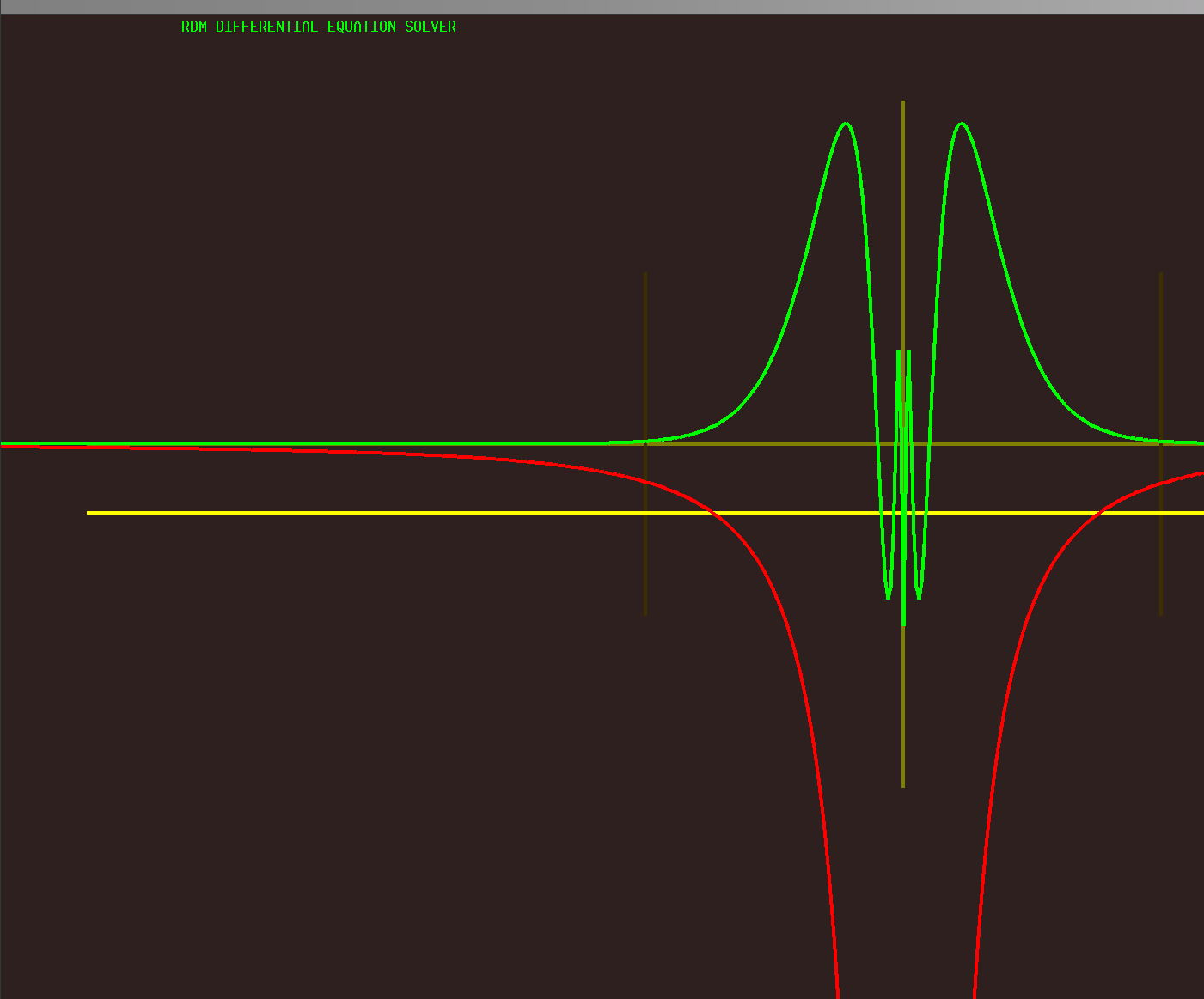
The first problem I ran into was that the solver immediately locked into the zero Psi degenerate solution and wouldn’t leave it to find valid solutions! Then I ran into trouble at the center point discontinuity. By carefully setting initial conditions near the negative infinity starting point and using symmetry to manage the discontinuity, I was able to start getting valid results, and am using the classic hydrogen atom radial (r direction) Schroedinger equation to calibrate the results. Here is one of the first pictures I got of the Psi expectation value on x.
I haven’t tried the u,d,u case yet because a lot of work remains to get this fully functional. Right now, this only works on 1-dimensional real equations. Once this is calibrated and working as expected, I need to expand it to generate complex valued Psi wave function amplitudes. Then it needs to automate the search for valid bounded energy levels. Then it has to be expanded to work in more than one dimension.
A lot of work ahead. The hope is that this approach will allow deeper investigation into differential equation problems with non-analytic solutions such as the u,d,u quark configuration.
Agemoz
Tags: physics, quantum, quantum theory, special relativity
 Agemoz's Physics Blog
Leave a comment