Update: oops. The charge doesn’t come out to exactly 2/3 for the vertex particles. The geometry of charged point particles is very constraining, but the four-particle case leads to a charge that is not exact. Oh, that was a disappointment! I’m rechecking, but looks like this is less useful than I thought.
Update #2: Actually, this result is not surprising–I made the common amateur mistake of applying a classical equation to a quantum (wavefunction) problem. Duh. I’ll be attempting to put the force equation into the Schroedinger wave solver and see what it shows. I don’t want to abandon this work since the matchup of the valid point-particle geometries to real-life quark combinations is still very interesting. The number mismatch is definitely due to using a bad computational methodology, so I don’t want to give up on this.
While it doesn’t really affect anything, I did discover another stable 5 particle solution, a tetrahedron of four particles surrounding a center particle of opposite charge.
(original post) The last month investigation into the R3 + I twist vector field has led to some very interesting insights, such as how particle quantization would work, and why there are 4 elementary point-particle variations, one for each of the spin-up and spin-down electrons and positrons. Quantized photons have their own in-line twist model, where R2 out of the R3 + I provides a frame-independent polarization. Then I made the wonderful discovery that we don’t have to make up a new I rotation dimension for this whole approach–we already have it in the time dimension of spacetime.
So, with this new infrastructure I went back to the Schroedinger Equation problem of protons and neutrons. Previously, I used charged elementary particles (up and down quarks) to attempt to find a time-independent solution. As I reported about a month ago, there are none. But, using my new R3 + I (spacetime) study, I was able to work out a different type of solution that looks very promising.
I did something different this time. Rather than starting with the u,u,d quark configuration of protons, I also looked at free neutrons, which will decay into a proton, an electron, and a neutrino. The neutrino is a very small part of the total proton energy, so if we ignore it (this is one reason why mathematicians dislike physicists 🙂 then we get a different way of constructing the proton. This is just charge geometry. I am pretending the strong force is not at play here, which should be OK if the proton is a lone free particle.
If a neutron is a d,d,u configuration, but decays into a proton plus an electron plus a neutrino, then we could say that
proton = u + u + d + e- + O(0) = neutron = u + d + d
this leads to
d = u + e-
which then gives
proton = u + u + u + e-
Now, there are two statically stable multi-particle configurations, one with four particles and one with five. You can also get one case with three particles in a line, which I investigated a few months ago–but the Schroedinger Equation solver showed no solutions, so I had to rule out that case. Let’s look at the four particle solution:
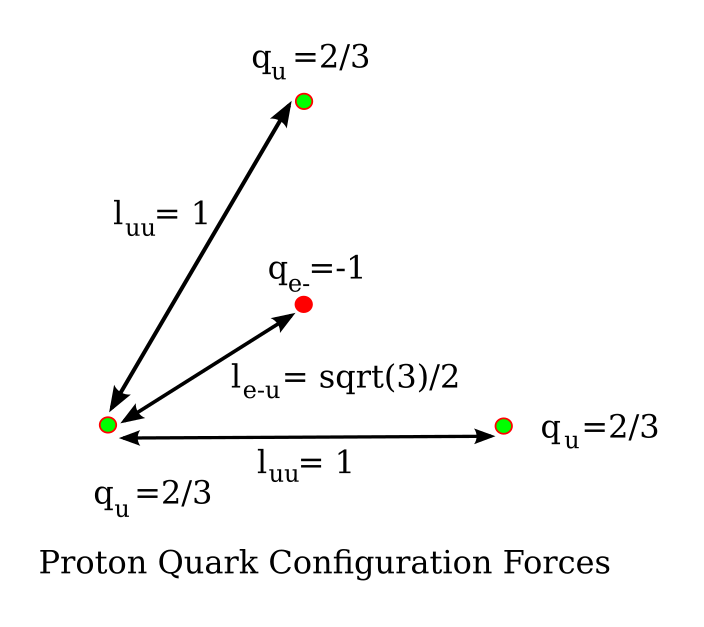
This is statically stable only if the force between two vertex particles of the triangle is equal to the force from a vertex to the center particle of opposite charge. Let us arbitrarily set the distance between vertices of our equilateral triangle to 1(the ratio of the forces is independent of r, so it doesn’t matter what we set it to). The force between charged particles is proportionate to q1 * q2 / (r * r), so if we put our u particles at the vertices and the e- at the center, the force between the vertex particles is
force(u to u) = 2/3 * 2/3 / (r(u to u) * r(u to u)) = 4 / 9
Now, the force from a vertex to the center particle e- uses an r that is sqrt(3) / 2, so we get
force(u to e-) = 2/3 * (-1) / ((sqrt(3) / 2) * (sqrt(3) / 2)) = 2/3 * 4 / 3 = 8 / 9
Now, don’t forget that each vertex has two other vertices to provide a force component, so lo and behold,
force(u) = -force(u to e-) = 8/9
and thus now we have a stable configuration, the only one possible. You can put whatever you want for r, as long as the vertex charge is -2/3 of the center charge, you will always have a stable solution. Mass doesn’t matter–it affects acceleration, not force, so since this is a static configuration, mass has no effect on the result. This geometry shows why up quarks have to be 2/3 the charge of electrons!
If you look at the neutron using this same analysis, you will get a u + u + u + e- + e-. It turns out there is only one stable 5 particle solution, can you find it? It’s a fun exercise!
Agemoz
Tags: physics, quantum, quantum theory, special relativity
 Agemoz's Physics Blog