I have found that static point particle charge configurations are rare, and happen to match a geometric construction of quarks in a proton and a neutron. Static charge configurations result from combinations of positive and negative charges that are arranged in stable configurations. There are surprisingly few of these. It is easy to show that in 3 dimensional space (R3) there are no possible two particle solutions, and also that there are no solutions with 6 or more particles. There is a single in-line 3 particle solution, one four particle solution, and two five particle solutions.
What got me especially interested in this line of thought was that a little bit of quark algebra shows that protons and neutrons exactly match the four-particle version and one of the five-particle solutions (see the previous post here for details). I then computed the required charges to form a static configuration for these cases, and thought I came up with the 2/3 charge (relative to the electron -1 charge), but after a lot of rechecking I found some mistakes and realized the required charge value is close, but but does not match. See the updated configuration figure below with a corrected le-u. I’m no fan of numerology in physics, so that seemed to blow this exciting idea out of the water–everything has to work right for this concept to be true.
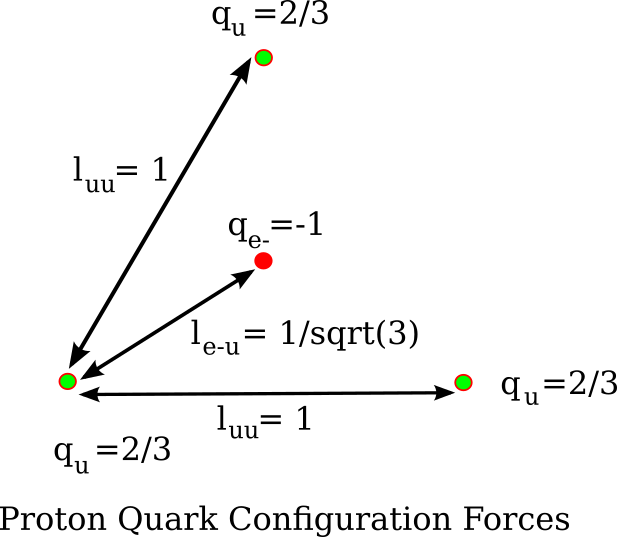
If you look at the figure, you can see the four particle solution, which is a center e- surrounded by three up quarks in an equilateral triangle. The charge forces don’t balance unless the charge is larger than the electron charge, not 2/3. Setting the charge of the up quark to +2/3 results in a force from the electron to the quark of 2 versus a force from the up quark to the other two up quarks equal to 4/(3 sqrt(3)). Numerically the magnitudes are 2.0 versus 0.77, but these have to be exactly equal to produce our geometrically static stable configuration of point particles.
update: arrgh! fixed le-u again, had it right the first time…
I realized that I was applying a classical force model to a quantum wave function system, so I did some simulation work using my Schroedinger wave solver to see if all this would come together to produce the expected charge for this quark construction of the proton and the neutron. This work immediately showed that my static configuration cannot produce a solution unless a momentum term is added. Unfortunately, this complicates things because now we can’t just work with normalized charges–we can assume that the three up quarks orbit the center electron, but now the units involve a momentum term that has no charge factor, so the computation gets more detailed. The momentum term has the usual Schroedinger equation Planck’s constant squared over 2*mass factor, which has to be normalized to the actual charge factor–and now the solution is dependent on radius, the distance between particles in our 4 particle triangle configuration.
The problem has become somewhat more complicated and will require more study which is now underway.
Agemoz
Tags: physics, quantum, quantum theory, special relativity
 Agemoz's Physics Blog
Leave a comment