In the last post, I discussed how point particles in R3+T dimensions have the ability to form 4D rotations, opening the door to why we have four “electron-class” (i.e., spin-up electron, spin-down electron, spin-up positron, and spin-down positron), and also enabling elementary particle quantization. What I mean by that is that only certain dual-spin combinations are stable, just like only certain orbital energies are possible in the atom. This quantization comes about because the ratio of the two spins on a single directional vector must be a rational fraction in order that these spin wave functions will have stable solutions.
As you all know, in 2D and in 3D, the possible rotations (assuming no external angular forces) will always lie in a plane, but in 4D systems like our R3+T existence, the rotations trace out an infinite number of path possibilities. This is because a single spin will lie in a plane, and 4D spaces allow a point particle to have two independent spins. For all you skeptics (and I really hope all of you who study physics are very skeptical of any new claims, including mine–that is a prerequisite in this field) I was able to prove that dual-spin particles are real and do not require any external forces to sustain the point particle. Here, I used Mathematica to create 4D projections to demonstrate what happens in a dual-spin point particle when different ratios are selected.
First, I created a number of sequenced views of dual rotations in 4D, here are a couple:
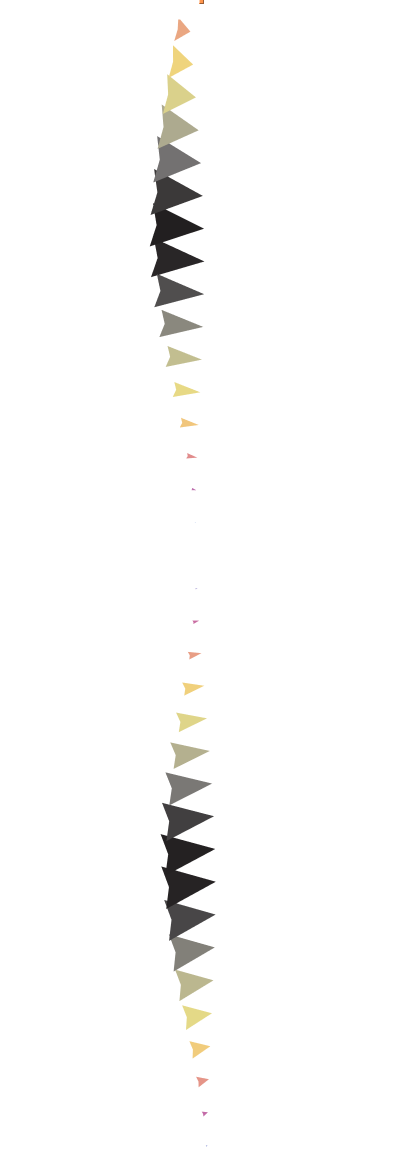

Note, these are timewise (positive time direction up) 4D projections for a couple of rotation ratios in x, y, z, and t. The colors are the phase of the base frequency (the quantization frequency of my hypothesis), while t dimension component (not the progression of time) is displayed here by varying the magnitude of the projection vector. You can see (sort of) the variation in time of the x, y, and z components. Note that these are all point particle pictures, so there is no displacement–just the progression of the composite spin for the particle. This turns out to be a hard way to visualize what is happening in 4D, so I tried a different way.
Here’s a much easier way to see how the spins are behaving–note that the curves represent a single (combined dual spin) vector direction from the center, there is no physical displacement shown. You see here x, y, z directions as represented, while t (the t dimension vector component, *not* actual time passage) is represented by the color (red is +1, blue is -1). As might be expected, a 1:1 phase will always generate a circle just like in 2D or 3D, but other rational fraction ratios generate true–and interesting! 4D curves.


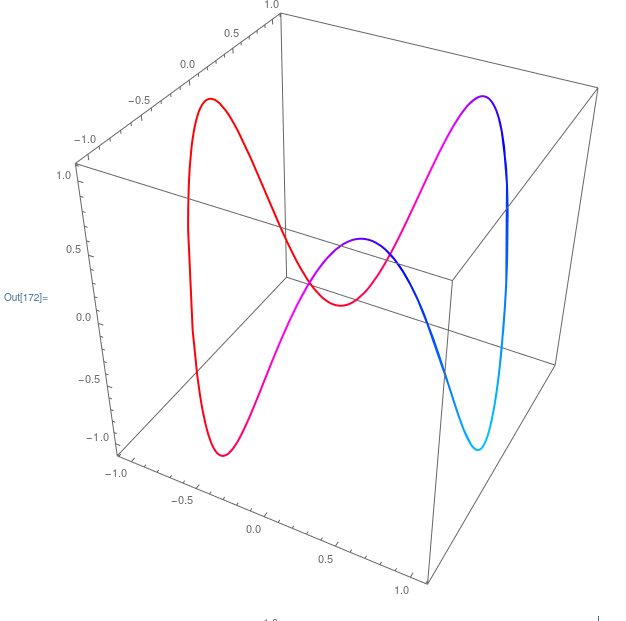
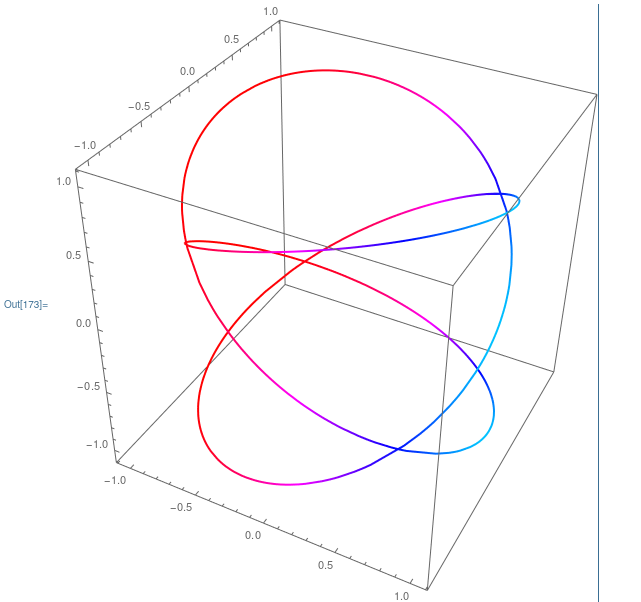

As you can see, 4D dual-spin particles open up an entire world of possible point-particle solutions! It is important to note that the spins are independent of each other in regard to angular momentum, so all of these combinations, including the unstable one, require no external force to sustain the spin.
Agemoz
Tags: physics, quantum, quantum theory, special-relativity
 Agemoz's Physics Blog
Leave a comment