We live in a 4 dimensional universe, three spatial dimensions and one time dimension. Point particles can have spin directions in all 4 dimensions, but because we perceive only an R3 slice of our R3+t existence (the “Activation Layer” hypersurface), there are surprising implications for point particle spins. One in particular is that a point particle can have two independent spins with integer ratios for spin cycle time. A 2:3 ratio of these spins in R3+T will cause the particle to appear to be three unique particles in R3!
Point particles that spin in 2 or 3 dimensions must rotate within a plane, but in 4 dimensions, there are two possible independent planes of rotation, for example in R1 + R2, and in the R3 + T directions. Thus, it is possible to have two simultaneous but independent spins in a 4 dimensional point particle, requiring no external angular forces to sustain the two independent angular momentums. In the last post, I created some images that demonstrate some of the possible rotation direction paths (these are directions, there is no physical displacement for a point particle spin):

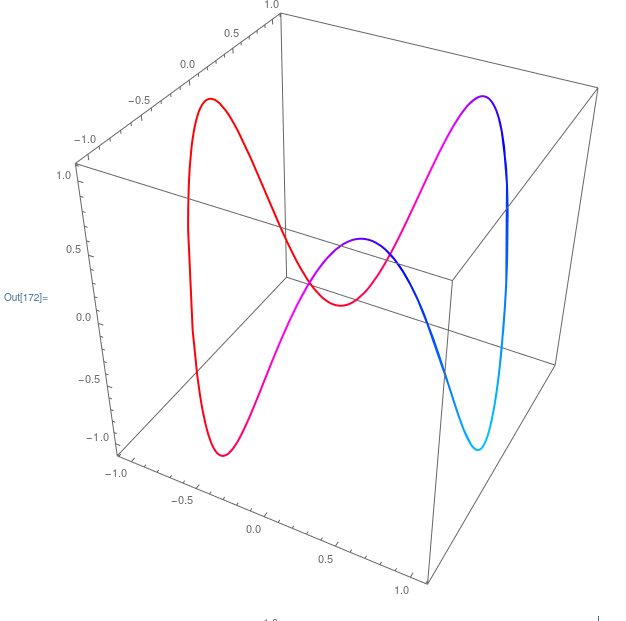
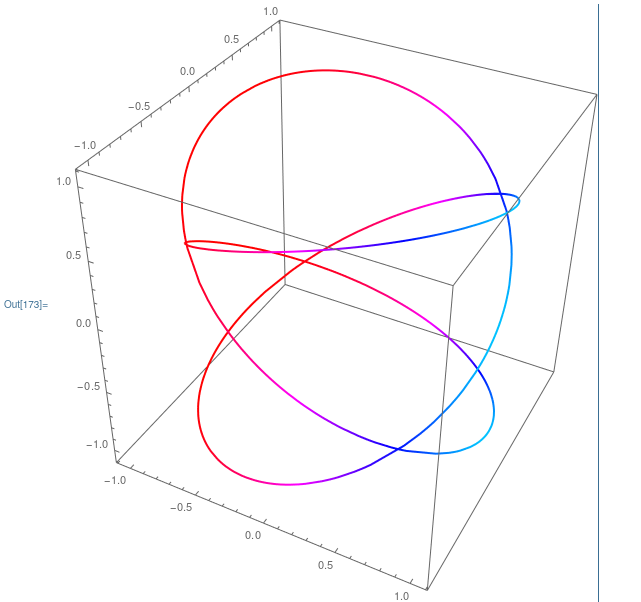
However, these pictures are misleading. It is very difficult for my mind to truly grasp what is happening when a four dimensional point particle spins in R3+T. These pictures shows the entire path in R3, with the part pointing in the fourth (T) direction represented by color, but in fact a 4 dimensional dual spin point rotation direction will actually appear and disappear from the R3 activation layer that we live in. Here is what the 2:3 case actually looks like:

Yes, you see what I see–in R3, a single 2/3 ratio dual spin particle looks like 3 stable, but unique spin directions over a time interval! The whole path is shown as a light color, but the locations where the spin direction (again, remember, these are spin directions, not displacements from a center point) lies in or close to R3 are shown in red. The path that lies in R3 show three separate components over time. The 1/3 ratio dual spin particle similarly show two different directions, but the 1:1 ratio case only shows 1.
I shamelessly speculate this is why we experimentally observe the appearance of three bound quarks in a proton and two bound quarks in a kaon, yet never observe isolated quarks. Dual spin particles rotating in the four dimensions of R3 and T provide a possible path to modeling the internal behavior of bound quarks. This is only the beginning–there are many possible rotation ratios that I think enables the entire particle zoo (both fermions and hadrons), and things like the 1/3 and 2/3 charge values emerge from this model.
UPDATE: The three “pseudo particles” that lie in the R3 plane are not all identical. I have previously hypothesized (see https://wordpress.com/post/agemozphysics.com/1722) that the second of two spin rates of an R3+T point particle (that does not include the T dimension) has to be responsible for both charge value and mass. Indeed, one of the three pseudo particles has double the angular momentum as the other two. Protons consist of two up quarks and one down quark with double the mass and half the charge, so the analysis of the dual-spin point particles continues to support the idea that the dual spins of R3+T point particles are responsible for the quark behavior of real-world hadrons.
Amazing stuff comes from thinking about point particles with dual spin in R3+T, I hope you think so too!
Agemoz
Tags: general relativity, general-relativity, particle zoo, physics, quantum, quantum theory, special relativity, special-relativity
 Agemoz's Physics Blog
Leave a comment