[edit: math corrections]
[edit: NOTE: dual-spin of 4D point particles is not superposed states on a single spin–see addendum below]
Four dimensional point particles in R3 + T spacetime have unique properties, in particular, the ability to have two independent spins, that appear to make them good candidates for a deeper understanding of what happens when a particle and anti-particle annihilate. I detailed this in the previous post (agemozphysics.com/2024/04/19/creation-annihilation-of-dual-spin-point-particles/).
I’ve made some additional progress, in particular, I see a fairly simple way to show the quantized angular moment of the electron from the details of the collision. I started by putting on my skeptic’s hat (actually, I try to make sure that stays on at all times), and posed a couple of questions:
Why do we need 4D point particles when the current Standard Model works fine with 3D spin wave functions for particles?
There is no measurable radius in a point particle such as an electron, so how are you going to compute an expected angular moment for the electron?
Let me do a quick summary from the previous post to start off: We have substantial experimental evidence that elementary particles such as the electron and quarks are point particles. From a idealized geometric point of view, point particles in three dimensional space are relatively uninteresting with only one possible spin axis and no internal structure. However, we also have significant experimental evidence of four dimensions including curvature in the time dimension, so it is very reasonable to assume that spin angles can point in that direction. In fact, point particles in four dimensions can have two independent spin planes, one in the X-T plane and one in the Y-Z plane, for example. When you examine the e-/p+ collision shown in the figure, we see a better view how the two point particles annihilate into two photons, where the mass and charge of the point particles vanish.
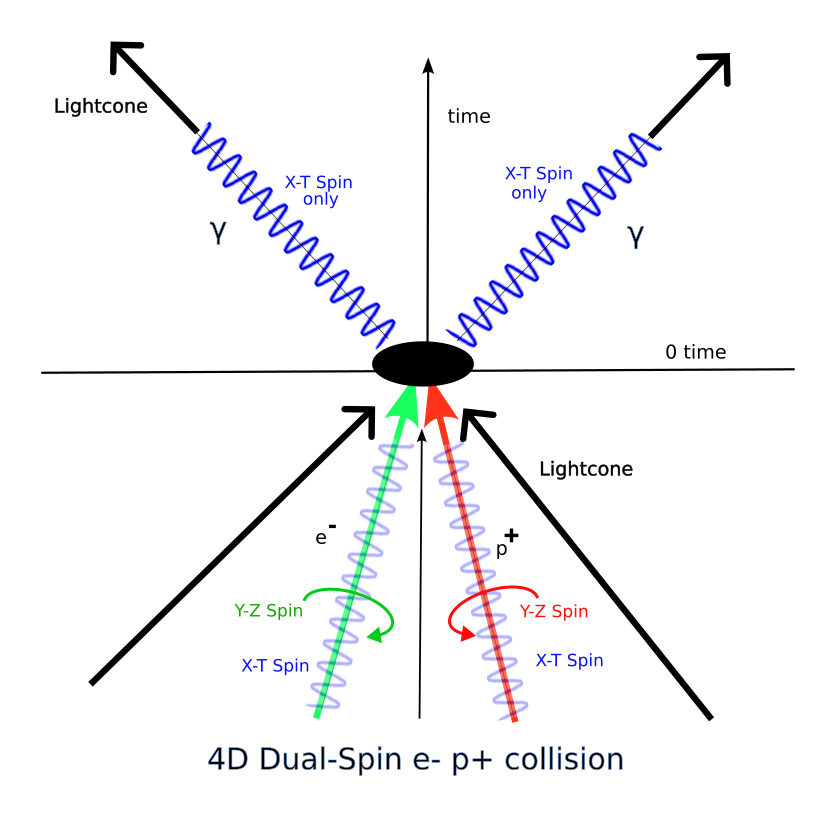
We know that quantum wave interference is present at the same wavelength in both the before and after cases, and the only way for a point particle to produce a wave is to oscillate in some way, which for a point particle can only be induced by some kind of spin. Therefore, the fact that mass and charge disappear after the collision cannot be due to that spin disappearing. But there is nothing else that can be added to a 3D point particle without giving it a radius of some sort–but 4D point particles can have two independent spins, and this is why I saw a door opening as to how the collision transformation would work. The second orthogonal spin encodes the mass and charge effects without changing the geometrical point particle concept. The collision can be explained simply as the transformation of the point particle Y-Z spin angular momentum entirely into the photons’ X momentum (and vice-versa for the e-/p+ pair creation). We get interesting insights when we set the dual-spin point particle angular momentum at some radius re to the linear momentum of the resulting annihilation photons.
However, point particles have no measurable radius, which fails to reasonably explain the actual measured angular moment of the electron. You would have to have an infinite mass to get a finite moment. How did I think this was going to work?
Quantum theory comes to our rescue here–we can’t think classically when working with elementary particles. I bet every good quantum scientist would immediately see the obvious solution–the electron is a point particle, but its location is always defined as a probability distribution–a wave function with a constant normalized magnitude radius, just like an electron orbiting a hydrogen nucleus. Now you can do a simple computation from the annihilation that looks like this:
Ee = h freq = p c (one of the pair of photons)
so then pphoton = h freq / c
In the dual spin situation, the Y-Z angular moment of the point particles must equal the photon moment at quantum radius re, so for one particle transformation:
me omega re = h freq /c
Let’s assume equal dual spins for the electron, where omega = freq * 2 Pi
so then me c re = (h / 2 Pi)
This is a nice way of saying the angular moment of the electron probability distribution is quantized to the quantum angular moment /h of the electron. Thus, the properties of a 4D dual spin point particle lead directly to the quantization of the electron moment.
Agemoz
Addendum: I realized that the dual-spin property of 4D point particles could be misconstrued as some variation of superposed states on a single spin property of a particle. In the Standard Model, quantum spin of elementary particles have two states such as +1 and -1. Until the spin of a particle is detected, the spin will generally be a superposition of these two states, and the orientation of the detector will determine the probability of decohering into one or the other state. Dual-spin point particles refers to something completely different, that is, the presence of two spin properties in a particle–either one of which could have superposed spin states.
Tags: physics, quantum, quantum theory, science, special relativity, special-relativity
 Agemoz's Physics Blog
Leave a comment