An Emergent Field is a term that refers to a field with quantum creation/annihilation behavior embedded within the field description, and a careful study of our hypersurface within R3 + T spacetime further refines its form.
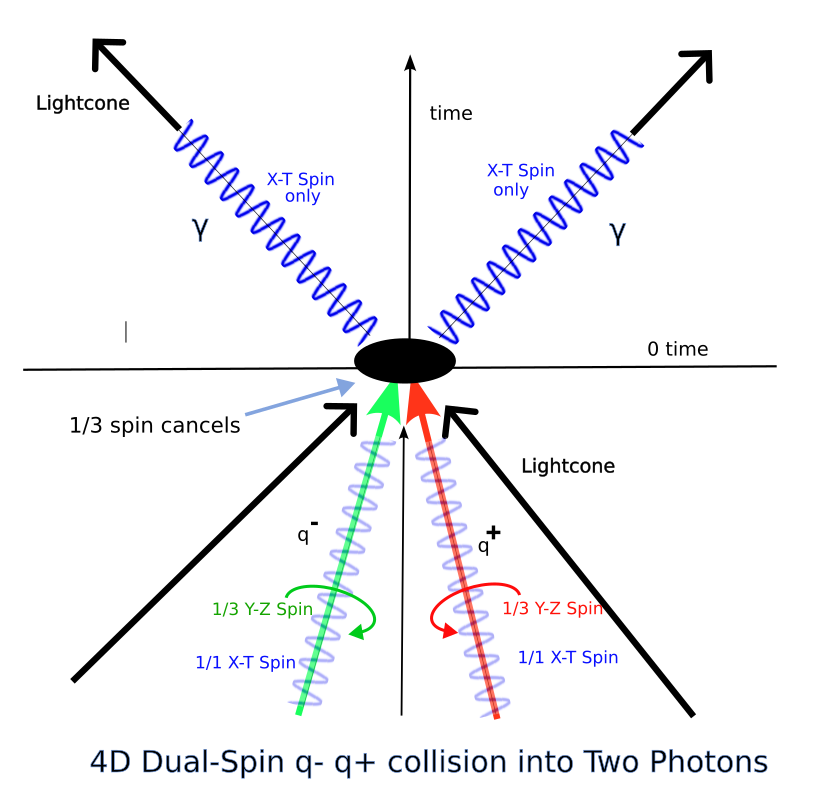
We need emergent field mathematics (see these posts: https://wordpress.com/post/agemozphysics.com/1860 and https://wordpress.com/post/agemozphysics.com/1873 ) because current perturbative methods separate out the fields and particles used in quantum field theories and are limited in ability to solve most interaction LaGrangian equations of motion. By forming particles from field elements, emergent fields should allow analytic solutions, and I found one such field that contains 4D (R3 + T spacetime) vector twists. In such a field, quantization to a background state, for example a vector rotation to and from the time direction, will force the spins to be integer multiples, which I state will be stable particles if the background state is a lowest energy state. Partial twists have to fall back to the background state and thus can behave as virtual particles, influencing LaGrangian equations of motion without a net mass (off shell to use physicist terminology). Now we have an infrastructure for quantum field theories which does not require the use of separate fields and particles currently used in perturbative quantum field calculations.
However, I’ve never liked this “lower energy state” idea. It does conceptually work, but I have never thought of any workable real-existence reason why a point particle spin pointing in the time direction would have lower energy and thus a tendency to move to that orientation. Since we are constantly moving forward in time, I thought there would be some kind of drag on the spin orientation, perhaps pointing backwards from the time direction like a wind–but to me, this seemed very hand-wavy hokey. We do get a similar kind of drag effect from the Higgs field that gives inertial mass to particles in R3, but mass isn’t spin, and it is a bridge too far for me to think that is what quantizes spin.
I think there is a better way, and it comes from my study of the spacetime hypersurface layer we live in (see https://agemozphysics.com/2023/02/08/space-time-activation-layer/ and https://agemozphysics.com/2023/02/14/gravity-and-the-activation-layer/ ). In these posts, I discuss how we are so used to seeing Minkowski space diagrams with light cone paths for particles, that we make big assumptions about what we would see if we traveled back or forward in time via a spacetime wormhole.
The Interstellar movie is the most recent famous example of this assumption–claiming that there is some point of view within a 4D or higher tesseract where we can see, move, and interact with various points in time and space. I claim that if we actually did travel back along the time dimension via a wormhole, we wouldn’t see anything there. Real life does not keep a copy of every moment like a reel of film, and thinking in terms of emergent fields and quantum field theory reinforces this.

There can be no doubt that we live in a single slice, a 3D hypersurface layer within R3 + T spacetime, at a specific but moving moment in time I like to call the activation layer of 4D spacetime. We clearly have no direct way of interacting with other hypersurfaces, even when severely contorting the shape of the hypersurfaces near black holes. We see no photons escaping other hypersurfaces even near a black hole, only those that can be found to be emitted from within our own hypersurface. Folding spacetime does not cause particles to leak into other hypersurfaces. Wormholes theoretically could connect us to other hypersurfaces, but there will be nothing there.
EDIT addition: There are Feynman path combinations that include reverse-time particles that Feynman himself claimed would show the existence of particles moving in the reverse time direction. However, there are two ways to use time to describe a particle–its movement in the time dimension, and its internal time clock. These are not the same thing, and if a particle were truly moving in the negative time direction (a tachyon), it would only show up as a momentary blip in our activation layer hypersurface. Feynman reversed-time particles actually have a reversed internal clock but move along in the forward time direction, and are just going to be another variation of particle (for example, anti-particles) traveling with us in our hypersurface. They are not going to be particles from another spacetime hypersurface.
In addition, I believe that all particle interactions have to be confined to within our hypersurface. Each particle (lepton or boson) has a wave phase that must be different for every unique hypersurface time, which means that if interactions were the weighted sum of phase contributions from each hypersurface, the LaGrangian solutions of motion would be vastly different than those computed from only within our hypersurface. There is nothing there. Life does not appear to record every moment, contrary to popular sentiment, so wormhole travel will not reveal what we all think it will. And more importantly for my study, removing the Minkowski spacetime path assumption for fields and particles provides significant guidance on how emergent fields must work.
This was a major insight for me, let me describe what I see in my next post.
Agemoz
Tags: general relativity, general-relativity, physics, quantum, quantum theory, science, special relativity, special-relativity
 Agemoz's Physics Blog
Leave a comment