EDIT: I added the math behind my claim that the 3D hypersurface activation layer is sufficient to contain the laws of special relativity, see about 4 paragraphs down. Also, fixed missing constant c in solution.
One of many aspects of the idea that all of our existence must be confined to a 3D hypersurface (the “Activation Layer”) within 4D spacetime is the principle that special relativity does not need anything outside of the hypersurface. However, I think most scientists are likely to reject the Activation Layer concept because special relativity has a number of characteristics and consequences that appear to require a true 4D spacetime existence, rather than a single 3D surface that moves through time.
Anytime someone tries to assign a single point in time for all of our existence is going to instantly run afoul of the way special relativity has observers seeing different event times and spatial or time intervals depending on an observer’s relative velocity. Even my own immediate reaction to the activation layer idea is “no way, that can’t work”. However, a lot of study and thinking has convinced me that the activation layer must be true and that special relativity does not deny its validity. I spent a lot of time thinking and studying special relativity to see how the two concepts could both be true, and this meant taking each of the special relativity cases in depth.
For example, let’s look at an obvious case: one detector receiving photons from two source events. Let’s set the geometry of the three components (detector, two sources, see figure), and assume photons are point particles. Classically, it does not matter whether the detector is moving or not (that is, if you vary the detector’s frame of reference)–if the photons arrive at the same time when the detector has no velocity, giving the detector any velocity will not change the simultaneous detection of the two event photons. But special relativity says that this cannot be true–detection will no longer be simultaneous, and a quantitative analysis will show that the apparent times of the two source events will vary depending on the detector’s frame of reference velocity and direction. This would appear to defeat the activation layer idea, which has both events emitting photons and being detected within a single 3D hypersurface, moving along the time dimension, of 4D spacetime. (A side note–general relativity also does not appear to require more than a single 3D hypersurface, but the hypersurface will contort according to the stress-energy tensor. I’ll discuss that in another post).
But in a quantum existence, the foundation of the activation layer theory, it’s actually a lot more complicated than that. I was able to show that when assuming a quantized 3D hypersurface, observing different event times does not defeat the activation layer concept, in fact, the activation layer predicts it. The quantized activation layer assumes that all particles are quantum group wave constructs. Neither photons nor detectors are point particles, but are spread out in some sort of Gaussian shape–they have a width both in space and time, and this changes the detection process analysis dramatically. I think you will readily see this in a qualitative way if we go back to the classical case but replace the three components with spatially distributed equivalents. Now study how different detector frame of reference velocities affects the apparent detection times. As before, a static detector will detect both photons simultaneously, but if the detector is moving, notice how the detection absorption time will vary and the events will no longer appear to be simultaneous. We don’t need to assume special relativity to see that the quantum behavior of the activation layer concept will exhibit the same type of time varying event behavior of special relativity.
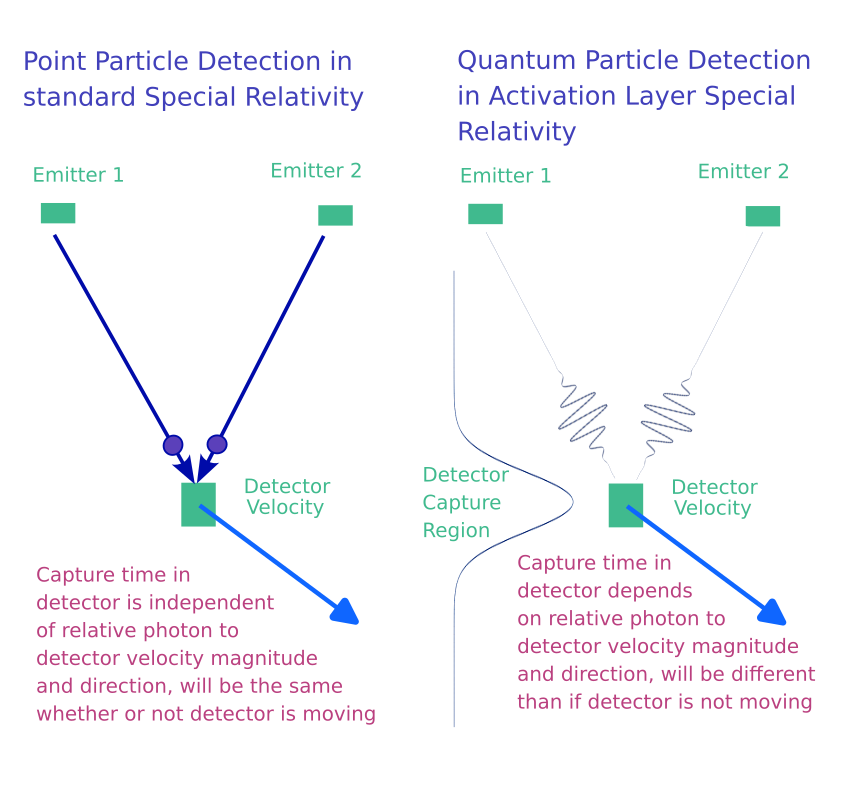
UPDATE: Here’s a bit of math to support this claim. This is dependent on the constant speed of the photons and on the quantum property that both the photons and the detector are group waves that Doppler shift (see this paper: https://agemozphysics.com/wp-content/uploads/2020/12/group_wave_constant_speed-1.pdf). The derivation goes like this (sorry, Latex doesn’t work on this blog):
Refer to figure 2, a simplified view of the velocities of the moving detector and one of the event emitters. The time for the detector to capture the photon, where td is the detection time, vp is the photon velocity, vd is the detector frame of reference velocity, and d is the detector capture region length:
td = d / Sqrt[vp^2 – vd^2]
which converts to:
td = d / (vp Sqrt[1 – vd^2 / vp^2])
But, since the photon is assumed to be a quantum group wave assembly, it will Doppler shift in such a way that its velocity is not dependent on the observer’s (detector’s) velocity–see the above-mentioned paper for this calculation. The constant photon speed is arbitrary in this analysis, but to match reality we will choose the speed of light c. Thus, the detection time occurrence will only vary as a function of the detector’s frame of reference:
td = d / (c Sqrt[1 – vd^2 / c^2]) = (d / c) * beta
Here we have the Lorentz Beta factor describing the time dilation of photon event detection. There are many other cases to examine, but it should be clear that special relativity doesn’t need other hypersurfaces, or for that matter, any of the rest of 4D spacetime, to correctly describe our existence.

This is just one case, and it doesn’t prove the activation layer concept, it just shows that special relativity does not deny its potential validity. You might object that at the quantum scale the time differences will be tiny and thus irrelevant, but this is not the case–significant detector frame of reference variations will cause dramatic differences in observable photon absorption times.
If the activation layer can be shown to be true, there are a lot of implications both at the quantum and cosmological level that I would hope would advance our understanding of many fields of science. It’s a significant constraint on the definition of our existence for which I keep seeing good evidence. While at first the 3D activation layer hypersurface appears to prevent the known properties of special relativity, a deeper investigation has led me to the discovery that the two theories can coexist.
Agemoz
Tags: general relativity, general-relativity, physics, quantum, science, special relativity, special-relativity
 Agemoz's Physics Blog
Leave a comment