In this paper https://agemozphysics.com/wp-content/uploads/2020/12/group_wave_constant_speed-1.pdf, I show how a classical (Newtonian) system that forms point particles as a Fourier sum of waves (a group wave composite) will obey the constant speed postulate of special relativity. In such a system, an observer with any relative velocity to the group wave particle will observe Doppler shifted waves that will cancel out his relative velocity, leaving only the constant velocity of the particle. Thus, the observed speed will appear to be independent of the observer’s frame of reference and we have a clean explanation of why we see the relativistic behavior of particles in our existence.
Digging deeper, however, exposes a showstopper to this hypothesis that all particles are group wave constructs. If there are two observers, spaced equidistant from the particle but positioned orthogonally from each other to form 90 degrees of separation, both must see constant speed of the particle independent of their own frame of reference. However, it is easy to construct this system such that one of the observers will not see any Doppler shifting and thus will not see the expected constant speed of the particle. The observation of constant speed must hold for all frame of reference angles simultaneously, and this is not possible with a group composite of linear plane waves.
The emergence of the special relativity constant speed postulate in a classical system has long convinced me I was on the right track, but with a lot of recent thinking, it became clear I wasn’t there yet. In a serendipitous Aha moment, I realized that plane waves were not the only possible wave solution that would Doppler shift. Any valid wave solution has to have a constant fundamental frequency in order to Doppler shift in the required way, and linear plane waves are not the only solution. Bessel functions also meet this requirement–in all directions.
Bessel functions are a class of solutions to partial differential equations with polar (radial) boundary conditions. The most famous example is the radial vibration of a drum surface–drum surface vibrations form standing waves that look like (but not identical to) a radial sinc function (sin(x)/x). The observed periodicity of the Bessel function will Doppler shift depending on the observer’s frame of reference regardless of his relative positioning to the particle, making it a much better solution than plane waves.
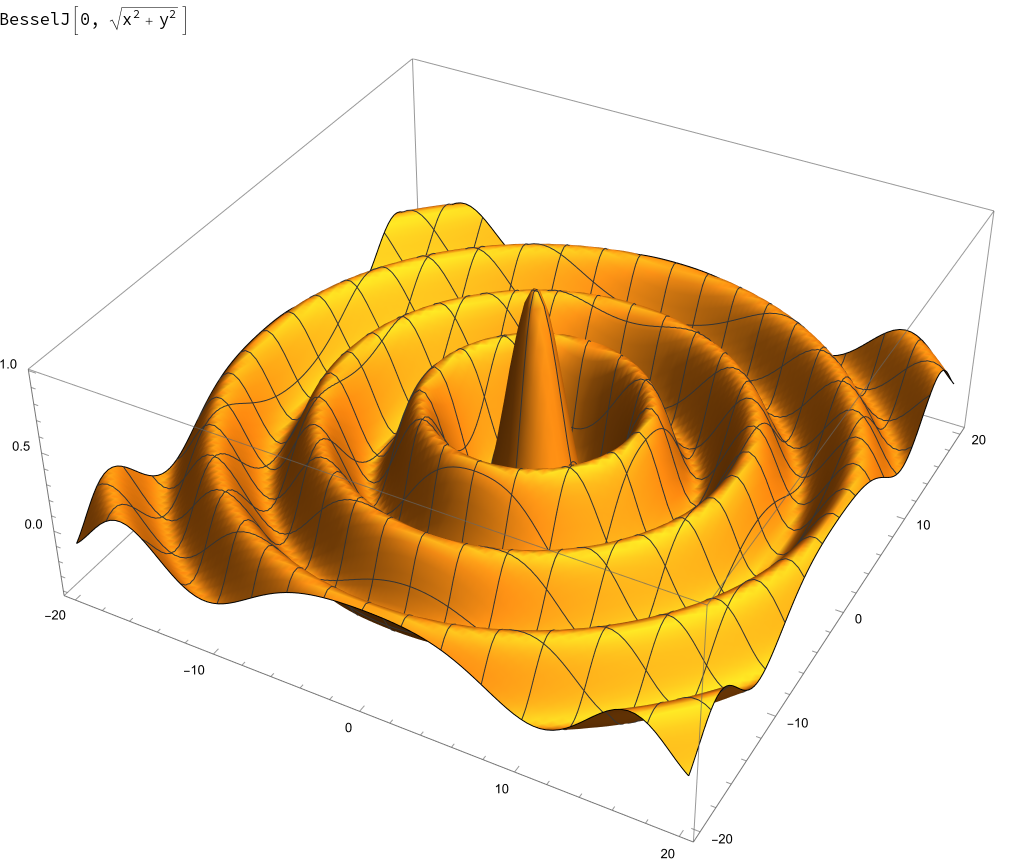
The immediate concern with a Bessel function solution to elementary particles then pops up–Where do the boundary conditions that form the Bessel function solution come from? I already have a workable hypothesis for that in these posts https://agemozphysics.com/2024/09/28/our-3d-hypersurface-slice-within-4d-spacetime-quantizes-elementary-particles/ and https://agemozphysics.com/2025/04/10/how-our-3d-hypersurface-activation-layer-predicts-the-heisenberg-uncertainty-relation/ — the Activation Layer sets a time dimension range combined with the light cone range within R3 defines a regional neighborhood that can permit valid standing wave solutions.
This is a much cleaner hypothesis than group wave formation of particles. I will go forward with this to see what new insights come from this line of thinking.
Agemoz
Tags: physics, quantization, quantum, quantum theory, science, special relativity, special-relativity
 Agemoz's Physics Blog
Leave a comment