Archive for the ‘Physics’ Category

Basis Field For Particles

July 16, 2016

I think every physicist, whether real or amateur or crackpot, goes through the exercise of trying to work out a geometry for the field that particles reside in.  This is the heart of many issues, such as why is there a particle zoo and how to reconcile quantum theory with relativity, either special or general.  There are many ways to approach this question–experimental observation, mathematical derivation/generalization, geometrical inference, random guessing–all followed by some attempt to verify any resulting hypothesis. I’ve attempted to do some geometrical inference to work out some ideas as to what this field would have to be.

Ideas are a dime-a-dozen, so throwing something out there and expecting the world to take notice isn’t going to accomplish anything.  It’s primarily the verification phase that should advance the block of knowledge we call science.  This verification phase can be experimental observation such as from a collider, mathematical derivation or proof, or possibly a thorough computer simulation.  This system of growing our knowledge has a drawback–absolute refusal to accept speculative ideas which are difficult or impossible to verify (for example, in journals) can lock out progress and inhibit innovation.  Science investigation can get hide-bound, that is stuck in a loop where an idea has to have ultimate proof, but ultimate proof has become impossible, so no progress is made.

This is where the courageous amateur has some value to science, I think–they can investigate speculative possibilities–innovate–and disseminate the investigation via something like a blog that nobody reads.  The hope is that pursuing speculative ideas will eventually reach a conclusion or path for experimental observation that verifies the original hypothesis.  Unlike professional scientists, there are no constraints on how stupid or uninformed the amateur scientist is and no documentation or credentials that says that science can trust him.  The signal-to-noise is going to be so high that it’s not worth the effort to understand or verify the amateur.  The net result is that no progress in our knowledge base occurs–professional scientists are stuck as publishable ideas and proof/verification become more and more difficult to achieve, but no one wants to bother with the guesses of an amateur.  I think the only way out is for an amateur to use his freedom to explore and publish as conscientiously as he can, and for professionals to occasionally scan amateur efforts for possible diamonds in the rough.

OK, back to the title concept.  I’ve been doing a lot of thinking on the field of our existence.  I posted previously that a non-compressible field yields a Maxwell’s equation environment which must have three spatial dimensions, and that time is a property, not a field dimension as implied by special relativity.  I’ve done a lot more thinking to try to pin down more details.  My constraints are driven primarily by the assumption that this field arose from nothing (no guiding intelligence), which is another way of saying that there cannot be a pre-existing rule or geometry.  In other words, to use a famous aphorism, it cannot be turtles all the way down–the first turtle must have arisen from nothing.

I see some intermediate turtles–an incompressible field would form twist relations that Maxwell’s equations describe, and would also force the emergence of three spatial dimensions.  But this thinking runs into the parity problem–why does the twist obey the right hand rule and not the left hand rule?  There’s a symmetry breaking happening here that would require the field to have a symmetric partner that we don’t observe.  I dont really want to complexify the field, for example to give it two layers to explain this symmetry breaking because that violates, or at least, goes in the wrong direction, of assuming a something emerged from nothing.

So, to help get a handle on what this field would have to be, I’ve done some digging in to the constraints this field would have.  I realized that to form particles, it would have to be a directional field without magnitude.  I use the example of the car seat cover that is made of orientable balls.  There’s no magnitude (assuming the balls are infinitely small in the field) but are orientable.  This is the basic structure of the Twist Field theory I’ve posted a lot about–this system gives us an analogous Schroedinger Equation basis for forming subatomic particles from twists in the field.

For a long time I thought this field had to be continuous and differentiable, but this contradicts Twist Theory which requires a discontinuity along the axis of the twist.  Now I’ve realize our basis field does not need to be differentiable and can have discontinuities–obviously not magnitude discontinuities but discontinuities in element orientation.  Think of the balls in the car seat mat–there is no connection between adjacent ball orientations.  It only looks continuous because forces that change element orientation act diffusely, typically with a 1/r^2 distribution.  Once I arrived at this conclusion that the field is not constrained by differentiability, I realized that one of the big objections to Twist Field theory was gone–and, more importantly, the connection of this field to emergence from nothing was stronger.  Why?  Because I eliminated a required connection between elements (“balls”), which was causing me a lot of indigestion.  I couldn’t see how that connection could exist without adding an arbitrary (did not arise from nothing) rule.

So, removing differentiability brings us that much closer to the bottom turtle.  Other constraints that have to exist are non-causality–quantum entanglement forces this.  The emergence of the speed of light comes from the fact that wave phase propagates infinitely fast in this field, but particles are group wave constructions.  Interference effects between waves are instantaneous (non-causal) but moving a particle requires *changing* the phase of waves in the group wave, and there is a limit to how fast this can be done.  Why?  I don’t have an idea how to answer this yet, but this is a good geometrical explanation for quantum entanglement that preserves relativistic causality for particles.

In order to quantize this field, it is sufficient to create the default orientation (this is required by Twist Field theory to enable emergence of the particle zoo).  I have determined that this field has orientation possible in three spatial dimensions and one imaginary direction.  This imaginary direction has to have a lower energy state than twists in the spatial dimension, thus quantizing local twisting to either no twists or one full rotation.  A partial twist will fall back to the default twist orientation unless there’s enough energy to complete the rotation.  This has the corollary that partial twists can be computed as virtual particles of quantum field theory that vanish when integrating over time.

The danger to avoid in quantizing the field this way is the same problem that a differentiable constraint would require.  I have to be careful not to create a new rule regarding the connectivity of adjacent elements.  It does appear to work here, note that the quantization is only for a particular element and requires no connection to adjacent elements.  The appearance of a connection as elements proceed through the twist is indirect, driven by forces other than some adjacent rubber-band between elements.  These are forces acting continuously on all elements in the region of the twist, and each twist element is acting independently only to the quantization force.   The twist discontinuity doesn’t ruin things because there is no connection to adjacent elements.

However, my thinking here is by no means complete–this default orientation to the imaginary direction, and the force that it implies, is a new field rule.  Where does this energy come from, what exactly is the connection between elements that enforces this default state?


Oh, this is long.  Congratulations on anyone who read this far–I like to think you are advancing science in considering my speculation!

Agemoz
The Arrow of Time and Misuse of Statistics

June 5, 2016

As an amateur physicist I try to avoid disputing established science, but one place I believe science has it wrong is the dimensionality of time.  If you read this blog at all, you’ll see I am trying to create a self-consistent world-view that conforms with peer-reviewed science.  My world-view attempts to add analysis and conclusions on some of the unanswered questions about our universe such as why are there so many elementary particles or how can quantum entanglement work.  I try never to dispute established science and to accept that my world-view is a belief system, not fact that must be forced on others–that is the mark of a crackpot that has just enough knowledge to waste other peoples’ time.

However, one place I break my rules of good behavior is this concept that time is one-dimensional.  For a long time, I’ve recoiled at the notion that the observer’s timeline could physically intersect a particular local spacetime neighborhood of an object event  multiple times.  I discussed this in a previous post, but now I want to discuss this disagreement from another angle–the claim for an existence of an Arrow of Time.

The Arrow of Time is a concept that describes the apparent one way nature of the evolution of a system of objects.  We see a dropped wine glass shatter on the floor,  but we never see a shattered wine glass re-assemble itself and rise up back onto a table.  We record a memory of events in the past, but never see an imprint of the future on our brain memory cells.  This directional evolution of systems is a question mark given that the math unambiguously allows evolution in either direction.  To put it in LaGrange equation of motion terms, the minimum energy path of an object such as a particle or a field element is one dimensional and there are two possible ways to traverse it.  The fundamental question is–why is one way chosen and not the other?

The standard answer is to invoke statistics in the form of the Laws of Thermodynamics, and I have always felt that was not the right answer.  Here is why I have trouble with that–statistics are mathematical derivations for the probability something will happen, and cannot provide a force that makes a particle go one way or the other on a *particular* LaGrangian minimum energy path.  It’s a misuse of statistics to use the thermodynamics laws to define what happens here.  In the case of the shattered wine glass, there are vastly more combinations of paths (and thus far higher probability) for the glass pieces to stay on the floor than there are for the glass shards to reassemble themselves–but that is not why they stay there!

The problem with the Arrow of Time interpretation comes from thinking the math gives us an extra degree of freedom that isn’t really there.  The minimum energy path can truly be traversed in either the time-forward or time-backward path, but it is an illusion to think both are possible.  Any system where information cannot be lost will be mathematically symmetric in time, creating the illusion of an actual path in time if only the observer were in the right place to observe the entirety of that path.  Einstein developed the equations of special relativity that were the epitomy of the path illusion by creating the concept of spacetime.  Does that mean the equations are wrong?  Of course not–but it exemplifies the danger of using the math to create an interpretation.  Just because the math allows it does not mean that the Arrow of Time exists–any relativistic system where information cannot be destroyed will allow the illusion of a directionality of time.

So what really is going on?  I’ll save that for a later post, but in my world-view, time is a property of the objects in the system.  There is only ONE copy of our existence, it is the one we are in right now, and visits to previous existences is simply not possible.  Our system evolves over time and previous existences no longer exist to visit.   Relativity does mean that time between events has to be carefully analyzed, but it does not imply its dimensionality.

Agemoz

Something-From-Nothing, Incompressible Fluids, and Maxwell’s Equations

May 22, 2016

I have made the claim that our universe must have emerged from nothing via the infinity times zero equation, and that we can derive the behavior of our universe from the geometry of a something-from-nothing system.  The something-from-nothing basis (which I’m going to start abbreviating as SFN) suggests an incompressible fluid, and two really cool consequences result from an incompressible fluid–Maxwell’s equations and three dimensions.

The assumption that a SFN system results in an incompressible fluid is a step of negative logic–you cannot have a compressible fluid as the basis of a SFN system because it implies density variation as a fundamental property–an extra rule on top of a nothing existence.  Then the question has to be asked, what is the origin of that rule, how did it come from nothing–and we’ve lost the deductive power of assuming a SFN system.  You can eventually create compressible fluids but you have to start assuming no density variations (incompressible fluid) and show how such a thing could emerge.

Why assume a fluid at all from a SFN?  That’s a much more complex question that I really want to flesh out later.  For now I would like to state that a fluid is just the result of the emergence of movement of elements of a field from an SFN system.  Developing that step is crucial to making a workable SFN theory, but for right now I want to show what results when you take that step.

An incompressible fluid is a really interesting concept that has no equivalent in real life.  Even an idealized steel bar with no internal atomic flexing is compressible by special relativity–apply a force to one end, and relativity dictates that the bar will compress slightly as the effect of the force propagates at the speed of light across the bar.  But an incompressible fluid violates special relativity and cannot exist as an entity with mass in real life.  However as a basis of a SFN system it turns out it can exist–and the very rules of special relativity have to emerge in the form of Maxwell’s Equations and three spatial dimensions.

You can see this when you realize that an infinite volume of an incompressible fluid cannot be pushed in the direction of an applied force.  Not because of infinite mass (mass emerges from an SFN system, but you can’t use it yet else you will engage in circular reasoning) but because an incompressible fluid won’t move without simultaneous displacement of an adjacent region.  Another way to state it is that incompressible fluids require a complete path for movement to happen.  In addition, movement of that path of fluid cannot initiate unless the limit of the size of the region containing the path approaches zero.  You can see that such a requirement eliminates movement in the direction of the force, only a transverse loop is possible.  You cannot have movement in either a one or two dimensional system–both would require movement to occur in the direction of the force in the infinitesimal limit.  You must have three dimensions*.  And, more profoundly, it is easy to see that Maxwell’s field equations are nothing more than the description of the motion of a fluid that rotates around the axis of an applied force (or vice versa).

Wait–I just said the incompressible fluid cant exist in real life, and is limited to an infinitesimal neighborhood?  Doesn’t that sound pretty useless as a basis for the universe?  No, because we use calculus all the time to integrate infinitesimal effects into a macroscale result.  Think Huygen’s principle, or better yet, Feynman path integrals, and the summing of all possible particle paths of LaGrange motion equations and QFT.  Even quantum entanglement has a geometrical explanation in this model–let me save those for a later post, this is about 10 times longer than anybody will read already!

Agemoz

*You must have at least three dimensions, but this analysis does not prove that more aren’t possible.  I’m thinking at this point that since more dimensions aren’t necessary, LaGrange type minimum energy paths eliminate their existence–although at gravitational scales we start to see evidence of spacetime curvature (more dimensions?).  There’s also arguments for more tiny scale dimensions when QFT is merged with relativity–but on an everyday macro scale of our existence, its quite clear that SFN system educes three dimensions.

Relativity and Something From Nothing Dimensions

May 20, 2016

The main guiding principles of the theories proposed in this blog is that this universe we observe have intrinsic principles of geometry that emerged from nothing.  This process of thinking generally leads logically to verifiable conclusions about how the universe works, but also points to some notable exceptions that conflict with currently established peer-reviewed science.  The question of whether a scientist/theoretician should take the time to look at the proposed conflicting theories or just label them as speculative or crackpot is a subject often covered in this blog, but I’m not going to go there today.  Two something-from-nothing conclusions that conflict with established science are the emergence of particles from field twists, and the time-is-a-property concept.  Both conclusions are accepted by no working theoretician, but I have seen reason to consider them and have discussed the former at length in this blog.  I don’t often talk about the relativity/gravity area but have been doing some thinking here lately.

I want to discuss special relativity in the context of the something-from-nothing principle because it leads me to conclude that time and space are not the same concept just observed from different frames of reference.  It will take me a bunch of posts here to flesh out my thinking on this, but in summary, I am suspecting that the interconnectedness of space and time does not mean that time is a dimension in the same way that space is.  In particular, I have come to the conclusion that time is a property of objects in space, and that means that once an object has exhibited a particular time event by an observer, it is not possible to physically revisit that event–by physically revisit, I mean exist in the same arbitrarily small spacetime neighborhood of the event where the observer’s time clock has two different non-local neighborhood times.  In other words, it is not possible for an observer to go back or forward in time to revisit an event he has already observed.  He can certainly observe photons that have traveled from the past or even the future depending on how frames of reference are set up, but not physically revisit as I’ve described here.

Let me elaborate in the next few posts, because knowledgeable relativist theorists will object that there are ways to bend spacetime in pretty extreme ways. The math of special relativity shows a duality between space and time that appears to show that time can be called a dimension.  For this reason, the standard interpretation has been to call time a dimensional quality, which implies that for some observer it is possible to arbitrarily visit any point on the timeline description of events for an object.

I’ve always questioned this.  There has never been a provable instance of actual dimensional behavior of time when defined this way (observer with two different timeline points in the same local spacetime neighborhood of an event).  I suspect that this is not possible for any observer because we are interpreting the math to mean time is a dimensional concept when in fact it is a property of an object that has a direct mathematical coupling to the objects location in space.  Or, to put it another way–they both seem to have dimensional behavior but that is an artifact that both are something-from-nothing concepts.

I’ve discussed the whole something-from-nothing emergence many times in posts on this blog, it essentially means that in a “universe” where there is nothing, it is possible or even certain that certain concepts including the emergence of objects, space, and time must happen–come into existence.  I’ll detail why in future posts (you can go back to previous posts to see discussion there too)–in its simplest form, my thinking is that an infinite emptiness things emerge because the multiplication of zero (nothing) times infinity does not remain zero.   All it takes is a fold, a density change of one of an infinite range of substances, over an infinite distance, over an infinite amount of time–and a contortion of unimaginable size and energy, a big bang could emerge.  Not possible in a finite world, but a nothing by definition, is infinite–no boundary conditions (otherwise you have a something!).  Uggh, you say–what a misappropriation of a mathematical equation!  Maybe so, you might be right–but to me, I see an open door (infinite emptiness) as to how our existence could form without the need for some intelligence of some sort to willfully create it.

I’ve always felt that this has to be true–I think it is a logical starting point to assume that the universe started from nothing.  The problem with assuming anything else, such as a creator, is obvious–what created the creator, and what created the infrastructure that allowed a creator to form.  There really is only one way that does not get into the recursive problem of creation–the formation of something from nothing.   This is the basis, the fundamental rule, of all of my thinking*–I assume the universe evolved from nothing and ask what kinds of physical structures could emerge given that constraint.

What does that say about the philosophical question of is there a God and a purpose or meaning of life?  I think quite a lot, but my focus is much more on what does this mean for the mechanics, the physics, of this existence in the hope of finding a provable and observable confirmation, something new that would prove or disprove my thinking process.

Will I be able to prove this idea?  Will I be able to convince you?  Probably not–I am nothing in the world of theoreticians and thinkers, and do not have the infrastructure access that would allow review and development of these ideas.  Extraordinary ideas require extraordinary proof, and I’m not equipped to provide that.  But I can still present the concepts here and a reader can think for themselves if there’s a possibility here and what to do about it.

More to come

*Note, there actually is a whole realm of beginning-of-universe alternatives I am skipping over due to the fact that I am making a specific set of assumptions about time.  The concept of creation is, of course, intrinsically connected to the interpretation of the observation of time.  There will be a variety of other possibilities of the formation of the universe based on different interpretations of what time means.  So far, I’ve not really investigated those because the something-from-nothing concept appears to be a very solid approach that takes time at face-value and does not require any unintuitive approaches to how time works or things like time as a dimension, which as I said above, does not have experimental confirmation.

Mathematical Basis for Twist Theory

September 28, 2015

The field twist theory I’ve been working on is designed to provide a geometrical basis for the particle zoo as well as provide a non-bizarro explanation of quantum entanglement.  I’ve had a bit of a breakthrough thinking that provides a mathematical foundation for the theory.

The theory posits that particles arise from electromagnetic fields (there, I said it, I’ve lost 95% of you already!).  For that to be a tenable hypothesis, I have to modify Maxwell’s equations to provide quantization.  A preposterous proposition since that has already been done successfully and particles predicted with the renormalizable Yang-Mills gauge invariant extension/generalization of Maxwell’s equations and the Lorentz force equations.

The problem is that half of Maxwell’s equations, the particle terms, are empirical.  According to my studies, there is currently no known means, not even the Higg’s field, for explaining why the masses are what they are.  The twist field theory attempts to derive the particle zoo by positing a variation of Maxwell’s field equations that replaces the particle terms.  Geometrically, quantization can be mapped to a rotation of a field vector where there is a preferential background state, that is, there is a potential to go to a background ground state.  For this to be achievable using Maxwell’s equations and maintain gauge invariance, there is only one possible such state–the imaginary vector of the EM field.  A quantized packet of energy would require a specific energy to complete one and only one rotation–a twist–to this background state.  The remaining issue is field dissipation–there is only one way that a twist rotation would not dissipate.  It must move axially at the speed of light and must not have a diffuse axial radius.

Once these criteria are met, it is possible to construct a variety of rings and knots and links that should give rise to the particle zoo and the required masses.  The simplest non-linear case is a ring, which has counteracting magnetic field interactions to quantize the loop size (the twist provides one term, the loop itself provides the counteracting term).  As I mentioned, this can all be achieved by replacing the particle terms in Maxwell’s equations with a potential to the imaginary background state.  Such a modification could answer the question of “if this is a valid modification to Maxwell’s equations, why hasn’t it been experimentally observed” because there is no ability to create a sensor made of particles capable of directly observing this background state.  It is this background state potential that shows up when E=hv is measured.  The requirement that the twist axis diameter be non-diffuse would be the explanation for why elementary particles such as the electron are showing zero radius within observable limits.

Interesting investigation for me–I suppose science fiction for the vast majority of you!  But that’s fine–I never said I was doing any great, just some interesting thinking with the studies I’ve done.

Agemoz

Symmetry Breaking Particle Basis

September 14, 2015

If you have any remote connection to physics, and read any of this blog, a logical question I’d expect you to ask is why are you writing about this twist theory thing?  Don’t you know that all the action (eg, Higgs Boson) is all about symmetry breaking and the mass/massless particles that are predicted by it?  The complex interchange/absorption of mass properties to massless particles to explain or predict particles such as the Higgs?

Definitely a good question I ask myself–why do I write on this blog, why waste my time spouting silly thoughts that won’t be read by anyone–and even if it is, why not just write about the current mainstream stuff going on?

I thought about that and here’s why.  I know that there are big efforts to uncover the particle zoo participants.  People a zillion times smarter than me are working on that and there is no way I would have anything to add.  I am going where it seems there is less written about and that I have a personal interest in–the basis system for the particle zoo.  We’ve come up with all these particles and force mediators but the question of how can they exist in our universe doesn’t seem to get much attention (I’m sure it does, I just don’t see much about it).  So I write some of my ideas.  I see a way to tweak the assumption set around Maxwell’s field equations to form particles at the quantum level–see the previous post.

I think this is a fair thing to write about–I’m not pretending to be a research scientist (see sidebar where I make it clear that I’m an amateur).  There’s 163 posts over the last 15 years or so, plus or minus some, talking about lots of physics ideas from the “something from nothing” concept of universe formation all the way up to this twist field thing that I talk about as a basis for particle formation and variations.

If by some stroke of luck you see something in this blog that gives you ideas for research or a paper, go for it!  I don’t need or want credit for it–just use what you see.

Thanks for reading!

Agemoz

22 Years!

September 9, 2015

It’s been 22 years since I started as an amateur crackpot, and have nothing more to show for it except that I’m still an amateur crackpot.  However, I did reach the goal of a better understanding of the physics behind the particle zoo and the history of physics.  I still think that my basic premise could work to produce the array of particles and force mediators we know to exist.  The idea is analogous to the Schroedinger wave solutions for excited electrons and is based on the assumption that at quantum scales there is a way (other than gravity) to curve EM waves.  We already know that this outcome cannot result from Maxwell’s equations alone, so I have proposed that EM field twists can occur.  These could be considered strings and consist of an axially rotating field vector that propagates only at speed c.  If the axis is a straight line, we have a photon that cannot rest and has no rest mass.  However, a twist that forms in a closed loop must only exist in quantized structures (any point on the loop must have a continuous vector twist rotation, so only complete rotations are possible).  Loops can exist as a simple ring or more complex knots and linked knots and would provide the basis for a particle zoo.  The loop has two counteracting magnetic fields that curve and confine the loop path, thus enabling the soliton formation of a stable particle–the twist about the axis of the twist, and the rotation of the twist about the center of the loop. Mass results from the momentum of the twist loop being confined to a finite volume, inferring inertia, and electric charge, depending on the loop configuration, results from the distribution of  magnetic fields from the closed loop.  Linked loops posit the strong force assembly of quarks.

The biggest objection to such a twist model (aside from assuming an unobserved variation of Maxwell’s equations that enables such a twist field) is the resulting quantized size of particles.  Electrons have no observed dimensional size, but this model assumes they result from twist rings that are far larger than measurements indicate.  I have to make another assumption to get around this–that collisions or deflections are the result of hitting the infinitely small twist ring axis, not the area of the ring itself.  Indeed, this assumption helps understand why one and only one particle can capture a linear twist photon–if the electron were truly infinitely small, the probability of snagging a far larger (say, infrared) photon is vanishingly small, contrary to experiment (QFT posits that the electron is surrounded by particle/antiparticle pairs that does the snagging, but this doesn’t answer the question of why only one electron in a group will ever capture the photon).

In order for this twist theory to work, another assumption has to be made.  Something needs to quantize the frequency of axial twists, otherwise linear twists will not quantize like loops will.  In addition, without an additional constraint, there would be a continuous range of closed loop energies, which we know experimentally does not happen.  In order to quantize a photon energy to a particular twist energy, I posit that there is a background state direction for the twist vector orientation.  In this way, the twist can only start and finish from this background state, thus quantizing the rotation to multiples of 2 pi (a complete rotation).  This assumption leads to the conclusion that this background state vector must be imaginary, since a real background state would violate gauge invariance among many other things and probably would be detectable with some variation of a Michelson-Morley experiment (detecting presence of an ether, or in this case an ether direction).  We already describe quantum objects as wave equations with a 3D real part and an imaginary part, so this assumption is not wildly crack-potty.

So in summary, this twist field theory proposes modifying the EM field math to allow axial twists in a background state.  Once this is done, quantized particle formation becomes possible and a particle zoo results.  I’ve been working hard on a simulator to see what particle types would emerge from such an environment.

One remaining question is how does quantum entanglement and the non-causal decoherence process get explained?  I propose that particles are group waves whose phase instantly affects the entire wave path.  The concept of time and distance and maximum speed c all arise from a limit on how fast the wave phase components can change relative to each other, analogous to Fourier composition of delta functions.

You will notice I religiously avoid trying to add dimensions such as the rolled up dimensions of various string theories and multiple universes and other such theories.  I see no evidence to support additional dimensions–I think over time if there were other dimensions connected to our 3D + T, we would have seen observable evidence, such as viruses hiding in those dimensions or loss of conservation of some quantities of nature.  Obviously that’s no proof, but KISS to me means that extra dimensions are a contrivance.  My twist field approach seems a lot more plausable, but I may be biased… 🙂

Agemoz

Geometry of the Twist Sim Math

January 5, 2015
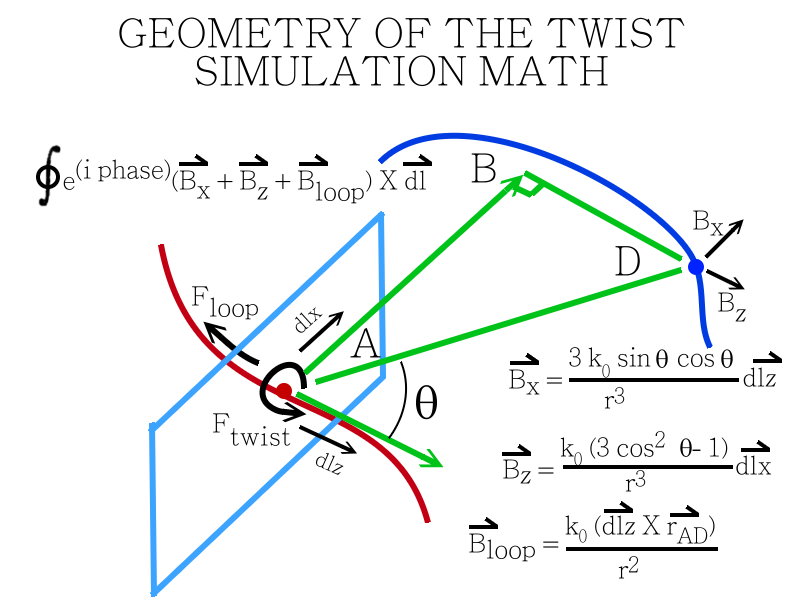
Here is a drawing of the forces on the twist path that the simulator attempts to model.

Here is a drawing of the forces on the twist path that the simulator attempts to model.

I created a picture that hopefully shows the geometry of the simulation math described in the previous post (see in particular the PPS update).  This picture attempts to show a generator twist path about point A in red, with the two force sources F(loop) and F(twist), which are delta 1/r^2 and 1/r^3 flux field generators respectively.  The destination point D path is shown in blue.  The parametric integral must be computed for every source point on each destination point–this will give a potential field.  When the entire set of curves lies on an equipotential path, one of many possible stable solutions has been found (it’s already easy to establish that any topologically unique closed loop solution will not degenerate because the 1/r^3 force will repel twist paths from crossing each other).  There probably is a good LaGrange method for finding stable solutions, but for now I will work iteratively and see if convergence for various linked or knotted loops can be achieved.


Agemoz

Simulation Construction of Twist Theory

December 2, 2014

Back after dealing with some unrelated stuff.  I had started work on a new simulator that would test the Twist Theory idea, and in so doing ran into the realization that the mathematical premise could not be based on any sort of electrostatic field.  To back up a bit, the problem I’m trying to solve is a geometrical basis for quantization of an EM field.  Yeah, old problem, long since dealt with in QFT–but the nice advantage of being an amateur physicist is you can explore alternative ideas, as long as you don’t try to convince anyone else.  That’s where crackpots go bad, and I just want to try some fun ideas and see where they go, not win a Nobel.  I’ll let the university types do the serious work.

OK, back to the problem–can an EM field create a quantized particle?  No.  No messing with a linear system like Maxwell’s equations will yield stable solitons even when constrained by special relativity.  Some rule has to be added, and I looked at the old wave in a loop (de Broglie’s idea) and modified it to be a single EM twist of infinitesimal width in the loop.  This still isn’t enough, it is necessary that there be a background state for a twist where a partial twist is metastable, it either reverts to the background state, or in the case of a loop, continues the twist to the background state.  In this system–now only integer numbers of twists are possible in the EM field and stable particles can exist in this field.  In addition, special relativity allows the twist to be stable in Minkowski space, so linear twists propagating at the speed of light are also stable but cannot stop, a good candidate for photons.

If you have some experience with EM fields, you’ll spot a number of issues which I, as a good working crackpot, have chosen to gloss over.  First, a precise description of a twist involves a field discontinuity along the twist.  I’ve discussed this at length in previous posts, but this remains a major issue for this scheme.  Second, stable particles are going to have a physical dimension that is too big for most physicists to accept.  A single loop, a candidate for the electron/positron particle, has a Compton radius way out of range with current attempts to determine electron size.  I’ve chosen to put this problem aside by saying that the loop asymptotically approaches an oval, or even a line of infinitesimal width as it is accelerated.  Tests that measure the size of an electron generally accelerate it (or bounce-off angle impact particles) to close to light speed.  Note that an infinitely small electron of standard theory has a problem that suggests that a loop of Compton size might be a better answer–Heisenberg’s uncertainty theorem says that the minimum measurable size of the electron is constrained by its momentum, and doing the math gets you to the Compton radius and no smaller.  (Note that the Standard Model gets around this by talking about “naked electrons” surrounded by the constant formation of particle-antiparticle pairs.  The naked electron is tiny but cannot exist without a shell of virtual particles.  You could argue the twist model is the same thing except that only the shell exists, because in this model there is a way for the shell to be stable).

Anyway, if you put aside these objections, then the question becomes why would a continuous field with twists have a stable loop state?  If the loop elements have forces acting to keep the loop twist from dissipating, the loop will be stable.  Let’s zoom in on the twist loop (ignoring the linear twist of photons for now).  I think of the EM twist as a sea of freely rotating balls that have a white side and a black side, thus making them orientable in a background state.  There has to be an imaginary dimension (perhaps the bulk 5th dimension of some current theories).  Twist rotation is in a plane that must include this imaginary dimension.  A twist loop then will have two rotations, one about the loop circumference, and the twist itself, which will rotate about the axis that is tangent to the loop.  The latter can easily be shown to induce a B field that varies as 1/r^3 (formula for far field of a current ring, which in this case follows the width of the twist).  The former case can be computed as the integral of dl/r^2 where dl is a delta chunk of the loop path.  This path has an approximately constant r^2, so the integral will also vary as r^2.  The solution to the sum of 1/r^2 – 1/r^3 yields a soliton in R3, a stable state.  Doing the math yields a Compton radius.  Yes, you are right, another objection to this idea is that quantum theory has a factor of 2, once again I need to put that aside for now.

So, it turns out (see many previous posts on this) that there are many good reasons to use this as a basis for electrons and positrons, two of the best are how special relativity and the speed of light can be geometrically derived from this construct, and also that the various spin states are all there, they emerge from this twist model.  Another great result is how quantum entanglement and resolution of the causality paradox can come from this model–the group wave construction of particles assumes that wave phase and hence interference is instantaneous–non-causal–but moving a particle requires changing the phase of the wave group components, it is sufficient to limit the rate of change of phase to get both relativistic causality and quantum instantaneous interference or coherence without resorting to multiple dimensions or histories.  So lots of good reasons, in my mind, to put aside some of the objections to this approach and see what else can be derived.

What is especially nice about the 1/r^2 – 1/r^3 situation is that many loop combinations are not only quantized but topologically stable, because the 1/r^3 force causes twist sections to repel each other.  Thus links and knots are clearly possible and stable.  This has motivated me to attempt a simulation of the field forces and see if I can get quantitative measurements of loops other than the single ring.  There will be an infinite number of these, and I’m betting the resulting mass measurements will correlate to mass ratios in the particle zoo.  The simulation work is underway and I will post results hopefully soon.

Agemoz

PS: an update, I realized I hadn’t finished the train of thought I started this post with–the discovery that electrostatic forces cannot be used in this model.  The original attempts to construct particle models, back in the early 1900s, such as variations of the DeBroglie wave model of particles, needed forces to confine the particle material.  Attempts using electrostatic and magnetic fields were common back then, but even for photons the problem with electrostatic fields was the knowledge that you can’t bend or confine an EM wave with either electric or magnetic fields.  With the discovery and success of quantum mechanics and then QFT, geometrical solutions fell out of favor–“shut up and calculate”, but I always felt like that line of inquiry closed off too soon, hence my development of the twist theory.  It adds a couple of constraints to Maxwell’s equations (twist field discontinuities and orientability to a background state) to make stable solitons possible in an EM field.

Unfortunately, trying to model twist field particles in a sim has always been hampered by what I call the renormalization problem–at what point do you cut off the evaluation of the field 1/r^n strength to prevent infinities that make evaluation unworkable.  I’ve tried many variations of this sim in the past and always ran into this intractable problem–the definition of the renormalization limit point overpowered the computed behavior of the system.

My breakthrough was realizing that that problem occurs only with electrostatic fields and not magnetic fields, and finding the previously mentioned balancing magnetic forces in the twist loop.  The magnetic fields, like electrostatic fields,  also have an inverse r strength, causing infinities–but it applies force according to the cross-product of the direction of the loop.  This means that no renormalization cutoff point (an arbitrary point where you just decide not to apply the force to the system if it is too close to the source) is needed.  Instead, this force merely constrains the maximum curvature of the twist.  As long as it is less that the 1/r^n of the resulting force, infinities wont happen, and the curve simulation forces will work to enforce that.  At last, I can set up the sim without that hokey arbitrary force cutoff mechanism.

And–this should prove that conceptually there is no clean particle model system (without a renormalization hack) that can be built from an electrostatic field.  A corollary might be–not sure, still thinking about this–that magnetic fields are fundamental and electrostatic fields are a consequence of magnetic fields, not a fundamental entity in its own right.  The interchangability of B and E fields in special relativity frames of reference calls that idea into question, though, so I have to think more about that one!  But anyway, this was a big breakthrough in creating a sim that has some hope of actually representing twist field behavior in particles.

Agemoz

PPS:  Update–getting closer.  I’ve worked out the equations, hopefully correctly, and am in the process of setting them up in Mathematica.  If you want to make your own working sim, the two forces sum to a flux field which can be parametrically integrated around whatever twist paths you create.  Then the goal becomes to try to find equipotential curves for the flux field.  The two forces are first the result of the axial twist, which generates a plane angle theta offset value Bx = 3 k0 sin theta cos theta/r^3, and Bz = k0 ( 3 cos^2 theta -1)/r^3.  The second flux field results from the closed loop as k0 dl/r^2).  These will both get a phase factor, and must be rotated to normalize the plane angle theta (some complicated geometry here, hope I don’t screw it up and create some bogus conclusions).  The resulting sum must be integrated as a cross product of the resulting B vector and the direction of travel around the proposed twist path for every point.

Principle of Replication and the Particle Zoo

June 27, 2014

I am continuing to develop the new twist simulation, and hope to get first runs maybe in the next several weeks or months.  It’s been a good exercise because it has forced me to be very clear and explicit about how the model works.  To paraphrase Feynman very loosely, “the truth does not lie”–I can’t just make the theory work just because I want it to.  But the exercise has been good because it’s clarified some important concepts that are distributed all throughout this blog, and thus a casual reader is going to have a very difficult time figuring out what I am talking about and whether there’s any real substance to what I’m thinking.  While there is a *lot* of thinking behind this approach, here are the fundamental concepts that are driving how this simulation is being built:

The twist field concept starts with E=hv for all particles, and this is a statement of quantization.  For any given frequency, there is only one possible energy.  If we assume a continuous field, the simplest geometrical model of this is a full twist in a field of orientations.  E=hv implies no magnitude to the field, you can imagine a field of orientable dots within a background state direction–quantization results when only a complete rotation is permitted, thus implying the background default direction that all twists must return to.

The second concept is a duality–if there is a vast field of identical particles, say electrons, the dual of exact replication is a corresponding degree of simplicity.  While not a proof, the reason I call simplicity the dual of replication is because the number of rules required to achieve massive repeatability has to withstand preservation of particles in every possible physical environment from the nearly static state–say, a Milliken droplet electron all the way to electrons in a black hole jet.  The fewer the rules, the fewer environments that could break them.

The third concept is to realize causality doesn’t hold for wave phase in the twist model.  Dr. Bell proved that quantum entanglement means that basic Standard Model quantum particles cannot have internal structure if causality applies to every aspect of nature.  The twist model says that waves forming a particle are group waves–a change in phase in a wave component is instantaneous across the entire wave–but the rate of change of this phase is what allows the group wave particle to move, and this rate of change is what limits particle velocity to the speed of light.  This thus allows particles to interfere instantaneously, but the particle itself must move causally.  Only this way can a workable geometry for quantum entanglement, two-slit experiments, and so on be formed.

Within these constraints the twist model has emerged in my thinking.  A field twist can curve into stable  loops based on standard EM theory and the background state quantization principle.  A particle zoo will emerge because of a balance of two forces, one of which is electrostatic (1/r*2, or central force) and the other is electromagnetic (1/r*3).  When a twist curve approaches another twist curve, the magnetic (1/r*3) repulsion dominates, but when two parts of a curve (or separate curves) move away from each other, the electrostatic attractive force dominates.  Such a system has two easily identifiable stable states, the linear twist and the ring.  However there are many more, as can be easily seen when you realize that twist curves cannot intersect due to the 1/r*3 repulsion force dominating as curves approach.  Linked rings, knots, braids all become possible and stable, and a system of mapping to particle zoo members becomes available.

Why do I claim balancing 1/r*2 and 1/r*3 forces exist?  Because in a twist ring or other closed loop geometries, there are a minimum of two twists–the twist about the axis /center of the ring, and the twist about the path of the ring–imagine the linear twist folded into a circle.  Simple Lorentz force rules will derive the two (or more, for complex particle assemblies such as knots and linked rings) interacting forces.  Each point’s net force is computed as a sum of path forces multiplied by the phase of the wave on that path–you can see the resemblance to the Feynman path integrals of quantum mechanics.

Soon I’ll show some pictures of the sim results.

Hopefully that gives a clear summary of why I am taking this study in the directions I have proposed.

Agemoz