Archive for the ‘Physics’ Category

Twist Field Theory Sim Results

June 30, 2013

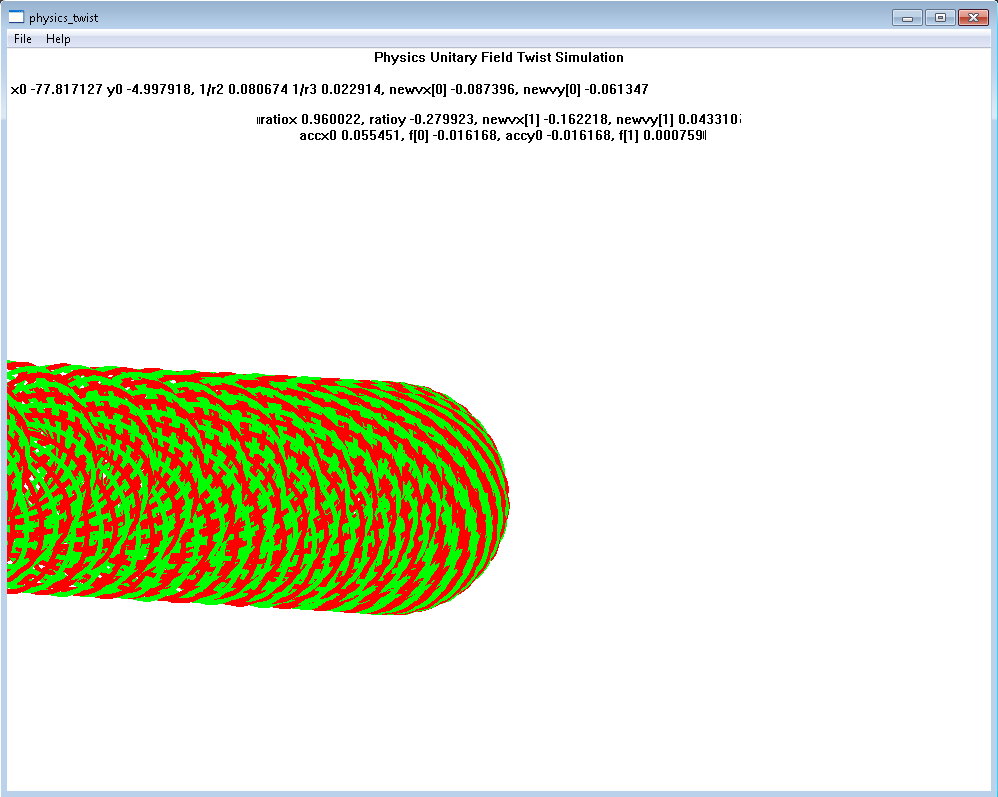
I have worked on my simulation that tests the acceleration concept that the unitary twist field predicts, and verified that it does what I expect qualitatively (quantitative calculations soon coming).  What is this?  The theory says that the twist ring of a particle twists from a real vector in R3 to I1 and back again.  If this is correct, then among other things, it should be possible to derive the acceleration of the twist ring in a 1/r^2 electrostatic field, because the twist will encounter a different distance from an electrostatic point source (I’m assuming far-field here).  The simulation without a remote field looks like this (the source field particle is to the left off screen (the real axis).  The vertical axis is the imaginary twist axis, this picture is showing a projection with one real dimension).

twist_ring_acc_nofield

But when the point source is added (it is located off-screen to the left), the twist ring moves away from the source as so:

twist_ring_acc_repulse

When the field polarity is reversed, the twist ring moves toward the source (to the left)

twist_ring_acc_attract

You can see the pattern of the rotating ring is changing, there is an acceleration as the particle moves to the left (toward the source) but when the particle moves to the right, the acceleration slows, eventually it appears to just have a constant velocity.  This sim set demonstrates how the theory explains electrostatic repulsion and attraction if particles are closed loop twists.

I used to have a charge loop theory which put the loop (twist ring) in real space (R3), but this didn’t work because the ring could have different orientations relative to a source field particle that would have to vary the electrostatic force, which is impossible.  In addition, the charge loop attraction would not compute correctly if there were three particles in a triangle.  Since the unitary twist field theory uses one common imaginary axis for twist rotation, and this is the axis of the 1/r^2 field, all particles will see an unvarying effect relative to each other regardless of their orientation in real R3 space.

Looks promising!  Next up is to quantitatively compute the acceleration, this should give the mass of the particle via the inertial factor.  From that, I should be able to show how mass results from the twist frequency, which is directly a function of the strength of the magnetic field relative to the electrostatic field, which comes from (or defined by) the fine structure constant.   If this collection of derivations matches reality, then maybe this theory is worth looking at!

Agemoz

New Papers on Speed of Light Variation Theories

April 28, 2013

A couple of papers to a European physics journal (http://science.nbcnews.com/_news/2013/04/28/17958218-speed-of-light-may-not-be-constant-physicists-say?lite –probably not the best place to get accurate reviews, but interesting anyway) attempt to show how the speed of light is dependent on a universe composed of virtual particles.  The question here is why isn’t c infinite, and of course I’ve been interested in any current thinking in this area because my unitary twist field theory posits that quantum interference results from infinite speed wave phase propagation, but that particles are a Fourier composition that moves as a group wave that forms a twist.  Group waves form a solition whose motion is constrained by the *change* in the relative phases of the group wave components.

Both theories were interesting to me, not because they posited that the speed of light would vary depending on the composition of virtual particles, but because they posit that the speed of light is dependent on the existence of virtual particles.  This is a match with my idea since virtual particles in the unitary twist field theory are partial twists that revert back to a background vector state.  Particles become real when there is sufficient energy to make a full twist back to the background state, thus preserving the twist ends (this assumes that a vector field state has a lowest energy when lining up with a background vector state).  But virtual particles, unlike real particles, are unstable and have zero net energy because the energy gained when partially twisting is lost when the twist reverts back to the background state.

These papers are suggesting that light propagates as a result of a constant sequence of particle pair creation and annhiliation.   The first glance view might be that particle pair creation is just a pulling away of a positron and an electron like a dumb-bell object, but because charged particles, virtual or real, will have a magnetic moment, it’s far more likely that the creation event will be spiralling out–a twist.  Yes, you are right to roll-your-eyes, this is making the facts fit the theory and that does not prove anything.  Nevertheless, I am seeing emerging consensus that theories of physical behavior need to come from, or at least fully account for, interactions in a sea of virtual particles.  To keep the particle zoo proliferation explanation simple, this sea of virtual particles has to be some variation of motions of a single vector field–and in 3D, there’s only two simple options–linear field variation, and twists.   Photons would be linear twists and unconstrained in energy–but particles with rest mass would be closed loops with only certain allowed energies, similar to the Schrodinger electron around an atom.  Twists in a background vector field also have the advantage that the energy of the twist has to be quantized–matching the experimental E=hv result.

Agemoz

Gaussian Wave Packets

February 20, 2013

It’s been a little while since I’ve posted, mostly because I have an unrelated big project going on, so I’ve been focusing on trying to get that out the door.  And, I’m working on getting the twist ring inertial math to work, a laborious project since the Lagrangian equation of motion has too many variables for solving.  I’m trying to find ways to simplify.  In addition, I also have an iterative sim of the inertial response ready to go but haven’t had time to set it up and run it.  Hopefully with the other project almost done I’ll get to it this weekend.

One thought I’ve had in the meantime–many  quantum mechanics exercises involve modeling a photon with a wave packet that is described as having the Gaussian integral form.  The most basic variation of this form (Integral[Exp[-x^2]]) is a bell shaped curve with amplitude 1 at zero and asymptotically goes to zero at +/- infinity.  I’ve had lots of lectures where an oscillating squiggle is used to represent the magnitude of the quantized photon wave packet.

A very interesting thought occurred to me is that this integral is a great representation of the unitary twist version of a photon packet.  A one dimensional magnitude projection of a twist from the Unitary Twist Field Theory would be represented exactly by a Gaussian curve, and if we use a complex value r to completely represent the twist function, then the Gaussian integral becomes Integral[Exp[-r^2]] and then this can be interpreted as a working model of twists–and thus support the notion that the twist theory has a well proven basis in the math of quantum mechanics.  Do I buy that, or should my skepticism meter be dinging my thinking process?  Right now, the idea looks pretty workable–it seems pretty clear that the r form clearly would represent a twist as well as a Gaussian envelope packet over a frequency of oscillation of E and B fields–making the twist theory a viable alternative to the magnitude constrained wave packet interpretation.  For the twist theory to be acceptable, there has to be a path to the math of quantum mechanics, and I think I see how this could happen.

Agemoz

Noncausal solution, Lorentz Geometry, and trying a LaGrangian solution to deriving inertia

December 31, 2012

Happy New Year with wishes for peace and prosperity to all!

I had worked out the group wave concept for explaining non-causal quantum interactions, and realized how logical it seems–we are so used to thinking about the speed of light limit causing causal behavior that it makes the non-causal quantum interactions seem mysterious.  But when thinking of a universe that spontaneously developed from nothing, non-causal (infinite speed) interactions should be the default, what is weird is why particles and fields are restricted to the speed of light.  That’s why I came up with the group wave construct for entities–a Fourier composition of infinite speed waves explains instant quantum interference, but to get an entity such as a particle to move, there is a restriction on how fast the wave can change phase.  Where does that limitation come from?  Don’t know at this point, but with that limitation, the non-causal paradox is resolved.

Another unrelated realization occurred to me when I saw some derivation work that made the common unit setting of c to 1.  This is legal, and simplifies viewing derivations since relativistic interactions now do not have c carried around everywhere.  For example, beta in the Lorentz transforms now becomes Sqrt(1 – v^2) rather than Sqrt(1 – (v^2/c^2)).  As long as the units match, there’s no harm in doing this from a derivation standpoint, you’ll still get right answers–but I realized that doing so will hide the geometry of Lorentz transforms.  Any loop undergoing a relativistic transform to another frame of reference will transform by Sqrt(1 – (v^2/c^2)) by geometry, but a researcher would maybe miss this if they saw the transform as Sqrt(1 – v^2).   You can see the geometry if you assume an electron is a ring with orientation of the ring axis in the direction of travel.  The ring becomes a cylindrical spiral–unroll one cycle of the spiral and the pythagorean relation Sqrt(1 – v^2/c^2)) will appear.  I was able to show this is true for any orientation, and hand-waved my way to generalizing to any closed loop other than a ring.  The Lorentz transforms have a geometrical basis if (and that’s a big if that forms the basis of my unitary twist field theory) particles have a loop structure.

Then I started in on trying to derive general relativity.  Ha Ha, you are all laughing–hey, The Impossible Dream is my theme song!  But anyway, here’s what I am doing–if particles can be represented by loops, then there should be an explanation for the inertial behavior of such loops (totally ignoring the Higgs particle and the Standard Model for right now).  I see a way to derive the inertial behavior of a particle where a potential field has been applied.  A loop will have a path through the potential field that will get distorted.  The energy of the distortion will induce a corrective effect that is likely to be proportional to the momentum of the particle.  If  I can show this to be true, then I will have derived the inertial behavior of the particle from the main principle of the unitary twist field theory.

My first approach was to attempt a Lagrangian mechanics solution.  Lagrange’s equation takes the difference of the kinetic energy from the potential energy and creates a time and space dependent differential equation that can be solved for the time dependent motion of the particle.  It works for single body problems quickly and easily, but this is a multiple body problem with electrostatic and magnetic forces.  My limited computation skills rapidly showed an unworkable equation for solution.  Now I’m chewing on what simplifications could be done that would allow determining the acceleration of the particle from the applied potential.

Agemoz

Noncausal Interactions, part II

December 11, 2012

I want to clarify the previous posting on how I resolve the noncausal paradox in unitary twist field theory–after all, this is the heart of the current struggle to create a quantum gravity theory.  Here, I’m continuing on from the previous post, where I laid out the unitary twist field theory approach for quantum interactions.  In there, I classified all particle interactions as either causal physical or noncausal quantum, and quantum interactions fall into many categories, two of which are interference and entanglement.  These two quantum interactions are non-causal, whereas physical interactions are causal–effects of physical interactions cannot go faster than the speed of light.

Many theories have attempted to explain the paradoxes that result from the noncausal quantum interactions, particularly because relativity theory specifies that no particle can exceed the speed of light.  The Copenhagen interpretation, multiple histories, string theories such as M theory, the Pilot wave theory, etc etc all attempt to resolve this issue–but in my research I have never found anyone describe what to me appears to be a simple solution–the group wave approach.

In my previous posting, I described this solution:  If every particle is formed as a Fourier composition of waves, the particle can exist as a group wave.  Individual wave components can propagate at infinite speed, but the group composition is limited to speed c.  This approach separates out particle interactions as having two contributors:  from the composite effect of changing the phase of all wave components (moving the center of the group wave) and the effect of changing the phase of a single fundamental wave component.  If the individual wave components changed, the effect is instantaneous throughout spacetime, but there is a limitation in how quickly the phase of any give wave component can be changed, resulting in a limitation of how quickly a group wave can move.

It’s crucial to understand the difference, because this is the core reason why the paradox resolves.  Another way to say it is that when a change to a wave component is made, the change is instantaneous throughout R3–but the rate of change for any component has a limit.  An analogy would go like this: you have two sheets of transparency paper with a pattern of parallel equally spaced lines printed on it.  If you place each sheet on top of each other at an angle, you will see a moire pattern.  Moving one sheet relative to the other will move the moire pattern at some speed limited by how quickly you moved the sheet.  But note that every printed line on that sheet moved instantaneously relative to every other line on that sheet–instantaneous wave component movement throughout R3.  Note that the interference pattern changes instantaneously, but the actual movement of the moire pattern is a function of how fast the sheets are moved relative to each other–exactly analogous to what we see in real life.  This is the approach that I think has to be used for any quantum gravity theory.

Agemoz

Noncausal interactions in the Unitary Twist Field Theory

December 10, 2012

It’s been a little while since I’ve posted, partly because of my time spent on the completion of a big work project, and partly because of a great deal of thinking before posting again (what a concept!  Something new!).  This blog has traveled through a lot of permutations and implications of the unitary twist field theory.  It starts by assuming that the Standard Model is valid, but then tries to create an underlying geometry for quantization and special relativity.  This twist vector field geometry is based on E=hv, and has worked pretty well–but when we get to entangled particles and other noncausal aspects of quantum theory, I’ve needed to do some new thinking.  While the noncausal construct is easily built on group wave theory (phase information propagates at infinite speed, but group Fourier compositions of waves that make up particles are limited to speed c), there are significant consequences for the theory regarding its view of the dimensional characteristics of the 3D+T construct of our existence.

As I mentioned, the unitary twist field theory starts with E=hv, the statement that every particle is quantized to an intrinsic frequency.  There really is only one way to do this in a continuous system in R3+T:  a twist within a background state vector field.  Twists are topologically stable, starting from the background direction and twisting to the same background direction with an integral turn.  Quantization is achieved because partial turns cannot exist (although virtual particles exist physically as partial turns for a short time before reverting back to the background state).  With this, I have taken many paths–efforts to verify this pet theory could really work.  For example, I tested the assumption of a continuous system–could the field actually be a lattice at some scale.  It cannot for a lot of reasons (and experiments appear to confirm this), especially since quantization scales with frequency, tough to do with a lattice of specific spacing.  Another concern to address with twist field theory occurs because it’s not a given that the frequency in E=hv has any physical interpretation–but quantum theory makes it clear that there is.  Suppose there was no real meaning to the frequency in E=hv–that is, the hv product give units that just happen to match that of frequency.  This can’t be true, because experimentally, all particles quantum interfere at the hvfrequency, an experimental behavior that confirms the physical nature of the frequency component.

So–many paths have been taken, many studies to test the validity of the unitary twist field theory, and within my limits of testing this hypothesis, it seems so far the only workable explanation for quantization.  I believe it doesn’t appear to contradict the Standard Model, and does seem to add a bit to it–an explanation for why we see quantization using a geometrical technique.  And, it has the big advantage of connecting special relativity to quantum mechanics–and I am seeing promising results for a path to get to general releativity.  A lot of work still going on there.

However, my mind has really taken a big chunk of effort toward a more difficult issue for the unitary twist field theory–the non-causality of entangled particles or quantum interference.  Once again, as discussed in previous posts here, the best explanation for this seems pretty straightforward–the particles in unitary twist field theory are twists that act as group waves.  The group wave cluster, a Fourier composition, is limited to light speed (see the wonderful discovery in a previous post that any confined twist system such as the unitarty twist field theory must geometrically exhibit a maximum speed, providing a geometrical reason for the speed of light limit).  However, the phase portion of the component waves is not limited to light speed and resolves the various non-causal dilemmas such as the two-slit experiment, entangled particles, etc, simply and logically without resorting to multiple histories or any of the other complicated attempts to mash noncausality into a causal R3+T construct.

But for me, there is a difficult devil in the details of making this really work.  Light-speed limited group waves with instantaneous phase propagation raises a very important issue.  Through a great deal of thinking, I believe I have shown myself that noncausal interactions which require instantaneous phase propagation, will specify that distance and time be what I call “emergent” concepts–they are not intrinsic to the construction of existence, but emerge–probably as part of the initial Big Bang expansion.  If so, the actual dimensions of space-time are also emergent–and must come from or are based on a system with neither–a zero dimensional dot of some sort of incredibly complex oscillation.  Why do I say this?  Because instantaneous phase propagation, such as entangled particle resolving, must have interactions in local neighborhoods that do not have either a space or time component.  Particles have two types of interactions–ones where two particles have similar values for R3+T (physical interactions), and those that have similar values only in phase space.  In either case, two particles will affect each other.  But how do you get interactions between two particles that aren’t in the same R3+T neighborhood?  Any clever scheme like the Standard Model or unitary twist field theory must answer this all important question.

Physicists are actively trying to get from the Standard Model to this issue (it’s a permutation of the effort to create a quantum gravity theory).  As you would expect, I am trying to get from the unitary twist field theory to this issue.  Standard Model efforts have typically either focused on adding dimensions (multiple histories/dimensions/string theories) or more exotic methods usually making some set of superluminal assumptions.  As mentioned in previous posts, unitary twist field theory has twists that turn about axes in both an R3 and a direction I that is orthogonal to R3 in time.  Note that this I direction does not have any dimensional length–it is simply a vector direction that does not lie in R3.  When I use the unitary twist field theory to show how particles will interact in R3+T, either physically or in entangled or interfering states, those particles would simply have group wave constructs with either a matching set of R3+T values (within some neighborhood epsilon value) or must have matching phase information in the I space.  In other words, normal “nearby”  interactions between two particles happen in a spacetime neighborhood, but quantum interference interactions happen in the I space, the land that Time and Space forgot.  There is no dimensional length here, but phase matches allow interaction as well.  This appears to be a fairly clean way to integrate noncausal behavior into the unitary twist field theory.

Obviously, there are still things to figure out here, but that is currently the most promising path I see for how unitary twist field theory will address the noncausal interaction construct issue.

Agemoz


Experimental Confirmation of Lattice-Free Spacetime

September 1, 2012

In my previous post, I posited that spacetime cannot be a lattice at Planck scale distances, and by sheer coincidence, this completely different experimental report also confirms the likelihood that spacetime is smooth at this scale:

http://www.space.com/17399-gamma-ray-photons-quantum-spacetime.html

A smooth spacetime means that Planck scale lumpiness (a lattice of one of the types I describe in the previous post) will not explain quantization.  I suspected that anyway, because quantization is scale independent.  Low energy photons are quantized over distances that are enormously vast (hundreds of orders of magnitude) compared to Planck scale distances, so I did not see how a lattice could induce that quantization.

The field twist is also scale independent, so is another nice arrow in the quiver for unitary twist field theory.  But I’m grappling with a big problem as I develop the specular simulator for the unitary field twist theory.  The probability of electron motion is affected by its ability to self absorb a virtual photon, and this probability is directly proportionate to the fine structure constant.  I believe that this number is the square of the probability to emit and the probability to absorb, making each have about an 8 percent chance of occurring.  Physicists have absolutely no clue why this probability is what it is.  QFT gives no guidance but uses the experimentally determined value of interaction probability as a foundation for every quantum interaction of particles and fields.

As usual, I am trying to find a geometrical reason that the unitary field twist theory might give that probability–some ideas, but nothing obvious.  I have to figure something out before I can even start constructing the specular sim.

Agemoz

Lattice fields and Specular Simulation (latest work)

August 25, 2012

The latest work on the twist model is proceeding.  This work makes the assumptions noted in previous posts–EM interactions are mediated by photons as a quantized linear field twists.  The current work assumes these photons comprise the macroscopic electrostatic and magnetic field,  are unitary, and that they are sparse (do not interact).  It assumes that the twist has a common imaginary axis and three real dimensions on R3, similar but not the same as the QFT EM field, which is a complex value on R3 (t is assumed in both cases).  Electron-photon interactions occur when a twist ring captures a linear twist and absorbs it.  I am assuming that a photon twist is magnetic when the real axis of the twist is normal to the real dimension direction of travel, and is electrostatic when the real axis of the twist is tangent to the direction of travel (note how relativistic motion will alter the apparent axis direction, causing the expected shift of photons from electrostatic to magnetic or vice versa).

This set of assumptions creates a model where the linear twist of the photon will affect a twist ring electron in different ways depending on the photon twist axis direction.  Yes, this is a rather classical approach that ignores the fact that quantum interactions are probability distributions, among other things.  My approach is to create a model simulation environment to test the hypothesis that quantization can accurately be represented by field twists, the foundation of the unitary twist field theory.  It does not currently include entanglement, which I represent as the assumption that field twist phase information is instantaneous but that particles (twists) are group wave assemblies that propagate no faster than the speed of light.

These assumptions require that I make changes to my current simulator, which is a lattice approximation of a continuous vector field twist.  I was able to show in that simulator that a continuous twist solution could not work due to the unitary field blocking effect.  From that (and from QFT), I concluded that the twist field must be sparse and specular, where interactions are mediated by linear twist photons that do not interact.  I cannot use my existing simulator for this model but must make a new version, which is underway.  It will take a while so my posts will become less frequent until I get this working.

However, since I am now going away from a lattice simulator to a sparse model simulator, it did make me think about lattices as a representation of existence, and I concluded that that cannot be.  I have often seen theories that our universe is a quantum scale lattice of Planck length.  This supposedly would explain quantization, but I don’t think it works–the devil is in the details.  If the lattice is periodic, such as an array of cube vertexes or tetrahedral vertices, then there should be angles that propagate photons differently than others.  If our existence is spinning on a periodic lattice, we should see harmonics of that spin as background noise.  Within the range of our ability to detect such “radiation” from space, neither are happening.

So, suppose the lattice is not periodic but is a random clustering of vertexes, which solves the problem of periodicity causing background frequencies.  In that case, I would expect that photon propagation would have velocity variation as it propagated through varying spacing of vertexes.  There would have to be an upper bound to the density of vertexes to ensure apparent constant speed, and I struggle to think what would enforce that bound.  This is probably the most workable of the lattice ideas, but due to the necessity of a vertex spacing constraint, there would have to be an upper limit to the allowable energy of a photon, something we have no evidence for.  At this point, I think there is no likelihood that existence can be described as a lattice.  That hypothesis is attractive because we can easily imagine a creator God could build a computer that could most easily create a model of existence using a lattice of some form.  But even though the Planck length lattice is far too small for us to detect directly, I don’t think the evidence points that way.  (Side note:  it’s so interesting to look at early literature to see the historical evolution of what people thought formed the underlying basis for our existence–early on, God creating and controlling a mechanical model, then universe models were complex automated assemblies of gears and pullies, then the steam-engine or steam-punk type of machine, then mechanical computing engines, and now computer program driven machines simulating a lattice…  What is next? !)

Back to the lack of evidence for an underlying lattice to our existence.  This is a more important  realization than it might appear, especially from a philosophical standpoint.  If there was evidence that the universe was built on a lattice, that would strongly imply creation by a being, because a lattice is an underlying structure and constraint.  Evidence that there is no lattice, which is what I think I am seeing, would imply that there is no higher being because it is hard for me to imagine constructing a world without a lattice.  Of course, it would only be a mild implication, because my ability to imagine how a universe could be constructed without a lattice is limited.  Nevertheless, it is a pointer in the direction of existence coming from nothing rather than being constructed by a God.

Pretty interesting stuff!  More to come as the new simulator work gets underway.
Agemoz

Quantized Fields

July 11, 2012

No, I’m not going to talk about the Higgs boson.  Well, except to make one reference to it as far as my work is concerned:  it’s a new (but long predicted, and not yet shown to actually be the Higgs) particle and field to add to the particle zoo.  A step backwards, in a way–I think our understanding will advance when we find underlying connections between particles and fields, but adding more to the pile isn’t helpful to a deeper understanding.  Oh, and that the Higgs approach adds an inertial property to mass particles, a mechanism caused by a drag effect relative to the field.  That matters to my work because it appears to be a different mechanism than how I propose mass gets attached to particles.  Yes, it calls into question the validity of my work, but so do a whole bunch of other things.  I’m proceeding anyway.

I got some interesting results from some simulation efforts–a second stable state with three components.  It is particularly interesting because it appears to settle into a three way braid–and more importantly, seems to progress to faster and faster speeds–limited to the speed of light.  Not sure why it does that, more investigative work to determine if this is a model problem or real behavior of the three twist solution.  Does make me think of a neutrino, but that’s pure speculation.  Here’s some curious pics.  These sim has all three twists with equal momentum.  I’m going to set one or two twists to double momentum and see what happens.  I also need to fix the attraction/repulsion in these cases, currently these cannot represent reality because of three charge values instead of two in real life (+,-)–but you can see what a fertile ground the twist model shows.

This 3D simulation of a three twist interaction stabilizes into three way braid

This 3D projection of a three way twist array eventually stabilizes into a closely interacting stable entity

But the real work I’ve been doing lately is not these sims–instead, it’s my thinking about the continuous property of fields and quantization.  If the unitary twist field is continous, it is blocking–a twist bend cannot propagate through another twist bend if it is separated by a plane with background state orientation–another way of saying a continuous unitary field cannot be linear.  Real EM fields are linear.  Are they also continuous?  At first, I said no, they can’t be,  since real EM fields should be blocking as well.  But then I realized that unlike the unitary twist field, real EM fields are linear (effectively can pass through each other) because the field of one source can add on top of another field from another source.  In this case, the magnitude of the field at a given point is not constrained, so this is what makes the fields of QFT work, that is, be continuous and also linear.

Mathematically, that is possible–but now I believe that even the QFT model of fields such as the EM field cannot be continuous for a different reason, field quantization.  QFT says you cannot extract any energies from the field that don’t meet the quantization constraint.   Unitary twist fields will derive this quantization because only full twists from and to the background field direction are possible and topologically stable.  Any partial twist must return to the background state and will dissipate.  Here’s why I now think that any quantized field cannot be continuous.  Let’s talk unitary twist field first.  I had a groundbreaking discovery with unitary twist fields a month or so ago when I found that if this field is continuous, it is possible to create a situation where it blocks passage of field states.  If you put two oppositely charged particles separated by a distance r, symmetry requires that a plane separating the two particles must have zero twist, and thus one particle would see zero twist at distance r/2–the same thing it would see at an infinite distance.  The problem is, then there is a situation where there is no difference from the uncharged background state and the first particle cannot respond differently than if there were no nearby charged particles.  The bisecting plane with zero bend acts as a barrier preventing or blocking  the other particle from affecting the first.

OK, that was the unitary twist field case.  Now the QFT case doesn’t have this problem since the bisecting plane holds magnitudes, not the zero background state of the unitary twist field.  Therefore, the first particle can be subject to the effects of the second particle since the bisecting plane no longer blocks.

But, QFT fields have a different problem that still says it can’t be continuous.  A non-continuous field is the saving grace that might allow unitary twist fields to be a valid underlying solution–if the field is not continuous, but is granular.  If the QFT field has to be granular, then unitary twist field theory becomes a valid underlying architecture for QFT (of course, other constraints or problems might invalidate unitary twist theory, but right now granularity allows the unitary twist field to be non-blocking, otherwise there’s no way it could work).  In the granular case, a given epsilon neighborhood sees these passing components going from one particle to the other without blocking.  Thus, any quantized field such as QFT fields or unitary twist fields will be linear (and div and curl will be zero) if and only if the granular parts do not interact.

As I continued down this path of thinking, I began to realize that whether the QFT EM field or the unitary twist field are correct real world descriptions, neither of them can be continuous.   You could argue that the field itself is continuous but the particles that are extracted from the field are quantized, but this idea has serious fails if you create a field from a limited number of quanta.  Inductive reasoning is going to force either model of the field to be composed of granular components–it will not be possible to create a field from two quanta that is continuous because the information of the quanta is preserved.  Why do I say that?  Because a two quanta field that is continuous may only release a quantized particle from the energy of the field.  If the quanta information is preserved in the field, I cannot see any way that a definition of continuous could apply to this field.

Now, if the field is composed of quanta that do not interact, then linearity will result simply by the ability of packing more or less quanta into a set epsilon volume.  Linearity means that the quanta cannot interact (otherwise magnitudes at some points will not sum, a linearity requirement).  Therefore, the quantized field can be considered granular and infinitely sparse, that is, no constructive summation of fields can cause loss of total volume density of quanta.  In other less obtuse and verbose words, the quantized field must not be continuous and must consist of non-interacting quanta, regardless of whether we are talking unitary twist field or QFT EM fields.  If you buy this, then the twist field is not blocking and is still a potentially valid description of reality.  If this is true, then the geometrical basis for quantization comes from the twists returning to a background state, a conclusion that QFT currently does not provide, and thus  unitary twist field theory work is still a worthwhile effort.

Agemoz

Multiple histories. Baloney!

June 29, 2012

I’ve dug in deep to trying to find out how to make a valid field description that will be implementable in a simulation.  The hope is, just like Conway’s game of life, the right unitary twist field model will show self sustaining quantized behavior that could provide a geometrical basis for the particle zoo.  When you do this, a lot of the baloney in a crackpot idea is forced out into the open–not easy to fool yourself when you have to actually implement an idea.  No surprise that that’s a tough road to follow–what I’ve found is that there are an awful lot of cool ideas that die this way.

I’m still working and thinking, but today I had a great discussion with a friend about a different topic.  Someone was asking me about multiple dimensions and multiple histories, and I told him what I thought–and we had a great time!  You may think physics is a mined out field with not much prospect of exciting work, but discussions like this are why I find this field so fascinating.  There’s not really any chance that I will actually add anything to the base of human knowledge–that’s for university physicists with papers to write.  But we can still think–and that is what I love to do!

Here’s the deal.  Multiple histories and String theory (theories, actually, including M-theory and other multiple dimensional approaches) are two broad classes of theories that try to resolve the non-causality of quantum problems such as entanglement and the dual slit experiment.  In other words, these are theories that try to form a common mathematical basis for general relativity and quantum theory.  These are really the only two approaches that are considered by mainstream physicists–and I don’t think a lot of them really like either approach.  Multiple histories, the idea that all possible alternatives to a triggering event  exist, and that observation resolves the alternatives to a single outcome without violating causality, and multiple dimension theories, which remove causality by providing a near zero length alternative path (via an additional set of dimensions) both have serious problems.  I have no doubt that the history of physics is full of fiery debate about which approach works and is real.

There’s no debate in my mind, though, I think they both severely violate the keep-it-simple-stupid rule–because I think there’s a far better answer.  Causality is a property of particles, massive or massless (eg, photons).  Quantum entanglement and non-causal interference is a property of wave phase.  A simple answer is that the Fourier composition of a collection of group waves is limited in velocity (to c), but the phase information propagates at infinite speed.  The phase information gets to the target (observation point) instantly, but the actual particle takes a while to arrive.  There’s a lot of details to this approach that I won’t cover in this post, but hopefully that is enough for you to get the gist.  No piling on of dimensions, no absurd multiple copies of the universe weaving in and out of observer views (do we have to include all possible observer outcomes as a set of histories–but then just where does it resolve to one observed outcome…. etc).

So my friend asks, if this is a real option, why isn’t presented and considered in the literature or in pop physics books and all?  Well, there’s an excellent chance that this idea *was* considered back in the early quantum theory days and rejected for obvious reasons, just not obvious to me.  Unfortunately, the literature only records successes, not failures and the reasons behind the failure–so valuable information and research about why something *wont* work does not get captured for future generations.  Perhaps a future version of the scientific method will evolve that realizes the value of wrong information (properly labeled) and include it with papers describing groundbreaking correct discoveries.

Even though I suspect a real working physicist would have an easy answer why this approach can’t be, I haven’t heard it yet, read of it yet, nor thought of a good reason why this can’t be the right answer–despite having a hopefully skeptical sense that I am unlikely to have a right answer when no one else has found it.  Don’t know what to tell you there, except that this phase/group wave idea seems a far simpler and more logical explanation than adding dimensions or whole universe copies to our existence.  And in any event, thinking about it and having fun discussing it isn’t restricted to university physicists!

Agemoz

PS:  It may look like I’ve left out the Copenhagen interpretation, which says the process of observation causes composite quantum states to resolve (decohere).  Not really–I categorize this interpretation as a variation that falls under the multiple histories category–the composite quantum state vector contains all possible outcomes).

PPS:  And, then you might come back with:  Oh, this looks like the discredited Pilot Wave approach, where there are multiple pieces to the particle and the surrounding part “guides” the particle.  Dr. Bell, who should have won a Nobel before he died, disproved that one by showing there cannot be internal structure explaining entanglement.   My counterpoint:  You are getting warmer, a better objection–but Fourier composition does not mean physical components–the Pilot Wave is not the same as a group wave composition forming a particle.

Then there’s DeBroglie, Bohm, and a whole bunch of others.  I’ll leave you to research the rest of it.  It’s kind of a tired debate now…