Archive for the ‘Physics’ Category

Unitary Twist Field Dreams

April 12, 2012

I’m going to do something a little different in this post.  It’s every amateur’s dream to be taken seriously by the professionals, so I’m going to have a little fun today and pretend that a physics professor looked at this and decided to be nice (he just got a big grant approved for his research and was feeling unusually magnanimous) and go over it with me.  This is not for real–a real professor would almost certainly not give the time of day to an amateur’s ideas–it just is too much work to dig in and be precise about why any set of ideas wont work, nevermind those from someone who hasn’t spent a lifetime dedicated to this field of study.  But, amateurs all get their Walter Mitty dreams, and this is mine–and this is my blog, so I can do what I durn please here!  Actually I don’t care if I’m recognized for anything I come up with, but it’d be cool if some part of it turned out to be right.  Anyway, here goes.

Prof Jones:  Hello, what do you have for me?

Me:  I have this set of ideas about how particles form from a field.

Prof Jones:  You have a theory [suppresses noisy internal bout of indigestion]

Me:  Well, yes.  I think there is a geometrical basis for quantum and special relativistic behavior of particles.

Prof Jones:  We already have that in QFT.  Are you adding or revising existing knowledge?  I’m really not interested in someone telling me Einstein or anybody else was wrong…

Me:  I believe I am adding.  I have tried to take a overall high-level view of what is now known, especially the E=hv relation and the special relativity Lorentz transforms, and see some conclusions that make sense to me

Prof Jones:  Well, I’ve had a lot of ideas thrown at me, and they are a dime-a-dozen.  It’s not the idea that’s important but the logic or experiment that supports it.  A good theory explains something we don’t understand and allows us to successfully predict new things we otherwise would not find.  Is yours a good theory?  Do you have supporting evidence or experiment?  Can you predict something I don’t already know with QFT?  Does it contradict anything I already know?  If you can’t pass this complete criteria, the theory isn’t going anywhere but the round file.

Me:  I don’t have anything that proves it.  I don’t have anything it predicts right now but I see some possibilities.  I don’t think it contradicts anything, but there are some question marks.

Prof Jones:  Urrg…. Well, this is your lucky day.  I happen to be in the mood for shooting down the bright ideas of poor suckers that think Nobel prizes are given out like puppies from a puppy mill to people that haven’t paid their dues in this very, very tough field.  So, let’s start with this question:  What makes you think you are the one that has come up with something new in quantum theory?  After all, you can’t argue that the set of smart-enough people that actually can legitimately call themselves physicists, theoretical or related, have spent cumulative millions of lifetimes trying to break down the data and clues we have to solve the very well-known problem you are looking at.  Don’t you think someone, or many someones, with a much deeper background than you would have long since considered whatever you have and passed it by fairly quickly?

Me:  [meekly] yes.

Me:  But I have thought about this for a very long time, and refined it, and received feedback, and really tried hard to make sure it makes sense.

Prof Jones:  Unfortunately, so has every honest physics PhD, and I’m afraid they are going to have a lot more mental “hardware” than you, having both genuine talent and also having brutally difficult training in abstract mental comprehension and synthesis ability and current knowledge.

Me: OK.  I guess I could quit doing this–I just find it so interesting.

Prof Jones: [softens just slightly, realizing there’s a lot of snarky but not-classy power in putting down those who try, but are so limited in resources or study time].  Well, just so you understand.  You aren’t going anywhere with this.  But let’s see what you got.  Before I dig in, I want to know what you are adding to existing theory, as succinctly as you can communicate.

Me:  Alright.  I thought about the way quantization works on particles and fields, and in both cases the E=hv relation defines very explicitly what must happen.  I spent a lot of time trying to construct a model of a system that is continuous but obeys this relation at the smallest scale.  I came up with three constraints that describe such a system–in fact, it looks to me that the E=hv relation actually specifies a geometrically defined system.  These constraints are:

1: The quantization is enforced by a rotation in a vector field, that is, a twist.

2: To ensure that only single complete rotations can occur, the field must have a local background state that the rotation returns to.

3: To ensure that the energy of the rotation cannot dissipate, the vector field must be unitary.  Every field element must have constant magnitude but can rotate in 3D+T spacetime.

Prof Jones:  I see what you are getting at.  The E=hv relation only allows discrete energy states for a given frequency within an available continuous energy range.  A twist is a modulus operation that works in a continuous 3D field to provide such discrete states provided that there is a default idle state, which would be your background vector orientation.  However, you realize that EM fields do not have limitations on magnitude, nor is there any evidence of a background state.

Me: I understand that.  I am proposing that because QFT shows how EM fields can be derived from quantum particles (photons), my theory would underlie EM fields.  I see a path where EM fields can be constructed from this Unitary Twist Field Theory from sets of quantized twists.  I agree that the background vector direction is a danger because it implies an asymmetry that could prevent gauge invariance–but I suspect that any detector built of particles that are formed from this twist mechanism cannot detect the background state.  The background state direction doesn’t have to be absolute, it can vary, and a unitary vector field has to point somewhere.  Continuity and energy conservation imply that local neighborhoods would point in the same direction.

Prof Jones:  Sets of quantized twists, hunh.  Well, you’ve got a very big problem with that idea, because you cannot construct a twist in a background unitary vector field without introducing discontinuities.  If you have discontinuities, you don’t have a unitary vector field.

Me: Yes, I agree.  However, if the twist moves at speed c, it turns out the discontinuities lie on the light cones of each point in the twist and are stable, each light cone path has a stable unchanging angle.  In a sense, travelling at the speed of light isolates the twist elements from what would be a discontinuity in a static representation.

Prof Jones:  I don’t think I agree with that, I would have to see proof.  But another question comes to mind.  In fact a million objections come to mind but let me ask you this.  You are constructing an EM field from this unitary vector field.  But just how does this single vector field construct the two degrees of freedom in an EM field, namely electrostatic fields and magnetic fields?  Just how are you proposing to construct charge attraction and repulsion and magnetic field velocity effects specified by Maxwell’s relations?  QFT is built on virtual particles, in the EM case, virtual photons.  How are you going to make that work with your theory?  You realize the magnitude, don’t you, of what you are taking on?

Me:  These are questions I have spent a great deal of time with over the last 20 years.  That doesn’t justify a bad theory, I know.  So I’ll just present what I have, and if this dies, it dies.  I’d just like to know if my thinking has any possible connection to the truth, the way things really are.  I realize that we have a perfectly workable theory in QFT that has done amazingly well.  But we also have a lot of particles and a lot of interactions that seem to me to have an underlying basis that QFT or relativity don’t explain, they just happen to work.  Renormalization works, but why?  These are some issues that tell me we can’t stop with QFT.

Prof Jones:  [sotto voce] The hubris is strong in this one.

Me: What

Prof Jones:  Nothing.  Go on.  What is your theory going to do with charge and magnetic behavior?

TO BE CONTINUED, SAME BAT-TIME, SAME BAT-CHANNEL

Agemoz

Twist Theory and Electrons

April 6, 2012

OK, applying this unitary twist field idea to photons seems pretty workable.  We get real photons and virtual photons, and get a good model for how quantization and circular polarization could work.

There are some big questions, though–the biggest of all is that this method of quantizing a continuous system requires a background vector state.  Now, this isn’t as bad as it would seem, because a unitary vector field has to have some direction, and continuity would imply that local neighborhoods would point in the same direction, and the model does not assume that the backround direction has to be absolute throughout, it can change.  Nevertheless, it would seem that a background direction might somehow be detectable with some variation of a Michelson-Morley experiment.  That’s going to get some attention on my part later, but for now I want to go in another direction.

Let’s talk electron models in the Twist Theory.  This is where real physicists have a heyday killing off new theories like this because the electron is so well studied and measured, there is so much that a theory would have to line up with before even beginning to come up with something new.  Don’t know what to say except it’s fun to see what comes out of such a study.

Let’s start with degrees of freedom, just like I just did with the photon, that could kill off the theory in a hurry–and for a long time I knew there was a problem, here it is:  electrons come in four permutations, spin up electron, spin-down electron, spin-up positron, and spin-down positron.  All of these have the same exact mass, charge (+ or -), spin moment, g ratio, and so on.  I have long felt that the electron is effectively modeled with a single unitary field twist ring.   Here’s a picture of the idea.

Twist ring model of an electron in a unitary field with a background state.

The ring has one point where the twist direction matches the background twist state.  The twist curves, unlike the photon, due to internal effects of the ring twist.  I have done math that shows there is a single such solution that is stable, but only in certain circumstances.  I will come back to the math of twist ring solutions, but right now, let’s just see if the degrees of freedom required would shoot this down even before getting to the math.  Sort of like checking to make sure an equation has consistency of units, otherwise the equation is just nonsense.  As I mentioned, there are four variations of the electron that have to have a unique twist field representation.  Are there four unique solutions for the twist ring?

Twist ring degrees of freedom with no background state. Note that two solutions are just mirror images of the other two, we only have one degree of freedom.

Of course, we have our four cases, and no more.  Ooops–wait, two of the four are just mirror images of the first two–we really only have two unique twist ring solutions!  It took me a while to realize there are actually four–in a unitary twist field there would only be two, but in a unitary twist field with a background state, necessary for quantization to work, there are actually four.

The background state required for quantization also provides a reference that prevents the two mirror cases from being identical to the first two cases. There are now two degrees of freedom.

The background state from which the twist must begin acts as a reference vector that keeps the mirror image twist rings from being identical by rotation.  To see this more clearly, look at the two degrees of freedom as a function of the planes they reside in:

The reference vector along with the ring center defines a plane (green) where two possible twist cases result in a unique degree of freedom. The blue plane that the ring resides in defines ring travel direction and is another unique degree of freedom.

One degree of freedom is establised by the ring rotation within the plane that includes the ring.  There are two possibilities, clockwise or counterclockwise.  The second degree of freedom is defined with the plane that the background vector lies in, as well as the center of the twist ring.  The background vector is the starting point for a rotation about the ring circumference.  It should be clear that the background vector creates a reference that makes the two mirror cases unique.  You could argue that it doesn’t matter if the mirror image rotation doesn’t have the same background state, but actually it does–it determines which way the ring will turn if it is moving in a magnetic field–the spin-up electron will move differently than the spin-down electron due to the opposite direction of its starting point vector.  I’ll keep thinking about this but so far, this appears to be valid.

Agemoz

Twists and Photons

April 2, 2012

One thing that may not be clear as I look for unitary field solutions to things like photons–everything has to work, one counter-example and I’m a crackpot pushing a theory that can’t be right.  I had thought that my simulations were using the wrong type of unitary field twist to represent photons (see previous post), that it has to be in line (“bicycle wheel motion”) in order to meet the experimental requirement that photons have the degree of freedom called circular polarization.  I was thinking that only in that case can the twist have circular polarization since the in-line twist can take on any orientation about the direction of travel.

But this is wrong, since the background vector orientation necessary for quantization (all twists must return to this background orientation for quantization to work) specifies a *second* axis that must be intersected.  Acck!! Two non-degenerate (ie, non-overlapping) axes means only one possible plane of rotation.  Such a model provides no degree of freedom for circular polarization.  As I thought about it, I realized the mistake was assuming that rotation had to occur about the axis of twist travel, it doesn’t.  It only must rotate through the axis specified by the background field.   Here’s an attempt to show what I mean:

Demonstration of how the unitary twist model is constrained by the background direction, thus allowing both quantization and circular polarization of photons

So–this may be a crackpot theory, but not because it can’t correctly represent valid degrees of freedom for photon polarization.

So… onwards.  I now have a workable set of constraints that should allow me to model valid unitary field twist behavior.

Agemoz

Conservation of Twist Energy

April 2, 2012

 I worked for a while with the 1/r^2 – 1/r^3 solution set and quickly discovered that this is just a lucky subset of the twist field solutions–every solved solution is unstable.  I can’t even find the solution that works in the ring case that appears stable, although I quit working on this because I realized that the twist field would yield a lot of cases that dont go into the 1/r^2 – 1/r^3 subset of solutions.

So, I went back to the generalized twist field, and  realized I had set up my simulations wrong.  The twist, as explained in a much earlier post (“Turning Bicycle Wheel”), has to be in-line with the direction of travel in order for the circular polarization degree of freedom of a photon to exist.  But even so, simulations show that the width, and hence the energy of the photon, has to be conserved but is not if the twist is not moving at the speed of light.  Even when moving at the speed of light, it was not clear why the width would be constant–but it has to be, else conservation of energy wont happen.  How can I make a simulation which observes both the quantization and conservation of energy of the twists in the vector field?

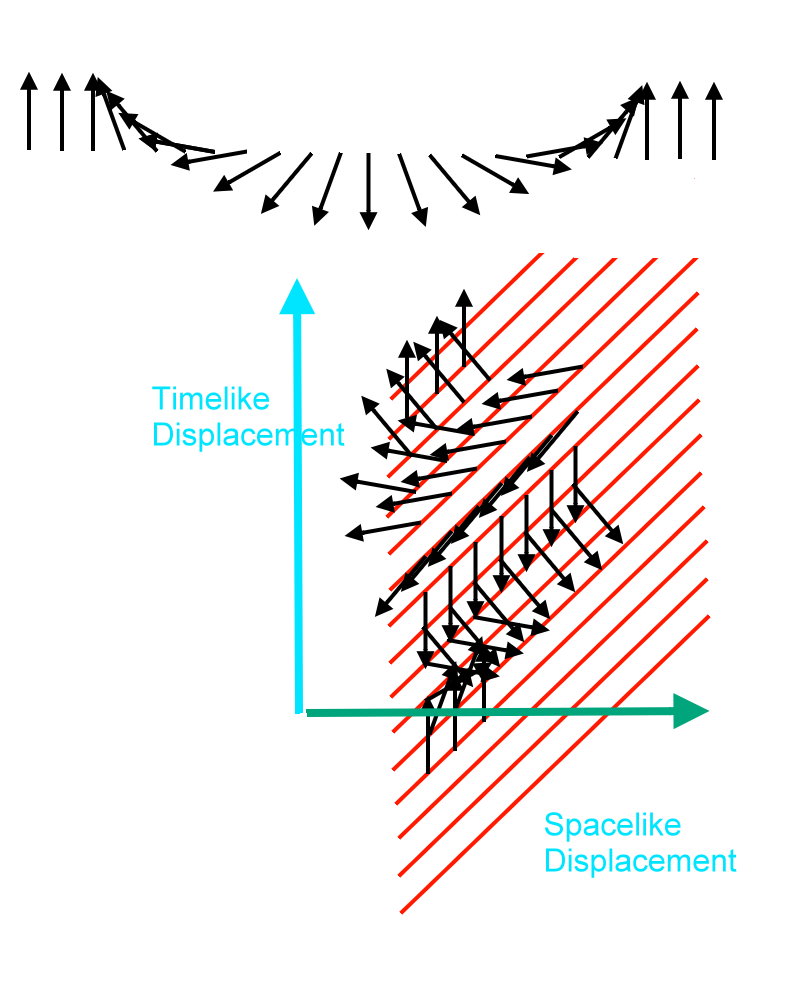
I thought for a while about this, and attempted to draw a Minkowski diagram (3D + T) representation of the twist.

Picture of field twist in Minkowski spacetime

This got really interesting really fast.  After a few mis-draws (my mind isn’t very well wired to view things in 4D), I realized that in Minkowski space, there is no twisting of the photon along the light cone path–in fact, in the one case of a twist moving at speed c, there is no acceleration at all–no forces needed to explain the twist structure!  Each light cone path has a twist angle that does not change over time, thus showing how twist width is conserved and thus how a photon holds its energy quantum without dissipation.  It’s hard to see, but I attempted a diagram–note that along the red light-cone paths, there is no change of the field angle.  A narrowing of the twist width either timewise or space wise would require a merging or deviation of angle paths not possible without some force source.

This should provide a basis for how to simulate the twists in a way that conserves energy.

Agemoz

String Solutions Search

March 12, 2012

The previous post outlines how twist solutions have to occur. In order for a twist solution to be stable, I discovered that width has to be preserved (this is logical since width of the twist is directly proportionate to energy) and that the twist has to move at speed c. This means that complex 3D structures can’t exist–only strings of twists. These apparently can be modelled by 1/r^3 – 1/r^2 solutions–I have two valid solutions, one of which is degenerate, so I’m going to hypothesize that there are more. I’m doing a deep dive to find out.

Agemoz

Why Static Twists Cannot Be Stable

March 11, 2012

Some really exciting results from my simulation results of the Twist hypothesis!  I have been simulating this for a while now, to recap:  The twist theory posits (among many other things) that underlying the photon elements of an electromagnetic field is a unitary twist field.  This unitary twist field is a direct (or mapped) result of the E=hv quantization of all particles.  Photons are linear twists of the unitary field, whereas massive particles are self-contained twists, such as a ring for electrons/positrons.  Quarks and other massive particles are posited to be other geometrical constructions.  If this model is studied, one very interesting result is the correct representation of the special relativity space and time Lorentz transforms, where linear twists travel at a maximum, but constant, speed in all frames of reference–but all self-contained structures such as the electron ring must obey time and spatial dilation.  The model correctly derives the beta dilation factor.

As a result of this work, I have put together a simulator to model the twist behavior in the hopes of verifying the existing corollaries to the twist theory, and also to see if more complex geometrical structures could be determined (say for quarks, although it is certain that the strong force would have to be accounted for somehow).

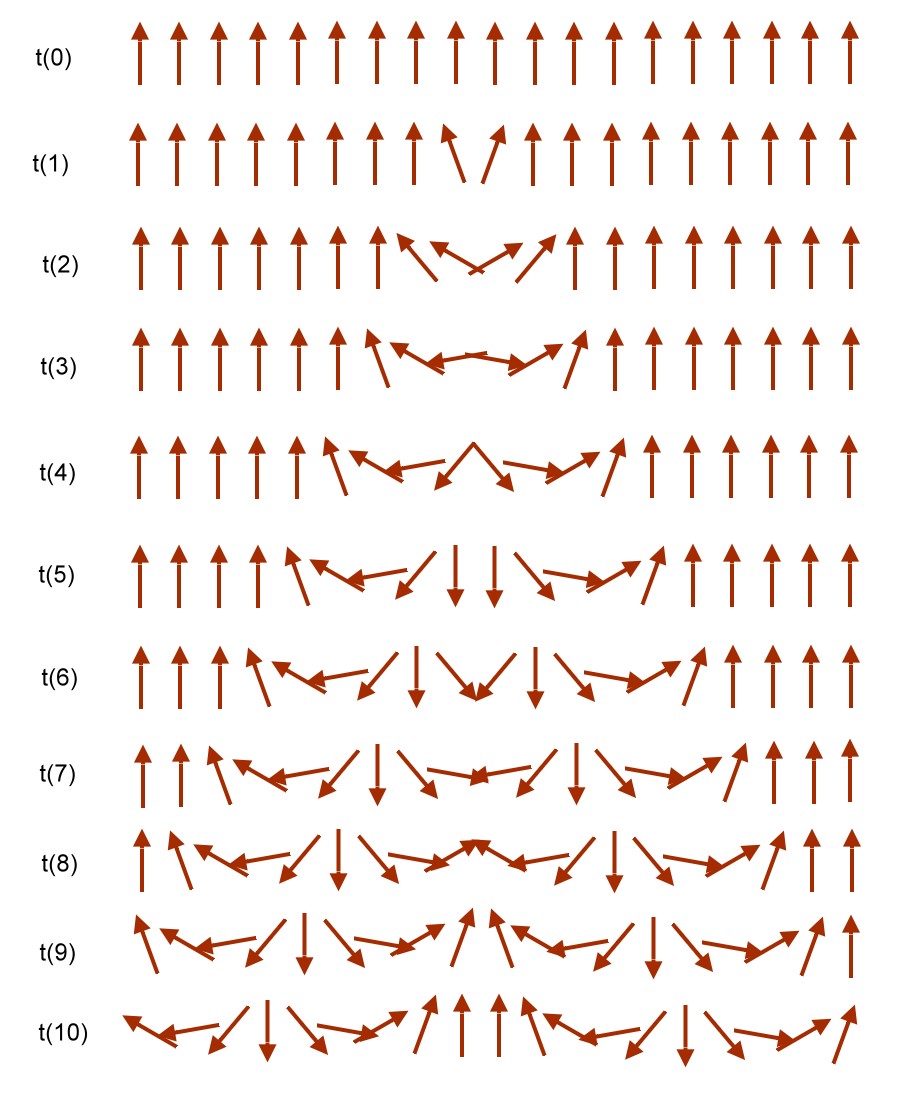
One of the results of the theory seemed to imply that a static linear twist should be possible, yet static photons do not exist in nature.  I’m very excited to have the simulator show its first demonstration of why this happens!  When I set up the simulator to do a static linear twist, I discovered (see previous posts) that the twist always self destructed by dissipation, and it took a lot of work to find out why.  This will be easiest to show with this diagram:

Why the static twist dissipates. Note the narrowing of the twist from the outside in.

The premise of the unitary twist theory is that E=hv particles can only be quantized geometrically in a continuous field system if particles exist in a localized background field direction have a fixed amplitude twist.  The fixed amplitude (different from an EM field that allows any magnitude) prevents the quantized entity from dissipating, and the background direction enforces quantization of the twist–partial twists (virtual particles) are not stable and fall back to the background direction, whereas full twists are topologically stable since the ends are tied down to the background direction such that the twist cannot unwind.  The frequency of the twist is determined by the twist width, shown in the diagram as omega.

Iteration of the linear twist in the simulation showed that, even though the unitary twist magnitude could not dissipate, the twist would vanish (see previous post pictures).  At first, I thought this was an artifact of the lattice form of the simulation, I represented a continuous twist with a stepwise model.  Further sims and analysis showed that the behavior was not a lattice effect (although it definitely interfered with the correct model behavior).  As this diagram shows, I was able to demonstrate that a static twist cannot exist, it is not stable.  What happens is that the twist width cannot be preserved over time because the ends experience normalizing forces to the background.  This process, demonstrated in the simulation, ultimately causes the particle to approach a delta function, at which point the simulation twist model gets a single lattice node and eliminates it.

It would be a valid statement to say that the sim does not correctly model what happens at that final stage, but there’s no question in my mind of the validity of the narrowing of the twist width.  There is only one way that the linear twist can be stable–if the light cones of each twist element are out of range of each other.  This can only happen if the twist elements are moving at speed c.

I was disappointed at first, I didn’t have a working model of the twist field.  But I didn’t see that the sim had handed me my first victory–the explanation of why there are no static photons.

Agemoz

Twist Discontinuity Sim Results

January 11, 2012

I came up with a pretty good mathematical structure for a twist with a discontinuity.  It essentially weights neighboring connections less for bigger steps between lattice elements, or in other words, it rewards continuity but doesn’t break on discontinuities.  After a number of rounds getting the model right and verifying, I got some pretty clear results–the static twist model dissipates.  The only way this twist can sustain itself is by moving at speed c, that’s my next step.  Here are some pictures:

Twist boundary initial state:

Initialize entire field, including boundary initial state

Here I fix the boundary state but let the rest of the field absorb the impact of the boundary initial state:

Fixed initial twist state, but field is released

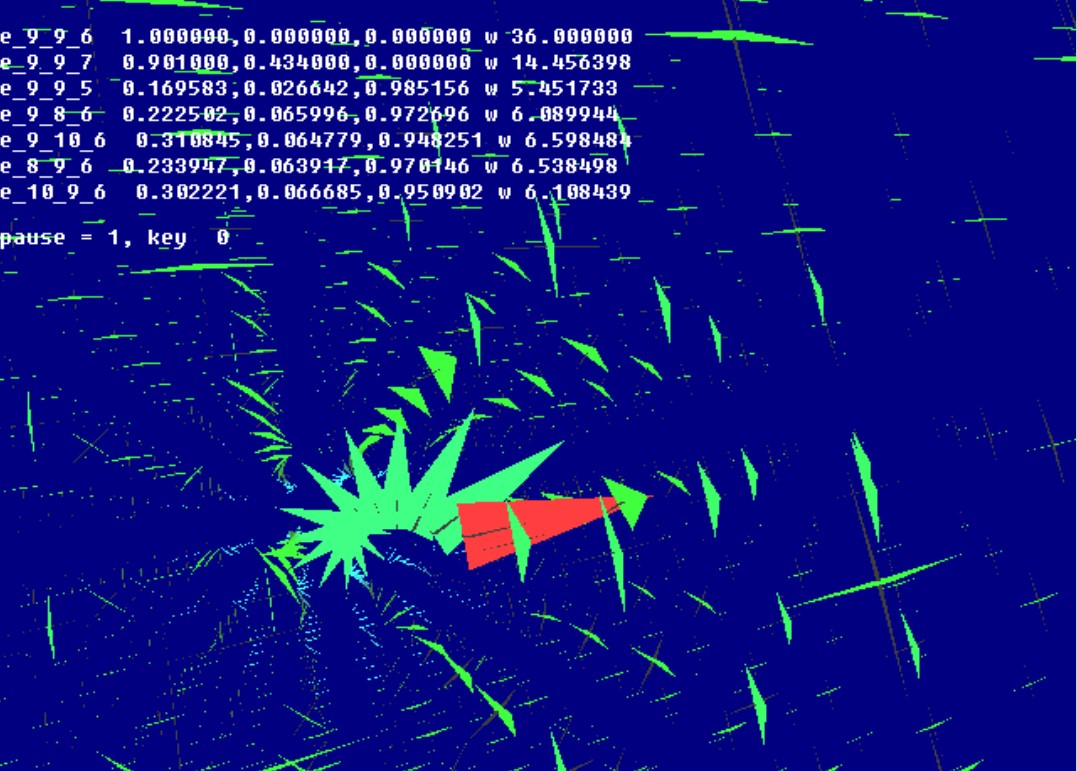
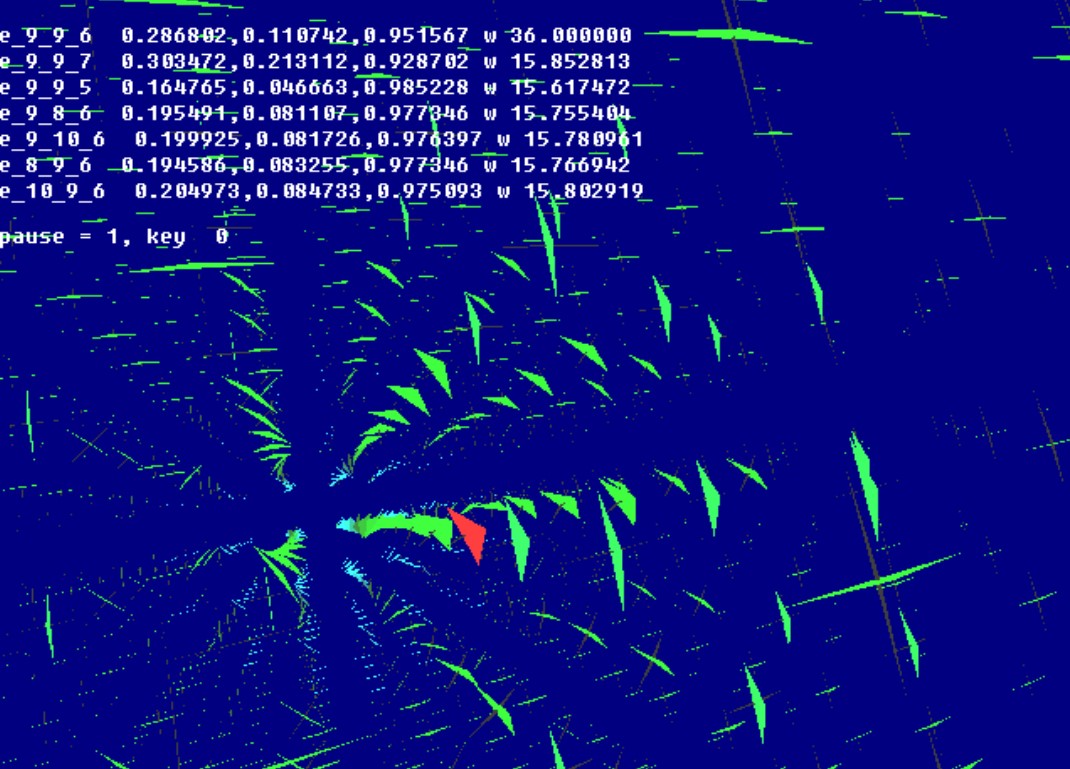
After a while, I see the field settling into a more or less stable state, so now I release the boundary initial state (the twist itself).  Here you can see how the twist dissipates into the axial dimension (I actually had proposed this as a means of getting into a twist without a discontinuity, but discovered that there is no possible way to do that.  This shows how the twist could emerge from a stable state with no discontinuities, but eventually there has to be a discontinuity.  I actually don’t see the discontinuity in this dissipated sim, but that’s going to be pretty hard to see in this 3D picture.  I’ll add some code that will show discontinuous regions overlaid onto this sim view.  Here are three pics showing how the twist dissipated.

Twist starting to dissipate, view along the twist axis

Twist starting to dissipate, view about 45 degrees off the twist axis

Twist starting to dissipate, view normal to the twist axis

So, it’s pretty clear–twist can’t work unless it’s moving along the axis at a speed such that nothing can get ahead of the twist, otherwise it will dissipate.  I’ll do another round of pics when I get that sim working.

Agemoz

Sim of twist with discontinuity

January 6, 2012

I’ve come to terms with the idea that if there’s any geometrical basis for particles and special relativity, the unitary field twist, with a discontinuity,  is the best such basis.  E=hv implies a 3D modulo construct, and a twist is really the only practical way to do this.  If you assume that every particle with mass is formed with a physically self contained twist loop, two fascinating results fall out.  First, the special relativity Lorentz transforms result–see what happens when you take a loop and move it at some significant fraction of the speed of light.  The beta factor sqrt(1- v^2/c^2)  is a direct result of uncoiling the rotating cylindrical twist loop–unrolling the cylinder will flatten out the loop into a right triangle hypotenuse, where one of the right triangle sides is the particle velocity v,the hypotenuse is the speed of light, and the third side is the loop radius, set in arbitrary units to 1.  For the time dilation results to work, I interpret the time to complete a single cycle as an intrinsic clock of the particle.  I’ve noted previously the other fascinating result, that a photon, represented by an unbounded twist (that is, one that moves in a straight line and thus is not confined to a region like a particle model) will always appear to have the same maximum speed regardless of the frame of reference (except for the degenerate case where the frame of reference exactly follows the path of the loop).   This can be seen by placing an unmoving, but rotating, loop in one frame of reference.  Now any other frame of reference, the loop will become a cylindrical spiral that obeys the beta relation apparent in the original frame of reference.  Doing the computation for the maximum speed of such a loop in the new frame of reference will show an asymptotic limit for the apparent speed of the loop relative to a clock in the original frame of reference.  Kind of hard to explain on this blog–you can try it out on some scratch paper.   The assumptions are that the loop cycle time, whether a flat loop or extended out into a “slinky toy” like spiral, is determined in either frame of reference by the time a rotation completes.  You will see that the apparent speed as measured by a clock in that frame of reference will always appear to be the speed that the loop cycles once in the stationary frame of reference (ie, the one moving with the particle).  I love this result because it says that if a particle is a loop, stretching it out due to being in a different frame of reference means that the measured transit time lengthens, but the apparent cycle time of the loop increases by the same amount (remember that the cycle time of a cylindrical spiral is the time to return to the same angle of rotation in the cylinder, but the slower the spiral turns due to increased particle speed, the slower the apparent time to that particle in a stationary frame of reference.  The net result is we can show that the apparent maximum speed of the particle is the same regardless of which frame of reference is used.

So there you are–a geometrical basis for twists to obey Lorentz transforms and a maximum speed.

As I mentioned, I’ve concluded that such a system of twists must have a field discontinuity to allow the twist to exist.  This has complicated my attempt to model (simulate) a field twist, but I think I figured out how to do it.  I’ll be working on this for a little while and will share the results.

Agemoz

PS, Some hater commented on my stuff here, laughing at it.  Yes, I know, there’s considerable hubris thinking that I’ve solved the mysteries of the universe when all the genius physicists have yet to do so.  Just so you know, I’m fully aware, I have done nothing worth anything, no amazing discoveries or such that is worthy of a paper to Journal of Physics.  Nothing here, move along.  I think I have some good ideas, but they are a dime a dozen until proven somehow with independent verification.  Maybe I will discover something with this latest simulation, or with some sort of experimental verification, or maybe even some more thinking–but right now I know I have nothing.  That’s OK–I have never pretended that I did, I’m just enjoying exploring ideas in a currently unknown area and thinking I’ve found some that seem to work.  This isn’t about seeking fame for discovering something amazing to all–this is just one person’s fun quest to guess at what might be the right way to interpret what we now see.

Twist discontinuity and Strings

December 15, 2011

As I’ve worked through figuring out what a mathematical description of a twist with a discontinuity would look like, I found several fascinating results.  First, I realized that the sheath surface surrounding the twist would have to be as thin as possible, a long tube of epsilon width–otherwise there would be paths outside of the twist that would get pushed aside, causing potential variations.  The lowest energy state for the twist with a sheath would have to be essentially one dimensional, tied down to the background state on either end.  Oh ho, I thought–this looks an awful lot like a string!

I’ve never been a fan of string theory–not because of the model that uses strings, but because string theory is associated with rolled up extra dimensions.  I’ve felt that adding rolled up dimensions, or any form of dimensional structure hidden within our three spatial dimensions, is a deus ex machina device to cram general relativity math into QFT.  In addition, I have the more subjective view that nature finds a way–if there were other dimensions, nature would fill it with vermin that evolved to take advantage of the space.  We would observe non-conservation of mass in the dimensions we can’t see in that case.  Of course, that is no proof, but it’s my instinct that if there really were something we would call a dimension orthogonal to our R3 space, our rules of conservation wouldn’t always hold.

So, the irony is that when I allow discontinuities into my twist field theory, I see that strings have to result or the theory can’t work.  This does several things–first, the problem of photon circular polarization becomes trivial.  Second, this matches the theory premise that twists have to have a tiny width, if any.  More of why this is so can be seen in my Paradoxes paper (rather old, and getting out of date as I’ve done further research–but the basic ideas still seem to work).

But where the string model gets *really* interesting is the realization that the twist enclosed with an infinitesimally thin sheath only has one path.

Quantum Field Theory works extraordinarily well, by that I mean that doing perturbative summations of multiple paths yields extremely accurate results confirmed by experiment.  So why is there no term for an electron interacting with an electron, or a photon interacting with a photon.  You thought that the infinities to be renormalized were bad before, wait till you throw those stinkers into the mix!   It’s because those two items consist of only one path.  That is why they have fixed particle parameters that don’t vary regardless of what is nearby–they are atomic, to use a rather ironic term.  An electron can interact with another electron only via photons, there is no way to some how break down an electron so it will interact directly with another–same with a photon.  There is only one path for each.  And this twist field string, with a sheath discontinuity, provides the reason why.

If it is right.

Agemoz

Rift in SpaceTime

December 13, 2011

I found a way to make the unitary twist field work when allowing discontinuities, although I’m not too sure I like it.  If the unitary field is such that continuity paths cannot be broken, but discontinuities do not exhibit any restoring force across the discontinuity, the twist tie-down at the ends can be achieved.  There is one thing to say for this approach–I actually like this better because no force is involved (which would have meant inventing another cosmic constant, a deus ex machina just to make my theory work).  But restricting continuity only on paths rather than volumes seems kind of arbitrary and unlikely in 3D+T…

This means that the sheath model of the twist would work–the twist path through the sheath is stable and holds the twist path, and the volume outside of the sheath is stable, and there are no potentials across the sheath.  How would such a twist form if all continuous paths must stay connected?   By complementary pair production.  If a pair of twists start as a point (maintaining patch connectivity, but some paths separate) and spread out in a line, the twists may or may not separate depending on the local field energies and directions–for example, a pair of photons or a particle/antiparticle pair.  Some pairs may complete, some may go part way and then recombine before completely separating, forming a momentary virtual particle pair.  Here’s a picture of the concept:

I’m not sure I really like this, but if we are going to allow a geometrical solution rather than the traditional quantum view, this one would work.  It limits the continuity requirement to paths rather than local neighborhoods–kind of problematic when working with a unitary field, but I suppose this concept is possible.  I’ll continue to work with the implications of such an approach.  One thing I see immediately–my previous conclusion using a continuous twist model was flawed–you cannot get circular polarization with the in-line twist.  With this sheath model, you can do the either in-line or orthogonal to both the background field and the in-line twist–or any linear combination of both.

A mathematical model for simulation is much harder when this kind of a discontinuity is allowed, because lattice simulations will result in improper artifacts on the discontinuity boundary that are dependent on the nature of the lattice cell.  In a continuous field simulation, the effects of the shape and iterative computations on the cell will have negligible effects on the overall simulation, but that is not the case when there are discontinuities.

Agemoz