Archive for the ‘Physics’ Category

Quantum Field Theory

January 9, 2011

OK, having thought this through, I still think this solution makes sense, although I realized that while the radial solution can’t give polarized photons, it still will be a legal field twist solution moving at c along the axis of the twist. Special relativity still says this rotation will have to occur in an infinitesimal neighborhood.

But as I chewed on this, I almost immediately had the obvious question–if this is true, then what is an electrostatic field? A magnetic field? How do these quantized twists combine to create our observed macroscopic behavior–especially, if both fields are just arrays of photons, what’s the difference? Any of you with a physics background will immediately answer, that’s well defined by quantum field theory, the math coming from Dirac and Klein-Gordon equation solutions. Fields are typically described as a system of quantum oscillators and the math works well, so how do I reconcile my thinking about twists with this stuff?

The biggest danger with running up against QFT is that I will be so totally wasting my time to try to add anything to it. Let me probe along this direction for a little while and see if something reasonable comes out or whether to take my thinking down another path.

A few thoughts I did have, ignoring QFT for a moment is that my recognition (that I just mentioned above) that there are two classes of special relativity field twists, both of which are wave twist solutions that are confined to an infinitesimal neighborhood in every frame of reference but its own. One class is the rotating bicycle wheel, which can orient in an R2 space about the axis of travel and thus gives us a model for polarized electrons. The second class is the axially rotating twist, which cannot give us any polarized solutions, and thus might be a model for the flux of a magnetic field. When I ask why some systems of photons give electrostatic fields and some give magnetic fields, and some give both, the twist solution seems like it might give an insight as to why. But QFT is the be-all and end-all that should answer this question, so I’m going to dig in and see if I can understand what it says about this question.

In a separate spate of thinking, going back to the infinitesimal twists that I worked out in the last post, I thought some about what is the photon level difference between an electrostatic field and a magnetic field. Ignoring my twist solution for a moment, I realized if we were to try to represent an electrostatic field by a point source with quantized photons streaming out from it, the strength of the field at any distance r is going to be proportionate to 1/r^2, just like the electrostatic field we know and love (the surface integral of the photon density on a sphere surrounding this point source should be constant, which means the photon density will vary inversely as the area of the sphere surface, which varies as r^2). The magnetic field flux density should obey a 1/r^3 rule because now the photon density from pole to pole of a point source will intercept a volume, not a surface. This 1/r^3 principle for twists was the founding principle of my discovery of the soliton twist ring solution described in my Paradoxes of a Point Source Electron paper. So–seems like while this is still a very primitive and early thought process, so far it seems to fit, and this thinking would be valid regardless of what you think a photon looks like.

OK, now let’s confront QFT. The first thought I have is this business about Virtual Photons and off-shell behavior. As I understand it, these are mathematical artifacts and do not represent actual physical behavior–the quantized field is an entity with system behavior that can be described by infinite interactions (ignoring self interaction of particles for the moment, which require renormalization techniques) of virtual photons. Kind of a goo that has quantized ripples in it that can’t be confined to infinitesimal twists.

Uhh, that’s not going to accommodate my twist theory at all, it looks like at this point. Let me try to get a better understanding of just what QFT is saying about electrostatic and magnetic fields before I decide where to take this thinking…

Agemoz
Turning Bicycle Wheel

January 2, 2011

Yup, that’s the image I have of the photon model of the unitary Maxwell’s field twist. There are four factors that determine why I think this is the correct image of the E field component. Physics textbooks show the photon wave as E and B sine waves orthogonal to each other on the axis of photon travel–but this cannot be the correct picture if all four factors are valid:

a: photons are circularly polarized about the direction of travel
b: photons are quantized as E=hv, which implies that for a given frequency there is only one possible energy. I claim this implies a unitary background field state because only in such a field is it possible to have a twist that is stable if and only if it completes one full twist before returning to the background state.
c: E=hv also implies that the E field component cannot go to zero, because then the E field component would have an additional degree of freedom that would allow the twist to dissipate. Once again, hopefully you can see why I think a unitary (directional only, fixed magnitude) field is required.
d: A static continuous field cannot support a twist without introducing a discontinuity. The only possible way to have a twist in a unitary E field is if the twist is moving at c such that it can have an unreachable region (light cone limit) outside of an epsilon neighborhood.

I realized that if the E field vector is turning in a circle such that the circle intersects the line of travel (hence the title of this post, the analogy of a bicycle wheel moving forward), that all requirements would be met. If arranged this way, the degree of freedom implied by the polarization of light is generated, and the E=hv constraint will be met–and since the twist axis is normal to the direction of travel, special relativity says that any observer (except for one in the frame of reference of the photon) must see the complete twist occur in an infinitesimal region–the bicycle wheel will turn into a line segment normal to the direction of travel. This line segment is not physical, it is just a pointer indicating the direction of the twist, so the complete neighborhood of the twist is infinitesimally small (perhaps the bicycle wheel hub is a better analogy for the twist, the spokes would be non-physical but indicate twist direction). To any outside observer, the direction of the unitary field is consistent–the twist is confined to an infinitely small region, where only a full twist is possible if the outer region is to remain consistent.

It could be argued that a background unitary field can’t be true or experiments would have picked this up–but another way to visualize my hypothesized field is by imagining one of those car seat mats that is an array of wooden balls–supposedly more comfortable for your back while driving. Imagine each ball painted white on one half, and black on the other half–and unlike a real mat, imagine that this array of balls is free to turn in any direction, but has a restoring force on neighborhood balls. The lowest energy state of all the balls is in one direction, but this direction can be anything. Now imagine a line of balls that twist such that the beginning and end point in the default direction. This model should help illustrate that there’s really nothing special about a default direction, yet should also show the special properties of a twist in such a field.

This is all well and good, but in the frame of reference of the photon, how is this going to work? The twist is going to have to be stable. Once again, special relativity may help us. The frequency of the twist will undergo a doppler effect such that in the frame of reference of the photon, the period is infinitely long, and the energy is zero–no particle.

One of the things I like about this picture of how things work is that the infinitesimal region (for any observer not in the frame of reference of the particle) will always orient itself such that the twist axis is normal to the direction of travel. It is easy to imagine the influence of the twist on neighboring field elements–the mechanism for the inducing of magnetic field elements (and vice versa) becomes evident as a percentage propagation of the twist (ie, the twist will induce neighboring field elements to bend a bit about the axis of the twist). This has major significance because this would alter the default field direction. And that would then do something really interesting–if another twist started in one field direction but ended up finishing the twist in another field direction, the direction of travel would change (because slightly less that a full twist would be required to reach the default field direction. This would provide the mechanism for the twist ring model of the electron–and as a second order effect, even show a way for general relativity (gravity) to work.

The other thing I really like about this model is what it says about the B field. It’s always been an interesting question in my mind why an E field morphs into a B field and vice versa by doing nothing more than changing the velocity of one’s frame of reference. Note that in this model, the B field is simply an E field vector that is moving in the direction of the E field vector. In the physics textbooks we see photon B field vectors orthogonal to both the E field wave and to the photon direction of travel–but I wonder if the reality of a B field is better shown as an E field vector in the direction of photon travel (so that the bicycle wheel can lie on the axis of travel–when the orienting spoke is pointing normal to the axis, it is an E field, when pointing parallel to the axis, it is a B field. This makes so much sense when you think of how the E field transforms to a B field just by adding velocity to the observers frame of reference.

Yow! That was a long post! That’s enough for now, but hopefully you can see how fascinating this line of thinking has been for me!

Agemoz

Special Relativity to the Rescue!

December 29, 2010

Well. A lot of work on the simulator and a whole lot more thinking, and I began to realize that within the constraints I had set, there is no solution. I thought I’d come up with a workable field solution that had no field discontinuities, and I was wrong. After more thinking, I realized that a unitary Maxwell’s field will never produce a stable solution–unless the twist is moving at the speed of light. This is a good thing, because if I had found a solution, I would then have to answer why single, non-moving twists in real EM field never occur. I have taken the long way around showing myself that even if a Maxwell’s field is unitary (thus giving us the required E=hv quantization), it cannot hold a twist in a non-relativistic situation. I had had a hunch for a while that since photons always move at c, I would have to include velocity in my search for a solution.

A few posts ago, I said something about a solution cannot rely on special relativity because different frames of reference will produce variations in the twist solution–but actually, after thinking it through, this will work, I think. The observed circular polarization of light means that the twist has two dimensions to work with–this, combined with the realization that a discontinuity can be avoided if the twist is moving at c (the wave front of the twist moves in such a way that no stable discontinuity will form), made me realize several things all at once. First, the twist must occur such that its axis is normal to the direction of movement, that is, the direction arrow of movement lies on a diameter line of the circle. Second, and this was a breakthrough realization–any object moving at c, according to special relativity, will have its axial dimension of components in the object reduced to zero in all frames of reference except that of the object itself. Oh ho, I thought!! I have constrained the field to be unitary, but when the twist moves at relativistic speed, the E field vector spins around and diminishes in magnitude–to the point where it goes to zero! The danger, of course, is thinking that our drawing of a vector arrow has a physical constituent–it doesn’t, it’s just a pointer for the direction of the twist within an epsilon neighborhood–but it’s not the vector that effectively disappears, it’s the spacetime dimension of the object. In every observers frame of reference except its own, the E field component in the direction of travel varies as the twist circles about its axis.

How does that help us avoid the discontinuity! Oh boy, I see it now–special relativity requires that the twist be confined to an infinitesimal neighborhood along the direction of travel. It is the only possible solution where a discontinuity cannot have a finite length. Zero times Infinity, we’ve been here before (see my posts on “something from nothing” quite a ways back). The background field direction is preserved–we get our E=hv quantization and a solution without a (finite) discontinuity. The astonishing thing about this is how it points to how the concepts of distance, time, and energy could emerge from a nascent universe–this infinitesimal space holds varying speeds of rotation. It also begins to answer the question of how to reconcile the unitary E field universe (required for E=hv quantization) with the observed non-unitary E fields we see in real life. A whole bunch of interesting insights seem to arise from this model.

More details to come, but it’s time to update the simulator for relativistic solutions. This could be a challenge…

Agemoz

Just What Is a Twist, Anyway

December 16, 2010

The simulation work has opened up a goldmine of thinking about the unitary EM field twist. So much has come out of it that I can’t really do it justice here, but I’ll summarize some of what has happened.

First. Any solution that includes a discontinuity seems to be unworkable–I currently see no way to define an infinitely continuous unitary vector field that has discontinuities, the two concepts do not appear to intersect. Not as obvious as it might first sound (continuous fields actually can have discontinuities, but not if the field is always unitary).

Second. Any solution that has no discontinuity and acts only on neighborhood field elements dissipates and thus cannot provide a particle twist solution.

Third. Photons are circularly polarized, which rules out an about axis solution. A 3D vector field solution would have to have an in-axis component (the pictures in previous posts show an about axis solution, but this cannot produce circular polarization). There are several more related questions here that are still getting attention.

Fourth. Twist solutions in a background appear to be the only possible way that E=hv quantization can occur for any of the three Standard Model forces. This really is the foundation of the Twist Ring methodology and this current work and thinking substantiates it. In the final analysis, some variation of this conclusion is going to have to hold true.

Fifth and probably most important. The constraints that solutions cannot have (1) a discontinuity (be analytic) and (2) not dissipate imply that the force(s) on field elements cannot be confined to an epsilon neighborhood. There has to be a background force– E=hv quantization already implies a background state in complex vector space, but this conclusion also says that there must be a background force as well.

6. The requirement that the unitary EM field elements be complex is a bit of a red herring, I think. E and B field components are interchangeable depending on the frame of reference. I currently think that taking advantage of the imaginary component to form a solution (for example, by creating a point where the neighborhood force would not apply) is erroneous because it will only work in a specific frame of reference.

7. Any of these schemes need to keep entangled particle properties in mind. I think I see a way, I alluded to this many posts ago when I claimed entanglement requires that group waves are limited by the speed of light but that phase information is not so limited.

I actually did find a geometrical solution that meets the fifth rule, but haven’t put it in the simulator yet.

Not sure if I’ll have more to post before the Christmas season, so if not, best wishes and thanks to my readers for a joyous, peaceful, and meaningful holiday.

Agemoz

First Results

December 6, 2010

Wow. This simulator is an amazing tool. I have discovered that I made a mistake in how I created the field, but in the process have learned a truth, I think. I’ll express it as a theorem because I haven’t thought it through yet or how I can prove it, it’s just at the “that makes sense” stage. It is this. If the unitary Maxwell’s field approach and my sim interpretation are correct, then a particle must have a field discontinuity.

Yow. So much for my clever 3D solution, because what I think I found is if there is no discontinuity, then there is always a path where the particle will dissipate–even a twist in a unitary field.

That would be a seismic change in my thinking. The generalization would be that there is NO geometric field solution that is stable if there is no discontinuity. I’m not yet sure if I believe that–it seems that if a twist in a field is not topologically equivalent to a constant field, then the topological type would be stable (a twist cannot dissipate into a constant field unless it is topologically equivalent). So what is the answer? Is the twist topologically equivalent, or did I make a mistake in how I handle the field sim?

I suspect I made a mistake in the sim and the twist is illegally creating a discontinuity that causes dissipation–or, actually what is more likely, the way I set up the field is wrong is causing dissipation. I already know that is true, and should have that fixed shortly. But, the sim also makes no attempt to correctly handle or prevent creation of a discontinuity (I had assumed I wouldn’t be dealing with them according to my theory). So, now I’m building in the mechanics in the sim to handle a field discontinuity, and also checking how the sim handles the twist topologically.

Agemoz

Where Am I??

November 25, 2010

If you’ve been following me here (thank you!) you may wonder if (or hope that, depending on your opinion of my views:) I’ve disappeared. Nope. But the trouble with blathering on a blog is that the time I spend writing does not produce data, and my twist ring idea needs substantiation. I’m deep in the process of creating a correctly working unitary Maxwell field sim that should demonstrate some of what I’ve been blabbing about, or disprove it. I’ve recently obtained a bigger, faster, more memory machine to do this work, and I’ve successfully rewritten the sim to be fully threaded (so in theory I can take advantage of up to 12 processing streams at once). The sim itself is running but I’ve got some bugs in displaying the results, I’m working on that right now. Once I get the sim more or less functioning, I will rewrite to use the SIMD instruction set, this should run around 50 times as fast as I have right now. Yes, you could make an argument that an analytic methodology would be a better way to prove/disprove what I’m thinking–but I like the visual approach, because even if I’m wrong, visualizing the geometry can sometimes guide me to a correct solution.

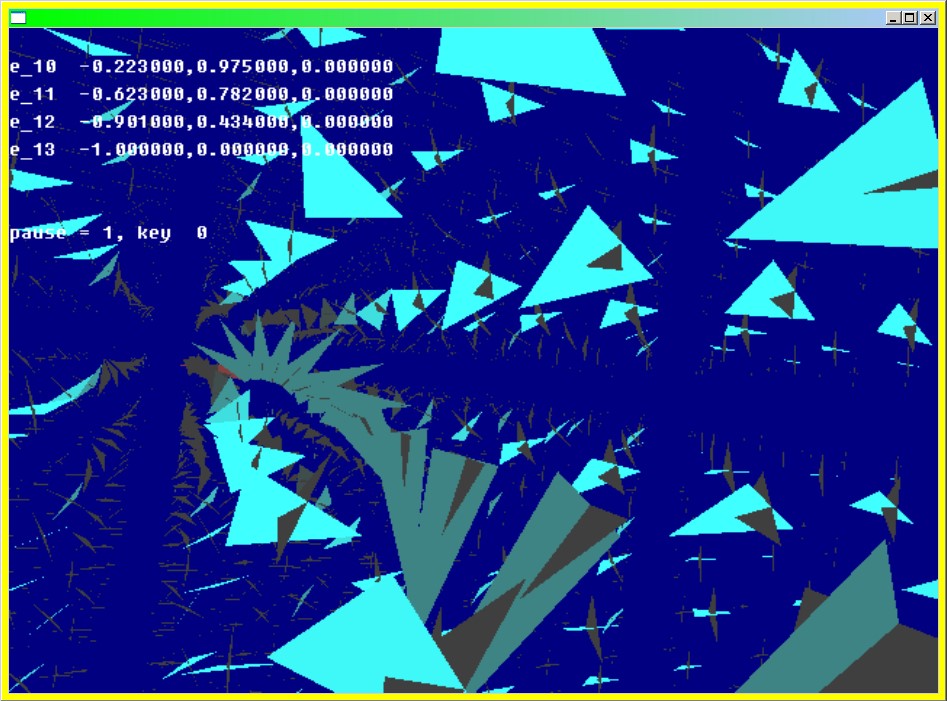
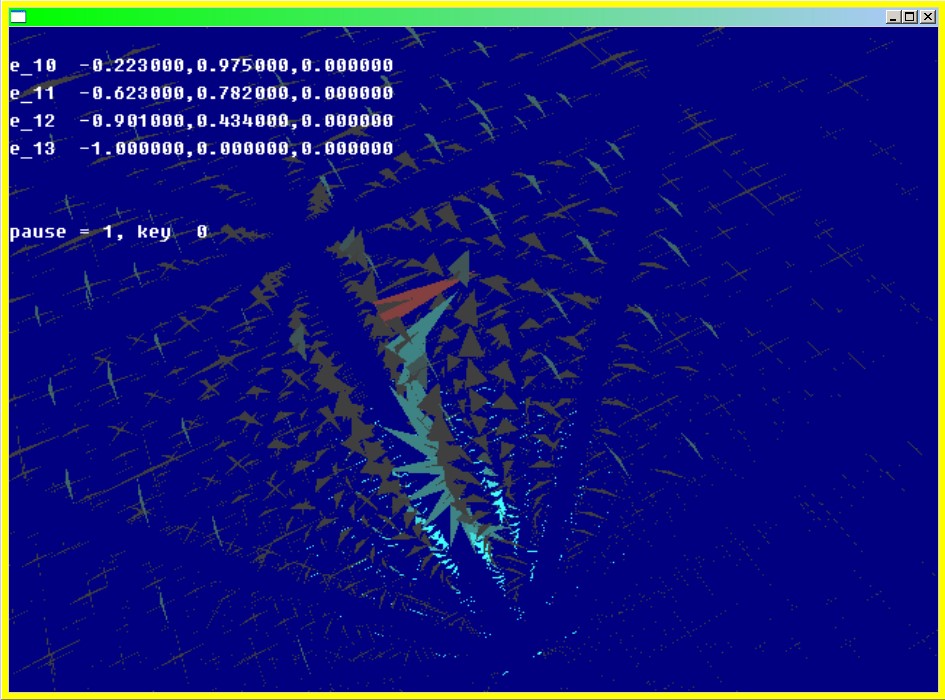
Stay tuned–pretty close to having some initial results. Here’s some pics before the twist is released:

Agemoz

Twist Ring and Standard Model

September 18, 2010

Just to reassure those (if any) with a physics background, this work I’m doing on twist rings isn’t some crackpot attempt to replace the Standard Model. It may be a crackpot attempt, but it’s not *that* particular crackpot attempt. The Standard Model describes the particles that have to exist in order that the three known forces (other than gravity, which isn’t included in the Standard Model) can work within R3 + T and still remain invariant to translation and rotation in any frame of reference obeying the Lorentz transforms. I believe that this requirement is another way saying that our existence within these forces are constrained by gauge symmetries, which when defined mathematically imply the existence of (among other things) energy exchange particles such as photons. My work is nothing more than to hypothesize an underlying field construction for one of those forces (EM) that has stable states. This field construction is a unitary version of Maxwell’s field and can be shown to allow stable states such as a linear twist and a circularly connected twist. Further computations show that there is a real life connection to photons and electrons/positrons–the stable states will obey E=hv and can result in twist ring solitons with only one possible mass–the measured mass of an electron. They also can be shown to exhibit time and spatial distortion matching the Lorentz transforms.

This results solely from considering the unitary Maxwell field–when the other two forces (strong, weak) are brought into play, I’m guessing that I would find other stable states that would have masses of quarks, etc. However, note that I’m careful not to try to disprove anything in the Standard Model, that would get me nowhere. The Standard Model declares that there will be both exchange and stable particles, but empirically adds them to the model to make the gauge symmetry math work out (for example, the particle components of Maxwell’s equations). I am adding a hypothesis about the underlying field that would unify the EM field and particle existence such that the symmetries will still exist–sort of a “why” there are the symmetries, particles, and Lorentz transforms.

I had thought we might get quarks solely from doing some unitary field for the strong force (note that as I mentioned, a unitary field seems to be a very elegant way of getting the E=hv quantization, regardless of which forces are involved)–but I’m pretty sure that the EM force also must be added in, otherwise I don’t see how we would get charge, and in particular charge that is exactly 1/3 (or 2/3) of the electron. I’m doing simulation work on the electron case, but my thinking is looking for stable states when the strong force is brought in for quarks. I’m betting that my simulations will show a 1/3 charge case when the strong force is brought in–wouldn’t it be cool if a quark mass value results!

However, I have realized that the unitary field model does not explain something that is critically important–entangled particles. Something is wrong here–entangled particles remain entangled even when a hypothetical “plank” is delivered between them. Entangled particles must have some type of connection in order to resolve uniquely to opposite states (for the case of the two state entangled pair). But I see no way that the unitary field could support this mechanism. This is a problem that has to be worked through. There’s an awful lot going for the unitary field–it is the cleanest way I can think of how a field could exhibit E=hv quantization–and I can even envision the physical mechanism for a unitary field, and also see an elegant connection to the infinite array of quantum oscillators (what is called Fock space). But entangled particles doesn’t seem to evolve in any way I can think of from this unitary field construction. This is getting a lot of my attention right now.

Agemoz

A Possible Analytic Solution?

August 22, 2010

Back from a nice photography trip–somewhat strenuous hiking, but it gave me a chance to figure out a possible Twist Ring solution. I’ve been working on simulation work in an effort to work out the math for the unitary field twist, but the sim was not behaving as expected. Just before I left on the trip, I had a pretty good idea why, but I was able to transform the twist solution to phase space (U2) and from there was able to show that the twist ring that is symmetric axially could not be a valid solution–there would always be a an epsilon region with a phase discontinuity. This helped me visualize that the solution had to be axially dependent–a phase discontinuity simply was not acceptable because then I no longer have a unitary field.
But that really complicates the search for a solution, because if I permit each field vector two degrees of freedom, I am working in SU3 (representing a complex vector field in R3 where each vector is unit magnitude). However, after some thought, I thought of a way to think about it that eventually led to a very exciting solution. The original Twist Ring theory as described in my Paradoxes of the Point Source Electron paper describes the work where I found a unique soliton solution for photons and electrons based on a unitary field twist. However, I did not describe it analytically (mathematically) because I hadn’t yet found it.
I had originally proposed that twists reside in a unitary vector field version of an EM field because quantized particles behaving as E=hv imply a missing degree of freedom, which I hypothesized would be a EM field with constant magnitude. This looked very promising because this provides the appropriate quantization at a given energy without constraining valid frequencies (hence energy) of independent particles. And, it preserved the ability to twist, thus permitting the wonderful results described in the Paradox paper.
Up to now, however, I hadn’t been able to describe the twist without having the solution melt away in time or without a field discontinuity. I tried a variety of twist solutions before finally proving that I could not do it in the simple form in U2 (projected variance along the axis of the twist). I then realized that a solution would have to map onto SU3 with the real and imaginary parts representing the unitary vector angles in polar form. Unable to visualize this much more complex solution, I had a great Aha! moment, and thought, what if I just ignore the region between the twist and the rest of the field? I’ll put a 2Pi twist in the field and surround it with the default field (the field outside the particle, which in our little test case points always to a default direction), separated by a sheath which I just say “I don’t know what’s in there”. But–after thinking for a while, all of a sudden I figured out what could be in there! The twist contains vectors that lie in the radial plane, and so does the default field vectors–but in S3, we have one more degree of freedom, vectors that point tangent to the axis of the twist. All I have to do is make sure that the sheath separating the twist from the default field contains these tangent vectors, and I will have a solution which has no discontinuities, yet can’t melt away without introducing an (impossible) discontinuity. The reason this works when Maxwell field solutions cannot is because the SU3 field is unitary (to enforce quantization) and cannot have field vectors go to zero.
What’s even better–I know there are more twist solutions possible. I’ve found two–the straight line twist (photons) and the ring twist (electrons and positrons, both spin up and spin down). But I can geometrically visualize other twist solutions, which hopefully will yield other particle solutions.

Stay tuned, this is an incredibly exciting result! First I have to confirm it with some analytic and sim work (the sheath is almost certainly not going to confine itself to a cylinder around the twist but will probably mold itself somehow onto the twist). I need to verify that the twist will preserve itself, that there is no way it can dissolve analytically, that is, without requiring a phase discontinuity. Then I need to work out a sim that shows how two twists can form in a field without introducing a phase discontinuity. This is necessary because otherwise spontaneous pair production of particles would be impossible.

Agemoz

Simulation Work underway

May 7, 2010

OK, getting the unitary field simulation underway–this is a really great way to visualize the potential of this approach–and a nice guide for checking my twist ring stuff. So far I don’t see a showstopper but I did have to resolve some issues. For example, if the field is unitary, then how come remote charges sense electric fields that are stronger or weaker–that is, how can you get a unitary field to represent potentials caused by a large number of charges? The devil is in the details that kills every crackpot physics idea, and this one has been nagging me. Two possibilities I see right now, either quantum particles only cause local unitary field variations, or there’s some complex interaction/vector arrangement that, Fourier-like, induces the effect of high potential by the frequency of vector changes. I don’t buy the first because to quantize a particle with precise limits imposed by E=hv, there cannot be a degree of freedom in the field magnitude. I kind of dont like the second option either but will go down this road for now.

One thing the simulation does show is the need for a background state–since the field is unitary, it cannot go to zero, but vector differences in the field are not permissible because this would create localized electric potentials. It’s possible this field is random (and might explain quantum jitter behind things such as brownian motion) but I have trouble with that because at some scale there is going to be work done (a perpetual motion engine). For now, I am assuming a localized unidirectional background and see what the sim does when that is disturbed with a twist.

I did my first run of that today.. and the twist promptly disappeared into the background. Oops, something is not right with my implementation, have to try some sanity checks. I kind of have a hunch the right answer will be random background…

Agemoz

The Unitary Field

April 28, 2010

The proposed complex vector field for the twist ring theory is continuous and unitary. It exists in R3 (while there’s a lot of talk of 10/11 dimensional solutions to satisfy relativity, I suspect that existence really is R3 but that the mass energy tensor just bends this R3 in all sorts of complex ways, we wont stop at 10 because third order effects will bend even that dimensional foundation. I don’t buy the rolled up dimension stuff at this point)..

There are several crucial questions about the viability of this vector field as a foundation for EM fields. The quantum nature of photons and particles shows up for two reasons: the hypothesized unitary magnitude of the field and the connection between the real and complex parts of this unitary field.

As mentioned, the twist of the field cannot induce a magnitude change by definition, so the first crucial question is how does the unitary field show an apparent variation of the B field inducing the E field in observation of an EM field (note that I am hypothesizing that the unitary field is the underlying structure for an EM field that adds the quantum characteristic).

The twist ring theory uses the unitary field to explain why we get stable quantized photons and electrons. For example, the photon is hypothesized to be a single full twist of the unitary field–a knot with a discontinuity that cannot disperse because the field magnitude is fixed at one. But why does the photon disperse at either end of the twist? Quantum theory analysis proposes that the photon has something approximating a Gaussian distribution of energy along the axis–how can the unitary field produce something that asymptotically goes to zero on the photon axis?

There’s a bunch more questions like these, but let’s stop here for now.

I’ll shortly post about what I think my answers are, and these will guide my construction (actually, reconstruction) of my unitary field simulation.

Agemoz