Archive for the ‘Physics’ Category

Back to Thinking

April 28, 2010

Well, I finished the programming contest, but didnt win anything or have anything to show for all that effort. Blecch. I wont do that again, that was a fairly significant waste of my spare time.

But now I’m ready to get back to my physics thinking work. I’d left off with my Paradoxes of the Point Source Electron at scribd, which describes the known issues with a point source electron and how a field twist ring model of the electron would address those issues. About 6 months ago, I began an attempt to more rigorously define just what a field twist ring is. The twist ring combined with the quantized E field of a photon led me to believe that the twist ring is a unitary complex vector field in R3 + T, unlike Maxwell’s EM field which is not unitary. The premise is that the unitarity is necessary to create the quantum behavior of particles while still being valid solutions of Maxwell’s equations.

To try to get some insight as to what kinds of behavior would result from a unitary field that obeys Maxwell’s field equations, I did some simple Mathematica analysis, but quickly discovered that I needed more detail to simplify the solution space, so I attempted an iterative solution, first in Mathematica, then as memory became an issue, moved to a C program to model this unitary field.

As mentioned a while ago here, sometimes you can find flaws in your thinking just in the process of attempting to create the sim, and I found an important one–if Maxwell’s field equations embody the conversion of twist to amplitude and vice versa, a unitary field will not work–it can only twist but cannot change amplitude. It was this discovery that made me realize that while the Paradox paper appears to make a good case for a twist ring, I need to augur in and specify exactly how this is going to work. I have to specify mathematically what the behavior and structure of the unitary field is, and I need to show, or at least provide a reasonable hypothesis, as to how this field will produce the macroscopic EM effects shown by Maxwell’s equations. In addition, I have to show that this field will produce a propagating photon and a stable twist ring.

I’ve already done some of this thinking and will detail where I am in my next post.

Agemoz
Field discontinuities

December 9, 2009

The math behind the twist ring is getting nasty–and now I think I understand why physicists dont go down this road. A Maxwell’s field solution is well known to be analytic (no discontinuities) and cannot permit any solution that has a discontinuity, and also is well known for degrees of freedom that allow any concentration of field energy to dissipate. Obviously, the quantum nature of photons and other particles doesn’t allow dissipation, and the twist ring approach has been my attempt to geometrically model a field system where this quantum behavior results. I do this by asserting that the twist ring approach requires a unitary field solution for quantization of twists to work. The observed macro behavior of electrostatic fields with magnitude (non unitary) is hypothesized to result from masses of (unitary field) photons–that is, I am asserting that the underlying behavior of normal electrostatic/magnetic fields, which is clearly non-unitary, results from the quantized behavior of a unitary field. The whole twist ring concept is based on this idea, since a twist in a normal electrostatic field clearly has degrees of freedom where it could dissipate–even a quantized photon cannot be represented in a Maxwell’s field.

However, if a unitary field cannot sustain a field twist, all is lost here and the twist ring approach would have to be abandoned. My recent work has demonstrated the likelihood that a full field twist (as opposed to a partial twist that returns the field back the way it came in a propagating photon model) requires that there is some region of the field that will have an epsilon neighborhood, arbitrarily small, where field vectors are not analytic or continuous. However, the unitary field requirement is very interesting because unitarity may sustain a twist where the discontinuity is forced to be distributed and a pole of infinite potential would not be formed.

No answers yet, but certainly clarification of what won’t work (true EM field). My other work especially with twist rings shows that unitary fields has the right degree of freedom to make quantization, special relativity, and electron states possible. But–a precise mathmatical model runs into trouble with the apparent need for a field discontinuity for twists. Don’t know where this is heading yet…

Agemoz

The nature of the field

December 6, 2009

I’ve attempted my first “photon” in the simulation, but am not getting propagation yet, probably because the parameters are not properly set up. I converted the field type to normalized and modified how information is displayed so that permutations of a unitary field can be more readily seen. It occurred to me that the fact that there is no propagation yet means that the simulator is working right–right now the field appears to be dissipating rather than propagating, which one would expect if the twist were not of the correct frequency and initial velocity.

This did get me thinking whether it can be shown that a unitary field can’t be right. If there is a photon in the presence of other photons, are there sufficient degrees of freedom available to represent the total system? In the presence of a strong E or M field? The problem is, though, if we take away the unitary requirement, then there is danger that quantization can be lost since photon E/M twist fields now have an extra degree of freedom (field magnitude). I realized that Maxwell’s equations can be slightly simplified if we assume unitary fields–and I also realized the quantum mechanics representation using multiple oscillators suggests unitary fields.

I did some additional thinking on this and think that unitary fields could work–for example, a high-voltage potential source could emit continuous streams of photons in the form of unitary field twists. Photons intersecting each other would have linear combinations of twist angles, not necessarily summing of EM field magnitudes. If such an approach using unitary fields doesnt work, there’s a very serious problem if magnitudes are allowed–this would provide a mechanism for quantum particles to dissipate.

But the most important reason that fields must be unitary: A twist cannot dissipate in a unitary field!! Unitary magnitude topologically means that there is one structure, and one structure alone, that cannot dissipate–the twist–without causing a field discontinuity. This is profoundly important because it provides the mechanism for quantum quantization. Up to now, there has been no geometrical explanation for quantum oscillators or the e = hv quantization.

I’ll keep cranking on this until an answer shows up.

Agemoz

Back: working on the twist field simulator

November 29, 2009

Well. It’s been a while since I’ve posted here, mostly because creating the scribd paper, and refinining it several times, diverted my efforts from this blog. Now the paper is done, and I am now doing the EM twist simulation in an effort to see if I can prove that the twist ring conforms to field Maxwell’s equations. I’m going to also try some Mathematica work to see if some simple analytic solutions for photon twist cases are possible.

Because this effort still is taking much of my thinking time, I don’t know how regularly I will post here. The big question isn’t answerable by my usual thinking processes, and this really is the big question that will decide which way my thinking goes. So–I’ll try to post occasional updates here, but my goal for the coming year is in that analysis. Right now, the simulator is up and running and looks like its working right, so soon I will put in a photon twist model and see if it will propagate correctly.

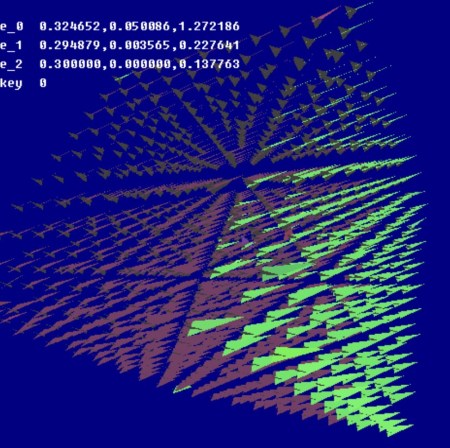
Here’s the latest output that is time delayed after an initial condition consisting of a largely empty field with a fixed 3×3 array of x directed E field components:

The cool thing about going away from generic thinking that I have been doing to an actual proof of a concept is that it force your thinking down channels or constraints that aren’t necessarily visible when just thinking. For example–this initial demonstration showed how magnitudes rapidly get out of control and illustrated that my hypothesis that the quantum EM field is a unitary field probably has to be true. I will rework the simulator to enforce this constraint. This requirement is mathematically equivalant to stating that accelerations are always perpendicular to the field element direction (velocity must be normal to the field element direction). Results to come in a few days. After that, if that looks good, I will create an initial condition that contains a linear twist and see if it self-propagates. If it does, I am probably on the way to showing that twist rings are a valid solution to Maxwell’s equations (it appears to be impossibly difficult to derive this analytically from differential equations) and that twist rings would be a sufficiently valid solution to represent our reality.

New version of the Twist Ring paper

August 31, 2009

I updated my Twist Ring paper at the scribd site:

http://www.scribd.com/doc/17227411/The-Paradoxes-of-the-Electron-Point-Source

This adds some specific analysis of the Heisenberg uncertainty paradox, and discusses the class of experiments that I call excitation experiments (using photons to add energy to a particle). This was important because this is commonly used in determining internal structure of particles but was missing from my paper. I also added a “future research” section which describes my work on creating a computer simulation of the twist ring.

Check it out and send me comments!

Agemoz

Susskind’s book

August 21, 2009

An honest writer on the subject of physics has to continuously check that what he writes or proposes is in line at least somewhat reasonably with the latest progress in physics. This behooves a responsibility to read and study as much as possible, even doing homework of various sorts. I picked up a very well written book by Leonard Susskind called The Black Hole War, where Susskind describes his efforts to persuade Stephen Hawking that Hawking’s claim that black hole evaporation causes a different entropy level (information is lost) is wrong. The cool thing about well written physics books for laymen is that if the physicist is at the leading edge, a lot of time he spends time not only on the subject at hand, but also talks a lot about supporting physics, which can give amateur physicists a lot of well summarized information (sans mathematics) of the latest physics thinking. Susskind’s book is one of the very best books I’ve seen in this regard, and his ability to write and explain clearly is on a par with Feynman.

The only trouble with this approach is sometimes you read something that contradicts your own pet theories, so the mark of the physics crackpot is to either not read or disregard what he has read. I’m trying hard not to be a crackpot, so I have very carefully read this very well crafted book with an eye out for why physicists have not gone down the road of twist rings (you know for certain that some large number of physicists have to have already considered this at some point, and I wonder why they chose not to pursue such a promising approach).

One thing among many that I didn’t know–he says two important thoughts about the point source electron (which my paper and the twist ring attempt to show as wrong). He said that while experimental scattering results show the infinitesimal cross section, all physicists actually believe that there will be electron structure at the Planck length scale (far tinier than what I propose). He also said that when they concluded point sources for the electron, it was because it wasn’t possible to add rotational energy to the electron (I had said in my paper that they determined that the electron was a point source because of scattering angles and momentum tracks, but Susskind is saying it is because the angular momentum of the electron cannot be increased, thus implying no interconnection energies can be added, thus implying there are no interconnections).

So far, nothing I’ve read seems to directly contradict my pet theory of twist rings, since there’s no possible way to add interconnect energy or other angular momentum elements to the twist ring (it is a soliton and does not have more than one stable energy state). My arguments against the point source are not discussed in this book–and nothing he writes about the Planck scale electron addresses or solves any of these arguments–so, so far, I’m not going to abandon the twist ring approach.

It’s tough to be conscientous and just want the truth when you’ve invested a lot of thought and think you might have a valid theory!! I am almost done with this book, at least for a first reading, and will see if anything else might show up that blows away twist rings…

Agemoz

PS: I read the wonderful description of the black hole entropy issue in Susskind’s book, but hated the reference to “information loss” in black holes. Physicists came up with a lousy word for entropy issues: “information” or “information loss”. I’ve always been confused by “information” and now understand what is really meant, number of unique states permitted with a particular system. Entropy is the log of that, and thus could be considered the quantity of basis states that covers the set of possible states. “Information” is an imprecise word for that, in my humble opinion…

Maxwell’s engine is running!

August 17, 2009

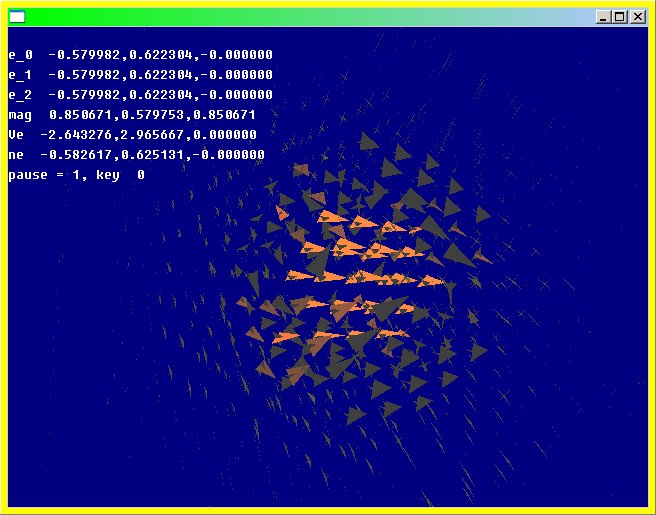
It’s pretty cool–I’m still in the debugging phase, but I now have it running and displaying in 3D in real time–slowly, but fast enough to see the field propagate (for a relatively small array, just to visualize). I’m testing various known field patterns for correct behavior. A pic is shown below–it has field arrows that change direction and color according to the current field vector. You can zoom in and around while the field is being processed (and this is a full field display, I have different modes to make the field perturbations visible. This sample has a static field state in the center.

Agemoz

maxwell_eng_pic

Maxwell’s engine and… an issue

August 8, 2009

I’m underway on creating a dynamic Maxwell’s engine. I will use a 3D environment (actually intended for gaming) called DarkBasic GDK, which is just an API for DirectX graphics. I’ll hopefully have first sims in a week or so–the code is mostly written except for the result display. This has been a really good exercise because it has forced me to refine carefully the specific mathematical model that represents the twist ring. I’ve already realized that there cannot be electrostatic attraction for two good reasons–the first is that infinities will arise that mean that renormalization issues will show up in the model if it’s purely electrostatic (due to the 1/r^2 force as the electrostatic components approach each other). I had already figured out that the 1/r^2 factor is the central force diffusion of the field vector, and that the 1/r^3 factor is due to the twist causing a drag of local E field vectors around the ring circumference, causing a local loop of current that generates a far field B component that drops off as 1/r^3.

The other reason, far more important, is something I’ve overlooked with the twist ring model. If the twist ring is symmetric, how does it generate a negative electrostatic field? If there are both positive and negative field components present, how does the resulting ring model of the electron generate an electrostatic field of negative potential? This could have killed the twist ring approach (and fact does rule out earlier approaches such as the dipole or charge loop), but after thinking about it, it clarifies a nagging issue that’s been sitting at the back of my mind for a while anyway. The twist ring is a complex field component that twists. It does not go positive and negative in value, it just twists–the mathematical representation cannot be e^i(omega theta – k t) like I have thought. It should be represented by a negative charge magnitude that twists around, but the generated neighborhood field will still show a negative charge. The direction of the field does not change the charge of the field.

I’m still thinking this through, and hopefully the Maxwell’s engine will substantiate this–but this is something that has to be resolved very specifically. Currently the paper says there is a radial e^i(omega theta – k t) field, but this can’t be right, that would imply a positive as well as negative field component which would be problematic in generating a negative field. I’ll update the paper with a change, and hopefully the Maxwell’s engine will reveal all…

Agemoz

Oh, I wish I were a mathematician, I wish I were a math…

July 31, 2009

The question of how can the twist ring work gets a clear guide from the (non) effect of E fields on a photon. I worried about whether 1/r^2 – 1/r^3 could be right given the symmetry between the E field and B field equations–but it is the only possible solution, I realized. If it is only due to B field curvature, then the solution is unstable, it will collapse to nothing on perturbation. And the E field having no effect on a photon clearly points the way–there cannot be attraction of E field components, only attraction/repulsion of twists, that is, rotating field components. And indeed, setting the ring twist induces two effects: an E field, which will diminish as 1/r^2, and a dragged twist of E field components about the ring curve at any point on the ring. This dragged twist is the current loop that will generate the far field 1/r^3 magnetic component.

So, I began the math. I looked at the various Maxwell’s equation field forms, and because of the ring cylindrical symmetry, chose the cylindrical form of Maxwell’s. I derived the expanded form from the grad cross F equations to grad^2 cross F = 1/c^2 partial^2(F)/partial(t)^2 (dang… wordpress needs mathematical notation), and now have a big ugly mess whose initial conditions are defined by the twists at radius re, omega as a function t/(re c) and dont care everywhere else. The idea is to prove that this gives a solution with 1/r^2 – 1/r^3 form and does not dissipate.

But–there’s no way Mathematica is going to do this (I couldn’t even get mathematica to correctly derive grad^2 F, but that might just be because it’s harder to manipulate than I know how to manage). I searched for some assumptions that would allow me to simplify the equations, but there is only the fact that F(phi) is zero on the ring radius. I can’t assume it is zero elsewhere because E field components are only normal to the ring circumference at the radial point–adjacent E field components are not normal and will contribute to the F(phi) term.

So–right now I only see that I can do an iterative solution, and perhaps that will show me some symmetries of the solution that will allow me to simplify enough to get an analytic solution. But, finding a dynamic Maxwell’s 3D solver that works in cylindrical components is unlikely at best (there are commercial tools, as I mentioned previously, but they are static). And writing such a tool is going to be a major project. I’m first going to trawl the net to see if there’s something I can work from…

Agemoz

More on Maxwell and Twist Rings

July 29, 2009

Continuing to delve into Maxwell’s for the Twist Ring, I realized there should be several symmetries that will make this derivation easier, I think. The E-field component magnitude on the ring is constant, and the change in phase is also constant, so since the B field will be a derivative of this, its magnitude should also be constant around any circumference. I briefly looked into getting a Maxwell’s eqn solver on the web–no open source ones yet, and it looks like the commercial ones do not necessarily handle moving situations (they solve things like antenna problems where the antenna does not move). It might be worth trying to write one (iterative Maxwell’s solver for the twist ring), but I’d rather get an analytic solution if possible.

I’m a little worried that the symmetry of the E and B fields are such that you cannot get a 1/r^3 – 1/r^2 differential equation, and that got me to thinking–did I make a wrong turn concluding that the twist ring solution is of this form? It’s a perfectly legitimate solution to only use the magnetic portion of the Lorentz force equations, it will generate curvature as well (but haven’t yet derived whether it is stable like the 1/r^3 – 1/r^2 case–it might be better since the 1/r^3 – 1/r^2 has 3D direction dependencies). I had wondered about this before, since I was worried about the 1/r^2 component. You can’t have E field components attracting each other, only particles. If I only have the magnetic part to worry about, this might simplify the derivation, and could get rid of some nagging problems with the 1/r^2 attraction business. I’m starting to think that there’s no way an attraction can be part of the electron model, instead a single normal force due to the twist in a magnetic field at constant speed c should also generate a fixed radius ring.

Whatever the right model, I need to be able to answer the question why doesn’t a photon path get bent by an applied magnetic field (or an E field, for that matter), since I’m proposing that the same magnetic field within the twist ring is bending the ring. It’s got to either be the effect of a twist moving through a specific ring E field, or perhaps the locality and intensity of the B field in the vicinity of the ring path that isn’t duplicated by a global B (or E) field.

agemoz