Twist discontinuity and Strings

December 15, 2011

As I’ve worked through figuring out what a mathematical description of a twist with a discontinuity would look like, I found several fascinating results.  First, I realized that the sheath surface surrounding the twist would have to be as thin as possible, a long tube of epsilon width–otherwise there would be paths outside of the twist that would get pushed aside, causing potential variations.  The lowest energy state for the twist with a sheath would have to be essentially one dimensional, tied down to the background state on either end.  Oh ho, I thought–this looks an awful lot like a string!

I’ve never been a fan of string theory–not because of the model that uses strings, but because string theory is associated with rolled up extra dimensions.  I’ve felt that adding rolled up dimensions, or any form of dimensional structure hidden within our three spatial dimensions, is a deus ex machina device to cram general relativity math into QFT.  In addition, I have the more subjective view that nature finds a way–if there were other dimensions, nature would fill it with vermin that evolved to take advantage of the space.  We would observe non-conservation of mass in the dimensions we can’t see in that case.  Of course, that is no proof, but it’s my instinct that if there really were something we would call a dimension orthogonal to our R3 space, our rules of conservation wouldn’t always hold.

So, the irony is that when I allow discontinuities into my twist field theory, I see that strings have to result or the theory can’t work.  This does several things–first, the problem of photon circular polarization becomes trivial.  Second, this matches the theory premise that twists have to have a tiny width, if any.  More of why this is so can be seen in my Paradoxes paper (rather old, and getting out of date as I’ve done further research–but the basic ideas still seem to work).

But where the string model gets *really* interesting is the realization that the twist enclosed with an infinitesimally thin sheath only has one path.

Quantum Field Theory works extraordinarily well, by that I mean that doing perturbative summations of multiple paths yields extremely accurate results confirmed by experiment.  So why is there no term for an electron interacting with an electron, or a photon interacting with a photon.  You thought that the infinities to be renormalized were bad before, wait till you throw those stinkers into the mix!   It’s because those two items consist of only one path.  That is why they have fixed particle parameters that don’t vary regardless of what is nearby–they are atomic, to use a rather ironic term.  An electron can interact with another electron only via photons, there is no way to some how break down an electron so it will interact directly with another–same with a photon.  There is only one path for each.  And this twist field string, with a sheath discontinuity, provides the reason why.

If it is right.

Agemoz

Rift in SpaceTime

December 13, 2011

I found a way to make the unitary twist field work when allowing discontinuities, although I’m not too sure I like it.  If the unitary field is such that continuity paths cannot be broken, but discontinuities do not exhibit any restoring force across the discontinuity, the twist tie-down at the ends can be achieved.  There is one thing to say for this approach–I actually like this better because no force is involved (which would have meant inventing another cosmic constant, a deus ex machina just to make my theory work).  But restricting continuity only on paths rather than volumes seems kind of arbitrary and unlikely in 3D+T…

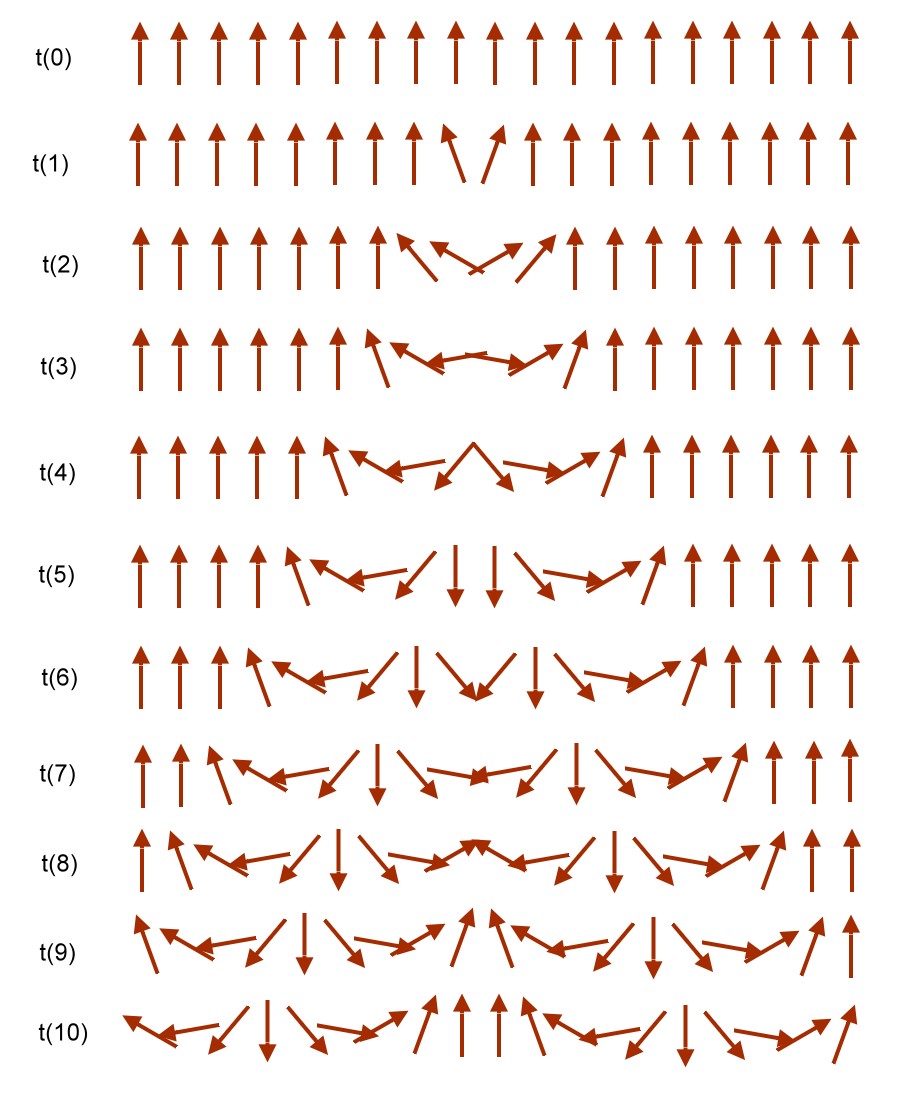
This means that the sheath model of the twist would work–the twist path through the sheath is stable and holds the twist path, and the volume outside of the sheath is stable, and there are no potentials across the sheath.  How would such a twist form if all continuous paths must stay connected?   By complementary pair production.  If a pair of twists start as a point (maintaining patch connectivity, but some paths separate) and spread out in a line, the twists may or may not separate depending on the local field energies and directions–for example, a pair of photons or a particle/antiparticle pair.  Some pairs may complete, some may go part way and then recombine before completely separating, forming a momentary virtual particle pair.  Here’s a picture of the concept:

I’m not sure I really like this, but if we are going to allow a geometrical solution rather than the traditional quantum view, this one would work.  It limits the continuity requirement to paths rather than local neighborhoods–kind of problematic when working with a unitary field, but I suppose this concept is possible.  I’ll continue to work with the implications of such an approach.  One thing I see immediately–my previous conclusion using a continuous twist model was flawed–you cannot get circular polarization with the in-line twist.  With this sheath model, you can do the either in-line or orthogonal to both the background field and the in-line twist–or any linear combination of both.

A mathematical model for simulation is much harder when this kind of a discontinuity is allowed, because lattice simulations will result in improper artifacts on the discontinuity boundary that are dependent on the nature of the lattice cell.  In a continuous field simulation, the effects of the shape and iterative computations on the cell will have negligible effects on the overall simulation, but that is not the case when there are discontinuities.

Agemoz

Renormalization and Twists

December 12, 2011

When I try to get a deep understanding of what E=hv quantization means, I see that for a given frequency, the energy of the smallest particle possible is quantized.  For such a particle to emerge from a field, I have to find out a logical or geometric way for the field to be quantized, and twists within a unitary background vector field appear to be the most obvious case.  This implies a force that exerts a tendency to tie down (for both ends of the twist region) to the background state direction, and one such “force” is the specification of continuity.  Unfortunately, I have yet to find a twist solution that doesn’t have a discontinuity somewhere, a contradiction in the theory’s assumptions.

I am going to specify the field as a spherical coordinate pair of angles, say f = (a,b) since this is a unitary field.  I can create a mathematical equation that specifies that curl in space equals displacement in time, and specify boundary conditions f(0) = (0,0), f(1) = (0,Pi), f(2) = (0,2 Pi) and see if I can show there are no continuous solutions.  This may be simple to do mathematically, I don’t know yet–the field equivalance of angles 0 and 2 Pi require some interesting complications to a proof.  I think I can show geometrically that there cannot be a solution, but the differential equation method should be conclusive.

Yet, somehow, I feel there has to be some kind of a solution.  I was thinking about renormalization and perturbation theory, how this alpha value probability is summed over all possible interactions.  There are first order terms (direct field photon interactions) and second order terms (virtual electron/positron) pair productions appearing in the first order interactions, third order terms as those interactions get pair productions of their own, and so on.   Summing over all these interactions iteratively gets us closer and closer to the right answer.  This is thought of as an electron interacting with its own field, which is a recursive problem since these interactions are mediated (via photons) with more electrons.  I just keep thinking that this recursion is analogous to a Taylor series expansion of an analytic function, we have the Taylor series but we don’t have the mathematical vocabulary/toolset to convert this series to an analytic function.  I have no doubt that every smart physics PhD candidate in the last 70 years has tried to find the analytic solution, and so far as I can see, no one has succeeded.  So I’m going to succeed?  I have no illusions on that matter, of course not.

But I’ve convinced that the two concepts I have mentioned above (E=hv quantization twists, renormalization perturbation) have to meet somehow.  Either these two concepts have to merge in the middle, or twists are the wrong way to express E=hv quantization.  I just can’t bring myself to throw out twists–it is such a clear-cut way to express a continuous modulo function on a field.  Perhaps there’s some kind of compromise where the field magnitude is not unitary–but if you do that, you cannot prevent dispersement of the field entity (that’s why Maxwell’s equations cannot yield a solution to quantization).  By adding the two assumptions (unitary field, localized background direction),  the necessary and sufficient conditions for quantized particles emerging from a field then exist.  The trouble is, just because it is necessary and sufficient doesn’t mean it is right…

Agemoz

Discontinuity Contradiction

December 10, 2011

Well, does it or doesn’t it?  If you are one of my readers following my thinking adventure (thank you!),  you’ve seen my stream of thinking where I debate what a unitary field twist solution to the particle zoo would look like.  I’ve come up with the twist idea because every particle must obey E=hv (energy is a quantized multiple of a particle’s frequency times a constant, ie, the discovery that won Einstein his Nobel).  Assuming a continuous field, and assuming that particles emerge from this field,  it is valuable to uncover geometric structures that also have this quantization, and a field twist is definitely one of them.

The cool thing about the field twist is how special relativity falls out of it–there are many derivations, but my favorite is how twist rings exhibit a maximum speed that is constant in any frame of reference, thus providing a geometrical explanation for the speed of light.

But, there’s a fundamental problem, as you’ve seen in my last several posts.  Twists assume a background state, and since the field is unitary, this means that quantization occurs as a result of a local twist in field direction.  In order to enforce an integer number of twists (no partial twists) there must be some kind of attraction to the background state.  I have used continuity as a means to generate this attraction–if the ends of a radial twist are locked to the background state, the twist will become topologically stable and will not dissipate.  All good so far, but EM field experts will point out that div(F) is not zero.  Geometrical analysis appears to show that there is no such Maxwell’s EM field valid solution.  That doesn’t bother me too much since this is not a Maxwell’s field, but is closely related, it is unitary (can’t go to zero) and this is what enables a stable entity such as a twist.

But what does bother me is that I can’t find a valid unitary twist field solution that doesn’t have a discontinuity in it, which contradicts the starting assumption of continuity–the thing that allows a valid tie-down at the ends of the twist.  If I allow discontinuities internally to the twist, what stops it from having discontinuities at the ends, and the model breaks down.

I thought I had proven inductively that there cannot be a twist solution without a discontinuity, but lately I found a flaw in that conclusion.  But one thing I’m pretty sure of now–if I allow discontinuities, I no longer have a tenable twist field solution, because not only is there a loss of the continuous field enforcing tie-down, but now the very definition of the field being unitary doesn’t make sense, you can’t have a magnitude variation.  It simply cannot have a discontinuity, else I no longer have a theory.

Agemoz

Twist has to have a Discontinuity

December 4, 2011

I kept thinking that a continuous twist solution (with no discontinuities) was a good thing, but it’s not, actually.  My previous post on electron size (two posts ago)  is why–one of the ways to discover whether a particle is point-like or not is to bombard it with high energy particles.  If there is any diffuse (distributed)  component to the particle, higher energy collisions will eventually plow straight through the muck.  But if the particle is truly pointlike, high energy collisions will bounce back even as the energy is increased, which is what we see with electron/positron collisions.

If the twist ring is to model the electron, it cannot be a continuous function.  I noted previously that if there were discontinuities in the unitary vector field twist, this would introduce potential energy infinities–but this more accurately models what happens with the electron anyway.  It vastly complicates my mathematical description of the twist field, but it has to be true–I have just about convinced myself that there is no possible continuous solution.  You can transform the twist angle vector field to a two element scalar field of angles (since I propose that the vector field is unitary).  When you do this to a field twist, you create a volume of angle pairs.  This volume, say a filled sphere, has zero pairs on the entire surface representing the background angles.  At the center lies a value (Pi,0) representing the twist.  A continuous vector field can be represented this way as a continuous but periodic scalar field (where 2 Pi maps to 0).  A diameter path of the twist has a zero on one end, and 2 Pi on the other–still zero–but with a full range from 0 to 2 Pi along the axis.  Even though 2 Pi is the same as zero, continuity requires (by inductive analysis) that any path on any sub-surface of the sphere that includes the twist and the 0 and 2 Pi points, must include the twist as well.  There is no “sheath” that can enclose the twist that won’t have the twist on its surface as well–but this is a contradiction since there must be some sphere big enough that the surface has all zero values–no twist.  The only way out is if there is some sheath that is discontinous from its internal composition.

This is a major shift in my thinking–probably a good thing as I mentioned, since the point-like electron requires infinite potentials due to its point-like collision behavior.

So how do I model this thing now?  I still want to create a simulatable model, but when infinite potentials are allowed, anything goes–I can make up whatever I want.  The trouble with that is the same kind of trouble we have with string theory.  Add a bunch of dimensions, and glory be!!  We can accomodate both the math of general relativity and quantum field theory, but so what, you haven’t really described anything.  Good models show basic intrinsics that separate them from models that don’t match reality.  Stuffing all possibilities into a model does not give any predictive behavior–and I have to give careful thought to introducing infinities into the twist model so that we still have something useful.

Agemoz

Twist in Trouble

December 2, 2011

Well, a lot has happened in the physics world–faster than light neutrinos, no Higgs yet, and an amazing story about t’Hooft (The Infinity Puzzle).

What about my stuff?  Well, I take time to think, I take time to run physics simulations, I take time to do various kinds of analysis, and I take time to post here.  I haven’t posted for a month or two because I am deep in the twist solution analysis.  I’ll try to post updates, but there are some pretty critical questions about this twist theory.

To refresh, I claim that E=hv quantization implies a twist structure.  Integral quantization for all particles in a continuous system implies that the particles are best modeled by a twist in a background state vector field.

That doesn’t mean that the twist is actually physical (reality) but it does mean there has to be a mapping.  When I study the options that come closest to the reality we observe by experiment, I have concluded that it is most likely that the twist is real in some way, in an underlying variant of a Maxwell field that is unitary.  As I’ve explained in the past here, such a system has to have a maximum speed for particles, and gives a geometrical basis for the laws of special relativity.  It shows how both photons and electrons could work, with correct values for mass resulting from the ratio of the electrostatic force to the magnetic force (twist rings), and the work I’ve been doing lately shows how inertial mass could spring from mass particles but not affect photons.  Pretty good snake oil, ain’t it!

But I see a problem.

The assumptions I’ve made above seem to be good, but I’ve attempted to do careful and very specific analysis of what the twist looks like mathematically.  As explained in previous posts, the twist for photons must be planar to the direction of travel and can only be stable if moving at speed c.  The twist for electrons is encompassed in a ring like the old DeBroglie electron, but is a twist, not an oscillation. When pushed by an external force, the ring distorts, and the resisting force of this distortion, which will be proportionate to the momentum of the twist, will give the inertial behavior of the particle.  Looks really good from all points of view.

Here’s the problem.  I believe I’ve proved that my current mathemetical 3D+T model of the twist, contrary to what I said in previous posts, has a discontinuity.  Although the twist is topologically stable, it cannot exist without a discontinuity in the field–even when confined to moving only at speed c.  This is a showstopper–if a continuous solution could be found, I would be on my way to computing the gravititational constant from the ratio of the electrostatic and magnetic forces.  But a discontinuous system means that infinities have to be introduced into the twist mathematical description.  Not impossible, but not elegant–suggesting that the model is too complex and that I’ve got it wrong here.

I’m not done–I am still searching for a way out.  I thought I figured this all out, but when I tried to pin down that solution from about a year ago, I found that it doesn’t work.  Now I’m looking at other possibilities again.

Agemoz

electron size

July 8, 2011

The thing that kills most crackpot theories about the electron, like my unitary field twist ideas, is that they assume a size and structure much larger than what experiment shows. Any theory that has a size near the wavelength of the electron is proposing a size many orders of magnitude greater than what scattering experiments indicate. In addition, experiments can indicate internal structure by bombarding the target with high energy photons–frequently this will induce excited states that imply something other than a point. There are many other experiments that indicate size and structure, but in every case, the electron shows point-like particle behavior. In the past, when I’ve proposed theories that give structure or size to the electron, physicists have responded by saying that that is contradictory to these experiments.

I’ve always had this in mind when I’ve thought through and posted about all these issues with the unitary field twist theory. I’ve suspected that the theory might predict a point scattering result because the ring (that models the electron) is a circular twist where the interaction cross-section is the infinitesimally wide width of a ring section. In addition, it is clear that a relativistic velocity stretches the ring into a spiral that asymptotically approaches a straight line twist where the cross-section will be tiny if not zero-dimensional. Scattering experiments accelerate particles such that this will happen.

The recent electrostatic moment experiment, where it was found that the electron has zero electrostatic moment, or as close to zero as could be measured, is a profound statement of the electron structure or lack of. It throws into doubt that there is a sizable structure such as the twist ring I propose. The only salvation here is that the twist ring consists of no charge distribution, but rather that the twists induce a magnetic component that in the far-field creates a uniform electrostatic field. I think this is workable but on the doubtful side. I began attempting to compute this field effect to see if a unitary twist ring model of the electron would match the known measured electrostatic field, and if this field would be uniform.

However, this line of thinking led me to an important realization. There is a question whether the electron is truly a zero dimensional point or just incredibly small, such as Planck length sized. I realized it cannot be a zero dimensional point–here’s my reasoning. An electron will experience a force (say from a source electron or positron) that points either toward or away from the source electron. If the electron is infinitesimally small, then there is a neighborhood that can be made arbitrarily small about it. The only way the receiving electron can know whether to move toward or away from the source particle is if there is a measurable field gradient within the active region of the receiving particle. This can’t be right if the electron is infinitesimally small because we can choose an arbitrarily small neighborhood around the electron. In so doing, we can make the gradient arbitrarily small and there would be an arbitrarily small force on the electron, because it is proportional to the field gradient in the electron neighborhood. The conclusion would have to be, if I’m thinking right, that there has to be a finite structure to the electron to pick up this gradient.

Another way to think about this is assuming a quantized field consisting of rays of virtual photons, and assuming that these photons are partial linear twists. If the active region of the electron is infinitesimally small, the intercept region is infinitesimally small and the probability for absorbing an electron is infinitesimally small. But I’ve been truly wracking my brain to try to think of an experiment that would (even coarsely) quantify the size of the ring and not the interaction cross-section of the ring.

While my analysis is by no means rigorous, the logic is strong and points me to the likelihood of a significant structure element for the electron.

I’m also doing another line of thought. If the unitary field twist theory is right, it should be possible to compute the effect of accelerating an electron twist ring. Acceleration will temporarily distort the twist ring and the force resisting this distortion should equal the inertia of the electron and yield the gravitational constant. Will it? I should find out soon…

Agemoz

Charge Photons, the Sequel

July 4, 2011

In my last post, I asked some questions about the nature of the photons that make up the electromagnetic field. QFT quantizes the EM field, and one of the methods of calculating the effect of quantization is with Feynman Path Integrals. These integrals effectively add in all possible interaction paths, which results in infinite sums that are removed by various renormalization procedures. I claim that the unitary field twist theory follows (or more accurately, underlies) QFT but doesn’t need renormalization–but let’s not go there today. I still am thinking about how electrostatic charge would work in general.

I mentioned last time how there is a paradox when constructing a system of oppositely charged particles. QFT says the attracting force is mediated by photons, which, as I mentioned previously, appears to not conserve momentum. The unitary field twist solution does not have this problem because there is a degree of freedom in the field twist version of photons that would allow the attractive force to work (see the paper in the media section here).

There are more questions though–first, what is the energy and nature of electrostatic field photons defined by QFT? Is the source particle constantly emitting these to maintain the field, and if so, wouldn’t there be a constant stream of photons that would dissipate the energy of the source particle (and if not, then there appears to be a conservation of energy problem)? Or, perhaps QFT says that the field photons are virtual. If so, are these virtual photons mathematical artifacts or in some way real? And what is their quantized energy, and how do we get a 1/r^2 dissipation that is quantized?

In the unitary field twist theory, unlike QFT, I’ve posited that virtual photons are partial twists that restore to the originating background field rather than completing the twist ( if the twist completed, then they would be topologically stable and would become real photons). In addition, since the twist has to originate in the twist ring (the source electron), the energy of every emitted virtual photon is zero since no net total twist results, so there is no energy dissipation problem. The 1/r^2 effect results from this stream of virtual photons passing as the surface of an expanding sphere away from the source electron (the sphere surface area decreases as 1/r^2, so the quantized virtual photon count per unit surface area drops as 1/r^2). Finally–since these virtual photons (partial twists that restore) carry no energy, they also cannot carry any momentum in their direction of propagation (photon momentum correlates directly to the total energy of the photon since it has no kinetic energy component), so there should not be a momentum conservation problem either.

So, nice clean answers from the unitary field twist theory, but I need to understand how QFT deals with all of these questions. So–I have some homework to do. First, a course on group theory–I need to understand the physicist’s notation of symmetry groups and maybe better understand representations and dynkin diagrams and all that–but most importantly, fully understand the EM symmetry group–and probably the strong force symmetry group as well. Then it’s time for a deep dive into QFT as it applies to the non-relativistic electrostatic field.

Agemoz

Charge Photons

June 22, 2011

I have continued to think a lot about the unitary field twist theory (in spite of the recent electron electrostatic moment results). I still think that the foundation of the theory is valid–to quickly review, the theory builds on the principle that E=hv specifies quantization of all particles at a given frequency. A photon can have any possible frequency, but every other aspect is fixed, such as magnitude, kinetic energy/momentum, and so on. I’ve based the theory on the assumption that the photons and other particles can emerge spontaneously from a continuous field. This has basis in QFT since it accurately describes particle interactions as functions of all possible combinations of emerging real and virtual particles. The same field that brings forth a photon of any frequency but fixed proportionate energy also appears to permit emergence of electron and quark particle-antiparticle pairs. This to me clearly indicates a continuous field (primarily because emergent photons can have any frequency, implying a continuum of possible emerging energies).

The only way I can see a continuous field produce a stable quantized entity is if a complete 2-Pi rotation field twist occurs within a background of constant amplitude. Such a twist will be topologically stable if the continuous field has constant amplitude (that is, a unitary vector field) with the right set of assumptions about being analytic and that there is a force that restores to the background field direction. I am assuming that this field is the underlying structure behind the electromagnetic field, and thus these twists exert a 1/r^3 central force, which can be shown to yield a soliton ring that has the mass and energy of an electron. In addition, such a ring gives rise to the special relativity Lorentz transforms, because the path of a ring moving at velocity gives a spiral. This spiral can be unwound into a right triangle and shown to yield the sqrt(1-v^2/c^2) time and distance factor (the beta of the Lorentz transforms). There are many other confirming computations that seem to point to the validity of the thinking behind the unitary field twist theory.

In such a theory, the twist is quantized because only a full 2-Pi rotation is possible–a fractional rotation cannot exist in the background field, and integer multiples of rotations have no connecting force and so can disperse into single twists. These twists are only stable if in a ring (or possibly more complex geometries, but must be spatially confined). Photons moving at c can be represented by linearly propagating twists.

Just like any other certified crackpot, I just don’t want to let go of the clarity and computational confirmation that the theory provides. So, I have chosen to put the zero electrostatic moment question aside, and think about another question.

If this theory is true, it seems like it should provide some insight into the problem of electrostatic charge attraction and repulsion. QFT says that these forces are mediated by photon exchanges. The problem is that if a system of opposite point charges, for example an electron and a positron, exists at some distance r between them, momentum doesn’t appear to be conserved in the attracting case. QFT computations should show that somehow this mathematically works–I’m studying this and maybe I’ll soon understand. I’m guessing that in QFT, the photons are dumped into the field in such a way as to affect the aggregate field behavior on the receiving particle. But in the meantime, I’ve been wondering if the unitary field twist theory could provide some insight.

The most interesting question to me is this: if we try to separate the system into three parts, the electron, the photons representing the electrostatic field, and the positron, what is different about the photons than if both particles were electrons? Yes, I know, the standard answer is that you can’t separate out the system in those three parts, shut up and calculate, the math works out (I’m assuming that is what I will find when I study QFT in more detail). You see my point, though–if the force is mediated in both cases by photons, the receiving particle must get photons that are somehow different depending on whether the sending particle (the one generating the initial electrostatic field) has positive or negative charge. How can photons carry this information when they themselves are not charged? What is different about the photons, or perhaps the aggragate, in the two cases?

In the case of the unitary field twist theory, it happens to have a degree of freedom that would explain what is different. As I mentioned previously in many posts, photons are represented by a linear path field twist where the twist axis vector is normal to the direction of travel (see the bicycle wheel post, think of the twist visualized as a bicycle wheel in line with the axis of travel–but remember that the twist vector is a direction only, it has no physical length). This system has the required degree of freedom to represent the polarization of light, the angle of the wheel on the axis relative to some fixed angle. But it has another degree of freedom, a rather clever one, I think–it can spin either clockwise or counterclockwise relative to the direction of travel. The receiving particle will have no knowledge of the charge of the sending particle, but can distinguish between a particle that twists forward in the direction of travel, or backwards.

If you are visualizing this correctly, I think your first response should be, wait a minute–the two aren’t unique since one is just the 180 degree polarized version of the second! And I would say, that’s what I thought at first–but remember that the unitary field twist exists and is quantized within a background field. This is what provides the base orientation for the rotation direction. You can have a full 2-Pi range of polarized photons from a negatively charged particle creating a negative electrostatic field, or a full 2-Pi range of polarized photons from a positively charged field. There is no overlap when using the unitary field twist model.

OK, so we have the required degrees of freedom in the photon spray that represents the quantized electrostatic field from a charged particle. Why does the receiving particle experience a force? How could the unitary field twist theory resolve the apparent contradiction of unconserved momentum if the particles are attracted to each other? How does this match up with the path integral approach of QFT? And can we quantitively compute just how much force will be created?

I’ll write more soon.

Agemoz
Quantum Oscillators

May 29, 2011

I thought more about the latest electron work recently in the news (http://http://physicsworld.com/cws/article/news/46085). It is not real clear from the article summary, but essentially it is saying that they found that the electric dipole moment of an electron is as close to zero as they can measure. The summary says that that means that it is perfectly spherical, but actually I’m not sure that’s the right conclusion to draw–what it really means that there is no off-center distribution of charge. For instance, if you try to represent the electron as a pair of opposite charges, there will be a measurable electric moment which will respond to an electric field. A zero electric dipole moment means that from every angle the electron will respond identically to an electric field, there is no “unbalanced” or asymmetrical charge distribution. The experiment leaves a little wiggle room (it sets an upper limit for the possible moment value) but probably shows that the electron is either a perfect point charge or has a perfect spherical distribution of charge.

The reason I suspect this means the end for the unitary twist field, at least the part that says that the electron is a twist ring of field elements, is that a charged ring, even a perfect ring, will have an electric dipole moment–an asymmetric distribution of charge. In fact, it also likely means that any string theory, such as the recently touted M-theory, is likely to be wrong.

The only way out that I see is the fact that a unitary field twist ring is not a distributed charge. It is a ring of constant field twist, which in the far field is going to generate a constant charge effect no matter what angle of the applied field is applied (this can be seen by doing a volume integral on the ring twist elements). An electric dipole moment will get a non-uniform value if there are diffuse charge regions that can block in-line charge potentials. So–maybe a ring of twists theory might squeak by and still be valid, although I admit I’m dubious and suspect it’s time to throw in the towel on this theory. Nevertheless, the theory is the product of years of work and I shouldn’t give up until I’m sure it’s really dead. After all, other than wasting my own time, I shouldn’t be doing any harm–unlike most crackpots, I try to make it clear this is the work of an amateur and is worth what you paid for it.

What keeps me going is interesting little tidbits about the theory that make me say, oh, that’s why this is so. For example, one long-standing question I’ve had is about quantum oscillators–the field of quantum oscillators maps C, or equivalantly R2) onto every R3+T neighborhood (this is an example of a “Fock space”, which maps a complex value onto every R3 location). But a unitary twist field would map R3 onto every R3 location (you can point a field vector in three directions). This was one question that has long made me doubt the validity of the unitary twist field theory. However, I suddenly realized this morning that the unitary twist field theory does indeed actually map onto the same field as the quantum oscillator field. This is because while the theory uses a 3D vector field in R3+T, the theory requires a background field direction, thus removing a degree of freedom because the only twists possible and stable are those that return to the background field direction! I now see how the unitary twist field theory would derive U(1) of the Standard Model for electromagnetic fields.

If I weren’t so discouraged about the implications for the unitary twist field theory of that experiment on the electron’s lack of an electric dipole moment, I would have said this is a remarkable discovery! But with the whole theory cast into doubt, at this point, I am not so sure it’s anything more than an interesting factoid…

Agemoz