A Possible Analytic Solution?

August 22, 2010

Back from a nice photography trip–somewhat strenuous hiking, but it gave me a chance to figure out a possible Twist Ring solution. I’ve been working on simulation work in an effort to work out the math for the unitary field twist, but the sim was not behaving as expected. Just before I left on the trip, I had a pretty good idea why, but I was able to transform the twist solution to phase space (U2) and from there was able to show that the twist ring that is symmetric axially could not be a valid solution–there would always be a an epsilon region with a phase discontinuity. This helped me visualize that the solution had to be axially dependent–a phase discontinuity simply was not acceptable because then I no longer have a unitary field.
But that really complicates the search for a solution, because if I permit each field vector two degrees of freedom, I am working in SU3 (representing a complex vector field in R3 where each vector is unit magnitude). However, after some thought, I thought of a way to think about it that eventually led to a very exciting solution. The original Twist Ring theory as described in my Paradoxes of the Point Source Electron paper describes the work where I found a unique soliton solution for photons and electrons based on a unitary field twist. However, I did not describe it analytically (mathematically) because I hadn’t yet found it.
I had originally proposed that twists reside in a unitary vector field version of an EM field because quantized particles behaving as E=hv imply a missing degree of freedom, which I hypothesized would be a EM field with constant magnitude. This looked very promising because this provides the appropriate quantization at a given energy without constraining valid frequencies (hence energy) of independent particles. And, it preserved the ability to twist, thus permitting the wonderful results described in the Paradox paper.
Up to now, however, I hadn’t been able to describe the twist without having the solution melt away in time or without a field discontinuity. I tried a variety of twist solutions before finally proving that I could not do it in the simple form in U2 (projected variance along the axis of the twist). I then realized that a solution would have to map onto SU3 with the real and imaginary parts representing the unitary vector angles in polar form. Unable to visualize this much more complex solution, I had a great Aha! moment, and thought, what if I just ignore the region between the twist and the rest of the field? I’ll put a 2Pi twist in the field and surround it with the default field (the field outside the particle, which in our little test case points always to a default direction), separated by a sheath which I just say “I don’t know what’s in there”. But–after thinking for a while, all of a sudden I figured out what could be in there! The twist contains vectors that lie in the radial plane, and so does the default field vectors–but in S3, we have one more degree of freedom, vectors that point tangent to the axis of the twist. All I have to do is make sure that the sheath separating the twist from the default field contains these tangent vectors, and I will have a solution which has no discontinuities, yet can’t melt away without introducing an (impossible) discontinuity. The reason this works when Maxwell field solutions cannot is because the SU3 field is unitary (to enforce quantization) and cannot have field vectors go to zero.
What’s even better–I know there are more twist solutions possible. I’ve found two–the straight line twist (photons) and the ring twist (electrons and positrons, both spin up and spin down). But I can geometrically visualize other twist solutions, which hopefully will yield other particle solutions.

Stay tuned, this is an incredibly exciting result! First I have to confirm it with some analytic and sim work (the sheath is almost certainly not going to confine itself to a cylinder around the twist but will probably mold itself somehow onto the twist). I need to verify that the twist will preserve itself, that there is no way it can dissolve analytically, that is, without requiring a phase discontinuity. Then I need to work out a sim that shows how two twists can form in a field without introducing a phase discontinuity. This is necessary because otherwise spontaneous pair production of particles would be impossible.

Agemoz
Ideas and Axioms

July 13, 2010

Just to clarify the previous post–what did I mean by being dead or alive just being different states, thus life (and death) are just ideas. This comes from a bunch of previous posts, where I realized that death just involves the breaking of certain ordered sequences of particles. One ordering gives us life and consciousness, but when we die, no particles are lost or gained–it’s just a different ordering that no longer sustains consciousness and thinking and actions directed by the brain. When I realized this, I determined that this would show that life is nothing more than an idea–a construction that sustains life behaviors. Since ideas have different levels of realization (eg, the three I mentioned, those that are realized in a physical system, those that are abstracted in an intelligence’s brain, and those that haven’t been set in either), this would imply that consciousness is an idea–and so is the physical system that realizes the idea of me.

It is such a human desire, probably based in his survival instinct of not wanting to die, to wish that life was more than just an idea–but the contrarian part of me says that a lot of things that people wish for but don’t observe become religions of hope and faith. With enough consensus, a lot of people can establish a doctrine that by sheer weight of documentation can give it an apparent reality in this existence that doesn’t match the behavior of the ideas in the physical realization of our existence. A less wordy way to put that is that religions are ideas, and very often (not provable, though) represent wishful thinking rather than real consequences of the realized idea of our existence. That is, they are ideas realized only in an intelligence’s mind and do not reflect reality.

However, in this post I want to just focus on this direction of life is just an idea in a physical system that provides the particles and interactions that consistently support it. I could spend some time defining what I mean by life and consciousness–you can see some of that earlier in this blog–but really, it doesn’t matter how it is defined. What I think matters a lot more is that ideas are constructions of constructions, a recursive process that should provide deep understanding of our existence if we can determine a starting point. As I’ve recently mentioned, our physical existence is just an idea as well, perhaps a system from nothing or some other field aggregating effect. The question of what sustains life seems to fall out of the consistency of application of rules to a system–a system is more physical the more consistently rules apply to the system.

For example, in our universe, electrons apparently have the same mass and charge throughout a universe who’s count of electrons is beyond immense. What is it that is enforcing that consistency? If you believe the twist ring theory I’ve worked my way through in this blog, it results from the connection ratio of electrostatic and magnetic (Lorentz) forces. But that just pushes it back another step–what establishes that ratio? In spite of all my work that shows that God is not necessary to define a system that emerges from nothing (see my previous posts on scale-less systems, which show that something will emerge from nothing provided there is no boundary–infinitely large or small), there appears to be a rule being enforced in this existence that assures the mass of an electron and the ratio of the Lorentz forces. And, as I’ve discussed previously, if this rule is an axiom, and there is more than one, this cannot arise from nothing. God, in some form, would have to exist to create a system with distinguishable rules).

However, if the universe came from nothing as a result of a single rule, it still seems to imply that God has to enforce the rule. That’s why I call the mass of an electron the God rule–if ideas are realizable, whether by abstraction in an intellect’s mind or as a physical permutation of particles and energies, on a system with a consistency of an axiom, something has to enforce that consistency. It could be an intelligence or a machine, but it appears to be axiomatic that axioms are not axioms. The fact that ideas exist in any number and extent of realization seems to counter the something from nothing existence.

Our consciousness is an idea, and the fact that there is a system of ideas who’s realization has eventually (over the life of this universe) has led to the creation of an intellect that can see that it is in a system of ideas has created a new category of ideas. We had the unrealized ideas, the abstracted ideas, the physically realized ideas (which could conceivably just be an abstracted idea in some intellect’s mind), and now the idea that is realized in such a way that within its realization is an idea that observes the realized idea of existence. This idea (observer) is capable of storing some subset of all possible abstractions in its brain, one of which would be the transcending understanding of what the idea of a system of ideas really is–and the transcending understanding of what axioms, if any, are real. This idea, which includes the storage of transcending ideas, is a new form of idea all by itself–what can I say such an idea, that life, would be? Could it find a path to immortality or God?

Dunno. Time for bed.

Agemoz

The Idea of a system that has ideas in it

July 12, 2010

Continuing from the previous post on what I find so fascinating about our existence: we live, we die, are just two permutations of ordering in a system that otherwise doesnt really change. And–ideas have different levels of realization. There are ideas that haven’t been formed by an intelligence but could be, ideas that have been abstracted in the mind of an intelligence, and ideas that have been built. Since built ideas are constructed in systems that are themselves potentially ideas (complex constructions of fundamental particles)–which may just be a continuously managed set of abstractions in the mind of an intelligence with no loss of generality. In other words, there is no conceptual difference between an idea that is built on a truly physical set of objects, or an idea constructed in the mind of an intelligence that maintains a set of rules in his mind of what that object does.

This is wonderful stuff! New horizons for me and my philosophical thought, reaching deeply into what it means to be alive–it’s just an idea, anyway! Yow, this is getting profoundly recursive, it’s turtles all the way down or is it? I think not–but I have to go, back in a day or two..

Agemoz

A New Fork in the Road

June 26, 2010

My thinking process has winded its way through a lot of physics in the last several years, and I’m slowly working my way through a computer simulation of some of this work. However, the problem with attempting to work on a problem in physics, even if it’s oriented toward understanding the greater overall picture, is that I must augur in to the problem with such intensity that I miss the forest for the trees. I have to truly prove that my thinking is correct or at least isn’t obviously wrong–and that takes a gigantic amount of time and thinking energy. The problem with that is that in my short life span, there’s not really time to do that, and in fact I’ve begun to realize that it’s not really even necessary.

Let’s look at my goals and whether that effort will contribute to them. Suppose I do find that twist rings have a valid solution space and match what we see in the real world. If I succeed, which the simulation might show but will require an enormous investment of my time, all I will have done is constructed an artifice that better shows the possibility that our existence can emerge from nothing. That is a huge deal, because my ultimate goal has been to try to establish whether this existence (or my existence and consciousness) was self-emergent or whether an intelligence guided it. In other words, is there a God, or not.

Lately, I’ve decided to think more in the direction of what the whole concept of adding to my knowledge about whether God exists or not means. That is, never mind the question of whether God exists or not, but rather what does it mean that I am asking that question. To make a long story short, (that is, a description of the latest bout of my thinking), I’ve realized first that my/our existence that we call reality is really just an idea that has experienced some degree of realization in a medium. For example, I think it is clear that the difference between a “live me with consciousness” and a “dead me with no consciousness” is just a different arrangement of particles–so I’ve concluded that there is not that much difference between reality and an idea.

To attempt to prove this, I think I’ve mentioned in the distant past here that ideas are constructs of other constructs, and the constructs can be expressed either in ones mind or of particle arrangements. Both are ideas and are essentially the same concept, but we happen to call one of those “reality”. One way to see this is to suppose that this existence of particles is just a consistent ordering of thoughts in some God’s mind. I am doubtful that is what is going on here, but the fact that that is a possibility (that our existence is merely sequences of neuronal information exchanges in a God’s mind or even a automated device like a computer) forces me to acknowledge that our reality is really just an idea.

As a result, my thinking has dug into the ideas about ideas, the realization that understanding what it means to have ideas is more critical than whether the twist ring theory has validity, or even whether God exists. You say, whoa, I don’t believe you–whether God exists or not is the most important question there is! And now I would respond “Is it? Suppose we could prove that God does or does not exist? What have we done?” And I think the truth is, not much. Sure, we might discover a purpose in life or get blessed reassurance about life and death and all–big things for us personally, but actually not too meaningful overall when you consider our existences and life and death really are just simple ideas with a complex implementation.

What is far more interesting is to realize that in the end, this existence and my consciousness is revealing the interplay of ideas with varying degrees of consistency. I have only a certain amount of time before the realized idea of me, which is enabling the idea of consciousness/self awareness, loses its consistency and breaks down and I die. In that time, can I form new ideas that raise my level and understanding of my self-awareness. I’ve expanded my ultimate goals, not just to find God, but to understand better what that idea means, and ultimately to understand what it means to be an idea capable of forming new ideas. Kind of a Grand Theory of Theories sort of a thing.

I have this vision that in 2000 years, mankind’s entertainment will be solely mental–manipulating particles (arms and legs in football, playing piano, travelling, etc) will long since have ceased to appeal to minds, but rather, we will engage in games or perhaps better, experiences, of manipulating and interchanging ideas about ideas and existence!

Alright, enough for one post. But you can see where I’m going. My life is heading toward the final stages, and I’m running out of time to put or form any new concepts in my brain. I’m feeling this biological clock that says, hurry–you are a self aware, self computing, self analyzing, sensing brain–but only for awhile. Hurry, hurry, you need to give birth to a critical idea that transcends, but you may not get there in time before the idea of you self-destructs……….

Agemoz

Simulation Work underway

May 7, 2010

OK, getting the unitary field simulation underway–this is a really great way to visualize the potential of this approach–and a nice guide for checking my twist ring stuff. So far I don’t see a showstopper but I did have to resolve some issues. For example, if the field is unitary, then how come remote charges sense electric fields that are stronger or weaker–that is, how can you get a unitary field to represent potentials caused by a large number of charges? The devil is in the details that kills every crackpot physics idea, and this one has been nagging me. Two possibilities I see right now, either quantum particles only cause local unitary field variations, or there’s some complex interaction/vector arrangement that, Fourier-like, induces the effect of high potential by the frequency of vector changes. I don’t buy the first because to quantize a particle with precise limits imposed by E=hv, there cannot be a degree of freedom in the field magnitude. I kind of dont like the second option either but will go down this road for now.

One thing the simulation does show is the need for a background state–since the field is unitary, it cannot go to zero, but vector differences in the field are not permissible because this would create localized electric potentials. It’s possible this field is random (and might explain quantum jitter behind things such as brownian motion) but I have trouble with that because at some scale there is going to be work done (a perpetual motion engine). For now, I am assuming a localized unidirectional background and see what the sim does when that is disturbed with a twist.

I did my first run of that today.. and the twist promptly disappeared into the background. Oops, something is not right with my implementation, have to try some sanity checks. I kind of have a hunch the right answer will be random background…

Agemoz

The Unitary Field

April 28, 2010

The proposed complex vector field for the twist ring theory is continuous and unitary. It exists in R3 (while there’s a lot of talk of 10/11 dimensional solutions to satisfy relativity, I suspect that existence really is R3 but that the mass energy tensor just bends this R3 in all sorts of complex ways, we wont stop at 10 because third order effects will bend even that dimensional foundation. I don’t buy the rolled up dimension stuff at this point)..

There are several crucial questions about the viability of this vector field as a foundation for EM fields. The quantum nature of photons and particles shows up for two reasons: the hypothesized unitary magnitude of the field and the connection between the real and complex parts of this unitary field.

As mentioned, the twist of the field cannot induce a magnitude change by definition, so the first crucial question is how does the unitary field show an apparent variation of the B field inducing the E field in observation of an EM field (note that I am hypothesizing that the unitary field is the underlying structure for an EM field that adds the quantum characteristic).

The twist ring theory uses the unitary field to explain why we get stable quantized photons and electrons. For example, the photon is hypothesized to be a single full twist of the unitary field–a knot with a discontinuity that cannot disperse because the field magnitude is fixed at one. But why does the photon disperse at either end of the twist? Quantum theory analysis proposes that the photon has something approximating a Gaussian distribution of energy along the axis–how can the unitary field produce something that asymptotically goes to zero on the photon axis?

There’s a bunch more questions like these, but let’s stop here for now.

I’ll shortly post about what I think my answers are, and these will guide my construction (actually, reconstruction) of my unitary field simulation.

Agemoz

Back to Thinking

April 28, 2010

Well, I finished the programming contest, but didnt win anything or have anything to show for all that effort. Blecch. I wont do that again, that was a fairly significant waste of my spare time.

But now I’m ready to get back to my physics thinking work. I’d left off with my Paradoxes of the Point Source Electron at scribd, which describes the known issues with a point source electron and how a field twist ring model of the electron would address those issues. About 6 months ago, I began an attempt to more rigorously define just what a field twist ring is. The twist ring combined with the quantized E field of a photon led me to believe that the twist ring is a unitary complex vector field in R3 + T, unlike Maxwell’s EM field which is not unitary. The premise is that the unitarity is necessary to create the quantum behavior of particles while still being valid solutions of Maxwell’s equations.

To try to get some insight as to what kinds of behavior would result from a unitary field that obeys Maxwell’s field equations, I did some simple Mathematica analysis, but quickly discovered that I needed more detail to simplify the solution space, so I attempted an iterative solution, first in Mathematica, then as memory became an issue, moved to a C program to model this unitary field.

As mentioned a while ago here, sometimes you can find flaws in your thinking just in the process of attempting to create the sim, and I found an important one–if Maxwell’s field equations embody the conversion of twist to amplitude and vice versa, a unitary field will not work–it can only twist but cannot change amplitude. It was this discovery that made me realize that while the Paradox paper appears to make a good case for a twist ring, I need to augur in and specify exactly how this is going to work. I have to specify mathematically what the behavior and structure of the unitary field is, and I need to show, or at least provide a reasonable hypothesis, as to how this field will produce the macroscopic EM effects shown by Maxwell’s equations. In addition, I have to show that this field will produce a propagating photon and a stable twist ring.

I’ve already done some of this thinking and will detail where I am in my next post.

Agemoz

Field discontinuities

December 9, 2009

The math behind the twist ring is getting nasty–and now I think I understand why physicists dont go down this road. A Maxwell’s field solution is well known to be analytic (no discontinuities) and cannot permit any solution that has a discontinuity, and also is well known for degrees of freedom that allow any concentration of field energy to dissipate. Obviously, the quantum nature of photons and other particles doesn’t allow dissipation, and the twist ring approach has been my attempt to geometrically model a field system where this quantum behavior results. I do this by asserting that the twist ring approach requires a unitary field solution for quantization of twists to work. The observed macro behavior of electrostatic fields with magnitude (non unitary) is hypothesized to result from masses of (unitary field) photons–that is, I am asserting that the underlying behavior of normal electrostatic/magnetic fields, which is clearly non-unitary, results from the quantized behavior of a unitary field. The whole twist ring concept is based on this idea, since a twist in a normal electrostatic field clearly has degrees of freedom where it could dissipate–even a quantized photon cannot be represented in a Maxwell’s field.

However, if a unitary field cannot sustain a field twist, all is lost here and the twist ring approach would have to be abandoned. My recent work has demonstrated the likelihood that a full field twist (as opposed to a partial twist that returns the field back the way it came in a propagating photon model) requires that there is some region of the field that will have an epsilon neighborhood, arbitrarily small, where field vectors are not analytic or continuous. However, the unitary field requirement is very interesting because unitarity may sustain a twist where the discontinuity is forced to be distributed and a pole of infinite potential would not be formed.

No answers yet, but certainly clarification of what won’t work (true EM field). My other work especially with twist rings shows that unitary fields has the right degree of freedom to make quantization, special relativity, and electron states possible. But–a precise mathmatical model runs into trouble with the apparent need for a field discontinuity for twists. Don’t know where this is heading yet…

Agemoz

The nature of the field

December 6, 2009

I’ve attempted my first “photon” in the simulation, but am not getting propagation yet, probably because the parameters are not properly set up. I converted the field type to normalized and modified how information is displayed so that permutations of a unitary field can be more readily seen. It occurred to me that the fact that there is no propagation yet means that the simulator is working right–right now the field appears to be dissipating rather than propagating, which one would expect if the twist were not of the correct frequency and initial velocity.

This did get me thinking whether it can be shown that a unitary field can’t be right. If there is a photon in the presence of other photons, are there sufficient degrees of freedom available to represent the total system? In the presence of a strong E or M field? The problem is, though, if we take away the unitary requirement, then there is danger that quantization can be lost since photon E/M twist fields now have an extra degree of freedom (field magnitude). I realized that Maxwell’s equations can be slightly simplified if we assume unitary fields–and I also realized the quantum mechanics representation using multiple oscillators suggests unitary fields.

I did some additional thinking on this and think that unitary fields could work–for example, a high-voltage potential source could emit continuous streams of photons in the form of unitary field twists. Photons intersecting each other would have linear combinations of twist angles, not necessarily summing of EM field magnitudes. If such an approach using unitary fields doesnt work, there’s a very serious problem if magnitudes are allowed–this would provide a mechanism for quantum particles to dissipate.

But the most important reason that fields must be unitary: A twist cannot dissipate in a unitary field!! Unitary magnitude topologically means that there is one structure, and one structure alone, that cannot dissipate–the twist–without causing a field discontinuity. This is profoundly important because it provides the mechanism for quantum quantization. Up to now, there has been no geometrical explanation for quantum oscillators or the e = hv quantization.

I’ll keep cranking on this until an answer shows up.

Agemoz

Back: working on the twist field simulator

November 29, 2009

Well. It’s been a while since I’ve posted here, mostly because creating the scribd paper, and refinining it several times, diverted my efforts from this blog. Now the paper is done, and I am now doing the EM twist simulation in an effort to see if I can prove that the twist ring conforms to field Maxwell’s equations. I’m going to also try some Mathematica work to see if some simple analytic solutions for photon twist cases are possible.

Because this effort still is taking much of my thinking time, I don’t know how regularly I will post here. The big question isn’t answerable by my usual thinking processes, and this really is the big question that will decide which way my thinking goes. So–I’ll try to post occasional updates here, but my goal for the coming year is in that analysis. Right now, the simulator is up and running and looks like its working right, so soon I will put in a photon twist model and see if it will propagate correctly.

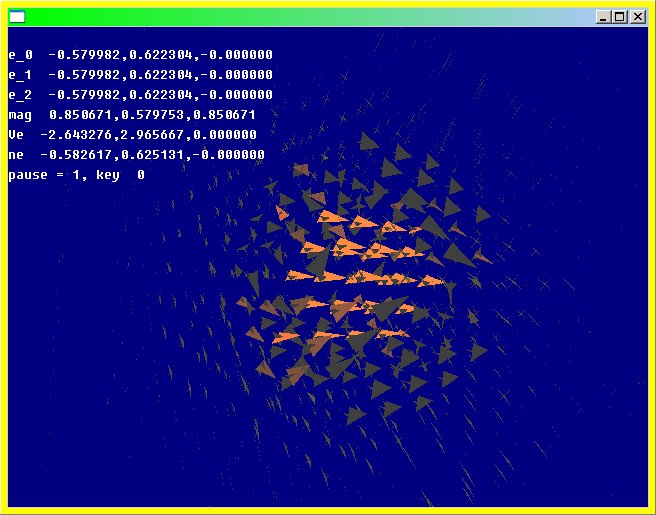
Here’s the latest output that is time delayed after an initial condition consisting of a largely empty field with a fixed 3×3 array of x directed E field components:

The cool thing about going away from generic thinking that I have been doing to an actual proof of a concept is that it force your thinking down channels or constraints that aren’t necessarily visible when just thinking. For example–this initial demonstration showed how magnitudes rapidly get out of control and illustrated that my hypothesis that the quantum EM field is a unitary field probably has to be true. I will rework the simulator to enforce this constraint. This requirement is mathematically equivalant to stating that accelerations are always perpendicular to the field element direction (velocity must be normal to the field element direction). Results to come in a few days. After that, if that looks good, I will create an initial condition that contains a linear twist and see if it self-propagates. If it does, I am probably on the way to showing that twist rings are a valid solution to Maxwell’s equations (it appears to be impossibly difficult to derive this analytically from differential equations) and that twist rings would be a sufficiently valid solution to represent our reality.