Activation Layer Deep Dive, Continued: Does Time Variation of Special Relativity Contradict the Activation Layer Hypothesis?

February 21, 2023

I have postulated that existence as we know it is confined to a 3D slice, a hypersurface isotropic in time, of 4D spacetime I call the activation layer. I’ve discussed in previous posts that this activation layer is why observers only are aware of one instance of time at any given point in time, and that interactions are confined to the activation layer. I’ve previously posted that this shows why we don’t get visits from the future and will not be able to observe or interact with our past selves–the activation layer is the only one of an infinite number of hypersurfaces in spacetime where observation and interactions occur. There is no existence in non-activated hypersurfaces, even if you use a wormhole to travel to them.

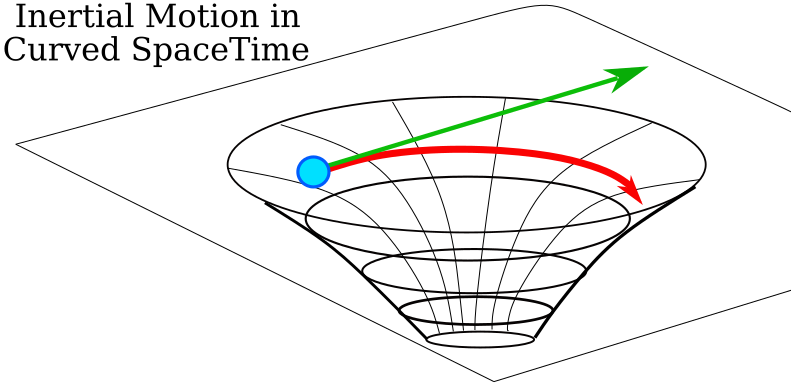
In previous posts (https://agemozphysics.com/2023/02/08/space-time-activation-layer/ and https://agemozphysics.com/2023/02/14/gravity-and-the-activation-layer/), I show how the timewise motion of the activation layer concept leads to why we experience the acceleration factor g of gravity. An object in the activation layer literally moves forward in spacetime, so if the spacetime region is curved, it experiences a force identical to the straight-line path of an orbiting planet in a curved spacetime. Einstein’s equivalence principle where inertial behavior cannot be distinguished from object motion in a gravitational field, therefore becomes an identity, and gravitational force becomes an illusion.

However, hypotheses such as the activation layer can sound good but fail as a representation of truth if something is found that leads to contradictions. In the last month or so I’ve been looking for both contradictions or ways to prove the hypothesis.

I always thought Neil Bohr’s “not even wrong” quote meant that he thought an idea was stupid because of a lack of knowledge or a faulty conclusion, but recently I learned that this is not the case. He meant that the idea was such that it could not be proved (or disproved) and thus was worthless to the progress of science. What I’m trying to do with with these posts is to address whether there is truth here and whether there are consequences (not “not even wrong”).

One really big elephant in the room for the activation layer hypothesis–cliche for an obvious objection–is that even in flat spacetime, clocks can progress at different rates for different observers (with different frame of reference velocities)–the obvious example being the twins paradox. Historically, the documented reason Einstein worked on general relativity was to extend the laws of special relativity to the curved spacetime of gravitational fields. The activation layer concept depends on the use of a time-wise isotropic hypersurface that always moves forward in time. How do we get different clock observations if time progresses identically everywhere in the activation layer?

Here is why I don’t think that is a showstopper: the activation layer forward time motion is the engine that powers the motion of every clock everywhere in the layer, but the rate of aging–the speed at which a clock ticks or the age of an observer–can vary depending on the observer’s frame of reference and the curvature of the activation layer in his local neighborhood. In other words, the word time is used to represent two different things. Declaring that time cannot be identical for every observer in the universe is ignoring the difference between the forward progress of hypersurfaces in 4D spacetime and the property of aging (clock ticking rate) for a given observer or entity within a hypersurface.

Here is an example of how to distinguish the two meanings of time. Mathematically, g is an acceleration factor dependent on the speed of the activation layer surface in time (the isotropic hypersurface time) and the curvature of the surface. You have to multiply it by a local observer’s time^2 (the observer’s aging rate, dependent on the locally applied laws of special relativity) to get the total effect of gravity on that observer’s awareness of time passing.

I will continue my deep dive into the activation layer with more posts to come. Next will be a discussion about why the activation layer hypothesis leads to one of the two postulates of special relativity, the speed limit set as the speed of light.

Agemoz

Gravity and Activation Layer Deep Dive

February 18, 2023

In my last post, I postulated that gravity arises from any curved spacetime that has an activation layer that constantly moves forward in time.

In MTW Gravitation, this activation layer would be called a hypersurface that is isotropic in time (a fancy way of saying that the surface is formed such that the time value is constant at all points in space), one of an infinite set of curved 3D surfaces through 4D spacetime. What I add to the concept is that existence as we think of it consists of objects and observers in only one (current time) hypersurface called the activation layer. I think the concept of gravity emerging from a moving hypersurface is a great idea, but as always in science, the devil is in the details. Let’s dive in a bit to see if the activation layer hypersurface has anything new worth investigating.

First, I want to make it clear that my activation layer thinking has to lie strictly within the math of general relativity. I am only proposing a constraint to what it means to exist in spacetime, but I am not proposing any changes to how general relativity computes world lines for objects or observers. The activation layer concept attempts to explain why we only can observe one point in time at a time–something that has to be added to 4D spacetime models of our existence. One interesting consequence of this addition is how gravitational potentials would then arise solely from the timewise motion of the hypersurface activation layer through its enclosing 4D spacetime.

To further clarify, I am proposing that time travel like what was shown in the Interstellar movie won’t work as expected–that any given time point, the only hypersurface that has anything in it is the “current time” hypersurface–the activation layer. Time travel is possible to other hypersurfaces via some mechanism like wormholes, but there will not be activated objects, particles or fields there. There is only one activated hypersurface–the one we are currently in.

This is where my activation layer idea starts, and as I postulated in the previous post, the timewise motion of the hypersurface through successive hypersurfaces in 4D spacetime will trace out worldlines that act as if there was a gravitational force (the Einstein equivalence principle of gravitational forces being indistinguishable from inertial acceleration forces). With this activation layer methodology, I am saying that the equivalence principle is not really an equivalence but rather an identity–they are the same. There is no actual gravitational force, just like there’s no real centripetal force being applied to an orbiting object.

However, for the application layer concept to work, there must be a difference between the current time hypersurface and all other hypersurfaces in 4D spacetime. This is what I am studying and researching. I’m especially interested in how this thinking might be used to determine the gravitational constant from the rate of time passing and spacetime curvature–in other words, the stress-energy tensor G = 8 Pi T.

One thing for sure, and what got me started on this whole thing, the 4D tesseract portrayed in Instellar has to be just completely wrong. Wrong even when accounting for Hollwood dramatization. Wrong even just from an observation point of view, never mind the problem of applying forces from one hypersurface (the activation layer) to another. And where did the photons come from that allows Cooper to see the tesseract? And how is Cooper’s 2D retinal sensors going to select which hypersurface it sees? And how is Cooper’s finger going to selectively apply forces to a watch that apparently exists in all hypersurfaces? The premise that gravitational forces cut across timelines to affect a ticking watch makes no sense–world lines are a reflection of how a hypersurface travels through curved spacetime. I see gravity as a pseudo-force like centripetal force, it’s an illusion.

Update: It has been several years since I read his book (“The Science of Interstellar”), so, because of my current issues with the movie science, I did a re-read of how Dr. Thorne worked out the details. I had forgotten how conscientously he and the movie people tried to get the science right. I feel a renewed push to come to a deeper understanding of where we differ in our thinking, especially in how gravitational waves can travel back in time.

The interesting thing about all this is if the equivalence principle is actually an identity principle, and gravity is just a pseudo force, maybe that will shed new insight on how to unify the math of gravity (general relativity) with quantum theory.

I actually wrote Dr. Thorne about these issues, and to give him credit, he did write back! All he said was… “Read my book.” 🙂

Agemoz

Gravity and the Activation Layer

February 14, 2023

General relativity shows how curved spacetime affects the motion of objects in the neighborhood of a large mass such as a planet or a star. Planetary orbits are described as the path of a planet moving in a straight line on a curved surface.

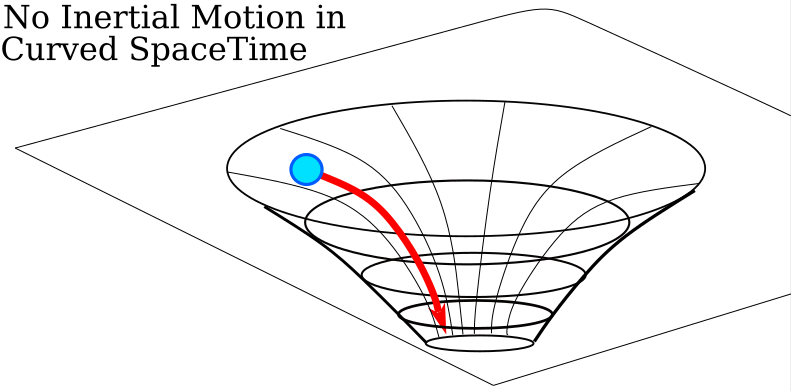
I have had no problem comprehending how curved spacetime would cause a moving object to move in a circular orbit without the application of an arbitrary force, but I’ve always had trouble understanding why a stationary object would move under the influence of gravity. It is not taking a straight line path anywhere regardless of the spacetime curvature it lies in. Why do we experience gravitational force if we are not on an inertial path? The answer I’ve been given is in that case, the object falls down the gravitational well–to which I respond, that’s no answer, you are using gravity to explain gravity! A more rigorous answer will show a path that seeks the lowest energy using something like a Lagrangian equation solution. But I still ask, why would potential energy be higher the further you move away from the gravitational well? It’s still using gravity to explain gravity.

In the last few posts, I have postulated the existence of an Activation Layer, a 3 dimensional slice of 4 dimensional spacetime. This activation layer shows why we only observe objects and interactions at one point in time at any point in time. I worked out some basic principles and properties of this activation layer, and then demonstrated the resulting futility of doing time travel. I showed that the activation layer would have to curve along with spacetime near large masses such as a planet or star, and that the activation layer has to continuously move forward in the time dimension, even if that dimension has been curved due to nearby masses.

I found that the activation layer provides an elegant solution to the gravity problem I describe above. I suddenly realized that even if an object is perfectly still, it will still be residing in the activation layer, which is constantly moving forward along the time dimension. There’s the path we needed! Look at the diagram to see how the activation layer will always tilt toward the gravitational well no matter where the object is. Since the activation layer is always moving forward in time, the tilt of this motion will always take the path of the object forward toward the gravitational well. Even with no initial motion in 3D space, the object will experience a force in that direction. (It’s important not to get confused by the apparent time direction of the activation layer out of the gravitational well–this is an artifact of drawing a 4D image on a 2D surface).

What’s so neat about this is how the activation layer concept shows why gravitational forces emerge from nothing more than curved space time plus the basic axiom that the activation layer always moves forward along the time dimension, even if that time dimension is curved.

Agemoz

Space-Time Activation Layer

February 8, 2023

In my last post, I described the well-known idea that a wormhole connecting past and present via the folding of spacetime is believed to allow travel to (or direct observation of) a past point in time for an observer. I predicted that the outcome will be disappointing, because while it should be possible to travel to a past point in time, I argue that there will be nothing there.

As I discussed, this is because R3 + T spacetime cannot be a complete description of our world–we are also constrained by something I called the activation layer. This activation layer is a three-dimensional slice of our four dimensional spacetime and our interactions and observations are confined within this slice. This activation layer is a necessary constraint for an observer to only see at one point in time (rather than seeing an event at all points in time simultaneously).

I found it odd that you can find physics papers and texts on every conceivable subject except this one. To me, this is an obvious constraint on our ability to observe our existence that is sitting right in front of our noses, yet as far as I can see, no one studies it! I have a pile of physics texts, such as the MTW Gravitation text, and I see no hint of this constraint even under some other name. Perhaps you all see something obvious here I’m missing.

So, let’s take a brief tour of the properties this thing, the activation layer, must have. There’s some easy observations we can make–low hanging fruit, to use a cliche.

It has to be a three dimensional surface that cuts 4D spacetime in half–the past (negative time), now (0 time, a 3D “plane”) and the future (positive time). The zero time “plane” is the only point in time we can observe or interact. Note that I’m specifically not referring to an observer’s lightcone, which is the set of possible spacetime points he eventually could interact with given the passage of time.

Is it flat–an Euclidean slice through spacetime? Of course not, otherwise the curved spacetime of general relativity is going to cause major-league observational contradictions as observers see constantly varying time points throughout space. The very nature of the activation layer means that observation of objects will pop in and out of existence in curved spacetime (the same reason why time travel to a past time will show nothing there).

Is the activation layer the same for every observer or is it a property that varies from observer to observer? Once again, if it varies between observers, then you can set up situations where some observers will see something that other observers will not. Conservation laws say it has to be common to every observer, even every entity, in the universe.

Does the activation layer move? Well, this is a bit semantic, since we observe that time passes, that objects move, and so on–kind of a recursive question about the activation layer that mathematicians love. However, I will just reply that since we observe clocks progress, not regress, everywhere in space, and there are no exceptions we can see–I am going to define every point in the activation layer at time 0 moves forward along the time dimension, even if this dimension curves or varies in direction and velocity depending on where you are and how you are moving in space. What it means for a layer to “move” along a time dimension is a really complicated concept to grasp.

Does the activation layer possess energy or is it affected by force? Now we are starting to get at the heart of how our universe works with this question. Another way to ask it is simply–Why is it there? It’s clear that the stress-energy tensor has to affect its curvature, so concentrations of any forces in a region are going to also affect the layer. However, forces will only affect it indirectly, by curving the spacetime it lies in. Asking whether it possesses an energy or mass is a really interesting question, I’m going to continue to study that idea. I suspect the answer will be no, otherwise there should be cases where the activation layer would exert gravitational force that should be observable, for example, around a black hole or in large scale cosmology.

Lastly, for now, how does this affect our quantum theories? From what I know, all quantum interactions, including entangled particles, must lie within the activation layer of spacetime. You cannot have entangled particles at the same physical point but one is in the past and one is in the future. Wave interference is clearly confined to within the activation layer, but we see quantum field theory suggesting past/future wave and elementary particle interactions. The activation layer is going to have significant implications that I am just beginning to think about.

Could the activation layer give us clues how to connect relativity and quantum theory? Could it give us insight into why gravity does what it does? I don’t know at this point. It certainly seems like the activation layer, right in front of our noses, needs to be studied. I’ll continue down this path for a while.

Agemoz

No Time Travel

February 1, 2023

One of the interesting aspects of the idea that elementary particles are twists in a field is how it impacts the idea that we can travel to a past time via a wormhole. The existence of wormholes is possible because the math of general relativity allows deformation of spacetime in such a way that past points in time are reachable via a path normal to our spacetime. This path could be constructed via a wormhole formed from a black hole or other gravitating object rotating at extreme speeds.

However, I make a prediction that if you do that, you will be disappointed. Barring disintegrating forces disrupting your travel plans through the wormhole, the unitary vector rotation theory, hypothesis, whatever you want to call it, says you will find nothing there. You can prove that the wormhole truly has taken you to the desired point in your past, you can ensure that time dependent spatial translation has not displaced the expected destination in spacetime–but you won’t find anything there, certainly no copy of you from the past. It’s not that rules of general relativity prevent you from talking to your past you, it’s that there really won’t be anything there!

While spacetime theory (special relativity) shows the interchangeability of space and time depending on properties of the observer (in particular, velocity), and general relativity shows how time deforms in the presence of nearby mass-energy objects, there is an additional property of the time dimension that constrains where an object will reside. This might be called an “activation layer” that exists in four dimensions (R3 + T) and can be thought of as a three-dimensional “plane” sweeping through spacetime. This activation layer is why we don’t experience all times at the same time.

Interstellar tries to say there is a place where an observer will see all objects and their relative interactions at all times–but this cannot be the whole truth. What actually would be seen is something akin to the watching the flame of a burning fuse move along the path of the fuse–objects only appear within the activation layer sweeping through the time dimension. Outside of that layer, spacetime reverts to a stable background state. Indeed, while this is one of the fundamental principles of the unitary vector rotation theory, the fact that an observer can only be aware of one and only one three dimensional layer of our four dimensional spacetime means that any theory has to have some variation of this activation layer in time. Indeed, this activation layer is a fundamental requirement for consciousness, but that’s a subject for another post.

So–if you travel in time via a wormhole, yes, you should be able to go to where you were in the past, but you won’t be able to send or receive communication to your past self–you won’t be there! Sorry, Kip! It doesn’t work that way! This activation layer will not be there anymore. The activation layer where you are now, but no longer in the past.

There should be a thought experiment that will prove this. Suppose you are on earth, and there is a strong gravitationally lensing blackhole some safe distance away, such that actions on earth curve back to earth for observation. Let’s say this distance is one light year away. Suppose there also is a nearby (to earth) wormhole connecting directly to your location on earth two years in your past. Now, on earth, you pulse a flashlight. Now you will have to wait two years before the gravitational lensing allows you to see the pulse of light. But wait! Would you also see a flash two years later through the wormhole?

I predict, no, you won’t. The black hole will lense the flash two years later because the *image* takes two years to travel to you. But the wormhole will show an image of what is there two years in the past along the time dimension, when the activation layer is long gone. You won’t see anything there.

Agemoz

The Stable Point Particle Solution for Protons and Neutrons

November 13, 2022

Charged point particles are very interesting because there’s only a few ways to produce stable (static) configurations of them. You cannot create a 2 particle solution or 6 or more particle solutions. Only three solutions exist: an in-line 3 particle solution, a 4 particle solution, and two 5 particle solutions (see the last few previous posts).

UPDATE: I have found that these charge stable particle solutions fall into a single class of solutions with one or two center particles, where the remaining particles have opposite charge and are equally spaced on a sphere about the center particle(s). If there are two center particles, they have to lie equally spaced on a line normal to the plane of a circle on the sphere (therefore, the three particle solution cannot have two center particles since three particles define a plane). I’m continuing to see if there are any other stable solutions, but after quite a bit of thinking, I see no more. The set of stably charged solutions is really small–there is only this class of solutions and no others–and it does appear to have a curious, possibly interesting, mapping to quark combinations as mentioned in the rest of this post.

Continuation of the original post:

This gets really interesting when applied to electrons and quarks. If you do a little “quark algebra” like this (I’m ignoring the relatively tiny neutrino component):

proton = u + u + d

neutron = u + d + d, which decomposes to a proton, e-, and neutrino -> u + u + d+ e- + O(0)

this leads to

d = u + e-

which then gives

proton = u + u + u + e-

neutron = u + u + u + e- + e-

These match two of the available stable charged point particle configurations, so I got very interested in studying this construction–seems like there might be a path to some kind of truth here. However, computing the traditional inter-particle forces q1q2/r^2 gives the required charge for the up quark that is not 2/3, but sqrt(3) electron charge.

I studied this for a while to see if my Schroedinger wave solver would give some insight, but it didn’t. It did show that one solution is to add a momentum term to Psi for the up quark (implying an orbital), but this did not get anything close to the expected up quark charge.

This problem (getting the correct value for the forces involved) is analogous to the quantum field issues encountered in the electron-photon interaction, and thus is likely to be a hard problem to solve. For example, I am assuming a shielded electron charge, ignoring creation-annihilator effects, ignoring vacuum polarization, ignoring well-researched strong force implications, etc, etc.

Nevertheless, I continued my thought process–I looked in detail at the development of the electron-photon interaction in quantum field theory. It establishes that charged attraction/repulsion is mediated by quantized photons, either virtual or real. On the macroscopic scale we model attraction with a central force (1/r^2) electrostatic field. At the quantum scale, I think there is evidence that something different happens.

I see a very important key with this discovery: any linear force granular particle interaction will always obey the central force property for far-field interactions simply because there is a 1/r^2 diminishing number of particles per square area as you move away from the source emitter. The particle current density in expanding spherical shell surfaces drops as 1/r^2.

This leads to a really important corollary: Individual quantized point particles cannot interact with a central force behavior but must interact linearly with r, otherwise the overall granular central force behavior would produce a composite function that is no longer central force.

This is why I hold the belief that quantum field renormalization is an unnecessary correction for the infinities resulting from central force (1/r^2) functions in quantum field equations as distances approach zero. Renormalization (for example, setting an r threshold or subtraction of infinities to make solutions workable) should not be necessary if we understand that electrostatic forces have a far-field central force behavior (1/r^2 dependence), but in the near-field quantized case must have a linear interaction behavior.

This near-field linear behavior also substantiates my view that the electrostatic central force equation q1q2/r^2 is not the right formula for the stable 4 point particle configuration, they must interact as q1q2/r. With this correction, we now get closer to the required 2/3 charge for the up quarks.

Feu = 2/3 * 1 * sqrt(3) = 2 / sqrt(3).

Fuu = 2/3 * 2/3 * 1 * 2 * sqrt(3) / 2 = 4/3 / sqrt(3))

Now the classical intra-proton quark forces, which must sum to zero if the up quark charge is 2/3, is off by an extra factor of 2/3. I have a number of approaches underway to address this.

One hint comes from unit analysis of the coulomb unit of charge.

Coulomb(SI units) = m/s sqrt(m) sqrt(kg)

There is no physical meaning to a square root of distance (or mass, for that matter) which says to me that charge only has meaning in context with another charge. I did some work a couple of years ago that suggests that near field charges emit and absorb exchange photons that results in a linear force due to point-particle wave interference: see this post

https://wordpress.com/post/agemozphysics.com/1295

I’m going to investigate using this approach on the 4 point-particle proton and see if I get insight as to how charge would work and if I get a correct up quark value in this near-field context.

Agemoz

PS: It is very interesting to me to think about gravity in context with the above-mentioned granular-particle rule and the corresponding central force corollary I discuss. Gravity is, of course, another central-force interaction–but to the best of our knowledge and observations, unlike quantum particles, there is no evidence of linear gravitational behavior at any scale, massive or tiny. I think this may be evidence that gravity is not quantized.

Schroedinger Solver Progress For Proton

November 8, 2022

I have found that static point particle charge configurations are rare, and happen to match a geometric construction of quarks in a proton and a neutron. Static charge configurations result from combinations of positive and negative charges that are arranged in stable configurations. There are surprisingly few of these. It is easy to show that in 3 dimensional space (R3) there are no possible two particle solutions, and also that there are no solutions with 6 or more particles. There is a single in-line 3 particle solution, one four particle solution, and two five particle solutions.

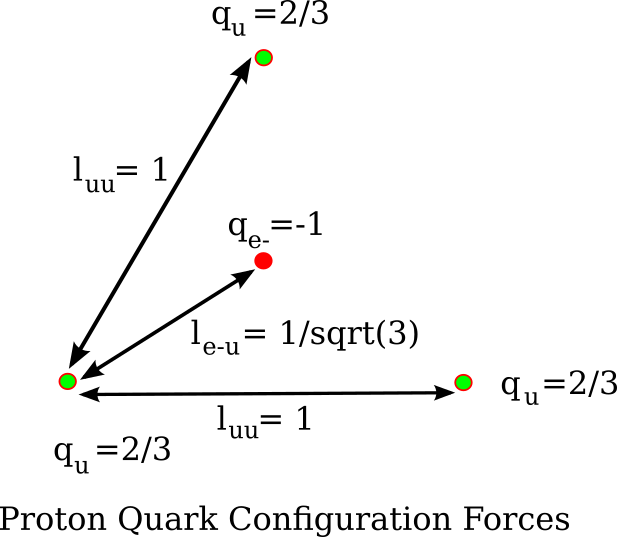
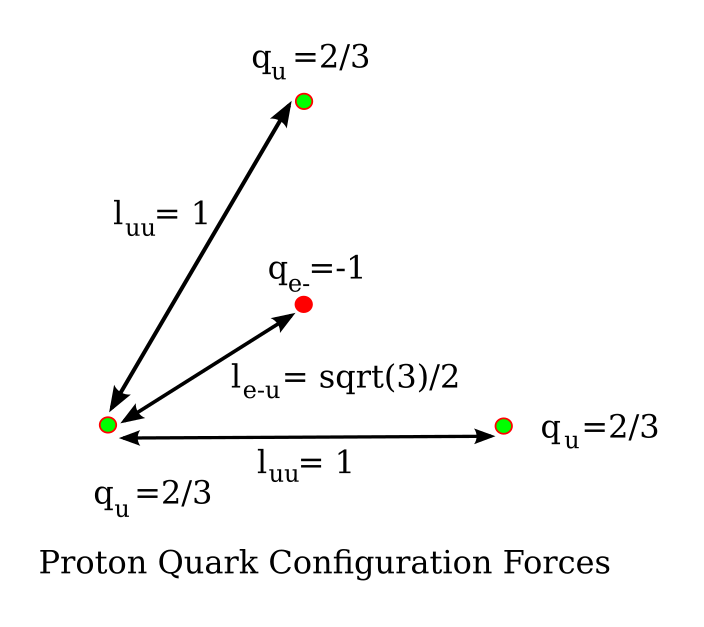
What got me especially interested in this line of thought was that a little bit of quark algebra shows that protons and neutrons exactly match the four-particle version and one of the five-particle solutions (see the previous post here for details). I then computed the required charges to form a static configuration for these cases, and thought I came up with the 2/3 charge (relative to the electron -1 charge), but after a lot of rechecking I found some mistakes and realized the required charge value is close, but but does not match. See the updated configuration figure below with a corrected le-u. I’m no fan of numerology in physics, so that seemed to blow this exciting idea out of the water–everything has to work right for this concept to be true.

If you look at the figure, you can see the four particle solution, which is a center e- surrounded by three up quarks in an equilateral triangle. The charge forces don’t balance unless the charge is larger than the electron charge, not 2/3. Setting the charge of the up quark to +2/3 results in a force from the electron to the quark of 2 versus a force from the up quark to the other two up quarks equal to 4/(3 sqrt(3)). Numerically the magnitudes are 2.0 versus 0.77, but these have to be exactly equal to produce our geometrically static stable configuration of point particles.

update: arrgh! fixed le-u again, had it right the first time…

I realized that I was applying a classical force model to a quantum wave function system, so I did some simulation work using my Schroedinger wave solver to see if all this would come together to produce the expected charge for this quark construction of the proton and the neutron. This work immediately showed that my static configuration cannot produce a solution unless a momentum term is added. Unfortunately, this complicates things because now we can’t just work with normalized charges–we can assume that the three up quarks orbit the center electron, but now the units involve a momentum term that has no charge factor, so the computation gets more detailed. The momentum term has the usual Schroedinger equation Planck’s constant squared over 2*mass factor, which has to be normalized to the actual charge factor–and now the solution is dependent on radius, the distance between particles in our 4 particle triangle configuration.

The problem has become somewhat more complicated and will require more study which is now underway.

Agemoz

Protons and Neutrons Have a Geometric Quark Solution in R3 + I

October 9, 2022

Update: oops. The charge doesn’t come out to exactly 2/3 for the vertex particles. The geometry of charged point particles is very constraining, but the four-particle case leads to a charge that is not exact. Oh, that was a disappointment! I’m rechecking, but looks like this is less useful than I thought.

Update #2: Actually, this result is not surprising–I made the common amateur mistake of applying a classical equation to a quantum (wavefunction) problem. Duh. I’ll be attempting to put the force equation into the Schroedinger wave solver and see what it shows. I don’t want to abandon this work since the matchup of the valid point-particle geometries to real-life quark combinations is still very interesting. The number mismatch is definitely due to using a bad computational methodology, so I don’t want to give up on this.

While it doesn’t really affect anything, I did discover another stable 5 particle solution, a tetrahedron of four particles surrounding a center particle of opposite charge.

(original post) The last month investigation into the R3 + I twist vector field has led to some very interesting insights, such as how particle quantization would work, and why there are 4 elementary point-particle variations, one for each of the spin-up and spin-down electrons and positrons. Quantized photons have their own in-line twist model, where R2 out of the R3 + I provides a frame-independent polarization. Then I made the wonderful discovery that we don’t have to make up a new I rotation dimension for this whole approach–we already have it in the time dimension of spacetime.

So, with this new infrastructure I went back to the Schroedinger Equation problem of protons and neutrons. Previously, I used charged elementary particles (up and down quarks) to attempt to find a time-independent solution. As I reported about a month ago, there are none. But, using my new R3 + I (spacetime) study, I was able to work out a different type of solution that looks very promising.

I did something different this time. Rather than starting with the u,u,d quark configuration of protons, I also looked at free neutrons, which will decay into a proton, an electron, and a neutrino. The neutrino is a very small part of the total proton energy, so if we ignore it (this is one reason why mathematicians dislike physicists 🙂 then we get a different way of constructing the proton. This is just charge geometry. I am pretending the strong force is not at play here, which should be OK if the proton is a lone free particle.

If a neutron is a d,d,u configuration, but decays into a proton plus an electron plus a neutrino, then we could say that

proton = u + u + d + e- + O(0) = neutron = u + d + d

this leads to

d = u + e-

which then gives

proton = u + u + u + e-

Now, there are two statically stable multi-particle configurations, one with four particles and one with five. You can also get one case with three particles in a line, which I investigated a few months ago–but the Schroedinger Equation solver showed no solutions, so I had to rule out that case. Let’s look at the four particle solution:

This is statically stable only if the force between two vertex particles of the triangle is equal to the force from a vertex to the center particle of opposite charge. Let us arbitrarily set the distance between vertices of our equilateral triangle to 1(the ratio of the forces is independent of r, so it doesn’t matter what we set it to). The force between charged particles is proportionate to q1 * q2 / (r * r), so if we put our u particles at the vertices and the e- at the center, the force between the vertex particles is

force(u to u) = 2/3 * 2/3 / (r(u to u) * r(u to u)) = 4 / 9

Now, the force from a vertex to the center particle e- uses an r that is sqrt(3) / 2, so we get

force(u to e-) = 2/3 * (-1) / ((sqrt(3) / 2) * (sqrt(3) / 2)) = 2/3 * 4 / 3 = 8 / 9

Now, don’t forget that each vertex has two other vertices to provide a force component, so lo and behold,

force(u) = -force(u to e-) = 8/9

and thus now we have a stable configuration, the only one possible. You can put whatever you want for r, as long as the vertex charge is -2/3 of the center charge, you will always have a stable solution. Mass doesn’t matter–it affects acceleration, not force, so since this is a static configuration, mass has no effect on the result. This geometry shows why up quarks have to be 2/3 the charge of electrons!

If you look at the neutron using this same analysis, you will get a u + u + u + e- + e-. It turns out there is only one stable 5 particle solution, can you find it? It’s a fun exercise!

Agemoz

The Equivalence of the Quantizing R3 + I Twist Field and Spacetime

October 1, 2022

Over the years, I have painstakingly worked out how adding a background state directional dimension to R3 enables integer rotations in the field that are quantized. This quantization enables things like quantum photons that observe E=hv and other quantized particles–and recently, I discovered that in R3 + I, point particles have four spin permutations, thus forming a model for the electron variations (spin-up and spin-down electrons and their antiparticles).

In all of this work, I didn’t really consider time as important in developing the rotation state quantization from the R3 + I field. It wasn’t really relevant to the question of point particles or particle quantization. But in the back of my mind, I kept thinking there is something awfully familiar about the properties of the R3 + I field. You probably all saw it before I did, but it suddenly hit me that spacetime has the same (x0,x1,x2,t) vector arrangement as my R3 + I vector rotation field. And, the t component in spacetime, while considered a dimension, is constrained differently than the spatial dimensions–as observers, we are unable to move backwards or forwards in time like we can in space. The dimensional aspect of time shows up in relativistic frame-of-reference situations, where, for example, different observers see different event simultaneity times.

Ignoring the field warping caused by general relativity, spacetime is covered by Minkowski four dimensional geometry with Euclidean axes described by the (x0,x1,x2,t) vector. The rather astonishing discovery I made was that allowing Minkowski field rotations to default to the t dimension direction, quantized twists can form and point particles can exist in the four electron variation forms.

We don’t have to make up a new +I dimension–spacetime itself can form quantized particles and four electron variations!

Agemoz

Point Particle Spin in R3 + I and the Electron Variations

September 29, 2022

Electrons come in four variations: spin-up e-, spin-down e-, and their antiparticles, spin-up p+ and spin-down p+. They all are, to the best of our knowledge, point particles and have precisely the same mass and charge magnitude. Throughout the history of physics, DeBroglie and many others tried to create dipoles and other (non-point) configurations to explain these variations but all fail to match experimental observation.

Point particles are a difficult model to work with geometrically in 3D space (R3)–there’s few properties you can assign to a point particle that would model the four electron variations. Even geometric spin is a questionable attribute unless the particle is assigned spin in the limiting case as the radius goes to zero. Even in that spin case in R3, there is no way to get the four variations just from spin because we must observe gauge/frame of reference invariance. You can’t even get two variations in R3! There’s always an observer transform (rotation or displacement) that will transform any given spin orientation in R3 into any other possible spin orientation. In R3, you only can have one electron variation, not the four that we observe.

The R3 + I case is a completely different situation. Point particles do really interesting things in R3 + I!

In the previous post, I make a case that rotations in R3 plus an additional background state rotation direction orthogonal to R3 enables both particle quantization and continuous field twists. It also opens up a completely different–and really interesting–situation on point particle spin. I discovered that there are exactly four possible unique combination spin cases that are topologically distinct and thus are gauge invariant–you cannot perform a rotation, for example, to turn a particle from a spin up case to a spin down case. We can cover the four electron variations in R3 + I!

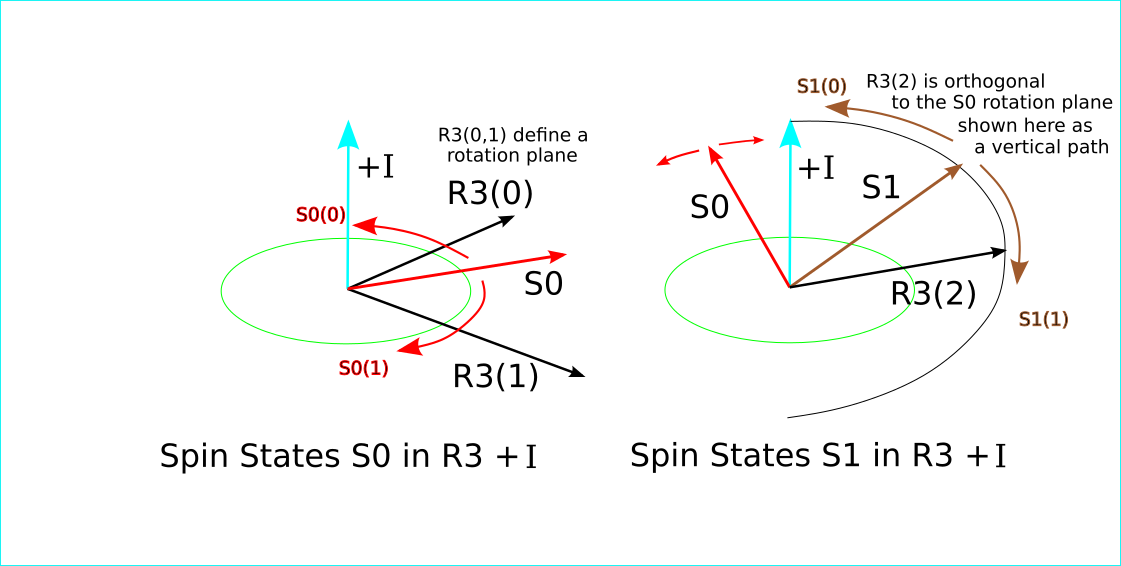
Here’s an explanation: The first thing to note is that this won’t work in R4 (four dimensions) unless one of them is a background state +I. That is, for this scheme to work, you have to have R3 + I. To quantize rotations, there has to be a preferred (lowest energy) rotation state that I label as +I (see the previous post for more on this). This assignment is also necessary to get four unique spin cases. If you have this +I background state, then you can anchor a rotation about it in either the clockwise or counterclockwise direction. These rotations are topologically unique–you cannot transform one into the other by rotating or otherwise moving the observer. This spin state consumes two of the three dimensions in R3, and I will call this set of spin states S0.

For any rotation position in this R2 + I (S0) case, you can use the third R3 dimension to add an additional orthogonal rotation, let’s call it S1. By itself, S1 isn’t helpful, because the S1 spin cases will not create a unique new spin state for the point particle–the apparent spin will go from clockwise to counter clockwise just by moving the observer to the opposite side along the current S0 direction. However, I discovered that the S0 spin path provides an anchor for S1 because it is spinning–the crossproduct of the R2 + I spin axis S0 rotation direction with the rotation using the third dimension from R3 (S1) will be unique and frame-of-reference invariant in four possible ways. R3 + I thus has four possible point particle variations that would model the spin-up and spin-down e- and p+ elementary particles.

Here I attempt to show a picture of S0 and S1–since I’m representing four dimensions on a two dimensional projection, this will take a bit of imagination to work out what I am trying to show.

A Representation of the S0 and S1 Spin Cases for a Point Particle in R3 + I

In conclusion–point particles aren’t very useful for modeling elementary particles in R3, but in R3 + I, they lead to a very different and interesting situation. R3 + I can exactly represent (no more, no less) the four unique spin cases that model the four electron variations: spin-up e-, spin-down e-, spin-up p+, and spin-down p+.

Agemoz