In the previous post, I posited that the difference between radiation pressure and charge force, both of which are mediated by photons, is due to different properties of photons. Radiation pressure is due to the ability of massless photons transferring angular momentum from a source such as atomic electron state changes to a destination (which also could be an atomic electron that changes state). Charge force cannot be the result of a momentum exchange, otherwise energy would not be conserved–charge forces exert continuously in all directions simultaneously. Nor could you have attractive forces, since momentum transfer is observably always positive, not negative. To address the fact that we know charge forces are mediated by photons, but cannot be transferring energy, I had posited that quantum interference (which redirects particle paths without expending energy) is responsible for charge force. This scheme does allow for negative momentum transfer necessary for charge attraction. However, I now see that this approach cannot work, at least in the way I have proposed.
A problem with this idea is that quantum interference requires identical frequency waves from two sources, or from the same source but via different paths. I can readily model charge attraction via quantum interference in my simulator (see many previous posts on attraction force simulations). However, this approach gets into trouble for two reasons–one is that charge is constant, but waves from a source particle can Doppler shift if the source is moving relative to the destination. If charge forces are due to quantum interference, the wave and the destination particle will have to have the same frequency when they meet, and Doppler shifting of a moving source particle means they won’t have the same frequency and won’t interfere.
The bigger problem with this approach comes from trying to explain the central force behaviour of charge. I had assumed that charge force, which decreases as the square of the distance from the source, was a result of the granular distribution of photons from the source. Any given neighborhood volume at a radius r from a source is going to occupy a percentage of the total surface area at that radius r. If there is a fixed emission of photons from the source, there will be a fixed distribution of photons within a surface area that varies as r^2, hence the central force dropoff of charge force (a generalization results than any system with quantized particles will observe central force behaviour). If the charge force is mediated by quantized photons, this works–but that cannot be, because then you have energy transfer that would dissipate the source mass. But if quantum interference of waves is the cause of charge force, then you don’t have particle quantization needed to get the central force 1/r^2 dropoff in charge field strength.
This is a variation of the quantum wave vs. particle dilemma. Photons act like waves or particles depending on the circumstances. However, neither particles (quantized photons) nor waves (quantum interference) explain charge forces. It appears to be some combination of both. Further work is needed before a satisfactory answer is found.
In the previous post, I described an asymmetry between two types of photon interactions–the fact that radiation pressure and electron level changes in atoms are repulsive only, but charged interactions can be attractive or repulsive. I hope you will take a moment to read it–it really is an interesting question. Quantum field theory addresses this issue mathematically, but does not answer why this asymmetry exists.
I will summarize that post as follows: Charge forces can be either attractive or repulsive, but radiation pressure is only observed to be repulsive, away from the emitter. The unitary rotation vector field theory (for which I’ve been writing a simulator) posits that there should be attractive radiation pressure via a new particle, antiphotons. I discussed in that post several other justifications for antiphotons that do not rely on believing in the validity of the unitary rotation vector field approach. These justifications essentially state that charge attraction requires that negative momentum be transported from source to destination via particles or field entities that have no momentum of their own.
The unitary rotation vector field describes specifically how this works, using the premise that electron/photon interactions are exchanges of angular momentum, either negative or positive.
However, there is no experimental evidence for antiphotons other than electrostatic attraction, so I became concerned that this is not the real reason for the force directional asymmetry. This post continues that line of thought with an examination of what the unitary rotation vector field idea says about the two types of photon mediated forces. While the theory does allow for negative momentum carrying particles called antiphotons, further investigation hints that this is not the cause for the force asymmetry. Rather, the two photon interaction forces are fundamentally different–one results from photon angular momentum exchange and the other is caused by quantum interference.
Both forces (charge and radiation pressure/electron level transitions) are said to result from photon exchanges and/or photon creation/annihilator operators. Radiation pressure and atomic electron level shifting clearly result from quantized photon packets and are observed to exchange only positive momentum (i.e., are repulsive forces). Energy is conserved as quantized exchanges in these cases.
Charge is different. There is no momentum or energy exchange. Imagine a single positron surrounded by a vast quantity of electrons in all possible directions. Computing the electrostatic force on each electron includes a full charge attraction contribution from the positron (along with a vast quantity of repulsive contributions from all the other electrons). This thought experiment seems to show that there cannot be energy flow in charged interactions, since there would have to be photon exchanges from the positron to each electron simultaneously, an energy flow that easily could vastly exceed the rest mass energy of the positron.
So what is really going on in charged interactions? One possible answer comes from the unitary rotation vector field theory–it is quantum interference between the source and the destination particles. This theory posits that particles form in a single-valued, unitary magnitude rotation field with a background state in a direction orthogonal to R3, the I dimension. Particles are group wave constructs composed of one or more “poles”, quantized single twist rotations from +I and back again. As a group wave, the particle is defined as a peak amplitude magnitude region and its location can be affected by waves from other sources without an expenditure of energy (for example, the relocation caused by quantum interference in the two-slit experiment). The simplest such particle is the one pole photon, a linearly propagating twist; two pole systems can form closed loops, because the waves from each pole form interference patterns (quantum interference) that reposition the pole location. A single pole photon has been demonstrated (see many previous posts) to momentarily shift–via quantum interference–the location of an intercepting two pole closed loop (an “electron”). I hope you will go back several posts and look at my simulation results that beautifully demonstrate this group wave position shifting behavior:
In this theory, an answer to the asymmetry of charge force bidirectionality versus observed unidirectional radiation pressure or atomic electron level change emerges. Simulations show that the twist is a stable state that forms R3 waves around it. Radiation pressure energy transfer (exchange of angular momentum) exerts repulsive forces only when a closed loop set of twists intercept a single pole photon. But charge interactions don’t work this way–instead, the spherical wave surrounding the twist photon form an interference pattern just like that of the two pole closed loop. Like other quantum interference scenarios, no energy exchange happens, instead the interference pattern forces the destination particle to exist in a nearby position either toward or away from the source emitter. Both attraction and repulsion are possible depending on the relative phase of the waves to the destination.
Further work here is needed to ensure that charge is relativistically invariant in this model.
So, to summarize what the unitary rotation vector field is telling us–radiation pressure and electron level changes are caused directly by angular momentum exchanges, and the photon is created or destroyed in the process. Charge forces are caused by quantum interference between the source and destination particles and no momentum is exchanged! The two types of forces are both the result of photon characteristics, the former due to the angular momentum of the photon, the latter due to the quantum interference wave pattern radiating from the photon. The unitary rotation vector field shows that antiphotons should be possible, but are not necessary to explain the directional asymmetry of charge and radiation pressure forces.
One of the interesting asymmetries in physics involve photons and charged forces. Photons have been observed to carry positive momentum from an atom to a detector (for example, another atom with electrons that can be knocked free, forming an electric current that can be measured). We can also measure the radiation pressure of photons, always exerting force away from the source. Finally, we can observe photon interactions in the form of electromagnetic forces between particles.
Charged forces are attributed to photons, both real and virtual, and are measured to be either attractive or repulsive. By symmetry, I would expect photons could also carry negative momentum, observable in antimatter atoms emitting antiphotons or as negative radiation pressure toward the source emitter.
We see negative momentum via charge attraction forces, but we don’t see attractive radiation pressure. Hence, I thought it logical to assume the existence of negative momentum photons–antiphotons.
I actually arrived at this conclusion from a different path–the photon model in the unitary rotation vector field theory has neither mass or momentum of its own but can carry either positive or negative momentum from a source to a destination. For this reason, I predicted the existence of antiphotons, but shortly thereafter realized that even if you don’t believe the unitary rotation vector field theory, antiphotons should exist by symmetry.
That was a daring statement to make–and it makes me nervous, because we’ve done enough high-energy particle collisions with antiparticles that I would have suspected we would have seen evidence of antiphotons. Both the asymmetry of the photon mediating charged interactions and the promising studies of the unitary rotation vector field suggest that antiphotons should be common in antiparticle interactions. In addition, the lack of antimatter in the universe strongly suggests an asymmetry in how gravity and radiation pressure affect formation of stars. Stars cannot exist without a balance of radiation pressure and gravity–if radiation pressure is negative, it will not form a stable state with gravity to form stars.
So, lots of good evidence that antiphotons should exist–so why don’t we see them? Either they are really hard to distinguish from photons, or are really hard to generate, or they don’t exist. I’ve put a lot of thought into this, and realized that studying charge forces using the unitary rotation vector field might suggest the correct answer.
According to quantum field theory, electric and magnetic forces are mediated by photons. Looking at the LaGrange equations of motion for electron/photon interactions, you can get both positive and negative momentum solutions for the photon wave equation, and in the standard model, attractive forces are interpreted to be photons interacting with an EM field via constructor/annihilator operators. In addition, virtual photons can exist for bounded spacetime neighborhoods that don’t conserve momentum.
The crucial question here is–why the asymmetry? Why couldn’t you interpret this in a symmetric way simply by saying the negative LaGrange solutions are simply photons carrying negative momentum–antiphotons? As mentioned previously, there’s many good reasons to think antiphotons should exist. But we don’t! Why not? We have negative momentum charge (attractive forces), but no observed negative radiation pressure, even though both are mediated by photons. We see no antimatter stars in astronomy, strongly suggesting that such stars do have negative radiation pressure, yet we see no evidence of an antimatter protostar cloud collapsing rather than assuming a stable state in the form of a star.
One answer is that antiphotons are hard to detect. An experiment to observe an anti-atom emit an antiphoton is going to be difficult to set up. You would have to have a detector that could tell the difference between an antiphoton and a photon. As I suggested in a previous post, this might be a positron brehmstrallung experiment that measures the tiny radiation pressure from antiphotons generated by positrons travelling through a magnetic field. Maybe the reason has simply been that no one has looked for an antiphoton, after all, we’ve been taught for so long that photons are their own antiparticle, there is no such thing.
Although I thought the derivation of antiphotons from the unitary rotation vector field was clever, I really have doubts. I think we would have seen antiphotons in high energy collisions creating a negative momentum collision track. There’s good reason to believe that antiphotons should exist, yet there has to be a reason why we don’t see negative momentum carrying photons, but do see negative carrying charge forces.
For this to make sense, the answer may be much more controversial: that photon mediated charge forces and photon radiation pressure forces involve photon particles that are different in some way. If photons cannot carry negative momentum, we are forced to conclude that charge forces are not mediated by the same particles as radiation particles–a theory that goes against the well tested Standard Model. Alternatively, we could decide the issue has to do with the difference between photons and virtual photons (or similarly, quantized photons versus the quantized EM field), but it is very clear to me that neither case can explain the observed asymmetry in photon mediated interactions.
I think insight into the question of antiphoton existence and the charge force asymmetry question can be found by looking at the way the unitary rotation vector field addresses these photon interactions. Since this post is already long, I’ll present my observations in my next post.
That should be a controversial title and garner an immediate rejection from every physicist (I have lots of practice with that). However, it appears to be true as a model for our real world! Let me see if I can explain why I think this way.
I have been working on a simulator which models reality using a unitary vector rotation field with instantaneous quantum interference waves (not an EM field, a failed approach tried by many researchers in the past and even recently–reference DeBroglie, Compton, etc). Because this field has a background state, rotations are quantized, and these rotations generate waves mathematically identical to quantum interference components. By default, rotations propagate in R3 on a linear path and are modelled as photons, but two or more rotations can generate interference patterns that can form closed loops. These closed loops are modelled to be stable or unstable elementary particles. For more information on the details of these conclusions, you can reference previous posts on this website.
Two of the most important derivations from this work are the emergence of the constant speed of light from any wave based model of reality (see this paper: group_wave_constant_speed) , and the prediction for negative momentum carrying photons labelled antiphotons, which have yet to be discovered. Linearly propagating field rotations acting as photons (or antiphotons) carry momentum at speed c from source to destination, but being intrinsically massless, do not have any momentum of their own.
It is well known that photons emerge from atoms when bound electrons change state, that is, fall to a lower energy state. Alternatively, the atom can capture an incoming photon by raising the energy level of a bound electron. In the unitary rotation vector field theory, the electron emits a photon as a full field rotation with a specific angular momentum. At first glance, I concluded that the linear momentum of the electron gets converted to angular momentum to a linearly propagating rotation–a photon. When the photon is absorbed, the photon’s angular momentum gets converted to linear momentum in the target particle.
However, I ran into problems trying to incorporate this exchange in my simulation. Essentially, a photon interacting with a target electron (linear momentum exchange) or vice versa, was getting too much energy and not matching reality. I finally figured out what was wrong–the concept of linear momentum gets in the way of reality. There can be no such thing as linear momentum! It is an illusion caused by a particle that consists of closed loop field rotations, that is, it has angular momentum confined inside a finite region.
What actually happens when a particle is observed to have linear momentum is that the particle rotations are waves, and increasing the relative velocity of the particle does not add linear momentum. Instead, it causes the particle component composite waves to Doppler shift (note that in all cases in this post, I refer to classical Doppler shifting, not relativistic). When this Doppler shifted wave strikes some other object, the object receives an energy proportionate to the Doppler shifting, which is directly proportionate to the relative velocity of the particle. The Doppler shifting of the angular momentum of the particle is sufficient to explain the momentum change of the target particle, so the standard physics principle of linear momentum cannot actually exist.
The fundamental discovery here is this: The transfer of momentum from photon to electron or vice versa is entirely a transfer of angular momentum that can get Doppler shifted into higher or lower frequencies and hence higher or lower levels of angular momentum (and hence kinetic energy). Our reality, at least in this model of the universe, does not provide for the existence of linear momentum of objects!
The previous post described the interaction between electrons and photons from both the quantum field theory and the unitary rotation vector field point of view. That post then showed how the unitary rotation vector field predicts that photons carry both positive and negative momentum–a photon has no mass of its own but at emission, converts linear momentum from the emitting particle to angular momentum. You cannot have a particle carry negative linear momentum, but you can have a photon carry negative angular momentum. At the time of absorption, the negative angular rotation converts to negative linear momentum and the target moves toward the source.
This is why a proton can emit photons that cause an electron to move toward the photons flight path source (attraction to the proton). In the previous post, I detail why that happens using the behavior shown in the unitary rotation vector field approach.
QFT, on the other hand, gets this result mathematically from solving the LaGrangian. We interpret that result by creating virtual (off-mass-shell) particles. When confronted with the momentum paradox (shooting photons at a target should always cause the target to recoil away from the photon source), we say that the EM field absorbs the momentum change to cause the target to move toward the photon source.
You can see why I think the QFT interpretation is overly complicated and what I really don’t like is the invocation of YAP–yet another particle–to patch up logical inconsistencies. But here is where the unitary rotation vector field really leads to new insights: We are taught in basic physics that photons are their own antiparticle. We know this cannot be true, because the photons emitted from a proton to a target electron have to somehow be different than photons emitted from an electron–one stream of photons causes the target to move toward the source (electrostatic attraction), and another stream of particles causes the target to move away (electrostatic repulsion). Unitary rotation vector field theory says that in one case the linear momentum to angular momentum conversion generates negative angular momentum, and the other case, positive angular momentum conversion.
This is so interesting because linear momentum is dependent on the direction of particle travel, and thus can never carry negative momentum. But a massless particle such as a photon can carry either positive or negative angular momentum independent of direction of travel. In order for oppositely charged particles to not violate momentum conservation due to attraction, negative linear momentum must be carried via photons and then converting to negative linear momentum at absorption!
This means the old adage that there is no antiphoton, photons are their own antiparticle, has to be wrong. As mentioned above, we already know it is wrong because oppositely charged particles attract each other. Negative momentum must be transported to the other particle regardless of the virtual particle activity along the interaction path. The unitary rotation vector field says there must be photon antiparticles, and thus it should be possible to set up an experiment where correctly generating a stream of negative momentum photons at a target will cause the target to move toward the source.
Physics discoveries are generally worthless without making a prediction of new previously unobserved behavior, and this is my prediction. I think if you could create an emitter, for example, bremsstrahlung from antiparticles such as positrons, you could measure negative photon pressure at a target and prove the existence of antiphotons.
Now here is where this discovery would become incredibly interesting. Photon pressure is a result of the solar wind; it’s behind the concept of a solar sail that could push a spacecraft out of the solar system. It’s also at the very foundation of a star’s existence–photon pressure prevents a star from collapsing into a black hole. Why are there no antimatter stars? Because now the photon pressure is negative (attractive due to emission of antiphotons)–the same direction as gravitational force. There is no equal but opposite force to create a stable equipotential. Antimatter stars must always collapse into a black hole.
UPDATED with more details on the unitary rotation vector representation of the test interaction (see section UPDATE below)
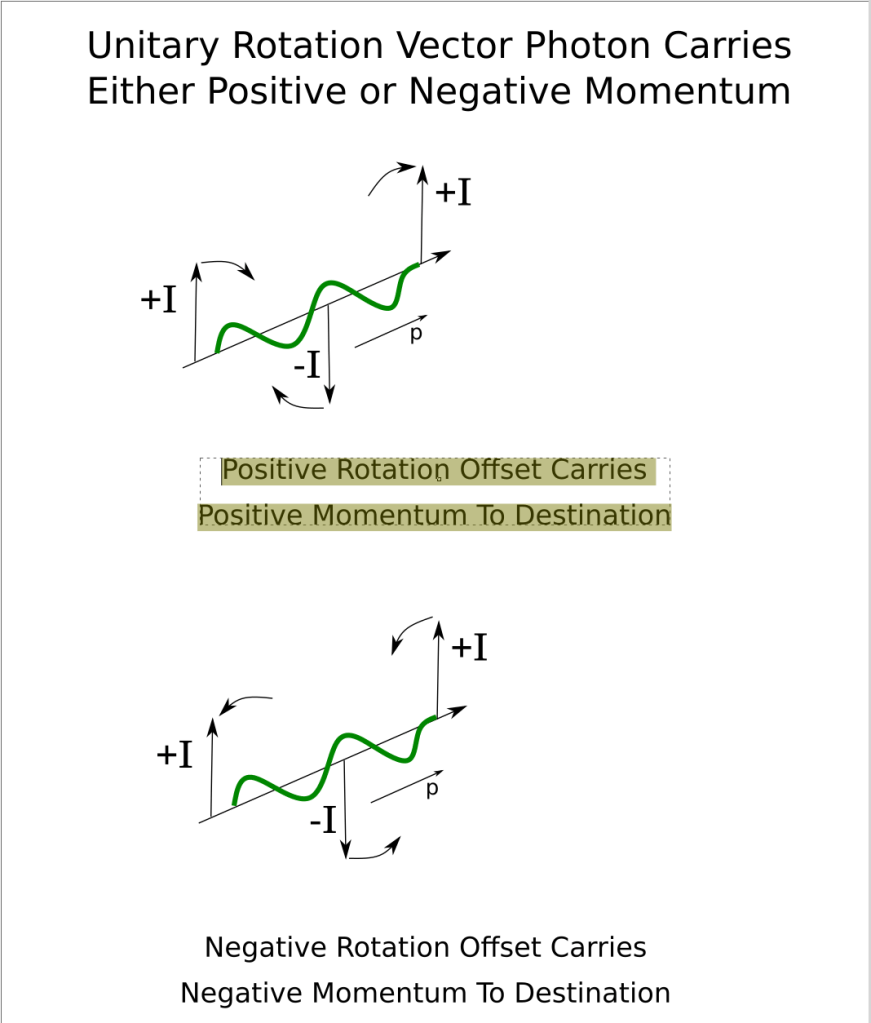
The latest simulations have shown some wonderfully interesting results. The last post showed how the Unitary Rotation Vector Field theory demonstrates particles that can both repel and attract due to quantum interference effects that relocate the stability region of particles. You can read about these results in previous posts, here is a schematic diagram of what happens, along with some sim output pictures demonstrating the principle:
I never intended to create a theory that competes with quantum field theory, but the principle of charge attraction and repulsion traditionally is derived directly from quantum field theory methods. So, it seems well worth the effort to compare the two approaches, and what I hope to gain by analyzing the properties of the unitary rotation vector field. While I have run unitary rotation vector field simulations of many particle types and interactions, I think it will be illustrative to compare how each theory handles the simplest interaction of a pair of electrons (charge repulsion).
Quantum field theory solves interactions like these by using LaGrangian mechanics, that is, minimizing the action scalar. Doing a path integral of the LaGrangian over all paths, and setting the the derivative of the action at all points over time to zero yields a motion equation for the particles in the system. This computation will find the path of minimum action and thus will correctly represent reality. More specifically, the interaction of the two electrons is mediated by virtual photons–particles that do not reside on the surface of valid position/momentum solutions in space and time (off mass shell). By prepending a creation operator to the photon wave equation and appending an annihilation operator after it, quantum field theory creates a solution where the time evolution of the electrons go in opposite directions (repulsion).
On the other hand, the unitary rotation vector field (nearly identical to a Pauli spin matrix representation) gets repulsion and attraction in a different way. Both theories do sums of wave paths to find regions of quantum interference, but the wave equation is different. In quantum field theory, the wave equation is the Hamiltonian–the sum of energies such as kinetic energy and the voltage potential in an electromagnetic field. The creation/annihilation operators are probability functions for emergence of virtual particles. The integral is computed over sufficient time so that an operator isn’t left stranded (virtual particles wont conserve momentum in that case).
The unitary rotation vector field is different–it is single valued with only one rotation possible at any given point, and this constrains where particles can exist (the stability region) because the particle phase and the wave phase must match (see the above schematic).
The wave equations in quantum field theory have wave solutions that propagate over time (for example, the propagator in the La Grange equation of action). Solutions depend on virtual particles that don’t obey classical physics. Quantum field theory can’t work without them because on-mass-shell particles will induce the momentum paradox described in the previous post. Nothing propagates in the unitary rotation vector field–each point just rotates, so conservation of momentum works without inducing the paradox.
Probably the biggest reason I pursue the unitary rotation vector field, rather than just sticking with the established science of quantum field theory? The rotation vector field seems to give another possible view of the underlying mechanics of particle interactions that might yield answers not covered by quantum field theory. The most significant possibility comes from how it postulates a formation of elementary particles from quantum interference in a field. There are other reasons, such as the theory doesn’t require renormalization methods, it doesn’t depend on off-mass-shell particles to work, and doesn’t have a probabilistic dependence on when virtual particles form.
Since quantum field computations work, it’s arguable my efforts are a waste of time (and certainly could be wrong, or not even wrong). But my curiosity is here, and so for now I will continue.
Agemoz
UPDATE: I need to clarify the Unitary Rotation Vector Field representation of the particles involved so you can see exactly how I set up the simulation. There may be other schemes that work, but this is the approach I used in my simulations.
The unitary rotation vector field is continuous and only rotates a unitary vector (like the Pauli spin matrix). It can point in any of the three real dimensions in R3 or in one imaginary direction (the background state of the theory). This is the same vector space as the continuous quantum oscillator field, except that there is no variation in magnitude and you cannot have a zero length rotation vector.
Being single valued, a rotation cannot pass thru from one location to another without affecting each location in the path. As a result, particles must have the same phase as the sum of wave rotations (that is, quantum interference computed as a path integral) at each particle’s location, this is called the particle’s stability region, shown in black on my simulation images. A particle cannot exist anywhere except in a stability region, otherwise the location would have to simultaneously have two different rotations. Particles are forced to move when the stability region moves–a well tested example is quantum interference resulting from a single particle passing through two slits.
Each field location can be represented by a set of three rotation values–one straightforward basis is a rotation set that resides in the plane that includes the I dimension and the X direction, a rotation that includes both the X and Y directions, and finally one rotation that includes both the X and Z directions. My simulation uses this basis. All rotations are modulo 2*Pi (the simulation values go from -Pi to +Pi).
A photon in this theory is modelled with a single quantized vector rotation from the +I direction thru -I and then continues to +I (see the image figure below). There is a lowest energy state at +I and -I, so once the rotation does one rotation, it stops. The photon also has a translation along some real dimension axis.
In the interaction of a photon and electron shown in the above simulation pictures, the photon induces either a positive or negative rotation offset to the receiving electron, which causes the electron stability region (via quantum interference) to displace either above or below (attraction or repulsion respectively). The photon must be able to carry a positive or negative momentum. You can see that the rotation must lie in the plane that includes both the +I and the translation direction vector (otherwise you will not have photon polarization using any other rotation scheme). Note that there are two possible rotation directions–either rotation begins moving toward the direction of travel, or away from it, corresponding to the two possible rotation offset directions intercepted by the electron.
The really interesting thing about this configuration is that the photon becomes a momentum carrier, but intrinsically does not have any actual momentum due to its translation. The source particle emitted momentum is carried by the photon’s rotation but the photon has no momentum of its own (consistent with the fact that photons are massless particles). This is what allows photons to pass along either negative or positive momentum without inducing the momentum paradox. That is, shooting a massive particle at a destination particle cannot ever cause attraction, but photons can.
This seems to be a much better scheme for how photons carry electrostatic force than the virtual particle scheme used in quantum field theory. Virtual particles are just assumed to not obey momentum/position conservation from creation to annihilation, which means I can’t simulate it. I can only define the interaction as a black box. It computationally works, (there’s no way ever that I would say quantum field theory is wrong!!!) but my goal is that the unitary rotation vector approach could lead to a deeper understanding of particle interactions.
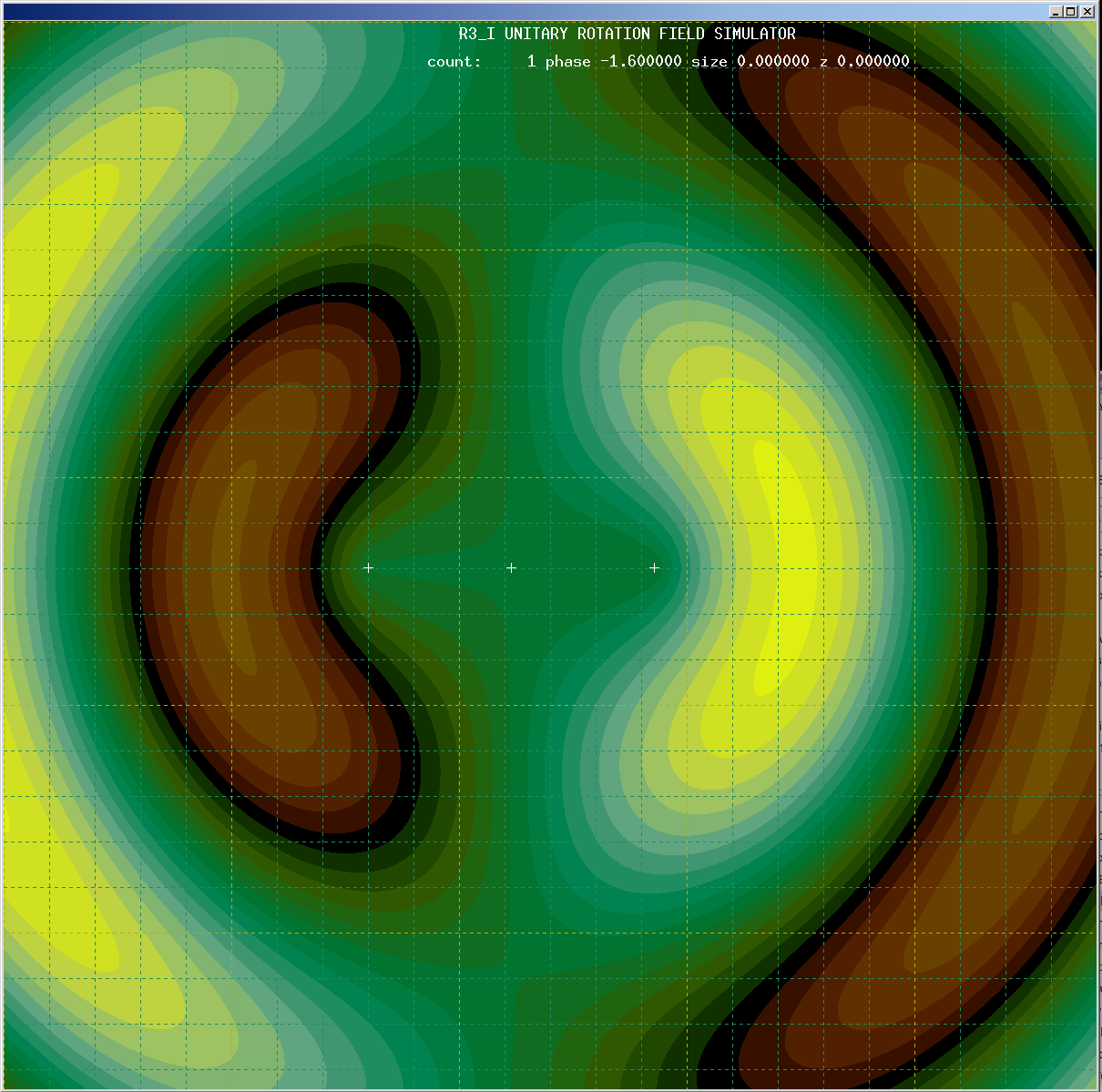
I set up a quantum interference unitary rotation vector field sim with a very basic idealized representation of a two pole “electron” and a much lower frequency one pole “photon” along the z-axis, and here is what I found:
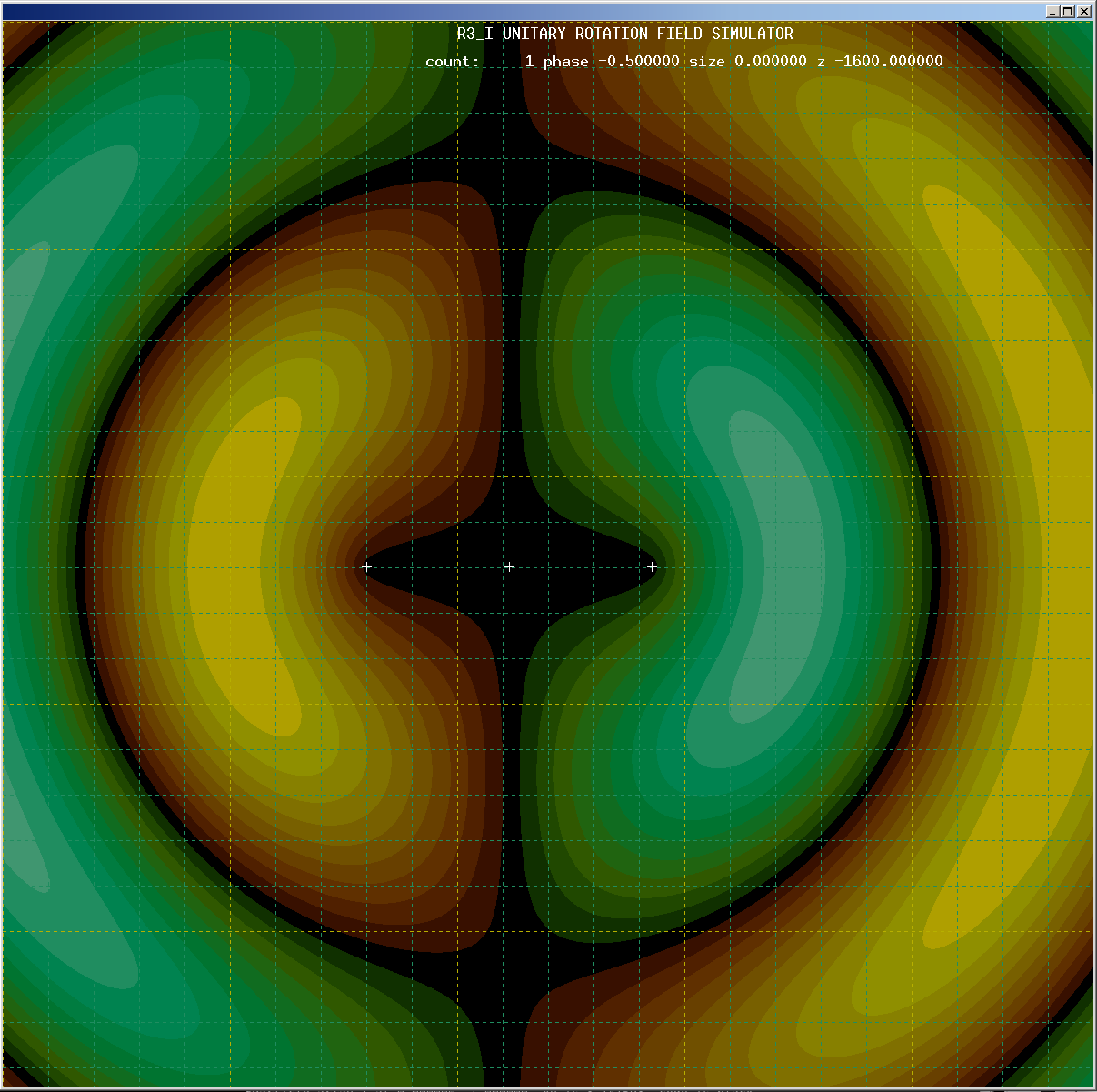
a: The “photon” wave (photon meaning the sim model of a photon in this post) makes the two pole electron unstable at the z = 0 axis position. Instead, the stability region moves along the z-axis depending on the phase of the photon pole. As a result, the quantum interference pattern from all three poles appears to force the electron to translationally move along the axis of the photon z displacement, which matches the expected electron-photon interaction behavior.
b: Depending on the phase of the incoming one-pole photon, I found that the stability region for the two-pole electron can either be below (away from) OR above (toward the photon). Could we at last have an explanation for why electrostatic fields emitted from a source can either repel or attract?
There is a momentum paradox in electrodynamics–if photons have momentum toward an electron, how can momentum be conserved if the electron ends up (due to charge attraction) with momentum in the opposite direction (toward the photon)? Quantum field theory computes that the field itself absorbs the momentum difference (and yes, mathematically that works) but intuitively I rebel at that analysis. The unitary rotation vector field appears to be providing a very elegant solution–quantum interference directs where the electron stability region has to go via wave interference, and in some phase cases it exists toward the photon rather than away from it.
c: It doesn’t matter where you put the photon. I get the same results regardless of the photon offset in the x-y plane (although as mentioned, the z offset causes the electron stability region to move along the z axis).
d: It doesn’t matter what frequency is used for the photon, although the stability region displacement above or below the electron initial position will vary linearly as 1/photon frequency. Higher frequencies cause the photon phase change and hence the change in z displacement to occur at a faster rate, lending credence to the idea that higher momentum photons will induce a larger momentum change in the electron.
e: The only thing the sim seems to get wrong is the absorption of the photon, which should disappear after encountering the two-pole electron. This will require more investigation.
So, in summary, at least on this first pass of testing, the hypothesis that quantum interference in a unitary rotation vector field is responsible for particle formation and particle interactions appears to behave correctly for the electron/photon interaction test.
That by no means is saying that my hypothesized unitary rotation vector field represents reality (if a real physicist were reading about my efforts, he/she probably would wish my efforts would die in a fire if I said something like that) but it looks pretty promising right now. In time and with more work, who knows where this will go–but the real test will be for some qualified researcher to confirm what I am seeing. Until that happens, you should assume that this is unreviewed work (by one author, the kiss-of-death for a research paper) and take it with a bucket of salt…
Agemoz
Here is a picture with the photon in the center, and the z plane is at zero (note this picture cannot be stable, the outside crosses are not in zero delta phase regions)
Looking at the same image, the region of stability has relocated closer to the photon (representing electrostatic attraction).
The region of stability displacement linearly varies as the phase shift induced by the photon, notice the region for a smaller phase shift has not relocated as far from the original electron position:
I’ve done extensive work trying to find all possible stable particle configurations using quantum interference, and only three combinations are showing definite stability; solutions exist for two and three poles. There is one valid set of four poles that statically would be stable but only in three dimensions (tetrahedral shape) but I see problems that indicate such a solution wouldn’t work dynamically (have to really watch out for confirmation bias because so far there is correlation to the real-life particle set) . It’s geometrically very clear that no 5 pole or higher can exist as a stable solution.
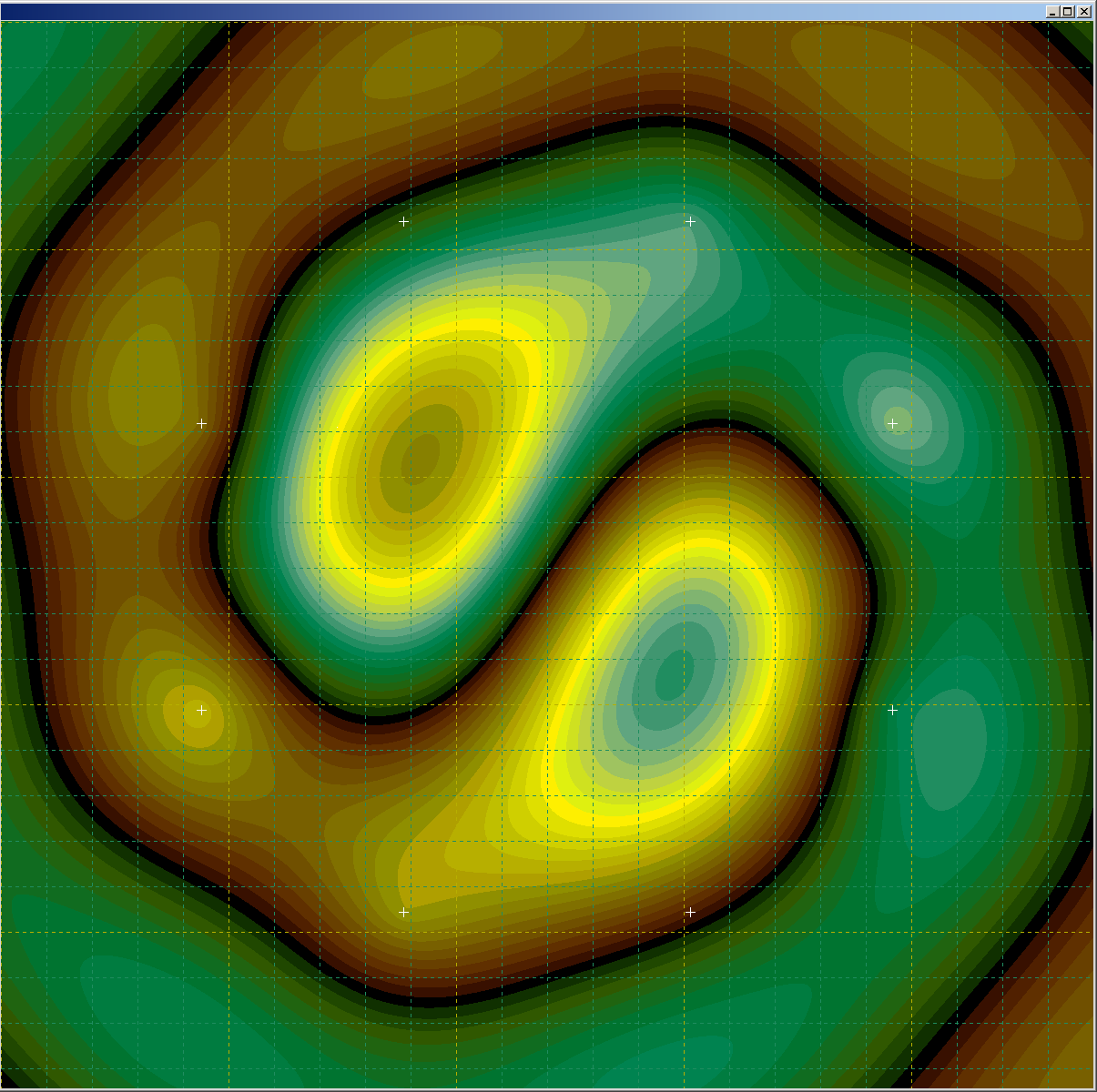
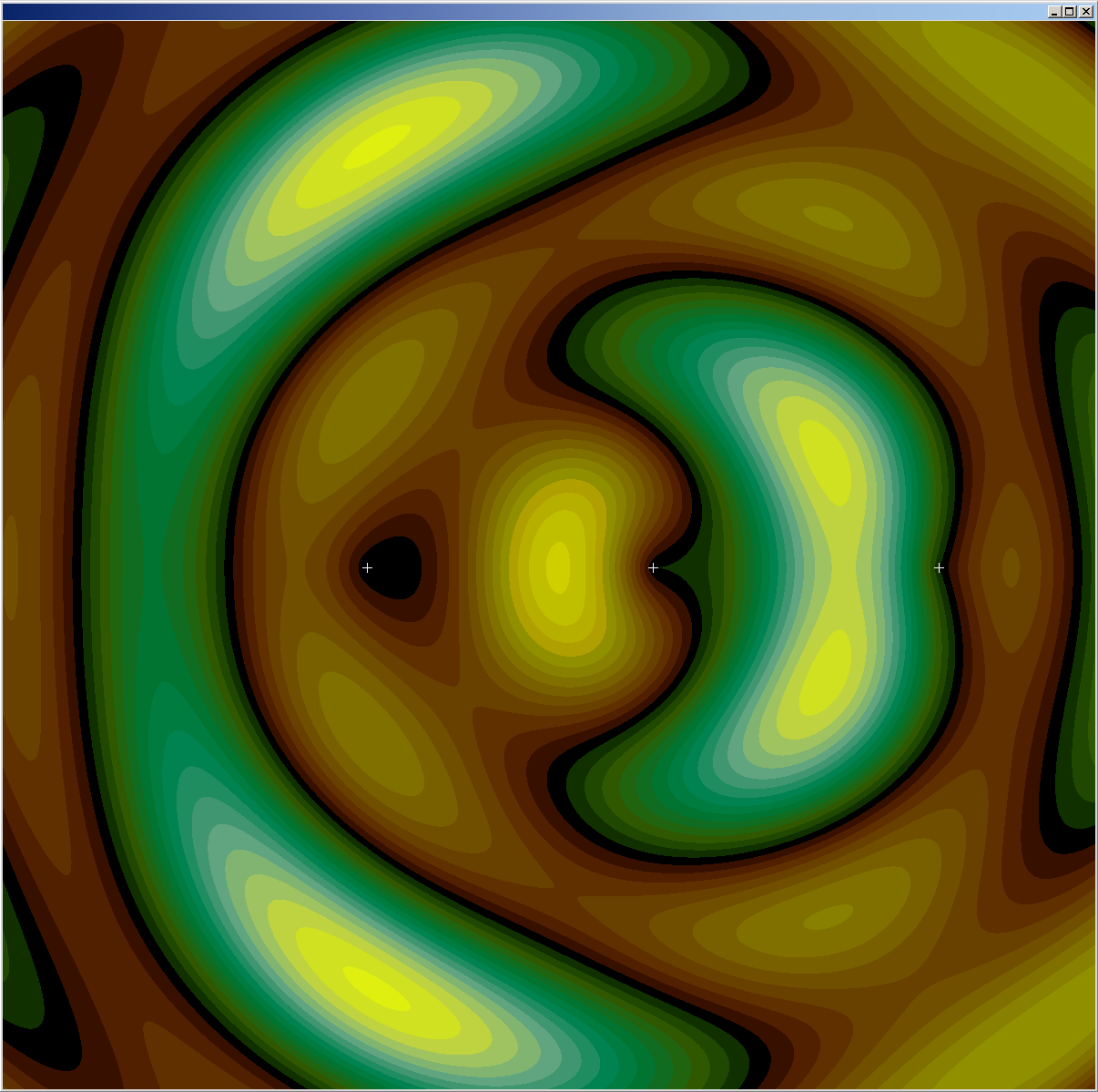
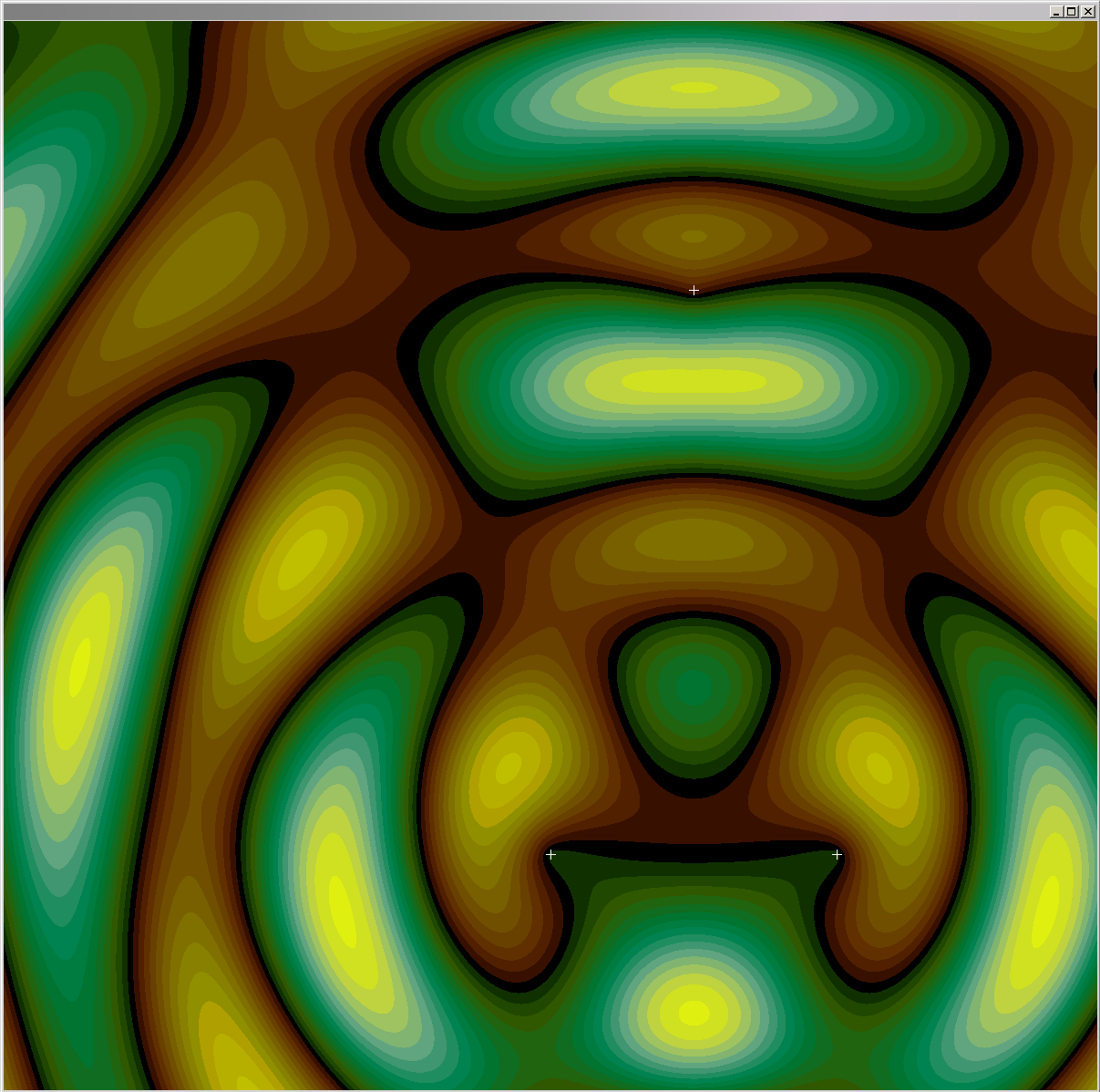
[UPDATE] More results I forgot to mention: A consequence of the 4 pole limit is that a twist ring cannot work. I approximated a twist ring with an 8-pole solution which shows no stability, and geometrically it’s easy to see why (an infinite overlap of wave phase points on every point of the ring). A ring will generate waves from all points about the ring, and there is no possible way this can exist in the single-value unitary rotation vector field. So, the twist ring, long promoted on this site as a valid field solution, bites the dust, at least for the unitary rotation vector field case. This is really interesting because it confirms the experimentally observed infinitely small point concept of current physics, and also seems to validate the Bohm interpretation of an infinitely small core with a non-causal guiding wave for particles. Here’s a picture–note the little crosses are the pole locations with stepwise increments in phase. You can tell that this is unstable because the phase delta between the sum of waves plus the particle phase must be zero and would show here as a black region–but instead many poles do not and cannot reside in a zero phase region. That is indicating that the particle phase and the wave phase are different, an impossibility in this single-valued unitary rotation vector field.
Also, (face-palm moment as I jumped too fast to conclusions) there actually are 5 pole and greater solutions, provided all the poles lie in a line. However, another constraint is emerging where this type of solution may not be stable except in the static case. Working on that one…
Here are pictures for two and three poles:
I’m now working on a sim where a unitary rotation vector field “photon” approaches and is captured by a field “electron”. Results shortly–should be interesting and a fairly definitive test for whether the unitary rotation vector field can really model reality.
The latest sims show yet another intriguing connection between three pole simulations and experimentally observed quark combinations. A couple of posts ago, I wrote a surprising result that only certain three pole configurations were stable. Those combinations happen to match the valid quark combinations for protons and neutrons, but all other combinations were clearly unstable. At first I thought, aha, a breakthrough, but after thinking about it I thought quark interactions are extremely complex and such a simple explanation shown by the sim couldn’t be the explanation for valid quark combinations.
Nevertheless, I have continued to explore three pole configurations and came up with another consistency (yes, this is confirmation bias at work here!). There are two valid three quark configurations, u-u-d (proton) and d-d-u (neutron). However, only one of them, the proton is stable–a free neutron will decay into a proton, an electron, and a neutrino after a while unless accompanied by a proton in an atomic nucleus.
Curiously, the three pole simulations are showing a similar disparity. The geometry of the two long wavelengths plus one 1/2x short wavelength is easy to see, you can set it up as an isosceles triangle. Here is the sim stability test for that case:
But the opposite case using one long wavelength and two 1/2 short wavelengths cannot produce a valid configuration, there is no way to lay this out such that wave phases match (try to lay out a triangle with two short sticks and one 2X longer stick, you can’t–they form a line). I have tried a number of sim configurations to get a valid configuration, and haven’t found one yet–just thinking about the geometry seems to show there cannot be one. Trying to line up the poles in any spaced combination gives unstable results:
What if we set up a known stable quark configuration (a neutron and a proton, three up quarks and three down quarks?) This requires 6 poles, but I haven’t found any configuration that works, at least in the 2D plane. You have to set up the poles so all 6 locations have identical phase matches for three up wavelengths and three down wavelengths (due to the unitary rotation field requirement, every location must be single valued, that is, have identical wave phase rotation values from every pole). Locating the poles so the long wave poles (up particles) are points on an equilateral triangle, and placing the short wave poles (down particles) on a nested upside-down triangle looked promising but doesn’t work. There are pairs going from the up poles to the opposite down poles that have a phase change of sqrt(3)/2, and phases won’t match. If there is a solution, maybe in 3D, I haven’t figured it out yet. And, it’s quite likely that stability in this configuration (an ionized iosotope of hydrogen with one neutron, technically ionized deuterium) conferred due to a particle property not modeled in the sim.
Or I’m certainly open to the possibility that the sim doesn’t model reality at all. It is intriguing, though, how many real-life quark properties are showing up in the sim. I’ll continue to investigate.
UPDATE: While the validity of the claim (quantum interference will induce stable particle formation in a unitary rotation vector field) is still holding up, the math used to compute the original image was wrong, and hence the image below needs to be updated. I’ve changed the rotation color mapping to make it easier to see the stable trajectory locations. The phase matching points (delta phase from all sources that sum to zero) now are shown as black rather than yellow, and I now have the sim actually draw the particle points (little white crosses) rather than me post drawing dots in the wrong place on the original image. The trouble with doing research is ensuring that everything is executed without mistakes, and that takes a lot of due diligence. Nevertheless, even with the mistakes corrected and a healthy dose of skepticism, I still am finding that the conclusion (stable particle formation in a unitary rotation field) is correct. Updated image:
ORIGINAL POST: Another step forward for the premise that quantum interference is responsible for the creation of particles. The same principle that redirects particles in the two-slit experiment is shown here to induce circular motion of quantum interfering poles, provided you are willing to assume that our existence arises from a single-valued unitary rotation vector field–a field that can only assume a rotation angle but does not have any variation in magnitude.
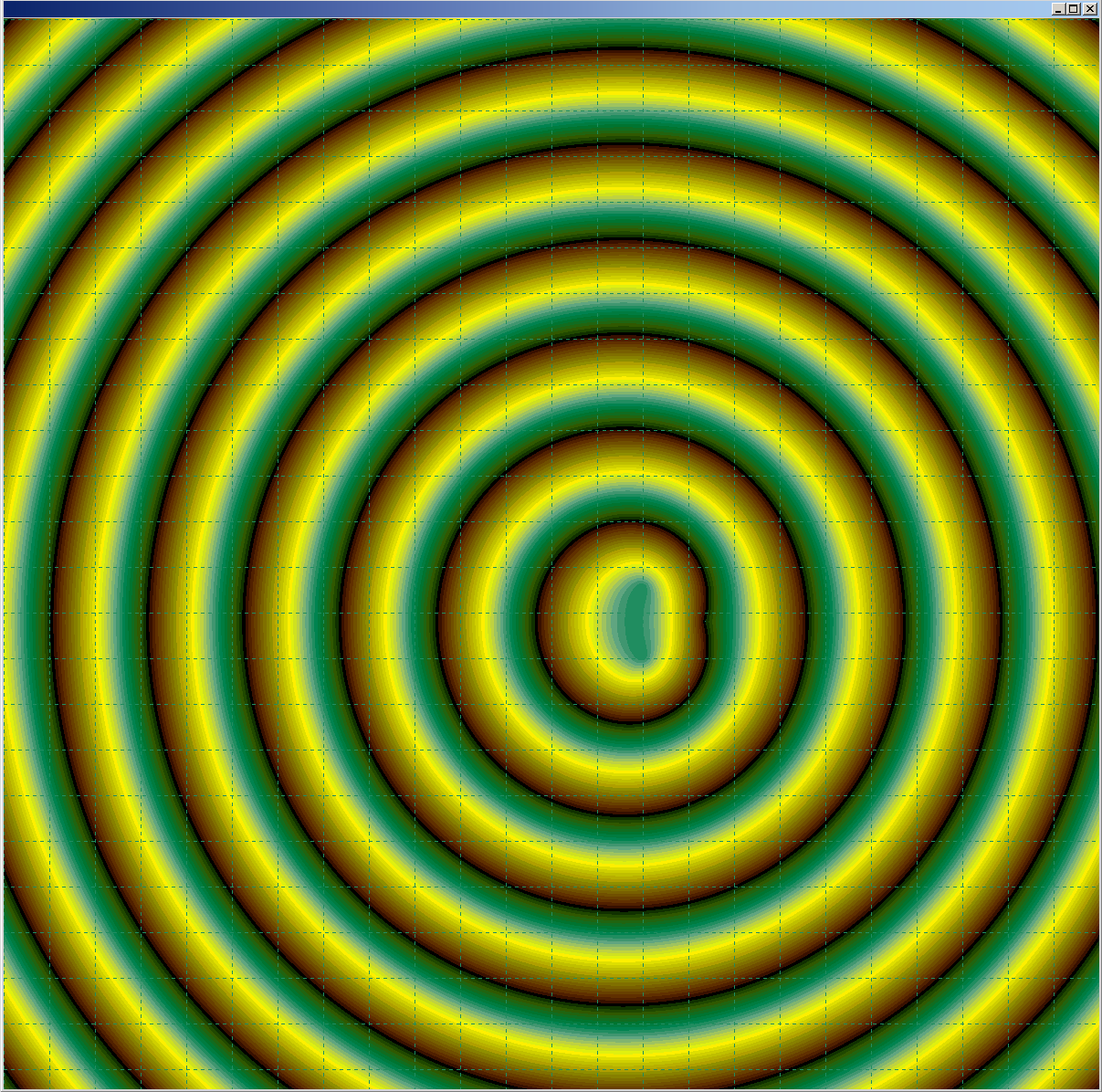
Here is a sample output of the simulator that shows two vertically spaced, oppositely rotated poles spaced at the right distance that the propagated rotation waves output from one pole match the phase of a second pole. In the unitary rotation field, the wave rotation from one pole must match the rotation of the second pole because the field is single valued, only one possible rotation is possible at any given point. You can see the interference pattern from two poles spaced such the phase of one particle matches the phase of the propagated wave from the other. Since the field is single-valued, the poles must follow the circular interference pattern produced by the simulator. Note that the yellow region shows wave phases where rotations would not match, no particle can reside here.
The poles are clearly bounded to travel in a circular path within the regions matching the pole phase (either brown or green). Note that quantum interference far from the actual pole positions do not affect the motion of the actual pole positions I have marked as oppositely colored dots (they actually must be the same rotation and hence the same color) on the sim. Based on a variety of sim results, I believe there are many valid solutions consisting of different pole configurations (see previous post for a three pole solution).
I'm an amateur physicist. I've studied physics and philosophy for a very long time, and have investigated some of the unanswered questions in physics with an intent of finding some possible explanations or theories on how they might work. Two of the most interesting questions for me are whether there is a geometrical basis for quantization and special relativity, and why there is a particle zoo (that is, is there an underlying structure that results in the particle zoo). I'm well aware of the danger of crackpot theories (usually characterized by just enough knowledge to get things wrong or silly), but allow myself to pursue ideas anyway as long as I'm clear about their speculative nature. I don't pretend that I have any significant discoveries to report, but thoroughly enjoy pursuing various ideas about how the universe works. To faciliate this study, I've created a lattice simulator that allows me to test a variety of ideas.
Archives
Unitary Twist Field Theory
A long description and justification for the thinking that has led to the Unitary Twist Field Theory. Note, IANAP (I am not a Physicist). This is long and describes the historical evolution of the Unitary Rotation Vector Field. The latest work has changed several parts, I am in the process of updating this.
Summary: A unitary rotation vector field is investigated as an underlying field that gives rise to the particles and fields of the Standard Model. The underlying field is single-valued, waves cannot pass through other waves. This is the means by which quantum interference redirects particle paths. The simulation work has revealed a new principle:
Quantum interference is responsible for redirecting particles along wave interference peaks–and also for creating those particles.
Long description: This effort to work out the details of this unitary twist field is based on the underlying assumption that our existence can emerge from nothing, and posits a reductionist approach to explaining the particle zoo. The theory basically says that there is a continuous rotation field in R3 + I that can produce stable solitons. Here is a list of the steps I have taken to arrive at this theory:
a: If existence does not require an intellect to form, the existence must arise from nothing, both space and time.
b: If existence does require an intellect (e.g, God) then further investigation isn’t really necessary because the rules for existence are set in a place we do not have access to.
c: One way to determine if the creating intellect exists would be to determine if the existence could not come into being without at least two rules, and such rules would have to come into existence from a creator. Saying that existence formed with one and only one rule is equivalent to saying that existence could arise from nothing and God is not required.
d: Finding God seems to be pretty much unanswerable without clear direct communication from God, whereas coming up with a way that existence could form from nothing seems to be an alternative possible approach for a human mind to answer the question about the existence of God.
e: Such an approach could start with the limits of current human knowledge, the known existence of the particle zoo. If a reductionist approach could be taken as to why the particles exist, we may be a step closer to saying that an intellect is not needed to create this existence. Conversely, if we can show with reasonable probability that it’s impossible to form particles from some continuous field, that’s an argument in favor of the necessity of an intellect in creating our existence.
f: I am assuming that a continuous field that can create stable particles is a reductionary step–that is, a step in the direction of finding a single rule defining this existence.
g: Now I start applying known physics to this field to determine what it must look like. I am assuming that this field is opaque, that is, there aren’t any parallel overlapping fields. This is clear because multiple rules are necessary to form two fields.
h: I assume that this field has elements that can only rotate. No displacement or magnitude can be applied to any field element. This assumption comes from the E = hv relation for particles, which basically says that particles are described only by frequency, there is no field degree of freedom equivalent to field magnitude.
i: when objects move, the field elements pass rotations via three types of momentum to adjacent elements. In this theory, no field element ever “moves”, instead particles move because field rotations pass as momentum from one field element to the next.
j: In order for E = hv to work, there has to be a means of ensuring that no partial or multiple count of rotations can exist. This is a form of field quantization, and I have proposed a background lowest energy state. In such a system, field rotations called twists start and stop at the background state rotation angle.
k: To ensure that R3 does not have an observable resonance (which would be experimentally discernable) that would undermine gauge theory symmetries, this background states points to an imaginary dimension. It is not possible to have the background state point to a basis vector in R3.
l: If the field has a crossproduct momentum transfer as well as the more standard linear translation of angular momentum of field rotation elements, this becomes a necessary and sufficient condition for forming stable linear particles of arbitrary frequency. UPDATE: simulation work shows that quantum interference is responsible for particle formation.
m: the crossproduct rule for momentum displacement allow a particle to start a single twist, and allows the particle to end the twist after one full rotation.
n: The crossproduct rule also allows the formation of twists that move along a curve. This is possible due to the vector combination of the crossproduct that is normal to the current element rotation orientation and speed. UPDATE: simulation work shows that quantum interference is responsible for path curvature.
o: If twists can curve, there are some twists that will form stable closed loops. There are many possible stable curve solutions, which I am proposing is the basis for the particle zoo.
p: A single free linear twist models a photon of some energy and length defined by the frequency of twist rotation.
q: Since the twist moves from +I background state to an R3 direction and continuing to rotate through to the +I direction, polarization of this twist arises as a linear combination of the two R3 vectors normal to the direction of twist travel. UPDATE: new simulation data suggests that quantum interference and momentum provide a basis for polarization, this will be revised.
r: The crossproduct momentum translation is necessary to allow a twist to start and to stop, otherwise field symmetry would propagate in both directions simultaneously at every point in the twist, and stable particles could not form (they would dissipate). In other words, the quantization of the field is ensured with the background state, and the ability to start and stop a twist arises from the crossproduct momentum translation. Thus it can be stated that to form stable particles from a field, it is necessary that a field capable of forming stable particles must have a handedness that can only come from a crossproduct momentum property. UPDATE: simulation results show this and following sections needs to be revised.
s: This handedness thus must be ingrained in any field solution that produces stable particles. This handedness of the field will show up in some cases as a chirality violation.
t: In order for the twist propagation to be stable, the only possible momentum transfer via crossproduct relation is at the speed of light, where the leading and trailing edge of the twist cannot be affected or connected to neighboring element rotations.
u: Any closed loop rotation sequence thus will be limited to the speed of light. If one were to unravel the cylindrical spiral path this loop takes in Minkowski space, a single quantized twist will form a right triangle where the hypotenuse is the speed of light times the time of one rotation of the twist, one side is the particle travel distance, and the other side of the triangle is the radius of the loop. This right triangle enforces a relation between the loop travel speed and the speed of light. This relation computes to the beta factor of special relativity and is the means by which special relativity geometrically arises from the twist theory.
v: A corollary to u: above is that time dilation for every particle results from the constrained stretching of the spiral helix in Minkowski space as the particle increases speed proportionate to the speed of light. In other words, each particle’s relativistic clock is implied by the time to complete a single twist. Observing from different frames of reference will alter the apparent time to complete a twist and thus affect the relative passage of time between particle and observer.
w: A single closed loop models the electron of one type of spin. The twist direction relative to direction of travel defines a spin-up or spin-down electron, whereas the loop curvature relative to the handedness of the field defines the particle vs the antiparticle version of the electron. Note that a linear twist does not have these degrees of freedom, so there is no antiparticle to the linear twist photon.
x: Quarks are posited to be linked twist loops, the up quarks have a single link going through its center and the down quark has two. The strong force results when linked twist loops are pulled apart such that twist momentums approach each other with an asymptotic direction conflict. The passage of a twist through the center of a loop affects the rotation of the loop by increasing the crossproduct momentum of the loop. Note that since electrons are modeled by a loop with no central twist going through it, electrons (and positrons) cannot combine with quarks.
z: This modeling of quarks seems to correlate to the masses of the up and down quarks–the twist going through the center of a up quark loop acts with a central force that causes the loop radius to reduce by half. The doubling of the resultant normal (to direction of twist travel) acceleration results in a loop that is 1/4 the size of the electron loop model. Similarly, a down quark has two twists going through its center, doubling again the normal acceleration of twist travel and causing that loop to be 1/8 in size. The rest masses of the electron, up quark and down quark correlate to this geometric analysis of particle loops. Electrons have a .511MeV mass, up quarks are 2.3MeV, and down quarks are 4.8MeV. Admittedly this may all be numerology, but I was surprised to find this mass correlation to loop length.
y: A possible model for the weak force results because there is a small chance for linked twist loops to tunnel through each other. If the rotation of one twist loop matches the rotation of a linked loop right at the point where linked loops are being pulled apart, the loops can separate. This is proposed as particle decay and would model the randomizing effect of the weak force.
Glossary
3D + T: the three spatial and 1 time-wise dimensions of our existence. Equations usually are set up for solutions in this space.
Causal: Causality: The property where a particle or field changes according to special relativity, that is, changes cannot propagate faster than the speed of light.
Dirac Equation: Relativistic equations using operators that effectively describes electron behavior in an atom and relativistic interactions of particles
Electron, Positron: charged fundamental quantum particles with spin (no known substructure with a fixed rest mass)
EM: EM Field: Electromagnetic Field.
Entangled Particles: A property of a system of particles where resolving a state of one of the particles instantly (non-causally) affects the remaining particles
Frame of Reference: Used in Special Relativity, refers to the observer's position relative to a system being observed. Special Relativity describes how a system (for example, a set of particles) will appear to the observer that is dependent on how fast and in what direction the observer is moving in relation to the system.
General Relativity: Einstein's theory describing the stress-energy tensor, which details the equivalence of acceleration and gravity and describes how dimensions distort and forces apply when objects are accelerated, especially as speeds approach the speed of light. For example, it describes how a particle's mass increases as it is accelerated.
Interference: Quantum interference: The property at small (quantum) scale where the probability of a particle state or location varies according to wave superposition, the trait of waves interfering with each other
Lorentz Transform: equations that describe how dimensions of time and space distort in different frames of reference (special relativity)
QFT: Quantum Field Theory: theory of how fields, such as the electromagnetic field, are quantized.
Quantum, Quanta: property where fields or particles have a property that can only have a particular value from a set (the set of real or complex numbers, for example)
Quantum Mechanics: the equations that describe the wave-like behavior of particles in various systems, such as a particle in a box.
Photon: quantum of light. Only one possible value of energy, depending on frequency.
Planck's Constant: The lower bound for simultaneous measurement of two orthogonal properties such as a particle's position and momentum.
Relativistic: Usually refers to particles or interactions of particles with velocities that approach the speed of light
Rest mass: Since any particle with mass will have that mass increase as it is accelerated, rest mass is defined as an intrinsic property of a particle that is not moving
Schroedinger Equation: Wave Equation: second order differential equation that describes the probability distribution of (for example) an electron around an atom
Special Relativity: Einstein's theory that describes how dimensions (space and time) interconnect and vary according to an observer's frame of reference. It specifies causality of all particles or field components, and that the speed of light is the same constant in every frame of reference.
Twist: Field Twist: Author's idea of how photons and electrons (twist rings) substructure could be described
Uncertainty relation: Heisenberg uncertainty principle: the lower bound (planck's constant) for resolving two orthogonal properties of a system.
Unitary: in transforms, the property that preserves magnitude (such transforms can cause rotation or displacement, but cannot change the size or shape of objects). In vector spaces (such as fields), unitarity implies that all vectors have a constant magnitude, only direction varies.





 Agemoz
 Agemoz's Physics Blog