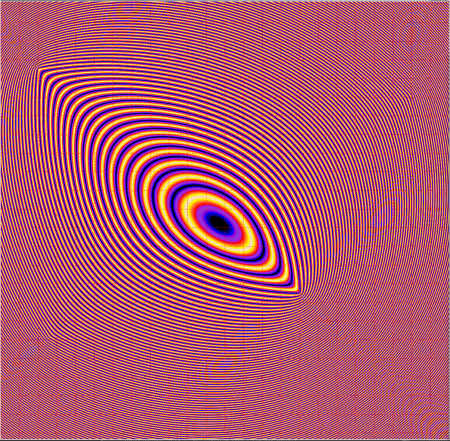
Unitary Rotation Vector Field Three Pole Solutions Exactly Mimic Quark Combinations

April 25, 2020

I apologize for overposting here–I’m definitely going to be overdoing it–but I just felt like I had one more result to post (UPDATE below).

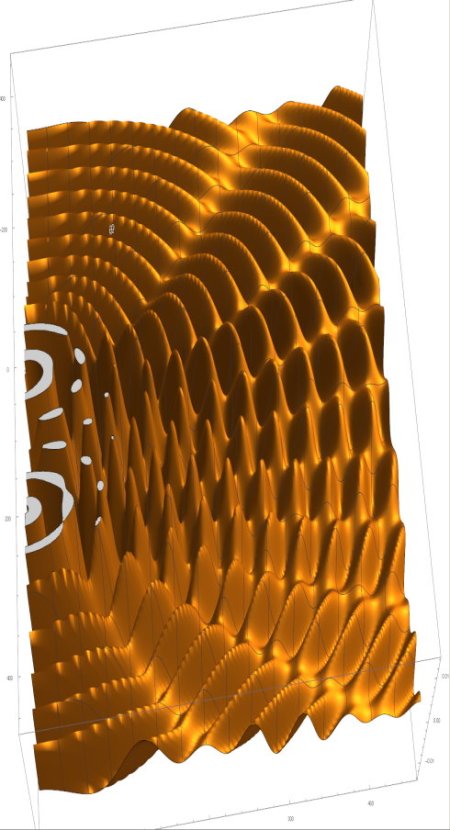
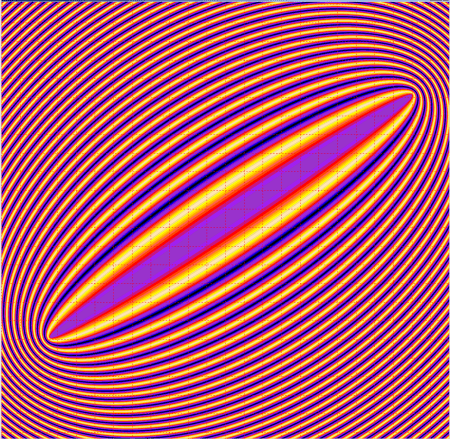
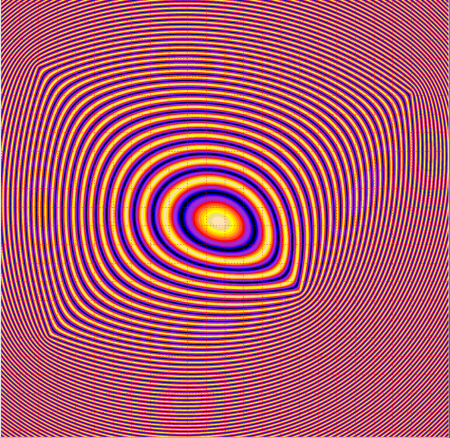
Most three pole solutions just produce the infinite wave results that are not sustainable as a real representation of particles, I just see the infinite series of wave rings.  But I thought, what if I tried to duplicate the three quark up/down configurations?  I place three poles in a triangle, and gave them all the same energy.  Nope, infinite rings.  Next, gave one of the poles half the frequency like an up quark.  Nope, still infinite rings.  Now, give it an antipole rotation: voila!  a stable particle configuration:
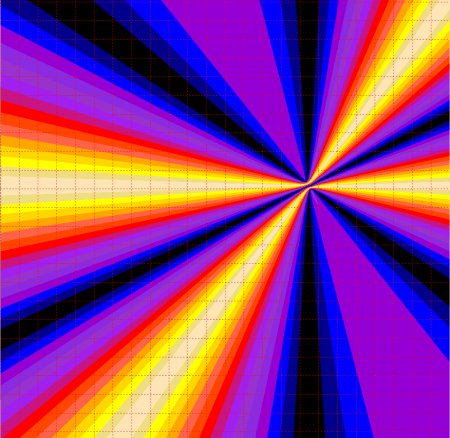
three_pole_m2_4_m2

In fact, I tried all combinations of “up” particles and “down” particles, and guess what–only two produced particles, the anti-up, down, down and the up, anti-down,anti-down configuration!  Yow–that was exciting.

However, Feynman’s ghost is here, and he says: be skeptical.  This may just have a stupidly simple reason, not a physics breakthrough.  It could just simply be the fact that 1 + 1 – 2 = 0, and -1 -1 + 2 = 0.

{update}:  quark sets have extremely complicated interactions and I now doubt that this configuration directly represents them (for example, where is the mass of the gluons).  It might give a clue of internal details of a quark set, but there has to be more to it.

Something much more significant is showing up with these sim results–the hypothesis that a testable principle exists.  It is this:

Quantum interference is responsible for redirecting particles along wave interference peaks–and also for creating those particles.

It doesn’t matter that we are talking wave functions (probability distributions) rather than actual waves, the redirection still happens.

It’s becoming very clear from these sim results that at certain wave frequencies, the effect of quantum interference must control the motion of poles because in the unitary rotation vector field, every field location is single valued (only one possible rotation at each point).  As a result, the quantum interference redirection that occurs in the two-slit experiment can also cause poles to encircle each other in a stable pattern.  I’m about to set up an experiment to directly test this principle.

More pictures to come…

Agemoz

Unitary Rotation Field Simulator: More Results

April 25, 2020

I’ll try not to post here too often, but a whole ton of results are coming back from different experiment configurations using the Unitary Rotation Vector Field simulator.  One thing that became immediately obvious is that stable solutions are not going to come from most pole configurations–the spreading waves you saw on the previous post aren’t sustainable in a universe full of particles.  I was pretty suspicious of something not right when I could make the dipole disappear entirely (see previous post).

I discovered a whole new ball game when I set up opposite pole dipoles:

dipole_1

The wave pattern disappears as the poles cancel out.  The residual rotations shown occur because I have yet to apply the effect of the I dimension (the background state referred to in previous posts about the theory I’ve been working on).  Here is a picture of two such dipoles of different frequencies:

two_dipoles_1

There are wide space dipoles representing lower energy solutions:

dual_2pi_dipole

Note that I’m just barely scratching the surface of the properties of this amazing field.  I’m only using one of the rotation modes (there are three in the R3+I field of the theory), I don’t have the background state turned on yet, I am currently only studying 2D configurations, and I have not turned on any time dependent characteristics, in particular, how such particles will move.  There’s so much to do and to document!

Agemoz

Unitary Rotation Field Sim First Light

April 24, 2020

The unitary rotation vector field is a promising candidate for an underlying field that theoretically should produce solitons, quantum effects, and special relativity.  In order to see if the field really could work or is just snake oil, I wrote a simulator.  That has taken a while to get working, but now I’m starting to get results that have been truly fascinating.

I’ve posted a ton of stuff about this field in previous posts.  I’ll go over a summary:  E=hv is true for all particles, and has led to a realization that a precursor field underlying our existence would have to have one degree of freedom per field element.  In contrast, an electromagnetic field has at least two: vector direction and vector magnitude.  This precursor field must have vector direction, so I posited that existence must be based on a unitary magnitude rotation vector field.  Years of thinking have led to all kinds of insights, including that such a field has to obey special relativity–a conclusion significant enough that I wrote a paper on it.  As I worked with this field, I came to the conclusion that such a field would support formation of solitons.  I also discovered that such a field would produce quantum effects such as the two-slit experiment interference pattern.

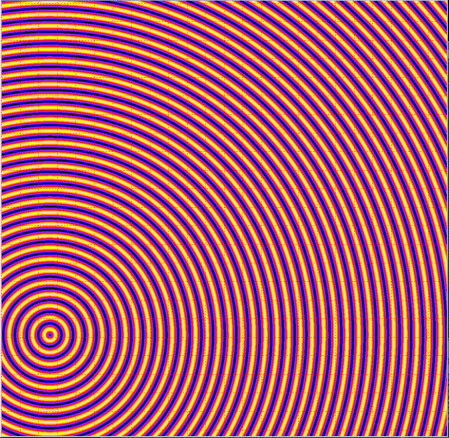
I have found a vast gold-mine of interesting consequences resulting from such a field to the extent that I felt a deeper dive into writing a simulator was worth the trouble.  After a long period of time, I now have initial results, and the very first pictures that were output made me realize what a very unique animal the unitary rotation vector field is.  Usually when we see interference effects between two oscillating sources (or the wave interference pattern that emerges from a two slit experiment barrier, we see something like this:

interference_pattern

But when I set up two sources using the unitary rotation vector field, I was so surprised that I thought there was something wrong with the simulator.  But then I thought about it for a while and realized–a unitary rotation field is a very different critter than what we are used to when we study EM theory or quantum mechanics.

Here is a picture of two identical (same wavelength) particles separated by a substantial distance.  It should be really clear that between these two particles the interference of rotation waves disappears.  The two particles are effectively entangled, and in this vector field the waves interfere along the path between them.

two_particle_1

Removing one of the two particles instantly removes the interference and the stable path between them.

one_particle_1

Now this is where things get bizarre beyond belief:  add a *third* particle nearby in space, and the wave pattern of the first two completely *disappear*!!  Going to four or more particles, the wave pattern causes a single new entity to appear in the center.  This aint your Gramma’s EM field here!

three_particle_unrelated_1

four_particle_same_1

five_particle_1

I will stop here, but I haven’t even begun–this is a 5D sim, I’m just testing 2D configurations to test it.  I am just capturing a single slice, but 3D configurations will be fascinating to uncover.  And–we are talking static configurations–wait until you see how these things move!

You may be completely skeptical that any of this connects with reality, or passes that ultimate test of new physics, that it predicts something new.  However, I am fascinated by the potential of this new tool, the unitary rotation vector field simulator, to lead to new insights about the theory I’ve worked on for so long.

Agemoz

Resolving the Rotation Field Contradiction

February 27, 2020

A while ago, I discovered a showstopper–a contradiction between two parts of the theory I’ve been working on that proposes an underlying unitary rotation field for the particle zoo.  The theory is based, in part, on two discoveries:  that any Fourier construction of particles (a sum of waves that results in a group wave delta function) will appear to move at constant speed regardless of observer frame of reference, thus providing a basis for special relativity, and secondly, that quantized energy states can emerge from an R3+I unitary rotation field.  Lots of work has resulted from this basic model of existence, including the quantized formation of stable solitons.

However, the showstopper problem needed to be resolved, and I think I have done so, although I’ve not proven it yet.  The problem is this:  how can a sum of waves exist in a unitary single valued vector field?  There is no magnitude component in such a field, so the only way to “sum” a Fourier composition of waves is to sum the rotations at any given point.  This doesn’t really work when you try to classically doppler shift the resulting field, there’s no wave components present in the resulting field and the special relativity behavior can’t emerge.  I’ve looked at abandoning the doppler shift approach, but there are only a few other ways that special relativity could emerge and so far they all seem unworkable as an underlying field for particles.

Coming back to the original premise, I can resolve the paradox if doppler shifting can occur on a single wave cycle (rather than requiring a sum of waves).  I believe that this should be true for this reason–when generating a Fourier sum of a delta function, normally waves of infinite span are used.  However, in the limiting case, all parts of the sum cancel out except in the region of the delta function, so the constant speed derivation is just as valid if you only use the sum of waves in the immediate region of the delta function.  A single cycle of oscillation will still doppler shift, and the apparent constant velocity of the resulting delta function is valid whether the infinite waves are summed or the region bounded (single cycle) waves are summed.  If there is only a single cycle wave present, its shape and velocity are still defined by the math of the original theorem with a different set of limits (described in this paper: group_wave_constant_speed) and now the contradiction is resolved.

There’s more work to do, I think it would be pretty easy to blow holes in this framework as it is.  Nevertheless, it’s the first time I’ve been able to work out a promising answer to the showstopper contradiction.

Agemoz


Rotation Field Momentum Transfer Induces Curvature

January 15, 2020

I am digging deep into the details of how an R3+I unitary vector field behaves.  I study this field because I’m hypothesizing that it is a good candidate for an underlying field that will produce the particle zoo of reality.  I’m not trying to figure out gravity or dark matter or any of that–I just want to find a workable underlying structure that could explain why there are stable and unstable particles, and why quantum creation operators evolve particle/antiparticle pairs.   If you take a look at some of my recent prior posts, you’ll see the thinking I used to come up with this field concept.

I really like this study, because it avoids the handwaving problem of trying to prove that some new idea represents actual reality.  Every amateur (and I’m sure most real-life physicists) have their pet idea of how things work, and the central problem in promoting that idea is not discovering new science, but rather the socio-political problem of convincing others, and in particular, professional researchers, that your idea is right.  That is a really hard problem that doesn’t involve actual science research.  I have attempted to publish papers in the past and have discovered that that activity is an exercise in futility.  What I love about my study of the R3+I unitary rotation field is that I leave that all behind–I’m just exploring how this field behaves, all the while keeping an eye out for something that might invalidate the field as a candidate for reality.

And to this end, I have discovered some great properties of this field.  The field so far shows the right degrees of freedom to produce linear and closed loop particles, shows why quantization occurs (the lowest energy state of the field is the +I rotation direction, confining twists to integer multiples of complete cycles) and clearly shows how the two types must interact.  Since (see previous posts) the field is blocking, a linearly propagating twist rotation through +I will propagate until it encounters a closed loop twist in this field.  Non-unitary fields such as an EM field permit varying vector magnitudes, including regions with zero magnitude.  In that type of field, there is no possible way that a linearly propagating twist can intercept and be absorbed by a closed loop through the center (think photon striking an electron).  But a unitary twist field, as shown in previous posts, has a very specific stable configuration of rotations that must exist in the center of the loop.  When a linearly propagating twist tries to collide with the closed loop, it cannot pass through (remember that unitary rotations cannot linearly combine, there is no magnitude other than 1).  It will pass its momentum components to the rotations in the loop, but cannot dissolve the loop unless the momentum of the linear particle approaches the momentum of the loop components and breaks the loop.  I know this sounds like handwaving, but I think if you do your own analysis of this field you will find this to be true.

Now on to the new findings:  as I dug deeper into the specifics of this interaction, I had to define exactly how rotation momentum would propagate through the rotation field, and in so doing discovered a very important principle, shown in the figure.  I described how momentum translates in spacetime with a single rule as follows–a delta rotation in R3+I propagates in the direction of rotation.  Quantization says that there must also be a background state restoration force (note that the momentum itself is not unitary, it can be zero or even infinite, and everything in between.  It’s only the vector magnitude that has to be unitary in the R3+I unitary vector field).  When looking at the geometry of this, I discovered something very important about the unitary rotation field R3+I–geometrically, if conservation of momentum is to hold, in certain circumstances, the momentum path must curve.

curved_momentum

Normally, if a quantized rotation twist propagates through the +I background rotation state, there is no reason why the momentum propagation rule wouldn’t ensure a straight line path.  However, suppose the twist passes through a region where the field is not at +I (the low energy state).  If this region is pointing orthogonal to the twist path, the resulting sum of the propagated twist rotation direction and the existing field direction would be linear and momentum magnitude and direction would be conserved.  But you cannot sum vector directions in this field–it is unitary, only rotations are allowed.  The only way the incoming momentum magnitude could be conserved is if the rotation follows a curved path (see illustration).

What this means is that in most circumstances, linear twists will propagate in a straight line since the default state for the path will be at the +I rotation direction.  But if it passes through a field region where there is an angle offset from +I (for example, in the neighborhood of a closed loop particle), it will curve in the plane of the angle offset and the direction of travel.  Two adjacent twists will curve antiparallel to each other and produce a sustained closed loop path, thus forming a field soliton.

In earlier posts, I hypothesized that quantum interference in an R3+I system would redirect a particle’s linear path and form a soliton–we know that to be true from experiments like the two-slit experiment, but I didn’t know why the curvature  would happen.  I was on the right path with quantum interference, but by breaking down how rotations must propagate, now I know geometrically that if we assume a unitary rotation vector field, then closed loop particles must occur.  Even better–the effect is contravariant.  That is, higher twist momentums lead to smaller closed loops.  In Newtonian physics’ descriptions of orbiting particles, the larger the momentum, the larger the resulting orbit.  The effect on path is covariant.  But you should be able to see (reference the figure) that in the R3+I unitary rotation vector space, the larger the momentum, the greater the curvature must be to conserve momentum magnitude, and the smaller the resulting path must be.  This field clearly provides the means for the contravariant relation between particle energy and particle wavelength–something no other theory that I know of has been able to explain.

Agemoz


Properties of a Unitary Rotation Field

January 6, 2020

The unitary rotation field in R3+I dimensions is part of a quantum interpretation that obeys special relativity.   Recently I was able to show that the field can produce both linear and closed loop soliton solutions that do not produce discontinuities in the field.  This is a big step forward in the hypothesis that this field is a good representation of how things work at the quantum/subatomic scale.   Note that this field is NOT the EM field, which under quantum field theory reduces to a system of quantized and virtual particles.

This unitary rotation vector field is derived from the E=hv quantization principle discovered by Einstein more than a century ago.  This principle only allows one frequency dependent degree of freedom, so I determined that only a field of unitary twists of vectors could produce this principle.  (I didn’t rule out that other field types could also produce the principle, but it’s very clear that any vector field that assigns magnitude to the vectors could not work–too many degrees of freedom to constrain to the E=hv property).  This has two corollaries:  first, no part of the field has zero magnitude or any magnitude other than unity, and, the field is blocking–you cannot linearly sum two such fields such that a field entity could pass through another entity without altering it.

Why did I determine that the rotation has to be in R3+I, that is, in four dimensions (ignoring time for now)?  Because of the discontinuity problem.  If the field were just defined as R3, you cannot have a quantized twist required to meet E=hv.  No matter how you set up the rotation vectors around a twist of vectors along an axis, there must be a field discontinuity somewhere, and field discontinuities are very bad for any reality based physical model.  That makes the field non-differentiable and produces conservation of energy problems (among many other problems) at the discontinuity.

However, all of quantum mechanics works on probability distributions that work in R3+I, so that is good evidence that adding a fourth dimension I for rotation direction is justified.  It doesn’t mean there is a spatial displacement component in I–unlike the R3 spatial dimensions, I is just a non-R3 direction.  And the I dimension does at least one other extremely important thing–it provides a default background state for all vectors.  In order for photons and particles to have quantized twists, a background starting and stopping vector rotation is necessary.  The unitary field thus normally would have a lowest energy state in this background state.

Aha, you say–that can’t work, the vacuum is presumably in this lowest energy state, and yet we know that creation operators in quantum mechanics will spontaneously produce particle/anti-particle pairs in a vacuum.  You would be correct, I have some ideas, but no answers at this point for that objection.  Nevertheless, I recently was able to take another step forward with this hypothesis.  As I mentioned, it is critical to come up with a field that does not produce discontinuities when vector twists form particles.  Unlike R3, the R3+I field has both linear and closed loop twist solutions that are continuous throughout.

This was very hard for me to show because four dimensional solutions are tough to visualize and geometrically solve.  I’m not a mathematician (whom would undoubtably find this simple to prove), so I used the Flatland two dimensional geometry analogy to help determine that there are continuous solutions for vector twists in four dimensions.  There are solutions for the linear twist (e.g., photons) and closed loop particles.  There are also solutions for linked closed loops (e.g., quarks, which only exist in sets of two or more).

I will follow up next post with a graphical description of the derivation process (this post is already approaching the TL;DR point).

Now, this is a very critical step indeed–there is no way this theory would fly, I think, if field discontinuities exist.  However, I’m not done yet–now the critical question is to show that the solitons won’t dissipate in the unitary rotation field.  If there are no discontinuities, then the solitons in a field are topologically equivalent to the vacuum field (all vectors in the +I background state).  What keeps particles stable in this field?  As dicussed in previous posts, my hypothesis has been to use the displacement properties of quantum interference–now that the discontinuity problem is resolved, a more thorough treatment of the quantum interference effects on the unitary rotation field approach is now necessary.

Regardless of how you think about my hypotheses that unitary rotation vector fields could represent subatomic particle reality, surely you can see how interesting this investigation of the R3+I unitary rotation field has become!

Agemoz

Defining a Unitary Rotation System Interaction

November 17, 2019

The new quantum interference interpretation described in previous posts provides a great connection between Newtonian physics, special relativity, and quantum mechanics.  I wrote a paper on it (group_wave_constant_speed), and then began working out a mathematical model that uses the main premise of the interpretation (particles form from a sum of instantaneous phase waves).  I’m taking some time from that work to post this progress report–a list of assumptions and structures I am assuming in this model, along with an effort to justify them.

The first question that has to be answered is whether the precursor waves (the instantaneous phase group wave described in the paper) can be modeled as single valued or can be superposed on each other in a linear combination.  Since I’m trying to construct a model representing the real world, I chose the E=hv relation to help answer this question.  This equation specifies that a given frequency can only have one energy for a quanta of that frequency, so that constrains the precursor field to just a single degree of freedom.  That strongly implies that a geometrical/mathematical model of a quanta must be a single unitary twist in some vector field.  In order to anchor this twist to a single rotation, there must be a lowest energy background state for the rotation, with a cost applied to any deviation from the background state.  This locks in the rotation to a single state.  If we allow the rotation vector to have a magnitude, we have too many degrees of freedom for E=hv to hold, so that means several things–first, that the rotation vector space is unitary, and secondly single valued–you cannot put two waves on top of each other in this field.  This has the additional effect that the field is blocking–you cannot pass information through a limiting neighborhood of a field without altering the vector orientation in that neighborhood.

The background vector state cannot exist in R3 without inducing a detectable dimensional preference in R3 (see Michelson experiment and similar), so I hypothesize a fourth imaginary dimension for it.  I realize that this violates the KISS (keep it simple) premise of science, but I believe it is required and so I assume a unitary four-vector field in R3 + I.  For the time being, time T will be independent of R3 + I but later I will bring in the necessary adjustments for special and general relativity.

With these assumptions in place, we are ready to define the mathematical basis for the precursor field, and make some more assumptions about how particles could interact.

It should be straightforward to define each element of this single-valued rotation field as a unitary three-vector, e.g., x = [xy_rot, xz_rot, and xi_rot] where ||x|| = 1.  Since this is a unitary vector field, no magnitude exists and a fourth vector element is not needed.

Let’s now consider two basic twist types in this vector field and determine a construct for how they will interact.  The first twist type is a linearly propagating twist, a quanta, of one complete cycle from the background state and back again.  The second twist type is a twist loop with one complete cycle (previous posts on this site describe how quantum interference will work to confine such a loop).  Can we propose a model interaction of these two types?  You can see why I propose a single-valued field–multiply-value fields cannot constrain the interaction, and in fact I believe that such a field would cause the two twists to fail to interact at all.  The blocking behavior of the single-valued field is necessary for interaction.

Now, both particles will have a fundamental wave frequency (see the paper for a more specific treatment), so let’s set up an interaction where the linearly propagating twist approaches a stationary twist loop.  We will use conservation of momentum to help constrain what happens.  The momentum of both particles is proportional to the fundamental wave frequency (E=hv, again), so if the linear particle is absorbed by the twist loop, the twist loop will emerge from the interaction with the same momentum as the propagating linear twist.

One promising way to make this momentum transfer work in our R3 + I vector field is to allow momentum transfer only when both particles have parallel vector alignment.  Then in that delta time, a delta momentum (which is inversely proportionate to the linear particle’s wavelength because the orthogonal rotation rate of the linear particle will vary as its frequency) will be exchanged.  Integrating over the time of the linear propagating particle, momentum will be conserved.  Note that only when the linear particle goes through the loop there will be a unique parallel vector alignment.  Nearby particles may have partial rotation absorption, however any virtual particle interaction such as this having an incomplete quantized rotation will fall back to the background state without having transferred a net momentum to the twist loop.

We have shown how the momentum exchange will produce a transfer inversely proportionate to the incoming particle’s momentum, but now we need to de-construct how the motion of the twist loop particle is affected  by this momentum change.  As this post is already too long, let’s start a new post for that…

Agemoz

A Solution for a Quantum Interference Soliton

September 29, 2019

Quantum interference will redirect particle paths due to wave interference effects, so it seems reasonable to assume that quantum interference could form an orbiting pair of group wave particles.  It is fairly easy to show that a pair of oscillating wave sources will generate an interference pattern such that if the sources follow the pattern peak amplitude path, the paths will orbit each other (see several recent previous posts on this topic).

However, in real life, there are only a very limited set of wavelengths that could produce actual particles–electrons, for example, could be the results of such orbiting internal wave structures, but why do rest-frame electrons have precisely the wavelength they have, and no other?  We know that geometry alone cannot form any specific wavelength soliton solution, because geometry by itself is scaleless–there is nothing in geometry that specifies that an orbiting pair of particles has to have a specific size.  The only fixed constants we have that could form solitons are the constants of physics–speed of light c, charge q, Planck’s constant, and so on.

I’ve thought for years about what could constrain the geometry to a single soliton size, and so have many others, including DeBroglie, Compton, and others who generally tried to use the obvious candidate–charge attraction.  But since EM fields are central force fields and produce unstable solutions involving infinities, no one accepts that approach anymore.

I think I have an answer.  It comes from quantum interference, speed c, and Planck’s constant–let’s see if you agree or think this is just another futile exercise in numerology or wishful thinking.

We will assume that on some tiny scale, electrons consist of a dual pair of oscillating wave peaks (see image).  Quantum interference determines that the peaks will orbit with a radius proportionate to the wavelength.  So far, there is nothing that constrains how big this orbit is–the larger the wavelength, assuming they all move at speed c, the longer the path time, which corresponds to the longer wavelength.   There are no unique solutions here.  We need to determine what could constrain this orbit radius.

We know that wave particle momentum is inversely proportionate to wavelength, but directly proportionate to orbit size.  In other words, the smaller the wavelength, the smaller the orbit–but conversely, the smaller the wavelength, the higher the momentum, and consequently, the larger the orbit.  There is only one wavelength where the orbit is the same for both.

I computed it this way.   Radius r of an orbit is equal to mass * velocity^2 divided by the force Fn (reference centripetal force) applied normal to the orbit path.  This is the quantum interference force and is independent of r (quantum interference does not obey the central force derivation used for charge or gravity, reference the Aspect experiment and similar).  Now, the wavelength must also define the radius; here, the radius r is equal to the wavelength wrapped around the orbit, that is, lambda/2 Pi.  We assume the velocity of the waves is always c, so for non-relativistic particles, E = m c^2 = hv.  Substituting into the first equation for r and using v = 2 Pi f, we obtain h c/(Fn lambda) = lambda / 2 Pi.

Therefore, there is only one wave solution for a dual pole orbit (yes, I did unit checking to make sure I didn’t goof something up on this):

lambda = Sqrt( 2 Pi h c / Fn)

Other wave peak geometries in R3 will produce similar solutions.  It’s not clear what Fn would be yet–more work to do here, but one thing is for sure–such a construct will only produce one solution.  The proposed soliton only works if Fn is independent of dipole spacing.  This works if we use the proposed idea that poles are Fourier sums of waves (see previous posts and this paper:  group_wave_constant_speed).  Quantum interference alters the wave sum to guide the poles.  No actual force is needed (the big drawback of the guiding pilot wave used in the Bohm quantum interpretation is the need for a new force not shown by experimental observation).

I will investigate further for specific particles such as an electron,  and report back.

Agemoz

dipole

dipole structure

sum_radials_00


Instantaneous Quantum Wave Phase Derives Special Relativity

August 24, 2019

None of the current well known quantum interpretations are satisfactory–they all have shortcomings that cause logical contradictions to known experimental data.  I think all would agree that the Everett many worlds interpretation has an element of absurdity to it (doesn’t mean it’s wrong, just seems improbable), and the Copenhagen interpretation where decoherence occurs somewhere near a detector has significant logical problems (see the EPR paradox to start).  Physicists seem to like best the modified Bohm interpretation that works around Bell’s inequality, but it adds a wave term (the guiding pilot wave) to equations describing time evolution of particle position and motion.  This redirects the particle to form an interference pattern on a target–but in so doing, since the particle has momentum, it exerts a force for which we have no experimental evidence.

So, I thought long and hard and came up with a new quantum interpretation that seems to overcome these problems, and as far as I can tell, seems logically consistent.  Better yet, particles that conform to the assumptions of this interpretation must meet the constraints of special relativity.

I thought this interpretation flows logically out of the thought process of how quantum interference works.  We know that quantum entangled particles will always resolve to opposite states instantaneously across any distance, appearing to disobey causality (when a detector resolves one of the particles, that sets the state of the other particle instantaneously even if they are far apart–see various Aspect experiment variations).  But, neither particle can exceed the speed of light, nor can any communication between the particles exceed the speed of light.

Now that gives a powerful hint of what this implies–that if the momentum aspect of the particle cannot exceed the speed of light, something else must exceed it.  I realized that if the particle was represented by some construct of waves, the waves could form a rogue-wave–a soliton or delta function where the group could not exceed the speed of light, but component wave phases would not have such a limit–a change in phase would be reflected across the entire length of the wave instantaneously.  The rate of change in time of this phase is limited, so that makes the particle as a whole causal–but the instantaneous effect of this phase change would cause an instantaneous effect on quantum interference over the entire distance of the wave.  And–a quantum interference effect would relocate the particle by virtue of the delta function sum of interfering waves, without the expenditure of energy (the problem with the Bohm interpretation).

This got much, much more interesting as I started working on the math for such a particle–I almost accidentally discovered that such particles would always look like it was moving at the same speed, regardless of how fast an observer was moving!  Instantly, I realized that this quantum interpretation would derive the primary postulate of special relativity–and leads to some pretty astonishing conclusions.  This happens because unlike a solid baseball, a group wave will classically Doppler shift according to the observer’s relative velocity.  If the entire wave Doppler shifts simultaneously, which will be true with this quantum instantaneous phase wave interpretation, the relative velocity of the observer’s frame of reference is exactly cancelled out by the corresponding Doppler shift of the particle’s wave components.

To me, this was an incredibly important finding–it says that any particle formed from instantaneous phase waves will act according to special relativity.  And–if a particle obeys special relativity, it must Doppler shift–and thus must be composed only of various types of wave.  There cannot be any internal structure in an electron, for example, that doesn’t Doppler shift and thus it must be composed solely of wave components.  Now, admittedly, that’s a pretty big box of components–they don’t have to be planar waves, but could be oscillating vectors, helical waves, compression waves, you name it.  All it has to do is Doppler shift and special relativity will fall out.

Amazing! Or so I thought.  I proposed this to many different experts in this field, and all of them pooh-poohed it.  I submitted to 5 journals–all rejected.  I guess I’m totally on my own, which is rather a shame–I think there’s some really good new stuff here.

Agemoz

PS: here’s the mathematical derivation, feel free to comment:

group_wave_constant_speed

Corrected Tilted Slit Experiment

August 11, 2019

CORRECTED UPDATE 19/08/10:  further analysis shows that the proposed experiment isn’t going to work as proposed.  I obtained a 1.1 nanometer electron wavelength for a static electron, but this is wrong.  Unlike photons, fermions have a wavelength that varies as their kinetic energy, but I did this incorrectly.  I recently recomputed the wavelength in a different way, simply by using E=hv.  Using E=.511MeV, or 8.2^10-14 J, and Planck’s constant as 6.6^10^34 J*s, I get an electron wavelength c / v or 2.998 10^8 m/s / 1.2 10^20cyc/s, which gives a wavelength for the static electron as 0.024 nanometers.  This is good news and bad news:  This wavelength now means that quantum interference could be the confining property for solitons, as I originally proposed a few posts back.  The bad news is that making a tilted two-slit experiment is probably not possible–the wavelength of the atoms composing the barrier is twice the length of the electron wavelength, so I think there is no realistic way to make an electron tilted two-slit barrier where the tilt could discern the electron interference pattern.  Since a single slit has two edges which will cause diffraction of the electron wave on both edges, it might be possible to create a barrier of layers of cold solid hydrogen (such a barrier would have to require some sort of atomic sublayer as a base since hydrogen forms only one bond) with a single slit that generates two interfering electron diffraction waves.  Tilting this barrier may be sufficient to discern whether electrons and positrons (or up-spin and down-spin electrons) produce two different interference patterns.  I’m tempted to submit an NSF research grant for such a research project just to see if I get anything besides a desk rejection!

The good news part of it means I want to return to my work using quantum interference as the cause of soliton particle formation.  This corrected wavelength computation now means quantum interference should produce self contained paths.  I do have to assume that any particle such as the electron has to have a dipole (or more) structure, as there will be no interference pattern from a monopole.  Waves, yes, but no interference that will define an orbiting path.  It’s really too bad that the tilted slit experiment is beyond the reach my lab skills and equipment–it would have been great to try to answer whether the electron structure is a monopole (concentric circle waves) or a dipole (spirals or antispirals).  My hunch based on all my investigative work is that it is a dipole, which means that the quantum interference redirection will produce sufficiently small paths to confine the electron waves.  It’s clear to me that investigation is now the way to go.

Stay tuned!tilted_single_slit