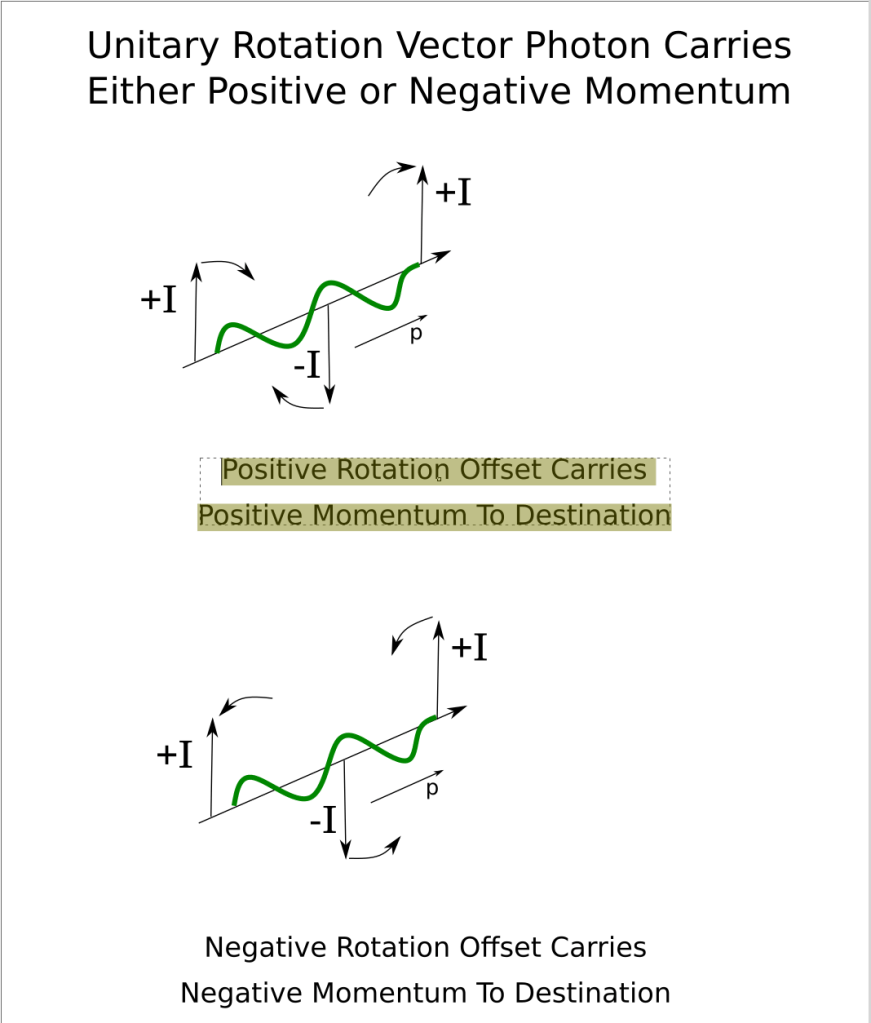
The previous post described the interaction between electrons and photons from both the quantum field theory and the unitary rotation vector field point of view. That post then showed how the unitary rotation vector field predicts that photons carry both positive and negative momentum–a photon has no mass of its own but at emission, converts linear momentum from the emitting particle to angular momentum. You cannot have a particle carry negative linear momentum, but you can have a photon carry negative angular momentum. At the time of absorption, the negative angular rotation converts to negative linear momentum and the target moves toward the source.
This is why a proton can emit photons that cause an electron to move toward the photons flight path source (attraction to the proton). In the previous post, I detail why that happens using the behavior shown in the unitary rotation vector field approach.
QFT, on the other hand, gets this result mathematically from solving the LaGrangian. We interpret that result by creating virtual (off-mass-shell) particles. When confronted with the momentum paradox (shooting photons at a target should always cause the target to recoil away from the photon source), we say that the EM field absorbs the momentum change to cause the target to move toward the photon source.
You can see why I think the QFT interpretation is overly complicated and what I really don’t like is the invocation of YAP–yet another particle–to patch up logical inconsistencies. But here is where the unitary rotation vector field really leads to new insights: We are taught in basic physics that photons are their own antiparticle. We know this cannot be true, because the photons emitted from a proton to a target electron have to somehow be different than photons emitted from an electron–one stream of photons causes the target to move toward the source (electrostatic attraction), and another stream of particles causes the target to move away (electrostatic repulsion). Unitary rotation vector field theory says that in one case the linear momentum to angular momentum conversion generates negative angular momentum, and the other case, positive angular momentum conversion.
This is so interesting because linear momentum is dependent on the direction of particle travel, and thus can never carry negative momentum. But a massless particle such as a photon can carry either positive or negative angular momentum independent of direction of travel. In order for oppositely charged particles to not violate momentum conservation due to attraction, negative linear momentum must be carried via photons and then converting to negative linear momentum at absorption!
This means the old adage that there is no antiphoton, photons are their own antiparticle, has to be wrong. As mentioned above, we already know it is wrong because oppositely charged particles attract each other. Negative momentum must be transported to the other particle regardless of the virtual particle activity along the interaction path. The unitary rotation vector field says there must be photon antiparticles, and thus it should be possible to set up an experiment where correctly generating a stream of negative momentum photons at a target will cause the target to move toward the source.
Physics discoveries are generally worthless without making a prediction of new previously unobserved behavior, and this is my prediction. I think if you could create an emitter, for example, bremsstrahlung from antiparticles such as positrons, you could measure negative photon pressure at a target and prove the existence of antiphotons.
Now here is where this discovery would become incredibly interesting. Photon pressure is a result of the solar wind; it’s behind the concept of a solar sail that could push a spacecraft out of the solar system. It’s also at the very foundation of a star’s existence–photon pressure prevents a star from collapsing into a black hole. Why are there no antimatter stars? Because now the photon pressure is negative (attractive due to emission of antiphotons)–the same direction as gravitational force. There is no equal but opposite force to create a stable equipotential. Antimatter stars must always collapse into a black hole.
Agemoz
 Agemoz's Physics Blog