That should be a controversial title and garner an immediate rejection from every physicist (I have lots of practice with that). However, it appears to be true as a model for our real world! Let me see if I can explain why I think this way.
I have been working on a simulator which models reality using a unitary vector rotation field with instantaneous quantum interference waves (not an EM field, a failed approach tried by many researchers in the past and even recently–reference DeBroglie, Compton, etc). Because this field has a background state, rotations are quantized, and these rotations generate waves mathematically identical to quantum interference components. By default, rotations propagate in R3 on a linear path and are modelled as photons, but two or more rotations can generate interference patterns that can form closed loops. These closed loops are modelled to be stable or unstable elementary particles. For more information on the details of these conclusions, you can reference previous posts on this website.
Two of the most important derivations from this work are the emergence of the constant speed of light from any wave based model of reality (see this paper: group_wave_constant_speed) , and the prediction for negative momentum carrying photons labelled antiphotons, which have yet to be discovered. Linearly propagating field rotations acting as photons (or antiphotons) carry momentum at speed c from source to destination, but being intrinsically massless, do not have any momentum of their own.
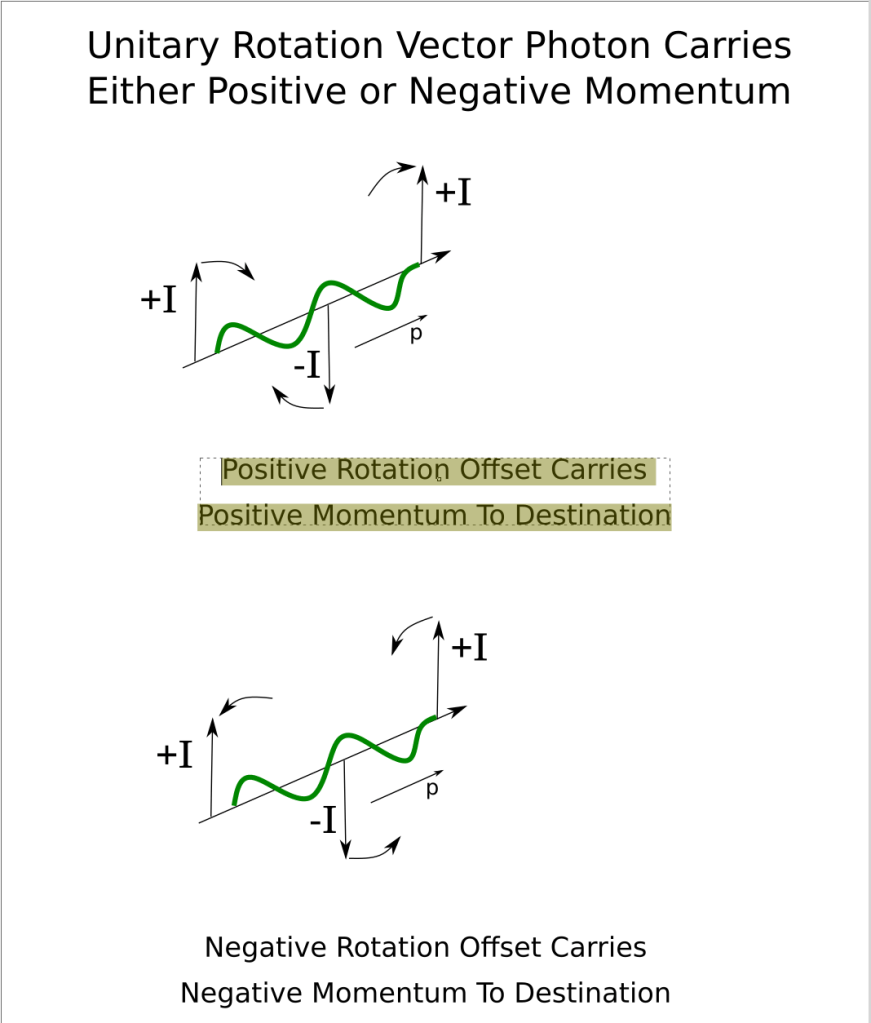
It is well known that photons emerge from atoms when bound electrons change state, that is, fall to a lower energy state. Alternatively, the atom can capture an incoming photon by raising the energy level of a bound electron. In the unitary rotation vector field theory, the electron emits a photon as a full field rotation with a specific angular momentum. At first glance, I concluded that the linear momentum of the electron gets converted to angular momentum to a linearly propagating rotation–a photon. When the photon is absorbed, the photon’s angular momentum gets converted to linear momentum in the target particle.
However, I ran into problems trying to incorporate this exchange in my simulation. Essentially, a photon interacting with a target electron (linear momentum exchange) or vice versa, was getting too much energy and not matching reality. I finally figured out what was wrong–the concept of linear momentum gets in the way of reality. There can be no such thing as linear momentum! It is an illusion caused by a particle that consists of closed loop field rotations, that is, it has angular momentum confined inside a finite region.
What actually happens when a particle is observed to have linear momentum is that the particle rotations are waves, and increasing the relative velocity of the particle does not add linear momentum. Instead, it causes the particle component composite waves to Doppler shift (note that in all cases in this post, I refer to classical Doppler shifting, not relativistic). When this Doppler shifted wave strikes some other object, the object receives an energy proportionate to the Doppler shifting, which is directly proportionate to the relative velocity of the particle. The Doppler shifting of the angular momentum of the particle is sufficient to explain the momentum change of the target particle, so the standard physics principle of linear momentum cannot actually exist.
The fundamental discovery here is this: The transfer of momentum from photon to electron or vice versa is entirely a transfer of angular momentum that can get Doppler shifted into higher or lower frequencies and hence higher or lower levels of angular momentum (and hence kinetic energy). Our reality, at least in this model of the universe, does not provide for the existence of linear momentum of objects!
Agemoz
 Agemoz's Physics Blog