Posts Tagged ‘charge’

Twist Ring Acceleration Sim Results

July 7, 2013

The initial measurements are in, and still look promising.  To recap, one stable form of the twist in the Unitary Twist Field theory is in a ring where the twist curves on itself as a combination of the electrostatic 1/r^2 and magnetic field 1/r^3 strengths (this ratio is defined by the fine structure constant).  There are potentially many solutions, but only one possible planar solution other than the linear twist–the twist ring.  I posited that if this were true, placing a twist ring in an external electrostatic field would cause the curvature to vary depending on the distance from a source charged particle.  Computing this analytically is a challenge, yielding a 24 term LaGrange differential equation of motion, so I decided to do this iteratively.

This was a lot easier, and has yielded promising results that suggest I might be on the right track.  The initial sims showed correct qualitative behavior with repulsion or attraction depending on the external field polarity, and I could visually see the correct acceleration behavior.

Next, I added quite a bit of numerical analysis code to the sim of the twist ring path, and was able to verify that a linearly varying field will cause the path of motion to accelerate at a constant rate–and that this acceleration is proportionate to the strength of the field within some level of accuracy.  Much more needs to be done to confirm these measurements, but the initial results show that this type of model (twist ring) will give electrostatic behavior.  Here’s a pic where you can see the displacement with time (the parabolic curve).  Following that, you’ll see my initial data set along with the Mathematica solution for the first three crossing points of the parabola–more computations will be done to establish that this really is a parabola.

From here, I will see if the correct mass results from the ratio of the strength of the 1/r^2 component to the 1/r^3 component in an electron.  There should also be other twist loop solutions possible in 3D, I’ve limited myself to the easiest (planar) solution to start.

Agemoz
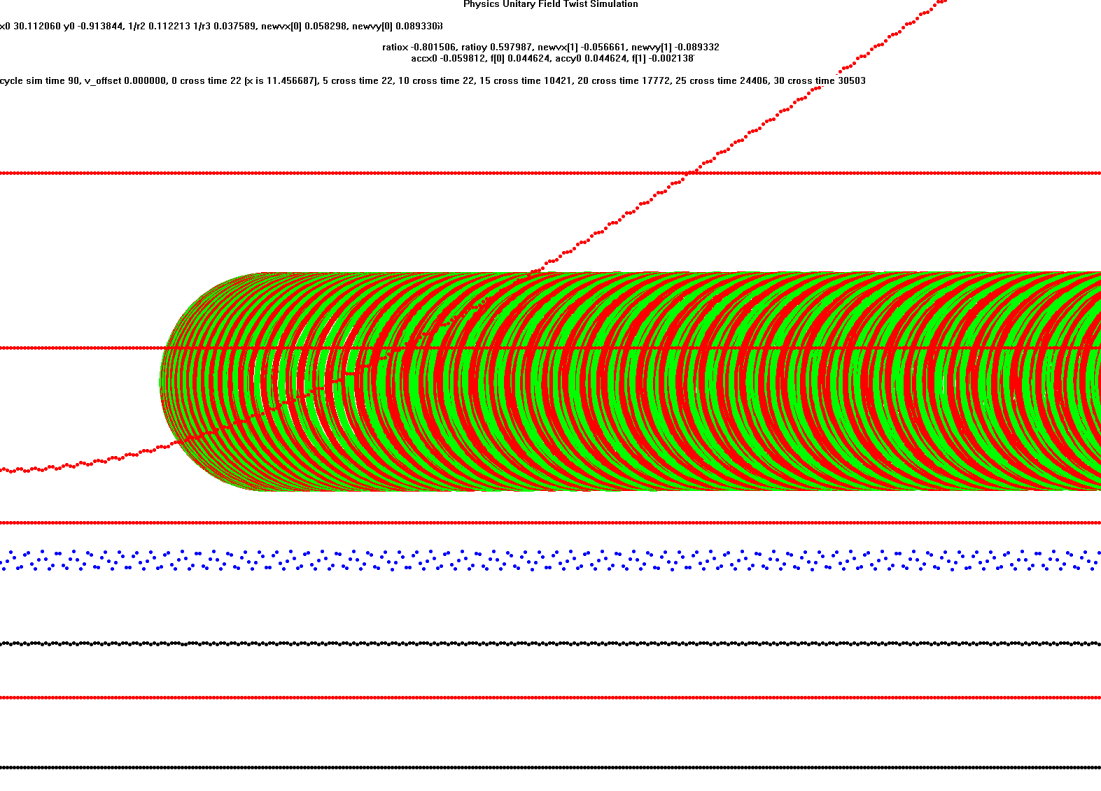
twist_ring_measured_repel

Here’s the initial sim time crossing points, along with the Mathematica solve solutions:

Running the Unitary Field Twist simulation to numerically derive the change in x as
a field is asserted on a 1/r^2 - 1/r^3 twist ring.  The field affects the curvature
(magnetic component).  The result generates the qualitative expected movement as if
there was a central force effect (q^2/r^2).  These results are an attempt to measure
the acceleration factor as a function of relative field strength (magnetic to
electrostatic).

Since the equations of motion due to the 1/r^2 - 1/r^3 equation in a linear field
were 24 parameter LaGrange equations of motion, I attempted to get an analytic
solution by examining the iterative numerical results.

Here is the result for 1:1 (1/r^2 to 1/r^3) field strength at distance 10 with
radius 1.5 and ring velocity 0.10545 and source field strength factor .0005.
The sim showed a cycle time of about 90.

field strength 0.00025
22:  11.457            (doesnt start at zero because cycle max x is not at zero)
14545: 15
25213: 20
34448: 25
43234: 30

using the first 3 terms in quadratic solution, I get
x = 8.92 10^9 * t^2 + .000114 * t + 11.455

field strength 0.0005
22:  11.457            (doesnt start at zero because cycle max x is not at zero)
10421: 15
17772: 20
24406: 25
30503: 30

using the first 3 terms in quadratic solution, I get
x = 1.912 10^8 * t^2 + .000141 * t + 11.454

field strength 0.0010
22:  11.457            (doesnt start at zero because cycle max x is not at zero)
7372: 15
12572: 20
17233: 25
21626: 30

using the first 3 terms in quadratic solution, I get
x = 3.82 10^8 * t^2 + .000200 * t + 11.453

More terms need to be computed, but there is a clear linear proportionality to the 
acceleration component of the curve, consistent with the expected electrostatic
relation of field strength proportionate to the acceleration of the destination
particle.

Quantized Fields

July 11, 2012

No, I’m not going to talk about the Higgs boson.  Well, except to make one reference to it as far as my work is concerned:  it’s a new (but long predicted, and not yet shown to actually be the Higgs) particle and field to add to the particle zoo.  A step backwards, in a way–I think our understanding will advance when we find underlying connections between particles and fields, but adding more to the pile isn’t helpful to a deeper understanding.  Oh, and that the Higgs approach adds an inertial property to mass particles, a mechanism caused by a drag effect relative to the field.  That matters to my work because it appears to be a different mechanism than how I propose mass gets attached to particles.  Yes, it calls into question the validity of my work, but so do a whole bunch of other things.  I’m proceeding anyway.

I got some interesting results from some simulation efforts–a second stable state with three components.  It is particularly interesting because it appears to settle into a three way braid–and more importantly, seems to progress to faster and faster speeds–limited to the speed of light.  Not sure why it does that, more investigative work to determine if this is a model problem or real behavior of the three twist solution.  Does make me think of a neutrino, but that’s pure speculation.  Here’s some curious pics.  These sim has all three twists with equal momentum.  I’m going to set one or two twists to double momentum and see what happens.  I also need to fix the attraction/repulsion in these cases, currently these cannot represent reality because of three charge values instead of two in real life (+,-)–but you can see what a fertile ground the twist model shows.

This 3D simulation of a three twist interaction stabilizes into three way braid

This 3D projection of a three way twist array eventually stabilizes into a closely interacting stable entity

But the real work I’ve been doing lately is not these sims–instead, it’s my thinking about the continuous property of fields and quantization.  If the unitary twist field is continous, it is blocking–a twist bend cannot propagate through another twist bend if it is separated by a plane with background state orientation–another way of saying a continuous unitary field cannot be linear.  Real EM fields are linear.  Are they also continuous?  At first, I said no, they can’t be,  since real EM fields should be blocking as well.  But then I realized that unlike the unitary twist field, real EM fields are linear (effectively can pass through each other) because the field of one source can add on top of another field from another source.  In this case, the magnitude of the field at a given point is not constrained, so this is what makes the fields of QFT work, that is, be continuous and also linear.

Mathematically, that is possible–but now I believe that even the QFT model of fields such as the EM field cannot be continuous for a different reason, field quantization.  QFT says you cannot extract any energies from the field that don’t meet the quantization constraint.   Unitary twist fields will derive this quantization because only full twists from and to the background field direction are possible and topologically stable.  Any partial twist must return to the background state and will dissipate.  Here’s why I now think that any quantized field cannot be continuous.  Let’s talk unitary twist field first.  I had a groundbreaking discovery with unitary twist fields a month or so ago when I found that if this field is continuous, it is possible to create a situation where it blocks passage of field states.  If you put two oppositely charged particles separated by a distance r, symmetry requires that a plane separating the two particles must have zero twist, and thus one particle would see zero twist at distance r/2–the same thing it would see at an infinite distance.  The problem is, then there is a situation where there is no difference from the uncharged background state and the first particle cannot respond differently than if there were no nearby charged particles.  The bisecting plane with zero bend acts as a barrier preventing or blocking  the other particle from affecting the first.

OK, that was the unitary twist field case.  Now the QFT case doesn’t have this problem since the bisecting plane holds magnitudes, not the zero background state of the unitary twist field.  Therefore, the first particle can be subject to the effects of the second particle since the bisecting plane no longer blocks.

But, QFT fields have a different problem that still says it can’t be continuous.  A non-continuous field is the saving grace that might allow unitary twist fields to be a valid underlying solution–if the field is not continuous, but is granular.  If the QFT field has to be granular, then unitary twist field theory becomes a valid underlying architecture for QFT (of course, other constraints or problems might invalidate unitary twist theory, but right now granularity allows the unitary twist field to be non-blocking, otherwise there’s no way it could work).  In the granular case, a given epsilon neighborhood sees these passing components going from one particle to the other without blocking.  Thus, any quantized field such as QFT fields or unitary twist fields will be linear (and div and curl will be zero) if and only if the granular parts do not interact.

As I continued down this path of thinking, I began to realize that whether the QFT EM field or the unitary twist field are correct real world descriptions, neither of them can be continuous.   You could argue that the field itself is continuous but the particles that are extracted from the field are quantized, but this idea has serious fails if you create a field from a limited number of quanta.  Inductive reasoning is going to force either model of the field to be composed of granular components–it will not be possible to create a field from two quanta that is continuous because the information of the quanta is preserved.  Why do I say that?  Because a two quanta field that is continuous may only release a quantized particle from the energy of the field.  If the quanta information is preserved in the field, I cannot see any way that a definition of continuous could apply to this field.

Now, if the field is composed of quanta that do not interact, then linearity will result simply by the ability of packing more or less quanta into a set epsilon volume.  Linearity means that the quanta cannot interact (otherwise magnitudes at some points will not sum, a linearity requirement).  Therefore, the quantized field can be considered granular and infinitely sparse, that is, no constructive summation of fields can cause loss of total volume density of quanta.  In other less obtuse and verbose words, the quantized field must not be continuous and must consist of non-interacting quanta, regardless of whether we are talking unitary twist field or QFT EM fields.  If you buy this, then the twist field is not blocking and is still a potentially valid description of reality.  If this is true, then the geometrical basis for quantization comes from the twists returning to a background state, a conclusion that QFT currently does not provide, and thus  unitary twist field theory work is still a worthwhile effort.

Agemoz

Continuous Fields Cannot be Linear

June 10, 2012

A shocking revelation for me, in all my years both as a professional electrical engineer and as an amateur physicist.  I realize I have zero credibility out there with anyone, but at least for myself, I have discovered something fundamental about fields that I did not know.  Perhaps if I were a mathematician I would have worked this out.  Nevertheless, it is quite provable in my mind, and has enormous impact on how I must model the two particle interaction, whether by QFT or unitary twist field theory.

The concept of linear central force fields means that multiple potential sources create the field by means of linear superposition.  If you have two sources of potential, the effect on the field at any point is the sum of the effect due to either one.  There are potential corner cases such as if the potential is infinite at the point source, but in every finite potential situation, the field is the sum of all sources at that point.  Electrostatic fields are supposedly both continuous and linear, but this cannot be at the quantum scale.

I have been discussing in previous posts the concept of a median plane between two charged sources, and particularly enlightening was the attraction case of a positive and negatively charged particle.  Between these two particles will be a median plane whose normal runs through both particles.  This median plane can have no absolute potential (relative to the electrostatic field potential at infinite distance).  This field cannot pass any information, even about the existence of, one charged particle through this median plane.  In fact, it is well known in electrostatics that if you put a metal plane between two particles and ground it, you will get the same charge field distribution as if the second particle wasn’t there–it cannot be determined if the second particle actually exists or not.

The only way a field can pass information across this median plane is if the field is not continuous.  If the field  is created by a spaced array of quantized particles, such that they never, or almost never, interact, then the effect of the field can be made linear.  Indeed, shooting real photons at each other could collide, but that is exceeding rare, and modeling the field by photons, virtual or real, in either QFT or unitary twist field theory,  would produce a linear superposition of fields.  But there is no question now in my mind that if I simulate this, I cannot assume a continuous electrostatic field, such a thing cannot exist.  This field has to be almost entirely empty, with only very sporadic quantized particles, then I can see how linearity would be possible.  Every quantized particle that interacts with a quantized particle from the other source will distort the appearance of linearity, so the fact that deviations from linearity are experimentally unmeasurable strongly points to a extremely sparse field component density.

I had thought that QFT virtual particles could construct a continuous field in a Taylor or Fourier series type of composition, but it is clear that it cannot.  The QFT virtual particles must be exceedingly sparse, just like the twists in unitary twist field theory.  It also suggests that QFT virtual particles would have to clump in some way in order for localized neighborhoods in the field to obey conservation.

Now I see a workable model for twists.  The median plane problem cannot exist if the field is not continous.

Agemoz

What Electrostatics Tells Us

June 7, 2012

I am attempting to work out a viable unitary twist field approach for the attraction and repulsion of charged particles.  I’ve discovered symmetry requires that the vector field would have to have a median plane where there is only a background state, which leads to problems describing how one particle would communicate via the field to another particle (so that the particles, if identically charged, would experience a force of repulsion.   It appears that this problem would also be experienced by QFT since it mediates by virtual photons, which are best described as partial field components that mathematically sum to get the desired result, but individually do not obey various properties such as conservation of energy or momentum.

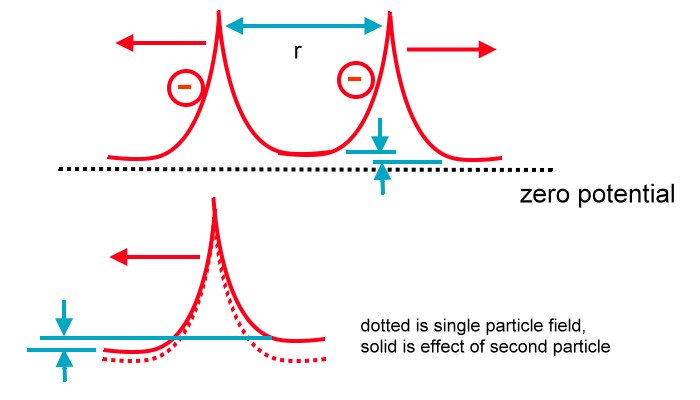
It will be instructive and potentially guiding to look at the two particle system from an electrostatics point of view.  Here are two figures, one for the two-electron case of repulsion, and one for the electron-positron case of attraction.  Note that the receiving particle experiences a force in the direction that is closest to the ground state potential in both cases.  If the field adjacent to a particle is radially unequal, the particle tries to move so that the field is closer to the ground state on every side of the particle.  It is interesting that in one case (the two electron repulsion state) the median plane is *not* at the ground potential, but in the attraction state, it is.  I see that from an electrostatics point of view, the median plane state, whether background or not, does not affect particle communication, whether by virtual photons in QFT or by bend of the imaginary vector in unitary twist field theory.  It is the field neighborhood, particularly the unequal, or unbalanced, aspect of the field near a particle that has to be responsible for forces on the particle.  It is not clear if the force is due to trying to minimize the overall field neighborhood to be close to the ground state, or if the force is merely trying to equalize the neighborhood (in fact, it is likely that both explanations mean the same thing given the relative nature of electrostatic potential).

The field near an electron when near another electron. Note how the force on a particle moves it toward a more equal field neighborhood.


Electrostatic field for the electon-positron attraction case. Once again, the particle moves to a field neighborhood closer to the ground state.

I will think on this, this means something for both QFT and unitary twist field theory–but exactly what is not clear in my mind yet.

Agemoz

Symmetry Constraint on Charged Particle Geometry

June 5, 2012

In working out the details of how the complex unitary twist field would work on a system of two charged particles, I came across a very important discovery.  This holds true even if you don’t believe in the unitary twist field theory tooth fairy, even if you only think in terms of QFT virtual particles.

If you have two identical charged particles such as electrons separated by a distance r, symmetry geometry requires that the interaction cannot be static.  Any continuous static field in this system must have a plane perpendicular to the path between the particles that is the same as if there were no particles–that is, identical to the background field.  For standard QFT, this plane cannot have an electrostatic potential relative to the field out at infinity.  For the Complex Unitary Twist Field theory, this plane must be at the background field state in the imaginary dimension.


But if this is true, then that becomes a point where the behavior of one particle cannot affect the other–there is no field potential.  I won’t go into the QFT case, but the analogy is similar when I try to work a geometric solution in the twist field case.  I had found a way that the bend of the twist field imaginary background vector would specify the effect of charge on the second particle.  But this bend has to be symmetric in this system, with a plane in the middle where the bend is the same as the overall background field with no charges.  Oops–the problem shows up where there is no way to communicate the bend effect to the second particle without creating a paradox–an impossible field situation.


Any static field between two identical charged particles must have a plane between them that cannot pass the charge effect. The charge effect must pass dynamically across this plane

I said, uh-oh–the unitary twist field can’t work this way with bends.  Then I realized this has to be true for QFT too!  The symmetry of the system says that there is no way that the charged particle force can be conveyed within a static field.  There has to be something dynamic passing through the plane–virtual photons for QFT, and probably some type of background vector motion for the unitary twist field.  These two theories have to converge, and symmetry is going to severely constrain what has to be happening across the plane.  Even if you ignore unitary twist field theory, and just make the statement that QFT claims that virtual photons are not real (and unitary twist field theory specifies virtual photons as partial field twists that don’t complete but revert back to the background vector state), this symmetry problem forces the virtual photons to have both a physical field property and a property of motion.

Agemoz

Fine Structure Constant Hunting

May 1, 2012

Built into current QED (quantum electrodynamics) is the QFT process of pertubative accumulation of virtual photons.  Each possible virtual photon term is assigned a unitless  probability (actually,  probability amplitude capable of interfering with other terms)  of occurrence called the fine structure constant.   Searching for the reason for the value of this constant is a legendary pursuit for physicists, Feynman made the famous comment about it:

It’s one of the greatest damn mysteries of physics: a magic number that comes to us with no understanding by man.

All kinds of research, study, and guesses have gone into trying to figure out why this number is what it is, and I can guarantee you this is a fruitless pursuit.  Think about it, there have been maybe millions of physicists over the last 100 years, the vast majority with IQs well north of 150, all putting varying amounts of effort into trying to figure out where this number comes from.  If none of them have come up with the answer yet, which they haven’t, the odds of you or I stumbling across it is certifiably close to zero.  That is an effort that I consider a waste of time. For one thing, this is a no-numerology physics blog.

One bad trait of many amateur physicists is to theorize answers by mixing up various constants such as pi, e, square roots, etc, etc and miraculously come up with numbers that explain everything.  Note, no knowledge required of the underlying science–just mix up numbers until something miraculous happens, you get a match to an actual observed physical constant (well, so close, anyway, and future work will explain the discrepancy.  Yeah… riiiight).  Then you go out and proselytize your Nobel prize winning theory, to the annoyance of everyone that sees what you did.  This is also called Easter egg hunting, and really is a waste of time.  Don’t do that.  Hopefully you will never ever see me do that.

Nevertheless, physicists are desperate for reasons why the fine structure constant is what it is, and all kinds of thought, analysis, and yes, numerology, have already gone into trying to find where it comes from.  Why do I insert a post about it in the midst of my step by step procedure of working out the role of unitary twist field theory in the electron-photon interaction?  Because, as I mentioned, the fine structure constant is fundamental to mathematically iterating terms in the QFT solution to this particular QED problem.  It stands to reason that an underlying theory would have a lot to say about why the fine structure constant is what it is.

Unfortunately, it’s clear to me that it’s not going to be that simple.  Pertubative QFT is exactly analogous to the term factors in a Taylor series.  You can create amazing functions from a polynomial with the right coefficients–I remember when I was much younger being totally amazed that you could create trigonometric functions from a simple sum of factors.  Just looking at the coefficients really tells you very little about what function is going to result, and that is exactly true in pertubative QFT.  The fine structure constant is your coefficient multiplier, but what we don’t have is the actual analytic function.  The fine structure constant has a large number of ways to appear in interaction computation, but the direct connection to real physics is really somewhat abstract.  For example, suppose I could geometrically explain the ratio of the charge potential energy between two electrons separated by distance d with the energy of a photon who’s energy is defined by that same distance d, which is defined as the fine structure constant value.  But I can’t.  The fact that it takes 137 of these photons (or equivalantly a photon with 1/137 the distance) to hold together two electrons to the same distance is not physically or geometrically interesting, it is a numerology thing.  Pursuing geometric reasons for the 137 is a lost cause, because the fine structure constant is a coefficient multiplier, an artifact of pertubative construction.

Nevertheless, I do see a way that the fine structure constant might be derived from the unitary twist field theory.  Don’t hold your breath–obviously a low IQ type like me isn’t likely to come up with any real discovery here.  Even so, I should follow through.  Here’s the deal.  Take that picture in the previous post, the second “Figure 2” that shows the effect of bending the imaginary vector.  I need to go back and edit that diagram, the circle ring is the twist ring electron, and fix that to be fig 3.  Anyway, the force on that electron ring is going to be determined by one of two things–the amount of the bend or the difference delta of the bend on one side of the ring versus the other.  The bend will gradually straighten out the further you get from a remote charge.   This computation will give the motion and hence the inertia of any self-contained twist (only the linear twist, the photon, will experience no net force from an imaginary bend).  This will be a difficult computation to do directly–but remember we must have gauge invariance, which leads to my discovery that a ring with an imaginary bend must have a frame of reference with no bend.  Find this frame of reference, and you’ve found the motion of the electron ring in the first frame of reference–a much easier computation to do.  This is real analysis and logical thinking, I think–not Easter egg hunting.

Agemoz

It must be my Imaginary Imagination

April 28, 2012

This modification to the unitary twist theory has everything going for it.  Here’s what happened: the twist theory needs a background state for quantization to work–enforcing integer twists means that all twist rotations except for one (the background state) to be unstable.   I originally put this background state  in R3 along with the rest of the twist rotation, but this ran into problems trying to work out charge forces–the requirement for gauge invariance becomes a show stopper.

So, using the fact that EM fields and photons are mathematically described as a complex wave function in C3, I proposed that the background state direction be an imaginary axis.  The twist would reside in a plane defined by one real vector and the single background vector pointing in a direction orthogonal to R3.  Now the photon wave equation immediately falls out, but we still get the quantization and special relativity Lorentz transforms unique to the unitary twist field approach.  The problem with discontinuities vanish now, because the twist never appears in R3, only between R3 and I1–the real and imaginary parts.

Assigning the unitary twist field theory background state to an imaginary direction (note vector arrows are direction only, don't try to assign a physical distance to these arrows!)

What happens to the charge attraction problem?  Can we still do virtual photons, which in this variation of  the theory become partial twists (bends) from the imaginary background state to some basis vector in R3?  I am working out a generalized solution but at first glance the answer is yes.  Two particles near each other will increase the apparent bend of the background state, opposite each other cancel the bend, and 90 degrees apart generate a Sqrt[2] compounding effect, bending to between the two particles–exactly what I would expect.

So, finally, back to the original question.  Can this modification finally make a workable solution to the attraction conservation of momentum problem?  Having the background state be orthogonal to all of R3 makes this a much better problem.  Now there’s no symmetry problem regardless of electron ring orientation.  Unlike before, where the background state was in R3, now the twist moment vector is always in the plane of the ring, which means that regardless of the orientation of the ring, one side of the ring will always experience slightly less background bend than the other.  This delta bend causes a distortion in the ring path travel, making it do a motion to compensate for the shorter return path to the background state versus the other side–causing motion of the overall ring (see figure 1.)  Now there is no momentum problem due to photon energy emission for attraction–the difference in bend from one side to the other simply causes the particle to move.  Now it is easy to see how the field carries the energy.   And most importantly, the solution is symmetric, there is no R3 direction preference, so gauge invariance should hold.

Effect of a remote charge on a local particle ring. Note that regardless of ring orientation in R3 or direction of I0 bend, this drawing will be valid, uplholding rotation and spatial invariance (Lorentz invariance not shown here).

It looks to me that there is no question about it, this has to be the right way to go.

More to come…

Agemoz

The Quandary of Attraction, Part III

April 26, 2012

I worked quite a bit with figuring out a way to make twists work in the electron-photon case.  I had excluded partial twist bending as a means of propagating the charge field of a remote charged particle, but this really troubles me, because it is a very clean way of representing virtual photons.  Virtual photons actually come from QFT as partial terms of a total expression of interaction probabilities.  They are a mathematical artifact only in the sense that there are constraints on the sum of all virtual interaction probabilities.  Even though they aren’t really “real”, they derive from real field behavior in aggregate, so there must be some physical analog if I’m going to construct an underlying theory.  Partial twists were perfect–since they have to return to the background direction without executing a full twist (otherwise there would be a real photon there), and since they have a linearity property where multiple charge sources can create a sum of bends, there was a good match for the QFT virtual particle artifice.  Such a bend will have an effect on a remote ring (charged particle) caused by the delta bend from one side of the particle to the other.  Here’s a simple picture that illustrates what I am thinking:

Problem with bend solution to Unitary Twist Field theory in a charged particle array

If bends are correct, there’s a whole bunch of problems that show up, the Figure 2 shows one of them–it doesn’t work correctly if a third charged particle is added at an angle to the line of the first and second particles.  In addition, the bends aren’t even correct if the field due to the receiving particle is added in.  It just doesn’t work, and so I decided to throw in the towel and say that bends are not virtual particles and there is no option but to only consider full twists for real photons.  The twist model won’t have a QFT equivalant mapping with virtual photons.  Oh, I really don’t like that.  I also really don’t like the background vector in R3 in order to enforce quantization–I see a large number of problems creating such a system that is gauge invariant (what I mean by that is that the system’s behavior is independent of absolute position, rotation, and Lorentz invariant to frames of reference in space-time).

It occurred to me that all these problems could be solved if we put the background vector direction orthogonal to our R3 space.  Not really a 4th dimension because nothing will exist there, but a 4th dimension direction to point.  I think multi-particle bends will correctly sum to create an electrostatic or magnetic field that QFT would generate with virtual photons, and now there is no preferred angle in R3 that would ruin gauge invariance.

I have to think about this a lot more because now there may be too many degrees of freedom for twists.  The work on circular polarization for photons wont be affected since the background direction just provides a reference for the available twists.  But the ring solution might end up with too many possibilities, I have to figure that out.  But I see a lot of promise in this adjustment to Unitary Twist Field theory–I think it is a closer match to what we know QFT and EM fields will do, yet still preserves the quantization and special relativity behavior that makes the Unitary Twist Field idea so compelling to me.

Agemoz

The Quandary of Attraction

April 20, 2012

Hah!  You read that title and thought you were getting a socially interesting topic rather than the boring amateur physics I usually post about!  But I’m not all mean, let me help you out:  http://en.wikipedia.org/wiki/Twilight_%28series%29

OK, now that all those guys are gone, let’s talk physics.  Hello?  Anyone left?  Guess not.  Well, then I can make outrageous crackpot claims and no one will care.

Last week, Prof Jones started in on reviewing the Unitary Twist Field idea.  He’ll be back, but today I want to address a crucial question about unitary twist fields.  The basic premise is built on a geometrical model of quantization using E=hv.  I see three principles that create an underlying geometry for EM fields that gives us both quantization and special relativity (see many previous posts).  These three principles are:

1: The E=hv quantization for fields and particles  is enforced by a rotation in a vector field, that is, a twist.

2: To ensure that only single complete rotations can occur, the field must have a local background state that the rotation returns to.

3: To ensure that the energy of the rotation cannot dissipate, the vector field must be unitary.  Every field element must have constant magnitude but can rotate in 3D+T spacetime.

I have figured out that the special relativity relations hold in such a geometry–there will always be a maximum possible observable speed c, and the Lorentz equations for space and time will also hold.  The correct number of degrees of freedom for photons (linear twists) and electron/positrons (ring twists) exist.  I’ve found that the uncertainty relation will hold for particles in this system.  I’ve found a bunch of other things that appear to match reality as well.  Yes, I am guilty of massaging this theory to get the facts to fit, but I’m doing the best to do it without glossing over any obvious fallacies–and when I encounter one, I adjust the theory.  I keep waiting for one to really kill off the theory, but so far that hasn’t happened.  However here is one that could kill it:

How does the theory explain attraction and repulsion of charged particles?

Real QFT theory, unlike my la-la land unitary twist field theory, says that this is mediated by exchanges of photons.  On the surface, this has a momentum problem because there is no way a particle can emit something with momentum in such a way that a second distant particle *approaches* the emitting particle.  That violates conservation of momentum and hence conservation of energy.  The mathematically derived QFT solution uses virtual photons to have the field around the second particle change in such a way that the particle moves toward the first–but this seems disengenuous to me–contrived, just as much or worse as my theory.  Nevertheless, the math works and that is enough for real physicists.

However, I am positing a new theory, somewhat outrageous in its claims, and thus demanding outrageously thorough verification.  Unitary Twist Field theory must have a (hopefully better) explanation how attraction and repulsion would work.  This issue is part of the more general issue of electron-photon interactions, and there are a whole huge array of sub-issues that come with this one simple interaction.  For example, photons of all frequencies (energies) and polarizations can interact with an electron, so any geometrical solution must not assume any preferred orientation of the electron moment or photon polarization or external electrostatic or magnetic field (ie, nearby sets of photons).   If the electron is one of many in a region, and a low energy photon that is far “larger” than the array hits the array, how is it that exactly one and only one electron absorbs the photon?  I could go on and on, but let’s zero in on this attraction issue.  How do I claim that would work in unitary twist field theory?

Actually, let’s ask the attraction question in a slightly different way so you can see clearly what the dilemma is for real-world physics theory.  QFT says that attraction/repulsion of charged particles is mediated by exchanges of photons.  Arrays of photons form an EM field that causes charged particles to change their path of motion in space-time.  This means that in a given frame of reference, a photon must be an element of either a magnetic field or an electrostatic field.  Here’s the question:

What’s different about the photon generating an electrostatic field and a magnetic field?

Real-world theory says that photons are oscillating electrostatic and magnetic fields–a rather unsatisfactory way to describe a photon because it is self-referential.  Electrostatic and magnetic fields are themselves composed of photons.   Nevertheless, the math works, so let’s ignore that for now.  However, referring to the question about what is different, photons have only one degree of freedom, polarization.  There is no anti-particle for photons, it is its own anti-particle.   Not a lot to work with here!  So–what is a “magnetic” photon, and what is an “electrostatic” photon?  Or is there something magic about how the photons are arranged as a group that explains the field property?  And don’t forget, this is in one particular frame of reference!  Go to a different frame and the field state *changes* from electrostatic to magnetic or vice-versa.

Unitary Field Twist theory has a very novel explanation.  Let’s wait for the next post to see it.

Agemoz