Posts Tagged ‘electron’

Precursor Field Constraints

August 31, 2016

I’m continuing to work through details on the Precursor Field, so called because it is the foundation for emergent concepts such as quantized particles and the EM field/Strong force. I mentioned previously that this field has a number of constraints that will help define what it is. Here is what I had from previous work: the precursor field must be unitary to satisfy the quantization implied by E=hv (no magnitude degree of freedom possible). It must be orientable to R3 + I, that is, SO(4) to allow field twists, which are necessary for particle formation under this theory. It must have a preferred background orientation state in the I direction to enable particle quantization. Rotations must complete a twist to the background state, no intermediate stopping point in rotation–this quantizes the twist and hence the resulting particle. This field must not necessarily be differentiable (to enable twists required for particle formation). There must be two types of field connections which I am calling forces in this field–field elements must have a lowest energy direction in the imaginary axis, such that there is a force that will rotate the field element in that direction. Secondly, it must have a neighborhood force whenever the field element changes its own rotation. I’ll call the first force the restoring force, and the second force the neighborhood force.

These constraints all result from a basic set of axioms resulting from the Twist Theory’s assumption that a precursor field is needed to form quantized stable particles (solitons).

Since then, I’ve uncovered more necessary constraints having to do with the two precursor field forces. Conservation of energy means that there cannot be any damping effect, which has the consequence that the twist cannot spread out. The only way this can occur is if the quantized twist propagates at the speed of light. This introduces a whole new set of constraints on the geometry of twists. I’m postulating that photons are linear twists which will reside on the light cone of Minkowski space, and that all other particles are closed loops. A closed loop on Minkowski space must also lie on a light cone for each delta on its twist path, which means that the closed loop as a whole cannot reach the speed of light. This can easily be seen because closed loops must have a spacelike component as well as a timelike component such that the sum of squares lies on the twist path elements light cone. This limits the timelike component to less than the speed of light (the delta path element has to end up inside the light cone, not on it).

One interesting side consequence is that a particle like the electron cannot be pointlike. The current collider experiments appear to show it is pointlike, but this should be impossible both because the Heisenberg uncertainty relation would imply an infinite energy to a pointlike particle but also because if an electron cannot be accelerated to exactly the speed of light, this forces its internal composition to have a spacelike component and thus cannot be pointlike. Ignoring my scientific responsibility to be skeptical (for example, another explanation would be massive particles are forced to interact within an EM field via exchange particles, thus slowing it down for reasons independent of the particle’s size–but if this were true, why doesn’t this also apply to photons), I have a strong instinct that says this confirms my hypothesis that particles other than the photon are closed loops with a physical size. This also makes sense since mass would then be associated with physical size since closed loops confine particle twist momentum to a finite volume, whereas a photon distributes its momentum over an infinite distance and thus has zero mass. Since collision scattering angles implies a point size, the standard interpretation is to assume that the electron is pointlike–but I think there may be another explanation that collider acceleration distorts the actual closed loop of the electron to approach a line (pointlike cross section).

Anyway, to get back on topic, my big focus is on how to precisely define the two forces required by the precursor field. I realized that the restoring force is the much harder force to describe–the neighborhood force merely has to translate the field elements change of rotation to a neighborhoods change of rotation such that the sum of all neighborhood force changes equals the elements neighborhood force. This gives a natural rise to a central force distribution and is easy to calculate.

The restoring force is harder. As I mentioned, conservation of energy requires that it cannot just dissipate into the field, and a quantum particle must consist of exactly one twist (otherwise the geometrical quantization would permit two or more particles). I’m thinking this means that a change in rotation due to the restoring force must be confined to a delta function and that the rotation twist must propagate at the speed of light, whether linearly (photons) or in a closed loop (massive particles). I suspect we can’t think of the restoring force as an actual force, but then how to describe it as a field property? I’ll have to do more thinking on this…

Agemoz
Geometry of the Twist Sim Math

January 5, 2015
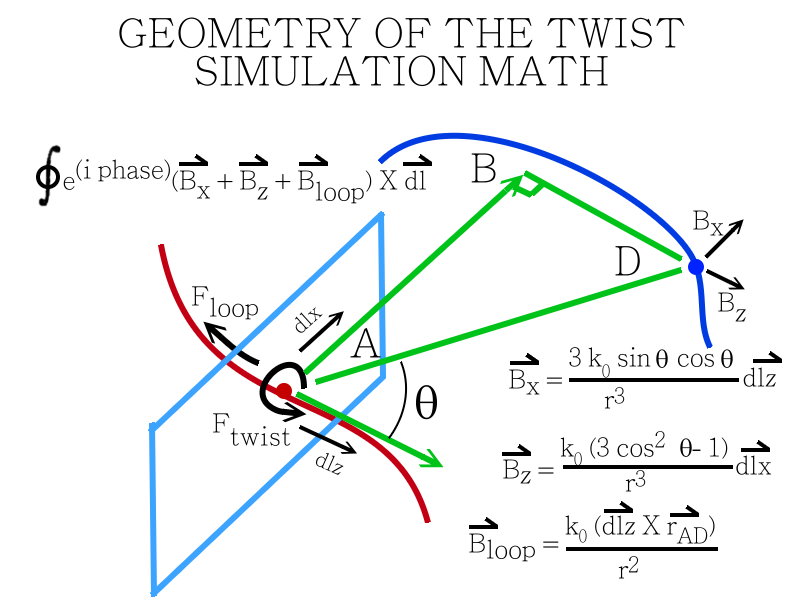
Here is a drawing of the forces on the twist path that the simulator attempts to model.

Here is a drawing of the forces on the twist path that the simulator attempts to model.

I created a picture that hopefully shows the geometry of the simulation math described in the previous post (see in particular the PPS update).  This picture attempts to show a generator twist path about point A in red, with the two force sources F(loop) and F(twist), which are delta 1/r^2 and 1/r^3 flux field generators respectively.  The destination point D path is shown in blue.  The parametric integral must be computed for every source point on each destination point–this will give a potential field.  When the entire set of curves lies on an equipotential path, one of many possible stable solutions has been found (it’s already easy to establish that any topologically unique closed loop solution will not degenerate because the 1/r^3 force will repel twist paths from crossing each other).  There probably is a good LaGrange method for finding stable solutions, but for now I will work iteratively and see if convergence for various linked or knotted loops can be achieved.


Agemoz

Simulation Construction of Twist Theory

December 2, 2014

Back after dealing with some unrelated stuff.  I had started work on a new simulator that would test the Twist Theory idea, and in so doing ran into the realization that the mathematical premise could not be based on any sort of electrostatic field.  To back up a bit, the problem I’m trying to solve is a geometrical basis for quantization of an EM field.  Yeah, old problem, long since dealt with in QFT–but the nice advantage of being an amateur physicist is you can explore alternative ideas, as long as you don’t try to convince anyone else.  That’s where crackpots go bad, and I just want to try some fun ideas and see where they go, not win a Nobel.  I’ll let the university types do the serious work.

OK, back to the problem–can an EM field create a quantized particle?  No.  No messing with a linear system like Maxwell’s equations will yield stable solitons even when constrained by special relativity.  Some rule has to be added, and I looked at the old wave in a loop (de Broglie’s idea) and modified it to be a single EM twist of infinitesimal width in the loop.  This still isn’t enough, it is necessary that there be a background state for a twist where a partial twist is metastable, it either reverts to the background state, or in the case of a loop, continues the twist to the background state.  In this system–now only integer numbers of twists are possible in the EM field and stable particles can exist in this field.  In addition, special relativity allows the twist to be stable in Minkowski space, so linear twists propagating at the speed of light are also stable but cannot stop, a good candidate for photons.

If you have some experience with EM fields, you’ll spot a number of issues which I, as a good working crackpot, have chosen to gloss over.  First, a precise description of a twist involves a field discontinuity along the twist.  I’ve discussed this at length in previous posts, but this remains a major issue for this scheme.  Second, stable particles are going to have a physical dimension that is too big for most physicists to accept.  A single loop, a candidate for the electron/positron particle, has a Compton radius way out of range with current attempts to determine electron size.  I’ve chosen to put this problem aside by saying that the loop asymptotically approaches an oval, or even a line of infinitesimal width as it is accelerated.  Tests that measure the size of an electron generally accelerate it (or bounce-off angle impact particles) to close to light speed.  Note that an infinitely small electron of standard theory has a problem that suggests that a loop of Compton size might be a better answer–Heisenberg’s uncertainty theorem says that the minimum measurable size of the electron is constrained by its momentum, and doing the math gets you to the Compton radius and no smaller.  (Note that the Standard Model gets around this by talking about “naked electrons” surrounded by the constant formation of particle-antiparticle pairs.  The naked electron is tiny but cannot exist without a shell of virtual particles.  You could argue the twist model is the same thing except that only the shell exists, because in this model there is a way for the shell to be stable).

Anyway, if you put aside these objections, then the question becomes why would a continuous field with twists have a stable loop state?  If the loop elements have forces acting to keep the loop twist from dissipating, the loop will be stable.  Let’s zoom in on the twist loop (ignoring the linear twist of photons for now).  I think of the EM twist as a sea of freely rotating balls that have a white side and a black side, thus making them orientable in a background state.  There has to be an imaginary dimension (perhaps the bulk 5th dimension of some current theories).  Twist rotation is in a plane that must include this imaginary dimension.  A twist loop then will have two rotations, one about the loop circumference, and the twist itself, which will rotate about the axis that is tangent to the loop.  The latter can easily be shown to induce a B field that varies as 1/r^3 (formula for far field of a current ring, which in this case follows the width of the twist).  The former case can be computed as the integral of dl/r^2 where dl is a delta chunk of the loop path.  This path has an approximately constant r^2, so the integral will also vary as r^2.  The solution to the sum of 1/r^2 – 1/r^3 yields a soliton in R3, a stable state.  Doing the math yields a Compton radius.  Yes, you are right, another objection to this idea is that quantum theory has a factor of 2, once again I need to put that aside for now.

So, it turns out (see many previous posts on this) that there are many good reasons to use this as a basis for electrons and positrons, two of the best are how special relativity and the speed of light can be geometrically derived from this construct, and also that the various spin states are all there, they emerge from this twist model.  Another great result is how quantum entanglement and resolution of the causality paradox can come from this model–the group wave construction of particles assumes that wave phase and hence interference is instantaneous–non-causal–but moving a particle requires changing the phase of the wave group components, it is sufficient to limit the rate of change of phase to get both relativistic causality and quantum instantaneous interference or coherence without resorting to multiple dimensions or histories.  So lots of good reasons, in my mind, to put aside some of the objections to this approach and see what else can be derived.

What is especially nice about the 1/r^2 – 1/r^3 situation is that many loop combinations are not only quantized but topologically stable, because the 1/r^3 force causes twist sections to repel each other.  Thus links and knots are clearly possible and stable.  This has motivated me to attempt a simulation of the field forces and see if I can get quantitative measurements of loops other than the single ring.  There will be an infinite number of these, and I’m betting the resulting mass measurements will correlate to mass ratios in the particle zoo.  The simulation work is underway and I will post results hopefully soon.

Agemoz

PS: an update, I realized I hadn’t finished the train of thought I started this post with–the discovery that electrostatic forces cannot be used in this model.  The original attempts to construct particle models, back in the early 1900s, such as variations of the DeBroglie wave model of particles, needed forces to confine the particle material.  Attempts using electrostatic and magnetic fields were common back then, but even for photons the problem with electrostatic fields was the knowledge that you can’t bend or confine an EM wave with either electric or magnetic fields.  With the discovery and success of quantum mechanics and then QFT, geometrical solutions fell out of favor–“shut up and calculate”, but I always felt like that line of inquiry closed off too soon, hence my development of the twist theory.  It adds a couple of constraints to Maxwell’s equations (twist field discontinuities and orientability to a background state) to make stable solitons possible in an EM field.

Unfortunately, trying to model twist field particles in a sim has always been hampered by what I call the renormalization problem–at what point do you cut off the evaluation of the field 1/r^n strength to prevent infinities that make evaluation unworkable.  I’ve tried many variations of this sim in the past and always ran into this intractable problem–the definition of the renormalization limit point overpowered the computed behavior of the system.

My breakthrough was realizing that that problem occurs only with electrostatic fields and not magnetic fields, and finding the previously mentioned balancing magnetic forces in the twist loop.  The magnetic fields, like electrostatic fields,  also have an inverse r strength, causing infinities–but it applies force according to the cross-product of the direction of the loop.  This means that no renormalization cutoff point (an arbitrary point where you just decide not to apply the force to the system if it is too close to the source) is needed.  Instead, this force merely constrains the maximum curvature of the twist.  As long as it is less that the 1/r^n of the resulting force, infinities wont happen, and the curve simulation forces will work to enforce that.  At last, I can set up the sim without that hokey arbitrary force cutoff mechanism.

And–this should prove that conceptually there is no clean particle model system (without a renormalization hack) that can be built from an electrostatic field.  A corollary might be–not sure, still thinking about this–that magnetic fields are fundamental and electrostatic fields are a consequence of magnetic fields, not a fundamental entity in its own right.  The interchangability of B and E fields in special relativity frames of reference calls that idea into question, though, so I have to think more about that one!  But anyway, this was a big breakthrough in creating a sim that has some hope of actually representing twist field behavior in particles.

Agemoz

PPS:  Update–getting closer.  I’ve worked out the equations, hopefully correctly, and am in the process of setting them up in Mathematica.  If you want to make your own working sim, the two forces sum to a flux field which can be parametrically integrated around whatever twist paths you create.  Then the goal becomes to try to find equipotential curves for the flux field.  The two forces are first the result of the axial twist, which generates a plane angle theta offset value Bx = 3 k0 sin theta cos theta/r^3, and Bz = k0 ( 3 cos^2 theta -1)/r^3.  The second flux field results from the closed loop as k0 dl/r^2).  These will both get a phase factor, and must be rotated to normalize the plane angle theta (some complicated geometry here, hope I don’t screw it up and create some bogus conclusions).  The resulting sum must be integrated as a cross product of the resulting B vector and the direction of travel around the proposed twist path for every point.

Yang-Mills Mass Gap

January 12, 2014

My study of vector field twists has led to the discovery of stable continuous field entities as described in the previous post (Dec 29th A Particle Zoo!).  I’ve categorized the available types of closed and open solutions into three broad groups, linear, knots, and links.  There’s also the set of linked knots as a composite solution set.  I am now trying to write a specialized simulator that will attempt quantitative characterization of these solutions–a tough problem requiring integration over a curve for each point in the curve–even though the topology has to be stable (up to an energy trigger point where the particle is annhiliated), there’s a lot of degrees of freedom and the LaGrange methodology for these cases appears to be far too complex to offer analytic resolution.  While the underlying basis and geometry is significantly different, the problem of analysis should be identical to the various string theory proposals that have been around for a while.  The difference primarily comes from working in R3+T rather that the multiple new dimensions postulated in string theory.  In addition, string theory attempts to reconcile with gravity, whereas the field twist theory is just trying to create an underlying geometry for QFT.

One thing that I have come across in my reading recently is the inclusion of the mass gap problem in one of the seven millenial problems.  This experimentally verified issue, in my words, is the discovery of an energy gap in the strong force interaction in quark compositions.  There is no known basis for the non-linear separation energy behavior between bound quarks or between quark sets (protons and neutrons in a nucleus).  Dramatically unlike central quadratic fields such as electromagnetic and gravitational fields, this force is non-existent up to a limit point, and then asymptotically grows, enforcing the bound quark state.  As far as we know, this means free quarks cannot exist.  As I mentioned, the observation of this behavior in the strong force is labeled the Yang-Mills Mass Gap, since the energy delta shows up as a mass quantization.

As I categorized the available stable twist configurations in the twist field theory, it was an easy conclusion to think that the mass gap could readily be modelled by the group of solutions I call links.  For example, the simplest configuration in this group is two linked rings.  If each of these were models of a quark, I can readily imaging being able to apply translational or moment forces to one of the rings relative to the other with nearly no work done, no energy expended.  But as soon as the ring twist nears the other ring twist, the repulsion factor (see previous post) would escalate to the energy of the particle, and that state would acquire a potential energy to revert.  This potential energy would become a component of the measurable mass of the quark.

The other question that needs to be addressed is why are some particles timewise stable and others not, and what makes the difference.  The difference between the knot solutions and the link solutions is actually somewhat minor since topologically knots are the one-twist degenerate case of links.  However, the moment of the knot cases is fairly complex and I can imagine the energy of the configuration could approach the particle energy and thus self-destruct.  The linear cases (eg, photons, possibly neutrinos as a three way linear braid) have no path to self destruct to, nor does the various ring cases (electron/positrons, quark compositions).  All the remaining cases have entwining configurations that should have substantial moment energies that likely would exceed the twist energy (rate of twisting in time) and break apart after varying amounts of time.

The other interesting realization is the fact that some of these knot combinations could have symmetry violations and might provide a geometrical understanding of parity and chirality.

One thing is for sure–the current understanding I have of the twist field theory has opened up a vast vein of potentially interesting hypothetical particle models that may translate to a better understanding of real-world particle infrastructure.

Agemoz

A Particle Zoo!

December 29, 2013

After that last discovery, described in the previous post, I got to a point where I wondered what I wanted to do next.  It ended the need in my mind to pursue the scientific focus described in this blog–I had thought I could somehow get closer to God by better understanding how this existence worked.  But then came the real discovery that as far as I could see, it’s turtles all the way down, and my thinking wasn’t going to get me where I wanted to go.

So I stopped my simulation work, sat back and wondered what’s next for me.  It’s been maybe 6 months now, and while I still think I was right, I miss the fun of thinking about questions like why is there a particle zoo and whether a continuous field could form such a zoo.  While I don’t sense the urgency of the study anymore, I do think about the problem, and in the recent past have made two discoveries.

One was finding a qualitative description of the math required to produce the field vector twist I needed for my Unitary Field Twist theory, and the second was a way to find the available solutions.  The second discovery was major–it allowed me to conceptualize geometrically how to set up simulations for verification.  The problem with working with continuous vector fields required by the twist theory is that solutions are described by differential equations that are probably impossible to solve analytically.  Sometimes new insights are found by creating new tools to handle difficult-to-solve problems, and to that end I created several simulation environments to attempt numerical computations of the twist field.  Up to now, though, this didn’t help finding the available solutions.

What did help was realizing that the base form of the solutions produce stable solutions when observing the 1/r(t)^3 = 1/r(t)^2 relation–the relation that develops from the vector field’s twist-to-transformation ratio.  Maxwell’s field equations observe this, but as we all know, this is not sufficient to produce stable particles out of a continuous field, and thus cannot produce quantization.  The E=hv relation for all particles led me to the idea that if particles were represented by field twists to some background state direction, either linear (eg, photons) or closed loops, vector field behavior would become quantized.  I added a background state to this field that assigns a lowest energy state depending on the deviation from this background state.  The greater the twist, the lower the tendency to flip back to the background state.  Now a full twist will be stable, and linear twists will have any possible frequency, whereas closed loops will have restricted (quantized) possibilities based on the geometry of the loop.

For a long time I was stuck here because I could see no way to derive any solutions other than the linear solution and the ring twist, which I assigned to photons and electrons.  I did a lot of work here to show correct relativistic behavior of both, and found a correct mass and number of spin states for the electron/positron, found at least one way that charge attraction and repulsion could be geometrically explained, found valid Heisenberg uncertainty, was able to show how the loop would constrain to a maximum velocity for both photons and electrons (speed of light), and so on–many other discoveries that seemed to point to the validity of the twist field approach.

But one thing has always been a problem as I’ve worked on all this–an underlying geometrical model that adds quantization to a continuous field must explain the particle zoo.  I’ve been unable to analytically or iteratively find any other stable solutions.  I needed a guide–some methodology that would point to other solutions, other particles.  The second discovery has achieved this–the realization that this twist field theory does not permit “crossing the streams”.  The twists of any particle cannot cross because the 1/r(t)^3 repulsion factor will grow exponentially faster than any available attraction force as twists approach each other.  I very suddenly realized this will constrain available solutions geometrically.  This means that any loop system, connected or not, will be a valid solution as long as they are topologically unique in R3.  Immediately I realized that this means that links and knots and linked knots are all valid solutions, and that there are an infinite number of these.  And I immediately saw that this solution set has no morphology paths–unlike electrons about an atom, you cannot pump in energy and change the state.  We know experimentally that shooting high energy photons at a free electron will not alter the electron, and correspondingly, shooting photons at a ring or link or knot will not transform the particle–the twists cannot be crossed before destroying the particle.  In addition, this discovery suggests a geometrical solution to the experimentally observed strong force behavior.  Linked loops modelling quarks will permit some internal stretching but never breaking of the loop, thus could represent the strong force behavior when trying to separate quarks.  And, once enough energy were available to break apart quarks, the resulting particles could not form free quarks because these now become topologically equivalent to electrons.

My next step is to categorize the valid particle solutions and to quantify the twist field solutions, probably by iterative methods, and hopefully eventually by analytic methods.

There’s no question in my mind, though–I’ve found a particle zoo in the twist field theory.  The big question now is does it have any connection to reality…

Agemoz

Atomic Orbital Correction

July 31, 2013

Oops, an error on the previous post.  I said the strong force is responsible for the repulsion of an atom’s orbital electrons from the nucleus, but of course that’s not right, it’s reponsible for the attraction binding the nucleus particles together.  By quantum mechanics, virtual photons in the EM field provide the electron attraction to the nucleus, and the the electron momentum prevents annhiliation.  In the Twist Theory approach, twists do mediate this interchange, but in the form of linear twist photons–no big surprise, here Twist Field theory does the same thing as quantum theory.  The trouble, though is why is the frequency of the photon what it is?  It would help vindicate the Twist Field theory if there was a plausable twist explanation, but I don’t see it.  As I mentioned in the previous post, the kinetic energy of an orbital is far smaller than the rest energy (and hence wavelength of its twist) of the electron–and the orbital size is correspondingly far larger by 7 or so orders of magnitude.  The twist field could maybe explain the energy of an electron, but right now I don’t see how it could explain the quantization of the orbital energy jumps.  The Rydberg Equation should give a clue with the 1/r^2 factor, but I don’t see a way for this to work geometrically yet.

Agemoz

Confirmed–Twist Model Now Functioning

July 26, 2013

sim_sample_r1_r2

Picture shows a sample run of the twist ring with an external field.  Red curve is displacement, black curve is twist ring velocity, blue is the acceleration of the twist ring (it decreases over time as the twist ring moves away from the source (located off image to the left).  The initial acceleration rise is not real, but an artifact due to a moving average getting enough data to compute.

I modified the model from a dipole approximation to an integrated sum of components on the ring, and got very clean results   I did a large number of runs with varying field strength and displacements, and am getting very clear correlation with the expected analytic behavior.  Looks like it is now working as expected–yayy!  There’s still a lot more to be done including characterizing the exact analytic acceleration factor and working out other solutions in R3.  Since this solution class is planar, the sim can get a valid solution in 2D, but other solutions will require expansion of the sim to handle 3D cases.  In addition, I’d like to further refine the model to operate in an atom (Schroedinger wave equation) and to investigate a relativistic model variation.

This may all be science fiction, but it is the only working geometrical model I know of that shows correct underlying attraction and repulsion in an external field.  QFT does mathematically derive attraction, but momentum conservation is an issue.  In electrostatic attraction, photons emitted by the source particle have to pull the destination particle toward it–an apparent violation of conservation of momentum.  I believe the QFT solution has the field absorbing the difference in momentum, but where does that momentum go once absorbed?  The Twist Field solution clearly successfully solves that issue, and this successful result also points out some other important question resolutions.

Previously, I have posted that I felt that a point size particle for the bare electron was not possible because then its active neighborhood could not detect a direction for field potential.  It would require a field vector and act on direction, which we know can’t be true–the electron is attracted to a charged source regardless of orientation.  The electron has to be able to sense a localized change in potential, and the Twist Ring model clearly shows how that would work.  There are still questions in my mind that the solution is clearly independent of either source or destination orientation, and there’s some real questions in my mind whether this works in relativistic environments, but one thing is for sure–this is the first time I’ve seen a working model that has the correct quantitative behavior.

Agemoz

Continuous Fields Cannot be Linear

June 10, 2012

A shocking revelation for me, in all my years both as a professional electrical engineer and as an amateur physicist.  I realize I have zero credibility out there with anyone, but at least for myself, I have discovered something fundamental about fields that I did not know.  Perhaps if I were a mathematician I would have worked this out.  Nevertheless, it is quite provable in my mind, and has enormous impact on how I must model the two particle interaction, whether by QFT or unitary twist field theory.

The concept of linear central force fields means that multiple potential sources create the field by means of linear superposition.  If you have two sources of potential, the effect on the field at any point is the sum of the effect due to either one.  There are potential corner cases such as if the potential is infinite at the point source, but in every finite potential situation, the field is the sum of all sources at that point.  Electrostatic fields are supposedly both continuous and linear, but this cannot be at the quantum scale.

I have been discussing in previous posts the concept of a median plane between two charged sources, and particularly enlightening was the attraction case of a positive and negatively charged particle.  Between these two particles will be a median plane whose normal runs through both particles.  This median plane can have no absolute potential (relative to the electrostatic field potential at infinite distance).  This field cannot pass any information, even about the existence of, one charged particle through this median plane.  In fact, it is well known in electrostatics that if you put a metal plane between two particles and ground it, you will get the same charge field distribution as if the second particle wasn’t there–it cannot be determined if the second particle actually exists or not.

The only way a field can pass information across this median plane is if the field is not continuous.  If the field  is created by a spaced array of quantized particles, such that they never, or almost never, interact, then the effect of the field can be made linear.  Indeed, shooting real photons at each other could collide, but that is exceeding rare, and modeling the field by photons, virtual or real, in either QFT or unitary twist field theory,  would produce a linear superposition of fields.  But there is no question now in my mind that if I simulate this, I cannot assume a continuous electrostatic field, such a thing cannot exist.  This field has to be almost entirely empty, with only very sporadic quantized particles, then I can see how linearity would be possible.  Every quantized particle that interacts with a quantized particle from the other source will distort the appearance of linearity, so the fact that deviations from linearity are experimentally unmeasurable strongly points to a extremely sparse field component density.

I had thought that QFT virtual particles could construct a continuous field in a Taylor or Fourier series type of composition, but it is clear that it cannot.  The QFT virtual particles must be exceedingly sparse, just like the twists in unitary twist field theory.  It also suggests that QFT virtual particles would have to clump in some way in order for localized neighborhoods in the field to obey conservation.

Now I see a workable model for twists.  The median plane problem cannot exist if the field is not continous.

Agemoz

Symmetry Constraint on Charged Particle Geometry

June 5, 2012

In working out the details of how the complex unitary twist field would work on a system of two charged particles, I came across a very important discovery.  This holds true even if you don’t believe in the unitary twist field theory tooth fairy, even if you only think in terms of QFT virtual particles.

If you have two identical charged particles such as electrons separated by a distance r, symmetry geometry requires that the interaction cannot be static.  Any continuous static field in this system must have a plane perpendicular to the path between the particles that is the same as if there were no particles–that is, identical to the background field.  For standard QFT, this plane cannot have an electrostatic potential relative to the field out at infinity.  For the Complex Unitary Twist Field theory, this plane must be at the background field state in the imaginary dimension.


But if this is true, then that becomes a point where the behavior of one particle cannot affect the other–there is no field potential.  I won’t go into the QFT case, but the analogy is similar when I try to work a geometric solution in the twist field case.  I had found a way that the bend of the twist field imaginary background vector would specify the effect of charge on the second particle.  But this bend has to be symmetric in this system, with a plane in the middle where the bend is the same as the overall background field with no charges.  Oops–the problem shows up where there is no way to communicate the bend effect to the second particle without creating a paradox–an impossible field situation.


Any static field between two identical charged particles must have a plane between them that cannot pass the charge effect. The charge effect must pass dynamically across this plane

I said, uh-oh–the unitary twist field can’t work this way with bends.  Then I realized this has to be true for QFT too!  The symmetry of the system says that there is no way that the charged particle force can be conveyed within a static field.  There has to be something dynamic passing through the plane–virtual photons for QFT, and probably some type of background vector motion for the unitary twist field.  These two theories have to converge, and symmetry is going to severely constrain what has to be happening across the plane.  Even if you ignore unitary twist field theory, and just make the statement that QFT claims that virtual photons are not real (and unitary twist field theory specifies virtual photons as partial field twists that don’t complete but revert back to the background vector state), this symmetry problem forces the virtual photons to have both a physical field property and a property of motion.

Agemoz

Fine Structure Constant Hunting

May 1, 2012

Built into current QED (quantum electrodynamics) is the QFT process of pertubative accumulation of virtual photons.  Each possible virtual photon term is assigned a unitless  probability (actually,  probability amplitude capable of interfering with other terms)  of occurrence called the fine structure constant.   Searching for the reason for the value of this constant is a legendary pursuit for physicists, Feynman made the famous comment about it:

It’s one of the greatest damn mysteries of physics: a magic number that comes to us with no understanding by man.

All kinds of research, study, and guesses have gone into trying to figure out why this number is what it is, and I can guarantee you this is a fruitless pursuit.  Think about it, there have been maybe millions of physicists over the last 100 years, the vast majority with IQs well north of 150, all putting varying amounts of effort into trying to figure out where this number comes from.  If none of them have come up with the answer yet, which they haven’t, the odds of you or I stumbling across it is certifiably close to zero.  That is an effort that I consider a waste of time. For one thing, this is a no-numerology physics blog.

One bad trait of many amateur physicists is to theorize answers by mixing up various constants such as pi, e, square roots, etc, etc and miraculously come up with numbers that explain everything.  Note, no knowledge required of the underlying science–just mix up numbers until something miraculous happens, you get a match to an actual observed physical constant (well, so close, anyway, and future work will explain the discrepancy.  Yeah… riiiight).  Then you go out and proselytize your Nobel prize winning theory, to the annoyance of everyone that sees what you did.  This is also called Easter egg hunting, and really is a waste of time.  Don’t do that.  Hopefully you will never ever see me do that.

Nevertheless, physicists are desperate for reasons why the fine structure constant is what it is, and all kinds of thought, analysis, and yes, numerology, have already gone into trying to find where it comes from.  Why do I insert a post about it in the midst of my step by step procedure of working out the role of unitary twist field theory in the electron-photon interaction?  Because, as I mentioned, the fine structure constant is fundamental to mathematically iterating terms in the QFT solution to this particular QED problem.  It stands to reason that an underlying theory would have a lot to say about why the fine structure constant is what it is.

Unfortunately, it’s clear to me that it’s not going to be that simple.  Pertubative QFT is exactly analogous to the term factors in a Taylor series.  You can create amazing functions from a polynomial with the right coefficients–I remember when I was much younger being totally amazed that you could create trigonometric functions from a simple sum of factors.  Just looking at the coefficients really tells you very little about what function is going to result, and that is exactly true in pertubative QFT.  The fine structure constant is your coefficient multiplier, but what we don’t have is the actual analytic function.  The fine structure constant has a large number of ways to appear in interaction computation, but the direct connection to real physics is really somewhat abstract.  For example, suppose I could geometrically explain the ratio of the charge potential energy between two electrons separated by distance d with the energy of a photon who’s energy is defined by that same distance d, which is defined as the fine structure constant value.  But I can’t.  The fact that it takes 137 of these photons (or equivalantly a photon with 1/137 the distance) to hold together two electrons to the same distance is not physically or geometrically interesting, it is a numerology thing.  Pursuing geometric reasons for the 137 is a lost cause, because the fine structure constant is a coefficient multiplier, an artifact of pertubative construction.

Nevertheless, I do see a way that the fine structure constant might be derived from the unitary twist field theory.  Don’t hold your breath–obviously a low IQ type like me isn’t likely to come up with any real discovery here.  Even so, I should follow through.  Here’s the deal.  Take that picture in the previous post, the second “Figure 2” that shows the effect of bending the imaginary vector.  I need to go back and edit that diagram, the circle ring is the twist ring electron, and fix that to be fig 3.  Anyway, the force on that electron ring is going to be determined by one of two things–the amount of the bend or the difference delta of the bend on one side of the ring versus the other.  The bend will gradually straighten out the further you get from a remote charge.   This computation will give the motion and hence the inertia of any self-contained twist (only the linear twist, the photon, will experience no net force from an imaginary bend).  This will be a difficult computation to do directly–but remember we must have gauge invariance, which leads to my discovery that a ring with an imaginary bend must have a frame of reference with no bend.  Find this frame of reference, and you’ve found the motion of the electron ring in the first frame of reference–a much easier computation to do.  This is real analysis and logical thinking, I think–not Easter egg hunting.

Agemoz