Posts Tagged ‘electrons’

What Electrostatics Tells Us

June 7, 2012

I am attempting to work out a viable unitary twist field approach for the attraction and repulsion of charged particles.  I’ve discovered symmetry requires that the vector field would have to have a median plane where there is only a background state, which leads to problems describing how one particle would communicate via the field to another particle (so that the particles, if identically charged, would experience a force of repulsion.   It appears that this problem would also be experienced by QFT since it mediates by virtual photons, which are best described as partial field components that mathematically sum to get the desired result, but individually do not obey various properties such as conservation of energy or momentum.

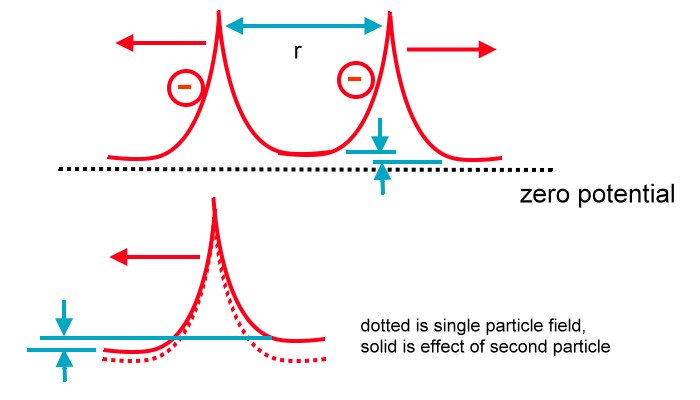
It will be instructive and potentially guiding to look at the two particle system from an electrostatics point of view.  Here are two figures, one for the two-electron case of repulsion, and one for the electron-positron case of attraction.  Note that the receiving particle experiences a force in the direction that is closest to the ground state potential in both cases.  If the field adjacent to a particle is radially unequal, the particle tries to move so that the field is closer to the ground state on every side of the particle.  It is interesting that in one case (the two electron repulsion state) the median plane is *not* at the ground potential, but in the attraction state, it is.  I see that from an electrostatics point of view, the median plane state, whether background or not, does not affect particle communication, whether by virtual photons in QFT or by bend of the imaginary vector in unitary twist field theory.  It is the field neighborhood, particularly the unequal, or unbalanced, aspect of the field near a particle that has to be responsible for forces on the particle.  It is not clear if the force is due to trying to minimize the overall field neighborhood to be close to the ground state, or if the force is merely trying to equalize the neighborhood (in fact, it is likely that both explanations mean the same thing given the relative nature of electrostatic potential).

The field near an electron when near another electron. Note how the force on a particle moves it toward a more equal field neighborhood.


Electrostatic field for the electon-positron attraction case. Once again, the particle moves to a field neighborhood closer to the ground state.

I will think on this, this means something for both QFT and unitary twist field theory–but exactly what is not clear in my mind yet.

Agemoz

The Quandary of Attraction, Part III

April 26, 2012

I worked quite a bit with figuring out a way to make twists work in the electron-photon case.  I had excluded partial twist bending as a means of propagating the charge field of a remote charged particle, but this really troubles me, because it is a very clean way of representing virtual photons.  Virtual photons actually come from QFT as partial terms of a total expression of interaction probabilities.  They are a mathematical artifact only in the sense that there are constraints on the sum of all virtual interaction probabilities.  Even though they aren’t really “real”, they derive from real field behavior in aggregate, so there must be some physical analog if I’m going to construct an underlying theory.  Partial twists were perfect–since they have to return to the background direction without executing a full twist (otherwise there would be a real photon there), and since they have a linearity property where multiple charge sources can create a sum of bends, there was a good match for the QFT virtual particle artifice.  Such a bend will have an effect on a remote ring (charged particle) caused by the delta bend from one side of the particle to the other.  Here’s a simple picture that illustrates what I am thinking:

Problem with bend solution to Unitary Twist Field theory in a charged particle array

If bends are correct, there’s a whole bunch of problems that show up, the Figure 2 shows one of them–it doesn’t work correctly if a third charged particle is added at an angle to the line of the first and second particles.  In addition, the bends aren’t even correct if the field due to the receiving particle is added in.  It just doesn’t work, and so I decided to throw in the towel and say that bends are not virtual particles and there is no option but to only consider full twists for real photons.  The twist model won’t have a QFT equivalant mapping with virtual photons.  Oh, I really don’t like that.  I also really don’t like the background vector in R3 in order to enforce quantization–I see a large number of problems creating such a system that is gauge invariant (what I mean by that is that the system’s behavior is independent of absolute position, rotation, and Lorentz invariant to frames of reference in space-time).

It occurred to me that all these problems could be solved if we put the background vector direction orthogonal to our R3 space.  Not really a 4th dimension because nothing will exist there, but a 4th dimension direction to point.  I think multi-particle bends will correctly sum to create an electrostatic or magnetic field that QFT would generate with virtual photons, and now there is no preferred angle in R3 that would ruin gauge invariance.

I have to think about this a lot more because now there may be too many degrees of freedom for twists.  The work on circular polarization for photons wont be affected since the background direction just provides a reference for the available twists.  But the ring solution might end up with too many possibilities, I have to figure that out.  But I see a lot of promise in this adjustment to Unitary Twist Field theory–I think it is a closer match to what we know QFT and EM fields will do, yet still preserves the quantization and special relativity behavior that makes the Unitary Twist Field idea so compelling to me.

Agemoz

The Quandary of Attraction

April 20, 2012

Hah!  You read that title and thought you were getting a socially interesting topic rather than the boring amateur physics I usually post about!  But I’m not all mean, let me help you out:  http://en.wikipedia.org/wiki/Twilight_%28series%29

OK, now that all those guys are gone, let’s talk physics.  Hello?  Anyone left?  Guess not.  Well, then I can make outrageous crackpot claims and no one will care.

Last week, Prof Jones started in on reviewing the Unitary Twist Field idea.  He’ll be back, but today I want to address a crucial question about unitary twist fields.  The basic premise is built on a geometrical model of quantization using E=hv.  I see three principles that create an underlying geometry for EM fields that gives us both quantization and special relativity (see many previous posts).  These three principles are:

1: The E=hv quantization for fields and particles  is enforced by a rotation in a vector field, that is, a twist.

2: To ensure that only single complete rotations can occur, the field must have a local background state that the rotation returns to.

3: To ensure that the energy of the rotation cannot dissipate, the vector field must be unitary.  Every field element must have constant magnitude but can rotate in 3D+T spacetime.

I have figured out that the special relativity relations hold in such a geometry–there will always be a maximum possible observable speed c, and the Lorentz equations for space and time will also hold.  The correct number of degrees of freedom for photons (linear twists) and electron/positrons (ring twists) exist.  I’ve found that the uncertainty relation will hold for particles in this system.  I’ve found a bunch of other things that appear to match reality as well.  Yes, I am guilty of massaging this theory to get the facts to fit, but I’m doing the best to do it without glossing over any obvious fallacies–and when I encounter one, I adjust the theory.  I keep waiting for one to really kill off the theory, but so far that hasn’t happened.  However here is one that could kill it:

How does the theory explain attraction and repulsion of charged particles?

Real QFT theory, unlike my la-la land unitary twist field theory, says that this is mediated by exchanges of photons.  On the surface, this has a momentum problem because there is no way a particle can emit something with momentum in such a way that a second distant particle *approaches* the emitting particle.  That violates conservation of momentum and hence conservation of energy.  The mathematically derived QFT solution uses virtual photons to have the field around the second particle change in such a way that the particle moves toward the first–but this seems disengenuous to me–contrived, just as much or worse as my theory.  Nevertheless, the math works and that is enough for real physicists.

However, I am positing a new theory, somewhat outrageous in its claims, and thus demanding outrageously thorough verification.  Unitary Twist Field theory must have a (hopefully better) explanation how attraction and repulsion would work.  This issue is part of the more general issue of electron-photon interactions, and there are a whole huge array of sub-issues that come with this one simple interaction.  For example, photons of all frequencies (energies) and polarizations can interact with an electron, so any geometrical solution must not assume any preferred orientation of the electron moment or photon polarization or external electrostatic or magnetic field (ie, nearby sets of photons).   If the electron is one of many in a region, and a low energy photon that is far “larger” than the array hits the array, how is it that exactly one and only one electron absorbs the photon?  I could go on and on, but let’s zero in on this attraction issue.  How do I claim that would work in unitary twist field theory?

Actually, let’s ask the attraction question in a slightly different way so you can see clearly what the dilemma is for real-world physics theory.  QFT says that attraction/repulsion of charged particles is mediated by exchanges of photons.  Arrays of photons form an EM field that causes charged particles to change their path of motion in space-time.  This means that in a given frame of reference, a photon must be an element of either a magnetic field or an electrostatic field.  Here’s the question:

What’s different about the photon generating an electrostatic field and a magnetic field?

Real-world theory says that photons are oscillating electrostatic and magnetic fields–a rather unsatisfactory way to describe a photon because it is self-referential.  Electrostatic and magnetic fields are themselves composed of photons.   Nevertheless, the math works, so let’s ignore that for now.  However, referring to the question about what is different, photons have only one degree of freedom, polarization.  There is no anti-particle for photons, it is its own anti-particle.   Not a lot to work with here!  So–what is a “magnetic” photon, and what is an “electrostatic” photon?  Or is there something magic about how the photons are arranged as a group that explains the field property?  And don’t forget, this is in one particular frame of reference!  Go to a different frame and the field state *changes* from electrostatic to magnetic or vice-versa.

Unitary Field Twist theory has a very novel explanation.  Let’s wait for the next post to see it.

Agemoz
Why Static Twists Cannot Be Stable

March 11, 2012

Some really exciting results from my simulation results of the Twist hypothesis!  I have been simulating this for a while now, to recap:  The twist theory posits (among many other things) that underlying the photon elements of an electromagnetic field is a unitary twist field.  This unitary twist field is a direct (or mapped) result of the E=hv quantization of all particles.  Photons are linear twists of the unitary field, whereas massive particles are self-contained twists, such as a ring for electrons/positrons.  Quarks and other massive particles are posited to be other geometrical constructions.  If this model is studied, one very interesting result is the correct representation of the special relativity space and time Lorentz transforms, where linear twists travel at a maximum, but constant, speed in all frames of reference–but all self-contained structures such as the electron ring must obey time and spatial dilation.  The model correctly derives the beta dilation factor.

As a result of this work, I have put together a simulator to model the twist behavior in the hopes of verifying the existing corollaries to the twist theory, and also to see if more complex geometrical structures could be determined (say for quarks, although it is certain that the strong force would have to be accounted for somehow).

One of the results of the theory seemed to imply that a static linear twist should be possible, yet static photons do not exist in nature.  I’m very excited to have the simulator show its first demonstration of why this happens!  When I set up the simulator to do a static linear twist, I discovered (see previous posts) that the twist always self destructed by dissipation, and it took a lot of work to find out why.  This will be easiest to show with this diagram:

Why the static twist dissipates. Note the narrowing of the twist from the outside in.

The premise of the unitary twist theory is that E=hv particles can only be quantized geometrically in a continuous field system if particles exist in a localized background field direction have a fixed amplitude twist.  The fixed amplitude (different from an EM field that allows any magnitude) prevents the quantized entity from dissipating, and the background direction enforces quantization of the twist–partial twists (virtual particles) are not stable and fall back to the background direction, whereas full twists are topologically stable since the ends are tied down to the background direction such that the twist cannot unwind.  The frequency of the twist is determined by the twist width, shown in the diagram as omega.

Iteration of the linear twist in the simulation showed that, even though the unitary twist magnitude could not dissipate, the twist would vanish (see previous post pictures).  At first, I thought this was an artifact of the lattice form of the simulation, I represented a continuous twist with a stepwise model.  Further sims and analysis showed that the behavior was not a lattice effect (although it definitely interfered with the correct model behavior).  As this diagram shows, I was able to demonstrate that a static twist cannot exist, it is not stable.  What happens is that the twist width cannot be preserved over time because the ends experience normalizing forces to the background.  This process, demonstrated in the simulation, ultimately causes the particle to approach a delta function, at which point the simulation twist model gets a single lattice node and eliminates it.

It would be a valid statement to say that the sim does not correctly model what happens at that final stage, but there’s no question in my mind of the validity of the narrowing of the twist width.  There is only one way that the linear twist can be stable–if the light cones of each twist element are out of range of each other.  This can only happen if the twist elements are moving at speed c.

I was disappointed at first, I didn’t have a working model of the twist field.  But I didn’t see that the sim had handed me my first victory–the explanation of why there are no static photons.

Agemoz