Posts Tagged ‘electrostatic’

Precursor Field and Renormalization

September 25, 2016

As I work out the details of the Precursor Field, I need to explain how this proposal deals with renormalization issues. The Precursor Field attempts to explain why we have a particle zoo, quantization, and quantum entanglement–and has to allow the emergence of force exchange particles for at least the EM and Strong forces. Previous efforts by physics theorists attempted to extend the EM field properties so that quantization could be derived, but these efforts have all failed. It’s my belief that there has to be an underlying “precursor” field that allows stable quantized particles and force exchange particles to form. I’ve been working out what properties this field must have, and one thing has been strikingly apparent–starting with an EM field and extending it cannot possibly work for a whole host of reasons.

As mentioned extensively in previous posts, the fundamental geometry of this precursor field is an orientable 3D+I dimensional vector field. It cannot have magnitude (otherwise E-hv quantization would not be constrained), must allow vector twists (and thus is not finite differentiable ie, not continuous) and must have a preferred orientation in the I direction to force an integral number of twists. Previous posts on this site eke out more properties this field must have, but lately I’ve been focusing on the renormalization problem. There are two connections at play in the proposed precursor field–the twist quantization force, which provides a low-energy state in the I direction, and a twist propagation force. The latter is an element neighborhood force, that is, is the means by which an element interacts with its neighbors.

The problem with any neighborhood force is that any linear interaction will dissipate in strength in a 3D space according to the central force model, and thus mathematically is proportionate to 1/r^2. Any such force will run into infinities that make finding realistic solutions impossible. Traditional quantum field theory works around this successfully by invoking cancelling infinities, renormalizing the computation into a finite range of solutions. This works, but the precursor field has to address infinities more directly. Or perhaps I should say it should. The cool thing is that I discovered it does. Not only that, but the precursor field provides a clean path from the quantized unitary twist model to the emergence of magnetic and electrostatic forces in quantum field theory. This discovery came from the fact that closed loop twists have two sources of twists.

The historical efforts to extend and quantize the EM field is exemplified by the DeBroglie EM wave around a closed loop. The problem here, of course, is that photons (the EM wave component) don’t bend like this, nor does this approach provide a quantization of particle mass. Such a model, if it could produce a particle with a confined momentum of an EM wave, would have no constraint on making a slightly smaller particle with a slightly higher EM wave frequency. Worse, the force that bends the wave would have the renormalization problem–the electrostatic balancing force is a central force proportionate function, and thus has a pole (infinity) at zero radius. This is the final nail in the coffin of trying to use an EM field to form a basis for quantizing particles.
The unitary twist field doesn’t have this problem, because the forces that bend the twist are not central force proportionate. The best way to describe the twist neighborhood connection is as a magnetic flux model. In addition, there are *two* twists in a unitary twist field particle (closed loop of various topologies). There is the quantized vector twist from I to R3 and back again to I, that is, a twist about the propagation axis. And, there is also the twist that results from propagating around the closed loop. Similar to magnetic fields, the curving (normal) force on a twist element is proportionate to the cross-product of the flux change with the twist element propagation direction. My basic calculations show there is a class of closed loop topologies where the two forces cancel each other along a LaGrangian minimum energy path, thus providing a quantized set of solutions (particles). It should be obvious that neither connection force is central force dependent and thus the  renormalization problem disappears.  There should be a large or infinite number of solutions, and the current quest is to see if these solutions match or resemble the particle zoo.

In summary, this latest work shows that the behavior of the precursor field has to be such that central force connections cannot be allowed (and thus forever eliminates the possibility that an EM field can be extended to enable quantization). It also shows how true quantization of particle mass can be achieved, and finally shows how an electrostatic field must emerge given that central force interactions cannot exist at the precursor field level. EM fields must emerge as the result of force exchange particles because it cannot emerge from any central force field, thus validating quantum field theory from a geometrical basis!

I thought that was pretty cool… But I must confess to a certain angst.

Is anybody going to care about these ideas? I know the answer is no. I imagine Feynman (or worse, Bohr) looking over my shoulder and (perhaps kindly or not) saying what the heck are you wasting your time for. Go study real physics that produces real results. This speculative crap isn’t worth the time of day. Why do I bother! I know that extraordinary claims require extraordinary proof–extraordinary in either experimental verification or deductive proof. Neither option, as far as I have been able to think, is within my reach. But until I can produce something, these ideas amount to absolutely nothing.

I suppose one positive outcome is personal–I’ve learned a lot and entertained myself plus perhaps a few readers on the possibility of how things might work. I’ve passed time contemplating the universe, which I think is unarguably a better way to spend a human life than watching the latest garbage on youtube or TV. Maybe I’ve spurred one person out there to think about our existence in a different way.

Or, perhaps more pessimistically, I’m just a crackpot. The lesson of the Man of La Mancha is about truly understanding just who and what you are, and reaching for the impossible star can doing something important to your character. I like the image that perhaps I’m an explorer of human existence, even if perhaps not a very good one–and willing to share my adventures with any of you who choose to follow along.

Agemoz

Simulation Construction of Twist Theory

December 2, 2014

Back after dealing with some unrelated stuff.  I had started work on a new simulator that would test the Twist Theory idea, and in so doing ran into the realization that the mathematical premise could not be based on any sort of electrostatic field.  To back up a bit, the problem I’m trying to solve is a geometrical basis for quantization of an EM field.  Yeah, old problem, long since dealt with in QFT–but the nice advantage of being an amateur physicist is you can explore alternative ideas, as long as you don’t try to convince anyone else.  That’s where crackpots go bad, and I just want to try some fun ideas and see where they go, not win a Nobel.  I’ll let the university types do the serious work.

OK, back to the problem–can an EM field create a quantized particle?  No.  No messing with a linear system like Maxwell’s equations will yield stable solitons even when constrained by special relativity.  Some rule has to be added, and I looked at the old wave in a loop (de Broglie’s idea) and modified it to be a single EM twist of infinitesimal width in the loop.  This still isn’t enough, it is necessary that there be a background state for a twist where a partial twist is metastable, it either reverts to the background state, or in the case of a loop, continues the twist to the background state.  In this system–now only integer numbers of twists are possible in the EM field and stable particles can exist in this field.  In addition, special relativity allows the twist to be stable in Minkowski space, so linear twists propagating at the speed of light are also stable but cannot stop, a good candidate for photons.

If you have some experience with EM fields, you’ll spot a number of issues which I, as a good working crackpot, have chosen to gloss over.  First, a precise description of a twist involves a field discontinuity along the twist.  I’ve discussed this at length in previous posts, but this remains a major issue for this scheme.  Second, stable particles are going to have a physical dimension that is too big for most physicists to accept.  A single loop, a candidate for the electron/positron particle, has a Compton radius way out of range with current attempts to determine electron size.  I’ve chosen to put this problem aside by saying that the loop asymptotically approaches an oval, or even a line of infinitesimal width as it is accelerated.  Tests that measure the size of an electron generally accelerate it (or bounce-off angle impact particles) to close to light speed.  Note that an infinitely small electron of standard theory has a problem that suggests that a loop of Compton size might be a better answer–Heisenberg’s uncertainty theorem says that the minimum measurable size of the electron is constrained by its momentum, and doing the math gets you to the Compton radius and no smaller.  (Note that the Standard Model gets around this by talking about “naked electrons” surrounded by the constant formation of particle-antiparticle pairs.  The naked electron is tiny but cannot exist without a shell of virtual particles.  You could argue the twist model is the same thing except that only the shell exists, because in this model there is a way for the shell to be stable).

Anyway, if you put aside these objections, then the question becomes why would a continuous field with twists have a stable loop state?  If the loop elements have forces acting to keep the loop twist from dissipating, the loop will be stable.  Let’s zoom in on the twist loop (ignoring the linear twist of photons for now).  I think of the EM twist as a sea of freely rotating balls that have a white side and a black side, thus making them orientable in a background state.  There has to be an imaginary dimension (perhaps the bulk 5th dimension of some current theories).  Twist rotation is in a plane that must include this imaginary dimension.  A twist loop then will have two rotations, one about the loop circumference, and the twist itself, which will rotate about the axis that is tangent to the loop.  The latter can easily be shown to induce a B field that varies as 1/r^3 (formula for far field of a current ring, which in this case follows the width of the twist).  The former case can be computed as the integral of dl/r^2 where dl is a delta chunk of the loop path.  This path has an approximately constant r^2, so the integral will also vary as r^2.  The solution to the sum of 1/r^2 – 1/r^3 yields a soliton in R3, a stable state.  Doing the math yields a Compton radius.  Yes, you are right, another objection to this idea is that quantum theory has a factor of 2, once again I need to put that aside for now.

So, it turns out (see many previous posts on this) that there are many good reasons to use this as a basis for electrons and positrons, two of the best are how special relativity and the speed of light can be geometrically derived from this construct, and also that the various spin states are all there, they emerge from this twist model.  Another great result is how quantum entanglement and resolution of the causality paradox can come from this model–the group wave construction of particles assumes that wave phase and hence interference is instantaneous–non-causal–but moving a particle requires changing the phase of the wave group components, it is sufficient to limit the rate of change of phase to get both relativistic causality and quantum instantaneous interference or coherence without resorting to multiple dimensions or histories.  So lots of good reasons, in my mind, to put aside some of the objections to this approach and see what else can be derived.

What is especially nice about the 1/r^2 – 1/r^3 situation is that many loop combinations are not only quantized but topologically stable, because the 1/r^3 force causes twist sections to repel each other.  Thus links and knots are clearly possible and stable.  This has motivated me to attempt a simulation of the field forces and see if I can get quantitative measurements of loops other than the single ring.  There will be an infinite number of these, and I’m betting the resulting mass measurements will correlate to mass ratios in the particle zoo.  The simulation work is underway and I will post results hopefully soon.

Agemoz

PS: an update, I realized I hadn’t finished the train of thought I started this post with–the discovery that electrostatic forces cannot be used in this model.  The original attempts to construct particle models, back in the early 1900s, such as variations of the DeBroglie wave model of particles, needed forces to confine the particle material.  Attempts using electrostatic and magnetic fields were common back then, but even for photons the problem with electrostatic fields was the knowledge that you can’t bend or confine an EM wave with either electric or magnetic fields.  With the discovery and success of quantum mechanics and then QFT, geometrical solutions fell out of favor–“shut up and calculate”, but I always felt like that line of inquiry closed off too soon, hence my development of the twist theory.  It adds a couple of constraints to Maxwell’s equations (twist field discontinuities and orientability to a background state) to make stable solitons possible in an EM field.

Unfortunately, trying to model twist field particles in a sim has always been hampered by what I call the renormalization problem–at what point do you cut off the evaluation of the field 1/r^n strength to prevent infinities that make evaluation unworkable.  I’ve tried many variations of this sim in the past and always ran into this intractable problem–the definition of the renormalization limit point overpowered the computed behavior of the system.

My breakthrough was realizing that that problem occurs only with electrostatic fields and not magnetic fields, and finding the previously mentioned balancing magnetic forces in the twist loop.  The magnetic fields, like electrostatic fields,  also have an inverse r strength, causing infinities–but it applies force according to the cross-product of the direction of the loop.  This means that no renormalization cutoff point (an arbitrary point where you just decide not to apply the force to the system if it is too close to the source) is needed.  Instead, this force merely constrains the maximum curvature of the twist.  As long as it is less that the 1/r^n of the resulting force, infinities wont happen, and the curve simulation forces will work to enforce that.  At last, I can set up the sim without that hokey arbitrary force cutoff mechanism.

And–this should prove that conceptually there is no clean particle model system (without a renormalization hack) that can be built from an electrostatic field.  A corollary might be–not sure, still thinking about this–that magnetic fields are fundamental and electrostatic fields are a consequence of magnetic fields, not a fundamental entity in its own right.  The interchangability of B and E fields in special relativity frames of reference calls that idea into question, though, so I have to think more about that one!  But anyway, this was a big breakthrough in creating a sim that has some hope of actually representing twist field behavior in particles.

Agemoz

PPS:  Update–getting closer.  I’ve worked out the equations, hopefully correctly, and am in the process of setting them up in Mathematica.  If you want to make your own working sim, the two forces sum to a flux field which can be parametrically integrated around whatever twist paths you create.  Then the goal becomes to try to find equipotential curves for the flux field.  The two forces are first the result of the axial twist, which generates a plane angle theta offset value Bx = 3 k0 sin theta cos theta/r^3, and Bz = k0 ( 3 cos^2 theta -1)/r^3.  The second flux field results from the closed loop as k0 dl/r^2).  These will both get a phase factor, and must be rotated to normalize the plane angle theta (some complicated geometry here, hope I don’t screw it up and create some bogus conclusions).  The resulting sum must be integrated as a cross product of the resulting B vector and the direction of travel around the proposed twist path for every point.

Principle of Replication and the Particle Zoo

June 27, 2014

I am continuing to develop the new twist simulation, and hope to get first runs maybe in the next several weeks or months.  It’s been a good exercise because it has forced me to be very clear and explicit about how the model works.  To paraphrase Feynman very loosely, “the truth does not lie”–I can’t just make the theory work just because I want it to.  But the exercise has been good because it’s clarified some important concepts that are distributed all throughout this blog, and thus a casual reader is going to have a very difficult time figuring out what I am talking about and whether there’s any real substance to what I’m thinking.  While there is a *lot* of thinking behind this approach, here are the fundamental concepts that are driving how this simulation is being built:

The twist field concept starts with E=hv for all particles, and this is a statement of quantization.  For any given frequency, there is only one possible energy.  If we assume a continuous field, the simplest geometrical model of this is a full twist in a field of orientations.  E=hv implies no magnitude to the field, you can imagine a field of orientable dots within a background state direction–quantization results when only a complete rotation is permitted, thus implying the background default direction that all twists must return to.

The second concept is a duality–if there is a vast field of identical particles, say electrons, the dual of exact replication is a corresponding degree of simplicity.  While not a proof, the reason I call simplicity the dual of replication is because the number of rules required to achieve massive repeatability has to withstand preservation of particles in every possible physical environment from the nearly static state–say, a Milliken droplet electron all the way to electrons in a black hole jet.  The fewer the rules, the fewer environments that could break them.

The third concept is to realize causality doesn’t hold for wave phase in the twist model.  Dr. Bell proved that quantum entanglement means that basic Standard Model quantum particles cannot have internal structure if causality applies to every aspect of nature.  The twist model says that waves forming a particle are group waves–a change in phase in a wave component is instantaneous across the entire wave–but the rate of change of this phase is what allows the group wave particle to move, and this rate of change is what limits particle velocity to the speed of light.  This thus allows particles to interfere instantaneously, but the particle itself must move causally.  Only this way can a workable geometry for quantum entanglement, two-slit experiments, and so on be formed.

Within these constraints the twist model has emerged in my thinking.  A field twist can curve into stable  loops based on standard EM theory and the background state quantization principle.  A particle zoo will emerge because of a balance of two forces, one of which is electrostatic (1/r*2, or central force) and the other is electromagnetic (1/r*3).  When a twist curve approaches another twist curve, the magnetic (1/r*3) repulsion dominates, but when two parts of a curve (or separate curves) move away from each other, the electrostatic attractive force dominates.  Such a system has two easily identifiable stable states, the linear twist and the ring.  However there are many more, as can be easily seen when you realize that twist curves cannot intersect due to the 1/r*3 repulsion force dominating as curves approach.  Linked rings, knots, braids all become possible and stable, and a system of mapping to particle zoo members becomes available.

Why do I claim balancing 1/r*2 and 1/r*3 forces exist?  Because in a twist ring or other closed loop geometries, there are a minimum of two twists–the twist about the axis /center of the ring, and the twist about the path of the ring–imagine the linear twist folded into a circle.  Simple Lorentz force rules will derive the two (or more, for complex particle assemblies such as knots and linked rings) interacting forces.  Each point’s net force is computed as a sum of path forces multiplied by the phase of the wave on that path–you can see the resemblance to the Feynman path integrals of quantum mechanics.

Soon I’ll show some pictures of the sim results.

Hopefully that gives a clear summary of why I am taking this study in the directions I have proposed.

Agemoz

Confirmed–Twist Model Now Functioning

July 26, 2013

sim_sample_r1_r2

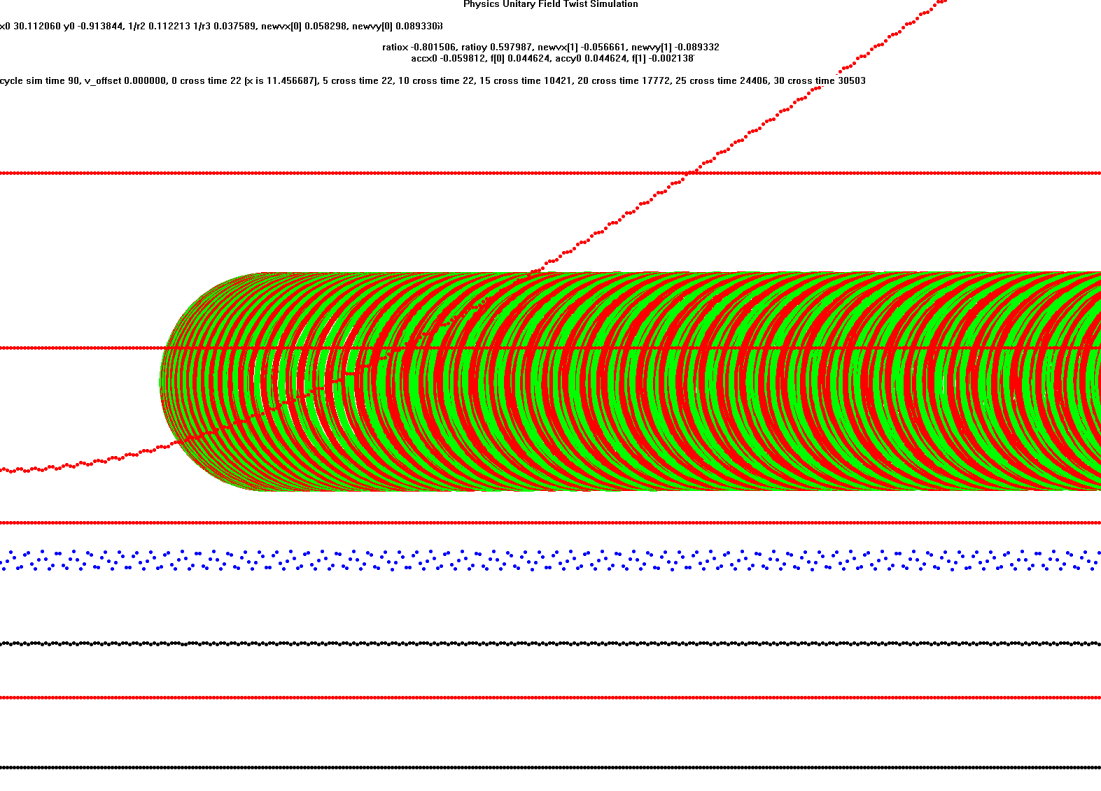
Picture shows a sample run of the twist ring with an external field.  Red curve is displacement, black curve is twist ring velocity, blue is the acceleration of the twist ring (it decreases over time as the twist ring moves away from the source (located off image to the left).  The initial acceleration rise is not real, but an artifact due to a moving average getting enough data to compute.

I modified the model from a dipole approximation to an integrated sum of components on the ring, and got very clean results   I did a large number of runs with varying field strength and displacements, and am getting very clear correlation with the expected analytic behavior.  Looks like it is now working as expected–yayy!  There’s still a lot more to be done including characterizing the exact analytic acceleration factor and working out other solutions in R3.  Since this solution class is planar, the sim can get a valid solution in 2D, but other solutions will require expansion of the sim to handle 3D cases.  In addition, I’d like to further refine the model to operate in an atom (Schroedinger wave equation) and to investigate a relativistic model variation.

This may all be science fiction, but it is the only working geometrical model I know of that shows correct underlying attraction and repulsion in an external field.  QFT does mathematically derive attraction, but momentum conservation is an issue.  In electrostatic attraction, photons emitted by the source particle have to pull the destination particle toward it–an apparent violation of conservation of momentum.  I believe the QFT solution has the field absorbing the difference in momentum, but where does that momentum go once absorbed?  The Twist Field solution clearly successfully solves that issue, and this successful result also points out some other important question resolutions.

Previously, I have posted that I felt that a point size particle for the bare electron was not possible because then its active neighborhood could not detect a direction for field potential.  It would require a field vector and act on direction, which we know can’t be true–the electron is attracted to a charged source regardless of orientation.  The electron has to be able to sense a localized change in potential, and the Twist Ring model clearly shows how that would work.  There are still questions in my mind that the solution is clearly independent of either source or destination orientation, and there’s some real questions in my mind whether this works in relativistic environments, but one thing is for sure–this is the first time I’ve seen a working model that has the correct quantitative behavior.

Agemoz

Twist Ring Acceleration Sim Results

July 7, 2013

The initial measurements are in, and still look promising.  To recap, one stable form of the twist in the Unitary Twist Field theory is in a ring where the twist curves on itself as a combination of the electrostatic 1/r^2 and magnetic field 1/r^3 strengths (this ratio is defined by the fine structure constant).  There are potentially many solutions, but only one possible planar solution other than the linear twist–the twist ring.  I posited that if this were true, placing a twist ring in an external electrostatic field would cause the curvature to vary depending on the distance from a source charged particle.  Computing this analytically is a challenge, yielding a 24 term LaGrange differential equation of motion, so I decided to do this iteratively.

This was a lot easier, and has yielded promising results that suggest I might be on the right track.  The initial sims showed correct qualitative behavior with repulsion or attraction depending on the external field polarity, and I could visually see the correct acceleration behavior.

Next, I added quite a bit of numerical analysis code to the sim of the twist ring path, and was able to verify that a linearly varying field will cause the path of motion to accelerate at a constant rate–and that this acceleration is proportionate to the strength of the field within some level of accuracy.  Much more needs to be done to confirm these measurements, but the initial results show that this type of model (twist ring) will give electrostatic behavior.  Here’s a pic where you can see the displacement with time (the parabolic curve).  Following that, you’ll see my initial data set along with the Mathematica solution for the first three crossing points of the parabola–more computations will be done to establish that this really is a parabola.

From here, I will see if the correct mass results from the ratio of the strength of the 1/r^2 component to the 1/r^3 component in an electron.  There should also be other twist loop solutions possible in 3D, I’ve limited myself to the easiest (planar) solution to start.

Agemoz

twist_ring_measured_repel

Here’s the initial sim time crossing points, along with the Mathematica solve solutions:

Running the Unitary Field Twist simulation to numerically derive the change in x as
a field is asserted on a 1/r^2 - 1/r^3 twist ring.  The field affects the curvature
(magnetic component).  The result generates the qualitative expected movement as if
there was a central force effect (q^2/r^2).  These results are an attempt to measure
the acceleration factor as a function of relative field strength (magnetic to
electrostatic).

Since the equations of motion due to the 1/r^2 - 1/r^3 equation in a linear field
were 24 parameter LaGrange equations of motion, I attempted to get an analytic
solution by examining the iterative numerical results.

Here is the result for 1:1 (1/r^2 to 1/r^3) field strength at distance 10 with
radius 1.5 and ring velocity 0.10545 and source field strength factor .0005.
The sim showed a cycle time of about 90.

field strength 0.00025
22:  11.457            (doesnt start at zero because cycle max x is not at zero)
14545: 15
25213: 20
34448: 25
43234: 30

using the first 3 terms in quadratic solution, I get
x = 8.92 10^9 * t^2 + .000114 * t + 11.455

field strength 0.0005
22:  11.457            (doesnt start at zero because cycle max x is not at zero)
10421: 15
17772: 20
24406: 25
30503: 30

using the first 3 terms in quadratic solution, I get
x = 1.912 10^8 * t^2 + .000141 * t + 11.454

field strength 0.0010
22:  11.457            (doesnt start at zero because cycle max x is not at zero)
7372: 15
12572: 20
17233: 25
21626: 30

using the first 3 terms in quadratic solution, I get
x = 3.82 10^8 * t^2 + .000200 * t + 11.453

More terms need to be computed, but there is a clear linear proportionality to the 
acceleration component of the curve, consistent with the expected electrostatic
relation of field strength proportionate to the acceleration of the destination
particle.

Twist Field Theory Sim Results

June 30, 2013

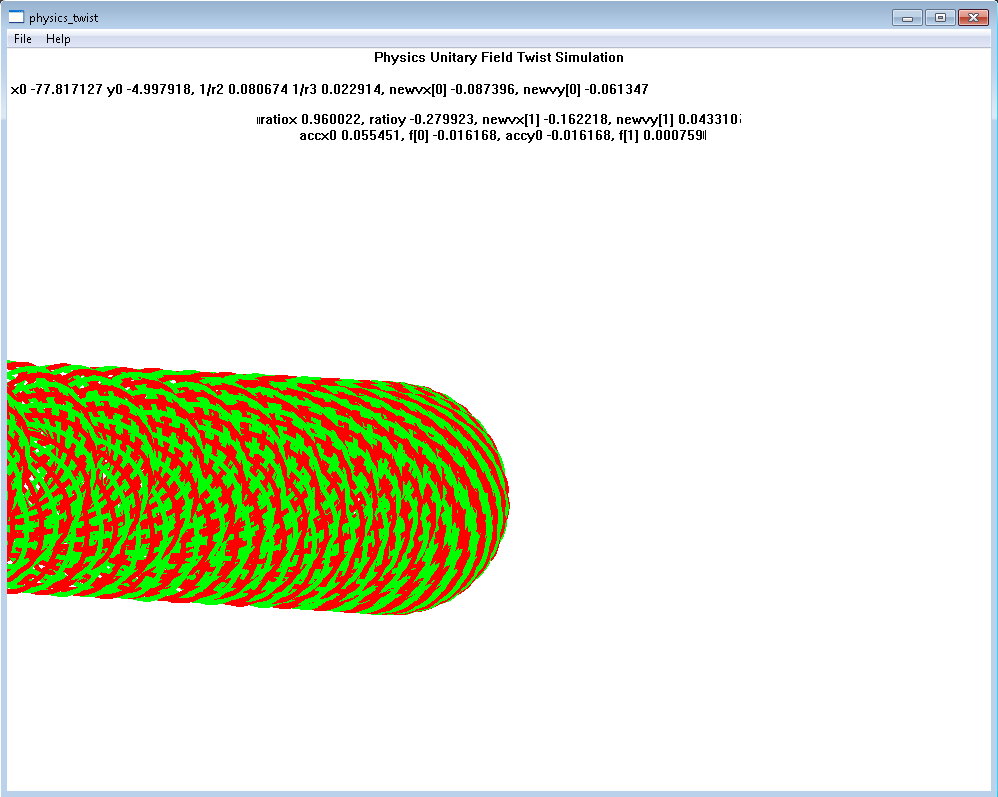
I have worked on my simulation that tests the acceleration concept that the unitary twist field predicts, and verified that it does what I expect qualitatively (quantitative calculations soon coming).  What is this?  The theory says that the twist ring of a particle twists from a real vector in R3 to I1 and back again.  If this is correct, then among other things, it should be possible to derive the acceleration of the twist ring in a 1/r^2 electrostatic field, because the twist will encounter a different distance from an electrostatic point source (I’m assuming far-field here).  The simulation without a remote field looks like this (the source field particle is to the left off screen (the real axis).  The vertical axis is the imaginary twist axis, this picture is showing a projection with one real dimension).

twist_ring_acc_nofield

But when the point source is added (it is located off-screen to the left), the twist ring moves away from the source as so:

twist_ring_acc_repulse

When the field polarity is reversed, the twist ring moves toward the source (to the left)

twist_ring_acc_attract

You can see the pattern of the rotating ring is changing, there is an acceleration as the particle moves to the left (toward the source) but when the particle moves to the right, the acceleration slows, eventually it appears to just have a constant velocity.  This sim set demonstrates how the theory explains electrostatic repulsion and attraction if particles are closed loop twists.

I used to have a charge loop theory which put the loop (twist ring) in real space (R3), but this didn’t work because the ring could have different orientations relative to a source field particle that would have to vary the electrostatic force, which is impossible.  In addition, the charge loop attraction would not compute correctly if there were three particles in a triangle.  Since the unitary twist field theory uses one common imaginary axis for twist rotation, and this is the axis of the 1/r^2 field, all particles will see an unvarying effect relative to each other regardless of their orientation in real R3 space.

Looks promising!  Next up is to quantitatively compute the acceleration, this should give the mass of the particle via the inertial factor.  From that, I should be able to show how mass results from the twist frequency, which is directly a function of the strength of the magnetic field relative to the electrostatic field, which comes from (or defined by) the fine structure constant.   If this collection of derivations matches reality, then maybe this theory is worth looking at!

Agemoz

The Quandary of Attraction, part II

April 23, 2012

I mentioned previously that the attraction between two opposite charged particles appears to present a conservation of momentum problem if electrostatic forces are mediated by photon exchanges.  Related to this issue is the question of what makes a photon a carrier of a magnetic field versus an electrostatic field. QFT specifies that this happens because the field (sea of electron-positron pairs/virtual particle terms) absorbs the conservation loss, but as far as I can find, does not try to answer the second question.

Part of the difficulty here is that attempting to apply classical thinking to a QFT problem doesn’t work very often.  Virtual photons in QFT do not meet the same momentum conservation rules we get in classical physics, either in direction or quantity.

But, since I hypothesize an underlying vector field structure, it is interesting to pursue how the Unitary Twist Field theory would deal with these issues.

I ruled out any scheme involving local bending of the background field vector.  This would be an appealing solution, easy to compute, and easy to see how different frames of reference might alter the electrostatic or magnetic nature.  But this doesn’t work because you must assume any possible orientation of the electron ring, and it is easy to show that a local bend would be different for two receiving particles at equal distance but different angles from a source particle.  I worked with this for a while and found there is no way that the attraction due to a delta bend would be consistently the same for all particle orientations.

The only alternative is to assume that the field consists of twists, either full or partial returning back to the background state (photons and virtual photons respectively).  Why does an unmoving electron not move in a magnetic field but is attracted/repelled in an electrostatic field?  QFT answers this simply by assuming that the electrostatic and magnetic components of the field are quantized and meet gauge invariance.   My understanding of QFT is that asking if a single photon is magnetic or electrostatic is not a valid question–the field is quantized in both magnetic and electrostatic components, composed of virtual photon terms that don’t have a classical physical analog.

I suppose the unitary twist field theory is yet another classical attempt.  Nevertheless, it’s an interesting pursuit for me, mostly because of the geometrical E=hv quantization and special relativity built in to the theory.  It seems to me that QFT doesn’t have that connection, and thus is not going to help derive what makes the particle zoo.

This underlying vector field does not have two field components real and imaginary, just one real.  Even if this unitary twist field thing is bogus, it points to an interesting thought.  If  our desired theory (QFT or unitary twist field) wants to distinguish between a magnetic field or an electrostatic field using photons, we only have one degree of freedom available to do the distinction–circular polarization.  What if polarization of photons was what made the field electrostatic or magnetic?

An objection immediately comes to mind that a light polarizer would then be able to create electrostatic or magnetic fields, which we know doesn’t happen.  But I think that’s because fields are made of much lower energy photons.  Fourier decomposition of a field would show the vast majority of frequency components would be far lower even when the field energy is very high–in the radio frequency range.  Polarizing sheets consist of photon absorbing/retransmitting atoms and would be constrained to available band jumps–I’m fairly certain that there is no practical way to construct a polarizer at the very low frequencies required–even the highest orbitals of heavy atoms are still going to be way too fast.

If polarization is the distinguishing factor, then it poses some interesting constructions for the unitary twist field approach.  If it is not, then the magnetic versus electrostatic can only be an aggregate photon array behavior, which seems would have to be wrong–a thought experiment can be constructed that should disprove that idea.  Quantization of a very distant charged particle effect, where the quantized field particle probability rate is slow enough to be measurable, could not show the distinction in any given time interval.

Supposing polarization is the intrinsic distinction in single photons.  Unitary twist fields have two types of linear twist vectors, those lying in the plane common to the background vector and normal to the direction of travel, and those lying in the plane common to the background vector and parallel to the direction of travel.  (There is a degenerate case where the direction of travel is the same as the direction of the background state, but this case still has circular polarization because there are now two twist vectors in the planes with a common background vector and a pair of orthogonal normal vectors).

Since static particles are affected by one twist type (inline or normal) and not the other, and moving particles are affected by the other twist type, one proposal would be that the particle experiences only the effect of one of the twist types relative to the path of motion and the background vector.  For example, if the particle is not moving, only twists normal to the direction of travel will alter the internal field of the receiving particle such that it moves closer or further away (attraction or repulsion).  A problem with this approach is the degenerate case, which must have both and eletrostatic and magnetic response, but both twist vectors will be inline twists, there is no twist normal to the background state that will include the background state vector.

More thinking to come…

Agemoz