Posts Tagged ‘fine structure constant’

Twist Ring Acceleration Sim Results

July 7, 2013

The initial measurements are in, and still look promising.  To recap, one stable form of the twist in the Unitary Twist Field theory is in a ring where the twist curves on itself as a combination of the electrostatic 1/r^2 and magnetic field 1/r^3 strengths (this ratio is defined by the fine structure constant).  There are potentially many solutions, but only one possible planar solution other than the linear twist–the twist ring.  I posited that if this were true, placing a twist ring in an external electrostatic field would cause the curvature to vary depending on the distance from a source charged particle.  Computing this analytically is a challenge, yielding a 24 term LaGrange differential equation of motion, so I decided to do this iteratively.

This was a lot easier, and has yielded promising results that suggest I might be on the right track.  The initial sims showed correct qualitative behavior with repulsion or attraction depending on the external field polarity, and I could visually see the correct acceleration behavior.

Next, I added quite a bit of numerical analysis code to the sim of the twist ring path, and was able to verify that a linearly varying field will cause the path of motion to accelerate at a constant rate–and that this acceleration is proportionate to the strength of the field within some level of accuracy.  Much more needs to be done to confirm these measurements, but the initial results show that this type of model (twist ring) will give electrostatic behavior.  Here’s a pic where you can see the displacement with time (the parabolic curve).  Following that, you’ll see my initial data set along with the Mathematica solution for the first three crossing points of the parabola–more computations will be done to establish that this really is a parabola.

From here, I will see if the correct mass results from the ratio of the strength of the 1/r^2 component to the 1/r^3 component in an electron.  There should also be other twist loop solutions possible in 3D, I’ve limited myself to the easiest (planar) solution to start.

Agemoz
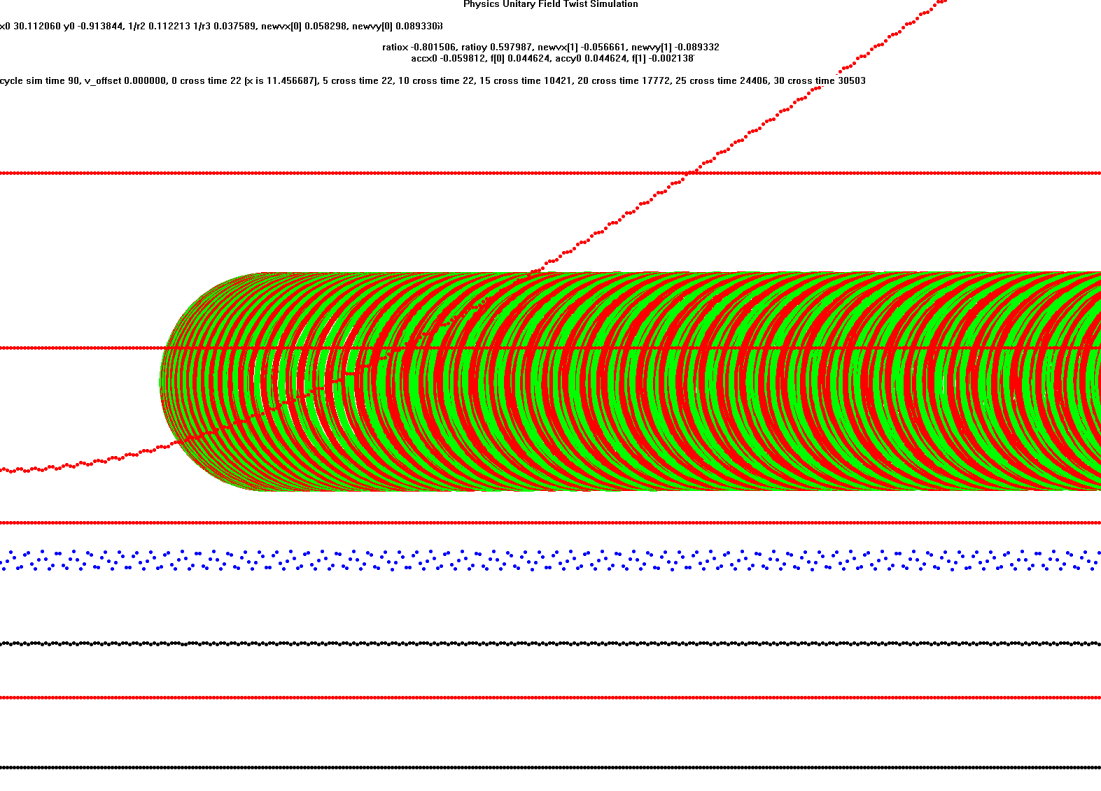
twist_ring_measured_repel

Here’s the initial sim time crossing points, along with the Mathematica solve solutions:

Running the Unitary Field Twist simulation to numerically derive the change in x as
a field is asserted on a 1/r^2 - 1/r^3 twist ring.  The field affects the curvature
(magnetic component).  The result generates the qualitative expected movement as if
there was a central force effect (q^2/r^2).  These results are an attempt to measure
the acceleration factor as a function of relative field strength (magnetic to
electrostatic).

Since the equations of motion due to the 1/r^2 - 1/r^3 equation in a linear field
were 24 parameter LaGrange equations of motion, I attempted to get an analytic
solution by examining the iterative numerical results.

Here is the result for 1:1 (1/r^2 to 1/r^3) field strength at distance 10 with
radius 1.5 and ring velocity 0.10545 and source field strength factor .0005.
The sim showed a cycle time of about 90.

field strength 0.00025
22:  11.457            (doesnt start at zero because cycle max x is not at zero)
14545: 15
25213: 20
34448: 25
43234: 30

using the first 3 terms in quadratic solution, I get
x = 8.92 10^9 * t^2 + .000114 * t + 11.455

field strength 0.0005
22:  11.457            (doesnt start at zero because cycle max x is not at zero)
10421: 15
17772: 20
24406: 25
30503: 30

using the first 3 terms in quadratic solution, I get
x = 1.912 10^8 * t^2 + .000141 * t + 11.454

field strength 0.0010
22:  11.457            (doesnt start at zero because cycle max x is not at zero)
7372: 15
12572: 20
17233: 25
21626: 30

using the first 3 terms in quadratic solution, I get
x = 3.82 10^8 * t^2 + .000200 * t + 11.453

More terms need to be computed, but there is a clear linear proportionality to the 
acceleration component of the curve, consistent with the expected electrostatic
relation of field strength proportionate to the acceleration of the destination
particle.

Fine Structure Constant Hunting

May 1, 2012

Built into current QED (quantum electrodynamics) is the QFT process of pertubative accumulation of virtual photons.  Each possible virtual photon term is assigned a unitless  probability (actually,  probability amplitude capable of interfering with other terms)  of occurrence called the fine structure constant.   Searching for the reason for the value of this constant is a legendary pursuit for physicists, Feynman made the famous comment about it:

It’s one of the greatest damn mysteries of physics: a magic number that comes to us with no understanding by man.

All kinds of research, study, and guesses have gone into trying to figure out why this number is what it is, and I can guarantee you this is a fruitless pursuit.  Think about it, there have been maybe millions of physicists over the last 100 years, the vast majority with IQs well north of 150, all putting varying amounts of effort into trying to figure out where this number comes from.  If none of them have come up with the answer yet, which they haven’t, the odds of you or I stumbling across it is certifiably close to zero.  That is an effort that I consider a waste of time. For one thing, this is a no-numerology physics blog.

One bad trait of many amateur physicists is to theorize answers by mixing up various constants such as pi, e, square roots, etc, etc and miraculously come up with numbers that explain everything.  Note, no knowledge required of the underlying science–just mix up numbers until something miraculous happens, you get a match to an actual observed physical constant (well, so close, anyway, and future work will explain the discrepancy.  Yeah… riiiight).  Then you go out and proselytize your Nobel prize winning theory, to the annoyance of everyone that sees what you did.  This is also called Easter egg hunting, and really is a waste of time.  Don’t do that.  Hopefully you will never ever see me do that.

Nevertheless, physicists are desperate for reasons why the fine structure constant is what it is, and all kinds of thought, analysis, and yes, numerology, have already gone into trying to find where it comes from.  Why do I insert a post about it in the midst of my step by step procedure of working out the role of unitary twist field theory in the electron-photon interaction?  Because, as I mentioned, the fine structure constant is fundamental to mathematically iterating terms in the QFT solution to this particular QED problem.  It stands to reason that an underlying theory would have a lot to say about why the fine structure constant is what it is.

Unfortunately, it’s clear to me that it’s not going to be that simple.  Pertubative QFT is exactly analogous to the term factors in a Taylor series.  You can create amazing functions from a polynomial with the right coefficients–I remember when I was much younger being totally amazed that you could create trigonometric functions from a simple sum of factors.  Just looking at the coefficients really tells you very little about what function is going to result, and that is exactly true in pertubative QFT.  The fine structure constant is your coefficient multiplier, but what we don’t have is the actual analytic function.  The fine structure constant has a large number of ways to appear in interaction computation, but the direct connection to real physics is really somewhat abstract.  For example, suppose I could geometrically explain the ratio of the charge potential energy between two electrons separated by distance d with the energy of a photon who’s energy is defined by that same distance d, which is defined as the fine structure constant value.  But I can’t.  The fact that it takes 137 of these photons (or equivalantly a photon with 1/137 the distance) to hold together two electrons to the same distance is not physically or geometrically interesting, it is a numerology thing.  Pursuing geometric reasons for the 137 is a lost cause, because the fine structure constant is a coefficient multiplier, an artifact of pertubative construction.

Nevertheless, I do see a way that the fine structure constant might be derived from the unitary twist field theory.  Don’t hold your breath–obviously a low IQ type like me isn’t likely to come up with any real discovery here.  Even so, I should follow through.  Here’s the deal.  Take that picture in the previous post, the second “Figure 2” that shows the effect of bending the imaginary vector.  I need to go back and edit that diagram, the circle ring is the twist ring electron, and fix that to be fig 3.  Anyway, the force on that electron ring is going to be determined by one of two things–the amount of the bend or the difference delta of the bend on one side of the ring versus the other.  The bend will gradually straighten out the further you get from a remote charge.   This computation will give the motion and hence the inertia of any self-contained twist (only the linear twist, the photon, will experience no net force from an imaginary bend).  This will be a difficult computation to do directly–but remember we must have gauge invariance, which leads to my discovery that a ring with an imaginary bend must have a frame of reference with no bend.  Find this frame of reference, and you’ve found the motion of the electron ring in the first frame of reference–a much easier computation to do.  This is real analysis and logical thinking, I think–not Easter egg hunting.

Agemoz