Posts Tagged ‘general relativity’

The Higgs Field and R3+T Dual Spin Point Particles

December 28, 2023

UPDATE: chart of all possible dual-spin combinations, both unquantized and quantized.

In our four dimensions (three space and one time), a single point particle can have two independent spins within two orthogonal planes, such as the plane lying in R1+R2 and another lying in R3+T. This fact, coupled the fact that our existence and interactions are confined to a R3 hypersurface “activation layer” within the R3+T universe, gives point particles a lot of interesting properties that point to why we have the particle zoo in real life, see https://wordpress.com/post/agemozphysics.com/1784. The most important property is the ratio of the two spin rates–when these are described as spin wave functions, we get quantization of the probability distributions. When combined with the activation layer, a single R3+T dual spin particle will pop in and out of existence, and it will appear to observers as multiple pseudo particles.

Dual-Spin point particles. Quantized spins must start and end in the R3+T background state (see text), especially note that there are only two possibilities regardless of the chosen spin ratios: two equal-mass particles, or three particles composed of two equal-mass particles and one particle with twice the mass of the other two (this assumes mass correlates to immersion time in real space, see text)

This system gives us the necessary degrees of freedom to specify charge and the different particle types such as the four electron-class particles (spin-up electron, spin-down electron, and their positron anti-particles). When the spin ratio has a factor of three, we get the degrees of freedom necessary for color charges and electric charges of several quarks, including the excited quark combinations of the various Delta particles. Even the particle masses due to the binding energy of quarks have a workable mechanism because force on particles is dependent on the percentage of time the particle spends in the activation layer. The higher the dual spin ratio, the less time external forces can affect each pseudo particle, and thus the higher the apparent mass of the particles.

One really nice thing about dual-spin point particles is that being a point particle, it is immune to concerns about relativistic invariance–with no time or spatial distance in the particle definition, the metric is always zero. All the properties I discovered so far do not have any danger of violating relativity.

One of the strongest reasons I think these dual-spin point particles match reality comes from the known behavior of half-spin particles. I was fortunate to attend one of Professor Feynman’s last lectures before he died, and I remember him discussing that half-spin particles do not have classical spin, but require two complete revolutions before returning to the original state. He used his hands to model how one quantum twist rotated the spin axis normal to the spin direction, and that two twists were required to return to the starting position of his hands. If ever there was a clearer example of the multiple dimensional nature of quantum particle spin, I haven’t seen it!

All of these R3+T point particle properties seemed to work fairly well matching the necessary degrees of freedom present in the Standard Model until I started evaluating the Higgs field. There are a lot of questions still, such as how we get the strong force/electric force counterbalancing within a nucleon or particle decay times, but nothing has really shut things down as much as trying to integrate the Higgs field into the dual-spin point particle idea.

The Higgs field, which is a constant scalar field regardless of the chosen frame of reference or the presence or absence of neighborhood particles, applies a drag to the motion of particles and is responsible for the apparent inertial mass of the particles. There are some relativistic invariance problems here–first, the Higgs force only emits a Higgs boson to resist motion when the particle accelerates in some way, not when it is moving at a constant velocity. Thus calling it “drag” is not a good label, it only “drags” changes in motion–how does the field know the difference? And secondly, there is no Higgs boson emission when observed in the frame of reference of the accelerating particle, so the field itself must be accelerating in that case–and then you really run into relativistic invariance problems because Higgs bosons are massive, and you just caused the mass to disappear!

The Higgs field is really treading dangerous ground given that the luminiferous ether was proven not to exist (see the Michelson-Morley experiment). A model having a constant scalar field which applies drag to particles sounds a lot like something that would break relativistic invariance no matter what mathematical hijinks are done.

Something feels off here in my understanding, and until I get past that, I won’t have a way to match the Standard Model mass effect. I like to think that the dual-spin point particle idea doesn’t need the Higgs field, but that fails when trying to understand why scientists have already detected the Higgs boson.

Agemoz

R3+T Dual Spin Point Particle Appears as 3 Unique Particles in R3

November 21, 2023

We live in a 4 dimensional universe, three spatial dimensions and one time dimension. Point particles can have spin directions in all 4 dimensions, but because we perceive only an R3 slice of our R3+t existence (the “Activation Layer” hypersurface), there are surprising implications for point particle spins. One in particular is that a point particle can have two independent spins with integer ratios for spin cycle time. A 2:3 ratio of these spins in R3+T will cause the particle to appear to be three unique particles in R3!

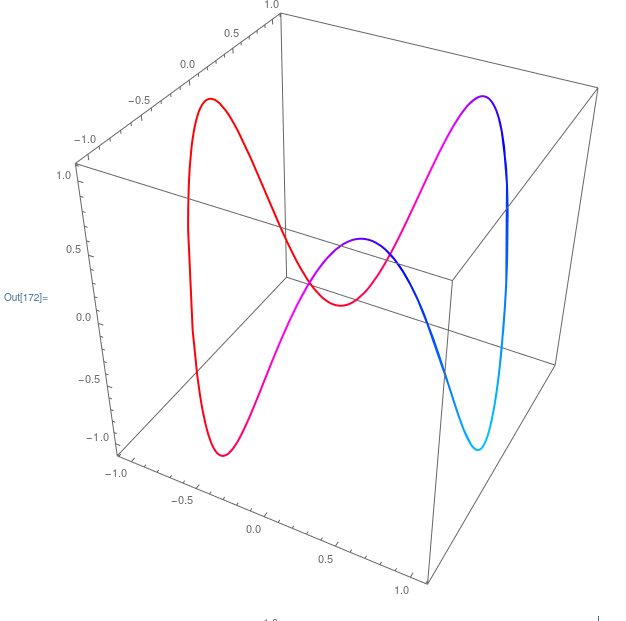
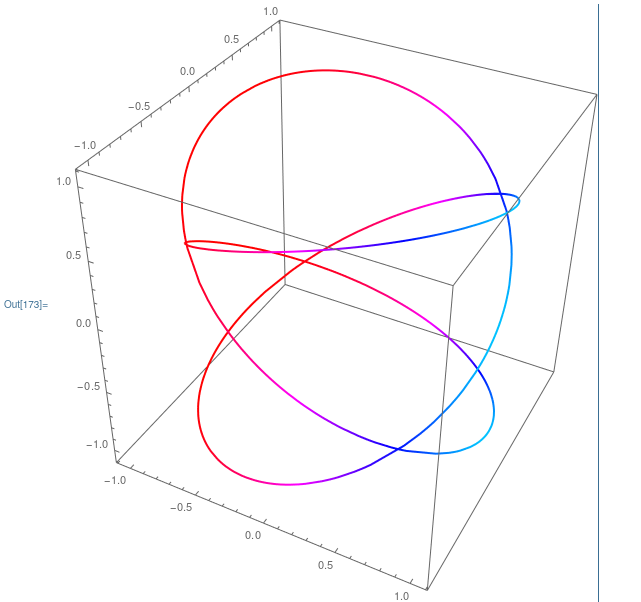
Point particles that spin in 2 or 3 dimensions must rotate within a plane, but in 4 dimensions, there are two possible independent planes of rotation, for example in R1 + R2, and in the R3 + T directions. Thus, it is possible to have two simultaneous but independent spins in a 4 dimensional point particle, requiring no external angular forces to sustain the two independent angular momentums. In the last post, I created some images that demonstrate some of the possible rotation direction paths (these are directions, there is no physical displacement for a point particle spin):

A four dimensional dual spin particle with 1:1 rotation. Color represents the T direction
A dual spin particle with 1:3 rotation
A dual spin particle with 2:3 rotation

However, these pictures are misleading. It is very difficult for my mind to truly grasp what is happening when a four dimensional point particle spins in R3+T. These pictures shows the entire path in R3, with the part pointing in the fourth (T) direction represented by color, but in fact a 4 dimensional dual spin point rotation direction will actually appear and disappear from the R3 activation layer that we live in. Here is what the 2:3 case actually looks like:

Yes, you see what I see–in R3, a single 2/3 ratio dual spin particle looks like 3 stable, but unique spin directions over a time interval! The whole path is shown as a light color, but the locations where the spin direction (again, remember, these are spin directions, not displacements from a center point) lies in or close to R3 are shown in red. The path that lies in R3 show three separate components over time. The 1/3 ratio dual spin particle similarly show two different directions, but the 1:1 ratio case only shows 1.

I shamelessly speculate this is why we experimentally observe the appearance of three bound quarks in a proton and two bound quarks in a kaon, yet never observe isolated quarks. Dual spin particles rotating in the four dimensions of R3 and T provide a possible path to modeling the internal behavior of bound quarks. This is only the beginning–there are many possible rotation ratios that I think enables the entire particle zoo (both fermions and hadrons), and things like the 1/3 and 2/3 charge values emerge from this model.

UPDATE: The three “pseudo particles” that lie in the R3 plane are not all identical. I have previously hypothesized (see https://wordpress.com/post/agemozphysics.com/1722) that the second of two spin rates of an R3+T point particle (that does not include the T dimension) has to be responsible for both charge value and mass. Indeed, one of the three pseudo particles has double the angular momentum as the other two. Protons consist of two up quarks and one down quark with double the mass and half the charge, so the analysis of the dual-spin point particles continues to support the idea that the dual spins of R3+T point particles are responsible for the quark behavior of real-world hadrons.

Amazing stuff comes from thinking about point particles with dual spin in R3+T, I hope you think so too!

Agemoz

The Quantization of Dual-Spin Elementary Particles

September 6, 2023

In my last post, I showed why there is reasonable evidence that elementary point particles have simultaneous spins on two axes. I have found that in our 4 dimensional (R3 +T) existence, point particles are really interesting entities, and lead to several ideas such as why we have a set of 4 electron class particles with the same charge magnitude and mass. Further study also shows that such particles have one of the spins quantized, leading to a hypothesis why we have elementary particles of specific mass and charge.

The analysis of the electron-positron collision into two photons led me to this dual-spin idea. There are other experimental results that also point to this, but this one in particular shows how a spin-based model of elementary particles must consist of spins on two normal axes. This assumes that photons are spins lying in the R1-T (the x and time) dimension subplane of our 4D existence, and that elementary (massive) particles have that spin but also have a spin in the R2-R3 (that is, the y,z) dimension plane. When the electron and positron (or any other complementary particle pairs) collide, the R1-T spin remains as photons, but the R2-R3 spins cancel and vanish. The charge properties of the colliding particles also vanish, strongly implying that charge is a result of the R2-R3 spin.

This motivated me to dig deeper, so I applied some study time to the concept of dual-spin elementary point particles, and came up with two charming surprises.

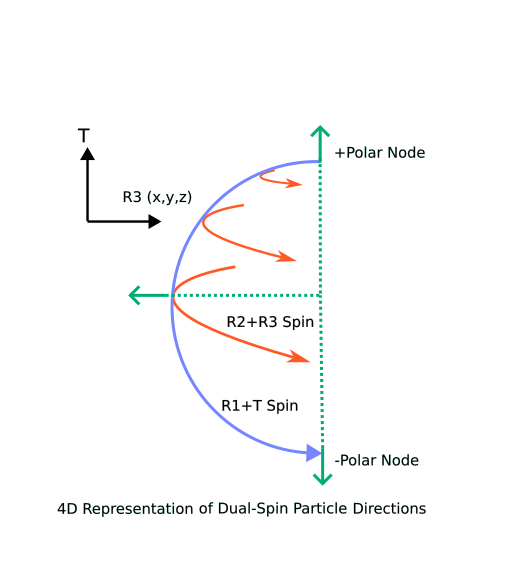
We all know that spin (rotation, twists are all analogous words in this study) is a direction vector property where the vector rotates about an origin point, and that any spin that has no angular force applied to it will lie in a 2D plane. We can have a vector spin in 2D space, but in 3D, vectors can still only spin in a 2D subplane. However, in 4D, such as our R3+T existance, it is possible for a vector to spin on two axes at the same time. It is tempting to think that these spins are independent, but they are not. There is only one vector, so at the poles of one spin, the other spin has a node where its position must be defined and the spin itself is undefined.

Quantum mechanics deals in wave functions of spin, and the component probability amplitudes must line up at node points. In atomic orbitals, this requirement quantizes the available orbitals–similarly, dual-spin particles are quantized at the poles (the +T and -T spherical orientations, for example). To clarify, the first spin (R1+T) sets node points for the wavefunction of the second spin (R2-R3). The second spin wavefunction must be an integer multiple frequency of the first spin in order for its node points to be identical to the first spin orientation.

This is very interesting to me! First, note that there are four electron class particles, the spin-up electron, the spin-down electron, the spin-up positron, and the spin-down positron. The dual-spin point particle concept gives rise to exactly 4 unique cases and thus is an exact match for describing the four electron class particles. I have to be careful here, because we have to ensure that any pair of these cases are unique even from a rotated observer’s point of view. You can prove this if you set an observer frame of reference on the first spin rotation. The first spin’s crossproduct can be either positive or negative–giving two spin states relative to the +T direction. For each of these, in that spin’s frame of reference, the crossproduct of the second spin then has either a positive or negative value, thus giving two unique states for each of the two original spin states. They do not overlap and give four unique spin states.

Second, and much more interesting, is that with this quantized second spin, I see good reason why we see quantized versions (for example, of charge and mass) of the various elementary particles. For example, the electron class particles should have an integer multiplier of 1:1 with the first spin cycle, and quarks have an integer multiplier of 1:3–but since charge must result from the second spin cycle rate (refer to the electron-positron collision where charge has to come from the second spin), it must be a rational fraction of the charge of the electron. What about 1:2 or other multiples, and what binds the quarks? We can stick with quantum field theory to do this, but I want to pursue this to see if there might be more to discover.

UPDATE: we can only get odd multiples, the 1:2 case is not possible. The 1:2 gives a direction that won’t line up with -T at the bottom “south” pole. Therefore, a particle with 1/2 charge is not possible.

Dual-spin point particles in R3+T are fascinating entities that I think have a lot of potential for interesting study.

Agemoz

Quantum Precession of Elementary Particles

August 21, 2023

Every physics student knows that quantum physics interactions are computed using wave functions as probability distributions. Rather than computing time evolving waves, we compute time evolving probability distributions, which has led to the conclusion that probability is an intrinsic property of elementary particles. We are taught to avoid applying classical mechanics to quantum events, but Einstein struggled with this conclusion and made the famous claim that “God does not play dice”. As I mentioned in the last post, there’s a simple explanation for why we cannot observe deterministic time evolving of waves and particles–waves result from zero time oscillations.

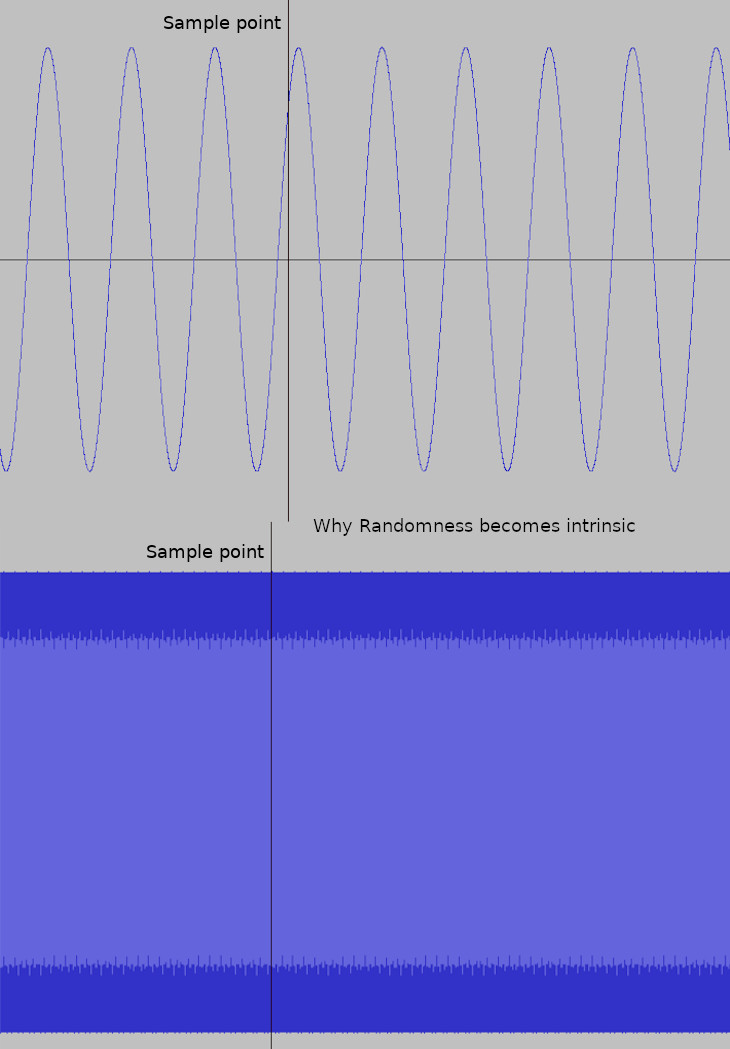
I think that a faulty assumption could have been made here (that quantum particles have an intrinsic random property). Every quantum experiment we can do shows the probabilistic nature of wave interference–but that doesn’t necessarily mean that we can never apply classical mechanics principles and laws (“shut up and calculate”). What these experiments really show is that we as observers cannot observe anything but a probability that something will have a given outcome. This can happen if particles have truly intrinsic randomness, or, it can mean that the rotation of a particle state takes epsilon or zero time and we can’t determine the phase of a rotation at any given point in time. Our instruments require a time interval and can’t catch a zero time wave phase. I think we have to choose one of those two assumptions, it’s not necessarily the case that randomness is truly intrinsic to quantum interactions.

To me, another part of established science confirms the idea of zero rotation time: the magnetic moment of an electron. As I described in a previous post, a inertial moment of an object is the integral sum of all point elements (such as a delta mass or charge) times its radius from a rotation axis, times the frequency of rotation. For a point particle, the angular moment results from a zero radius, and thus requires an infinite rotation frequency (zero rotation time) to get a finite inertial moment that appears when a magnetic field is applied to an electron. Just like the wavefunction probability distributions of quantum theory, this supports the idea of zero-time rotations.

So, I looked at this more, and combined it with the idea that particles are quantized unitary rotations, or vector twists, in 3D+T dimensions, where the T dimension direction is a background state. In previous posts I show that it is not possible to do a twist rotation in 3D without incurring a field discontinuity, but it is possible in four dimensions.

Now, if rotations occur in zero time, how do we get the non-zero wave time of the electron’s quantum interference property? A rotation of a vector that takes 0 time forms a disk, but we need to be mindful of the zero point size and zero rotation time, so this disk could be treated as an epsilon size and time while applying another classical property, precession. If the disk rotation plane (of epsilon size) does not line up with the inertial moment plane normal to its axis, the disk will precess at a rotation rate inversely proportional to its mass. I think this is where the quantum interference wavelength comes from. From previous posts, you can see that the elementary particle twist rotation occurs in the 3D+T plane that lies in one of the R3 dimensions and the T dimension direction (because this quantizes the rotation, see many previous posts). However, the particle’s magnetic moment lies in either the other two dimensions of R3, or in one of the other dimensions of R3 and the T direction. This particle of epsilon size and epsilon rotation time will precess in the plane normal to both the twist plane and the inertial plane. In this approach, photons are similar but the twist lies in the plane formed by one of the R3 directions along with the T dimension direction. Polarization is a degree of freedom set in the other two R3 dimension directions. Photons do not have the zero-time rotation and thus do not precess.

Now we can look at what happens when an electron and a positron collide to form two photons. It is established science that the collision removes the mass and charge of the incoming particles, and redirects the photon paths to lie on the lightcone (mass and kinetic energy is converted to frequency). If e- and p+ are precessing twists, note that the base frequency of the twist has to remain. You don’t have to assume twist theory to know that the photon energy frequency and the quantum interference frequency of the electron and positron are the same if there is epsilon-zero kinetic energy. The only thing that is cancelled out is the zero time twist! Therefore, both charge and rest mass then would have to be due only to the zero-time twist behavior of the elementary particles e- and p+. The photons have neither, so the precession of the zero-time twist becomes a non-zero time twist in the same R3+T plane but now moving on the lightcone.

Is this reality? Dunno, but it’s definitely a different way of thinking how quantum particles interact that doesn’t require intrinsic randomness.

Agemoz

Quantum Field Theory and Elementary Particle Twists

August 12, 2023

One of the unexpected outcomes from my latest thinking (see previous post, https://wordpress.com/post/agemozphysics.com/1700) was the realization that the wavefunction probabalistic nature of quantum theory has a rational basis. Quantum behavior is all about probability amplitudes, and a good question is “why do we work with probabilities rather than the math of wave propagation”. The famous quote attributed to Einstein “God does not play dice” is referencing his denial that probability could be intrinsic to nature. I think there’s a good way to understand why it is intrinsic to us as observers.

In that previous post, I showed how thinking of elementary point source particles with constant mass and charge of particles has to mean that they complete rotations in zero time, but the background state of the rotation enforces quantization (for example, constant mass for all electrons) and rotates at the quantum wave rate of the particle, thus forming interference wave patterns in its neighborhood. As I stated in that post, there are a lot of interesting results from this line of thought, and one of them has profound implications for quantum field theory.

Quantum Field Theory, or QFT, is used to evaluate the wavefunction probability outcomes for various particle interactions. There are two best-known mathematically equivalent methodologies–the path-integral approach and the operator approach. The former is essentially a normalized multiplication of all LaGrange path computation probabilities that result from a source set of particles going to a destination set of particles. The second approach is a matrix (operator) method of calculating the probability of a given destination outcome. The path-integral approach integrates the propagator times the action (a LaGrange minimum energy path computation) for each possible path from source to destination. The terms in the action must include all possible interaction behaviors such as a source particle going straight to a destination particle, or perhaps doing a photon exchange with an adjacent particle before becoming a destination particle, or even interacting with a spontaneously form particle-antiparticle pair before becoming a destination particle.

There are generally an infinite number of these possible action terms for a given interaction, so convergence to a valid result becomes a major issue in performing the calculation. Fortunately, charged interactions act with diminishing force over distance, so the computation perturbs the results with diminishing effect for each added action term. And, a lot of paths by symmetry often cancel out, simplifying the number of significant actions. This isn’t the case for quarks where the strong force does not diminish with distance, so the approximations and assumptions are much harder to compute. In any event, analytically computing QFT outcomes is severely limited to some very basic cases. The recent muon wobble calculations are done iteratively with computed lattice methods or something similar.

But let’s back up a bit. There’s a really interesting clue for understanding elementary particles here that really starts to make a lot of sense when you look at particle interactions having a zero-time rotation rate. This idea means that the rotation rate is infinite, we can never know what the current phase is–so when a detector intercepts the particle, to us as observers, it is completely random whether it absorbs and resolves to a observable state. It’s a nice way to explain why we have to work with probability amplitudes in quantum theory rather than just mathematically time propagating an initial state wave. Entangled particles are a special case and I describe my ideas how this works in previous posts.

But let’s take a look at how we compute path integrals in QFT. One action case that is really interesting to think about is the case where a source particle goes straight to a destination particle, but a nearby particle-antiparticle pair will form and perturb the result without directly interacting via photons. It doesn’t trouble me that this happens, but what surprises me is that it doesn’t matter where the particle-antiparticle pair is! It doesn’t matter how far apart the pair is, nor does it matter how long the pair stays apart! The computation is the same, it does not vary the result. This is so interesting to me because it strongly points to what does matter. A clue is provided by the operator methodology–there will be a multiplicand which includes a creation operator followed shortly by an annihilation operator. The thing that matters is solely the creation (and annihilation), just as I found in my thinking described in the previous post.

So what does this mean? Here’s what I think: since I have worked out that elementary particles and fields must be background state twists in a 4D spacetime (R3 + T), ( see this discussed in previous posts ad nauseum, such as https://wordpress.com/post/agemozphysics.com/1580). I see where the quantization must come from, the thing that affects the QFT probability computation: the only thing that affects the probability of a particular path is whether a twist splits into two or more twists–or recombines into one twist. It doesn’t matter where this happens, it doesn’t matter how long the split is maintained–it only matters that now there is a different twist configuration than there was prior to the interaction. Once it splits, then a new set of waves is added in to the system that affects the overall path probability independent of location or time of the split.

Now, using this idea, can I work with this infinite base rotation rate with a quantized background state rotation rate (forming field waves) to come up with a scheme that gives us a basis for QFT? This post is already too long, I’ll save that for an upcoming post. where I will describe my analysis of a very specific case.

Agemoz

The Creation Operator and the Quantized Properties of Elementary Particles

June 3, 2023

I’ve always been amazed and intrigued by the universe’s vast array of electrons (and other particle types) that all have precisely the same rest mass, magnetic moment, and quantum interference wavelength. As I discussed in the previous post, the constants are exact regardless of location in space or time, of observer relative frames of reference, presence within electromagnetic fields, and even of gravitationally induced spacetime curvature. I’ve tried to come up with any geometrical construction that would convey this constant behavior over all spacetime, and ruled out any pure geometrical construct that would do this. I also ruled out any scheme dependent on the constant speed of light–in fact, I was able to convince myself that this could not come from any internal property of the activation layer, our current time slice called a 3D hyperspace in 4D spacetime. The only workable hypothesis is that these constant properties of particles are invoked upon creation, that is, when the probability in the creation operator in quantum field theory generates a path to a particle-antiparticle pair.

However, as I showed in the previous post, the creation operator needs to be constrained to provide a quantized particle (quantizing to a specific rest mass, for example), and I hypothesized that nature really only provides one way to do this, via a rotation that has a background state. We see this kind of behavior when looking at atomic orbitals, where the probability distribution must be continuous and thus only allows these quantized states–integer fractions of the time to follow one orbit, one complete rotation. This doesn’t really work the same way for point particles like the electron, though, and while it is clear that this quantization has to occur during the activation of the quantum creation operator, I had to come with new ideas how this could work for point elementary particles.

I believed that the quantized rotation is a big part of why the resulting elementary particles have a constant set of properties no matter where in spacetime the creation operator probability activates, but with no constraint on how long the creation process takes, it seemed like even a quantized rotation could not fully define the particle wavelength and hence mass. We see this in photons–any possible wavelength can result depending on the transition times between atomic excitation levels. It seemed like any possible mass could result from a creation operator activation, and thus electron creation could not explain the constant electron rest mass we see through all of spacetime.

A really nice clue comes from the magnetic moment of the electron. We are taught in physics class not to take spin literally for quantum particles, but I’ve always been disturbed by the magnetic moment paradox of elementary particles. Moments are proportionate to the radius of the center of mass times the angular rotation rate. However, elementary particles have essentially zero radius, so no finite angular rotation rate will give anything but a zero angular momentum. I suddenly realized, here was how the creation operator could produce an absolutely constant mass for the electron no matter where or when it occurs in the universe. The angular rotation rate is infinite! That is, the creation process produces a single complete rotation of a point particle in zero time. Now the radius times angular rate can produce a finite value, and now we don’t need to include passage of time to get the particle rest mass from the creation operator activation.

We aren’t done yet, though, there’s still some issues with this thinking. First, if the rotation rate is infinite, then how do we get the particle’s quantum wavelength? For this, you can go back to previous posts on this website how I propose explaining the apparent non-causal behavior of entangled particles or the dual slit paradox. In the case of entangled particles, the detection of one particle instantaneously enforces the complementary state detection of the other particle. In the dual slit paradox, a particle going through a barrier with two slits will cause an interference pattern on a target detector screen, such that there are places on the screen where the single particle will never go. But close one of the slits, and now the particle can go there. You can time this closing such that there is not enough time for the closing to affect the path of the particle, and yet we still get the corresponding presence or absence of interference region particle detection.

These experiments have caused all kinds of discussions and interpretations such as the EPR (Copenhagen) interpretation, Everett many worlds, and the two variations of the Bohm pilot wave approach. I have long since believed in a new interpretation that no-one else appears to have proposed. This interpretation provides a useful means for understanding the particle-antiparticle creation I’ve been discussing.

In this proposal, particles are group wave constructs. The group waves propagate instantaneously but the phase change of these waves are limited by the speed of light. This means that interference effects such as demonstrated by entangled particles or the dual slit experiment propagate instantaneously, but the particle (the group wave construct) cannot move faster than the speed of light.

Now back to our creation operator activation of a quantized rotation in zero time. The rotation completes in zero time, resulting in a fixed angular moment, but the phase change of this rotation generates the electron particle wavelength. It’s the rotation rate of the background state that sets the quantum interference wavelength (and hence its mass and magnetic moment). I like this idea a lot because it provides not only a means to get the electron constants regardless of spacetime curvature or observer frames of reference, but also provides a definitive answer why we can’t use the DeBroglie or Compton methods for modeling an electron, that is, of wrapping that wavelength around a ring like an atomic orbital–we always knew from experimental evidence that this wavelength was too big to represent any internal structure of the electron. This methodology (retrieving quantum wavelengths of a particle from phase shifting of a zero-time rotation spin rate) is a great explanation for why quantum mechanics works in wave functions and probability amplitudes rather than the math of propagating waves. This electron point particle model at last has a workable geometric construct and gets us much closer to why its properties never vary throughout our universe.

Agemoz

Particle Mass Quantization

May 29, 2023

One of the great mysteries of the universe is why particles have precisely constant properties such as mass and magnetic moment for an electron everywhere in the universe, regardless of whether we are at the scale of electrodynamics or in the vast scale of electron jets from giant black holes. I have uncovered how the creation operator of quantum field theory may hold the secret as to why this happens.

I am definitely not the first to propose that gravity is an illusion, but I think I make the best case for it that I have seen. Einstein showed how space (R3) and time both act as interconnected dimensions, from which their curvature successfully derives gravitational effects. Since we only experience one moment in time, I have made the case ( see https://agemozphysics.com/2023/02/14/gravity-and-the-activation-layer/ and agemozphysics.com/2023/03/25/elementary-particles-and-gravity/ ) that this moment we experience is a 3D hyperspace in 4D spacetime, and that this hyperspace is moving along the time dimension. The effect we call gravity results in curved paths for object motion, but the fact that even static objects experience gravitational forces leads me to conclude that the hyperspace motion along the time dimension of curved spacetime is responsible for all gravitational effects. If we can answer why mass and energy curve spacetime, we can show how gravity becomes an illusory effect similar to centrifugal force even for stationary objects.

To do this, we have to have a detailed description for particles that doesn’t currently exist. By far the most important question I have ever considered is why particles such as the electron all have precisely the same mass, charge, and magnetic moment. From the scale of subatomic interactions all the way to electron jets in giant black holes, the properties of the electron (and quarks, and so on) never change. Something is enforcing this constant property set throughout all the known universe over all known time. Another way to say this is that the electron rest mass is quantized to one and only one value. The rest mass of any collection of electrons is an exact multiple the mass of a single electron.

I used to think that the answer could be found in geometry and the constant speed of light, but after decades of study I have finally determined that particle property quantization cannot come from geometry. It can’t come from the speed of light either–there is always a rotating frame of reference for which the elementary particle will have a different velocity or rotation, yet have the same constant particle properties.

There is only one way in nature to achieve quantization like this: a rotation from and to a default lowest energy background state (ground state). The background state cannot lie in R3 without inducing observable frequencies while moving or rotating, so the only remaining workable candidate is if the background state lies in the time dimension.

I had hoped that uncovering the principles of the activation layer would point to why this quantization occurs–and indeed, it points the way–but it’s not the activation layer that does it. We need to look at Einstein’s prize winning discovery that photons are quantized to get a powerful clue as to what is happening. Photon energy is precisely defined by its wave frequency. Normally, a wave has both frequency and amplitude, but photons cannot have a variable amplitude while still conforming to E=hv. From this, and the realization that nature only does quantization via a background state rotation, I conclude that photons are unitary vector rotations from and to the background state. Polarization results from the photons rotation axis orientation relative to its direction of travel.

To get a constant electron mass, the same thing must happen, but it took quite a while to figure out how it could work. One of many ideas I considered was when I attempted to build in the activation layer a pulse or constant rate of rotation that would define the electron mass through all the universe (imagine the activation layer expanding in all directions as a result of the big bang, and that particles in R3 are like the iridescent interactions on the surface of a soap bubble)–but this doesn’t work. For one thing, how could this pulse stay precisely constant in all directions for all time, and be unchanged by the spacetime curvature induced by masses such as black holes? How can this effect remain even in different frames of reference? After a fruitless search for any way that could work, I finally came to the conclusion that the activation layer alone cannot hold the reason for quantization of particle properties.

The answer has to lie in the creation operator of quantum field theory. This operator can only produce a quantized mass particle if it causes a single rotation to and from the same background state as photons. It can do this if momentum and energy are conserved over an interval of time. Photons only have one twist in R3 as well as T to conform to the single rotation rule, but particles such as electrons will be induced where more dimensions of R3 are involved. Electrons have to form along with positrons–and would normally recombine unless there are impacts that separate the masses. We already know this happens by observing Hawking radiation. At the time of the big bang, there would be huge masses of collisions that prevent great masses of particle-antiparticle pairs from recombining. It can also happen in our current time whenever an electron-positron pair form in a high energy magnetic field or amidst a concentrated photon beam.

If there is sufficient energy, even combined sets of particles, such as quark configurations and more complex particle combinations, can form as long as the net result of a creation operator results in a single background state rotation. We see hints of this combined particle set subrotations with the +1/3, -2/3 charge of quarks in a proton. This would have happened en masse during the sea-of-quarks phase after the big bang, where the presence of massive quantities of energy in the form of photons and other particles would have blocked many quark-antiquark recombinations.

I think that the quantum field creator operator has to hold the secret why the values of particle masses and other properties could arise with such vast and precise consistency.

Agemoz

Elementary Particles and Gravity

March 25, 2023

I have continued with my investigation of the activation layer, the 3D slice of spacetime that forms a isotropic hypersurface (see previous posts such as https://agemozphysics.com/2023/02/21/activation-layer-deep-dive-continued-does-time-variation-of-special-relativity-contradict-the-activation-layer-hypothesis/ )

This work appears to show that travel (such as through a wormhole) to past points along the time dimension will show nothing there, and will also show why we have the spacetime properties resulting from special relativity (see this paper https://agemozphysics.com/wp-content/uploads/2020/12/group_wave_constant_speed.pdf). This paper shows one of the steps necessary to derive the second postulate of special relativity, why it emerges if all particles in a system of particles are composed entirely of waves. Conversely, this is why special relativity in a system implies that all particles must be formed entirely from waves (any non-wave component will dissociate from the particle due to differing component velocities). This is consistent with the known wave-particle duality of quantum mechanics.

If the activation layer concept is true, it says that gravity is an illusion, that the Einstein equivalence principle is actually an identity since even static objects in the activation layer is moving in a straight line in a curved spacetime. In this interpretation, gravity results from the curvature of spacetime–but then what causes the curvature if not gravitational force? If gravity is not directly the cause of spacetime curvature, what does?

We know that any collection of fermions and/or bosons must curve spacetime. Each particle contributes to the overall curvature experienced by all other particles in the region. In the past, I have always thought that to create a gravitational force, each particle must somehow shrink the spacetime region–pull it in–and then all nearby particles will get pulled in to get the gravitational forces on them.

This activation layer concept demonstrates this is wrong.

I’m pretty sure everyone who studies general relativity knows the opposite has to be true. If there are no particles in a region, spacetime is flat (yes, that is an assumption I am making). Add particles and spacetime distends the activation layer (the active slice, or hyperspace, that we live in). This is easy to see when you think of anti-gravity in flat spacetime, there is no way to make it flatter! You can only curve it away from flatness to create the curved spacetime that results in gravitational effects*.

What that means is that every particle (whether fermionic or bosonic) must distend or poke out from spacetime, and overall curvature results from the combined effect of many of these acting at the same time. The resulting overall curvature then causes the particles to follow the world lines derived from the principles of general relativity.

From the paper I list above, along with other derivations, particles must all break down to some composition of waves. My current big question is why would a particle composition of waves (the group wave discussed in the paper) distend a flat spacetime? It must somehow drag the activation layer behind the overall time dimension motion of the 3D hypersurface slice. (Note that this dragging cannot cause the activation layer to break apart into separate pieces–continuity keeps the layer surface intact, otherwise energy regions would spontaneously form and conservation laws would be violated).

I think that question is the most important result of this activation layer work–why does a group wave particle distend spacetime? If that question could be answered, it would go a long ways toward understanding our existence.

Agemoz

PS: * This has cosmological consequences: our existence since the big bang could only experience positive gravitational effects, not anti gravity. Yes, you could cancel out existing gravitational force by somehow flattening spacetime in a region, but overall you cannot create a region where antigravity is predominant. Stars form only where gravity balances the repelling properties of collections of particles. Somewhere in here may be the reason why we exist in a particle world, not an antiparticle world.

Activation Layer Deep Dive, Continued: Does Time Variation of Special Relativity Contradict the Activation Layer Hypothesis?

February 21, 2023

I have postulated that existence as we know it is confined to a 3D slice, a hypersurface isotropic in time, of 4D spacetime I call the activation layer. I’ve discussed in previous posts that this activation layer is why observers only are aware of one instance of time at any given point in time, and that interactions are confined to the activation layer. I’ve previously posted that this shows why we don’t get visits from the future and will not be able to observe or interact with our past selves–the activation layer is the only one of an infinite number of hypersurfaces in spacetime where observation and interactions occur. There is no existence in non-activated hypersurfaces, even if you use a wormhole to travel to them.

In previous posts (https://agemozphysics.com/2023/02/08/space-time-activation-layer/ and https://agemozphysics.com/2023/02/14/gravity-and-the-activation-layer/), I show how the timewise motion of the activation layer concept leads to why we experience the acceleration factor g of gravity. An object in the activation layer literally moves forward in spacetime, so if the spacetime region is curved, it experiences a force identical to the straight-line path of an orbiting planet in a curved spacetime. Einstein’s equivalence principle where inertial behavior cannot be distinguished from object motion in a gravitational field, therefore becomes an identity, and gravitational force becomes an illusion.

However, hypotheses such as the activation layer can sound good but fail as a representation of truth if something is found that leads to contradictions. In the last month or so I’ve been looking for both contradictions or ways to prove the hypothesis.

I always thought Neil Bohr’s “not even wrong” quote meant that he thought an idea was stupid because of a lack of knowledge or a faulty conclusion, but recently I learned that this is not the case. He meant that the idea was such that it could not be proved (or disproved) and thus was worthless to the progress of science. What I’m trying to do with with these posts is to address whether there is truth here and whether there are consequences (not “not even wrong”).

One really big elephant in the room for the activation layer hypothesis–cliche for an obvious objection–is that even in flat spacetime, clocks can progress at different rates for different observers (with different frame of reference velocities)–the obvious example being the twins paradox. Historically, the documented reason Einstein worked on general relativity was to extend the laws of special relativity to the curved spacetime of gravitational fields. The activation layer concept depends on the use of a time-wise isotropic hypersurface that always moves forward in time. How do we get different clock observations if time progresses identically everywhere in the activation layer?

Here is why I don’t think that is a showstopper: the activation layer forward time motion is the engine that powers the motion of every clock everywhere in the layer, but the rate of aging–the speed at which a clock ticks or the age of an observer–can vary depending on the observer’s frame of reference and the curvature of the activation layer in his local neighborhood. In other words, the word time is used to represent two different things. Declaring that time cannot be identical for every observer in the universe is ignoring the difference between the forward progress of hypersurfaces in 4D spacetime and the property of aging (clock ticking rate) for a given observer or entity within a hypersurface.

Here is an example of how to distinguish the two meanings of time. Mathematically, g is an acceleration factor dependent on the speed of the activation layer surface in time (the isotropic hypersurface time) and the curvature of the surface. You have to multiply it by a local observer’s time^2 (the observer’s aging rate, dependent on the locally applied laws of special relativity) to get the total effect of gravity on that observer’s awareness of time passing.

I will continue my deep dive into the activation layer with more posts to come. Next will be a discussion about why the activation layer hypothesis leads to one of the two postulates of special relativity, the speed limit set as the speed of light.

Agemoz

Prediction: Why We Have a Matter, Not AntiMatter, Universe and an Experiment to Prove it

July 1, 2020

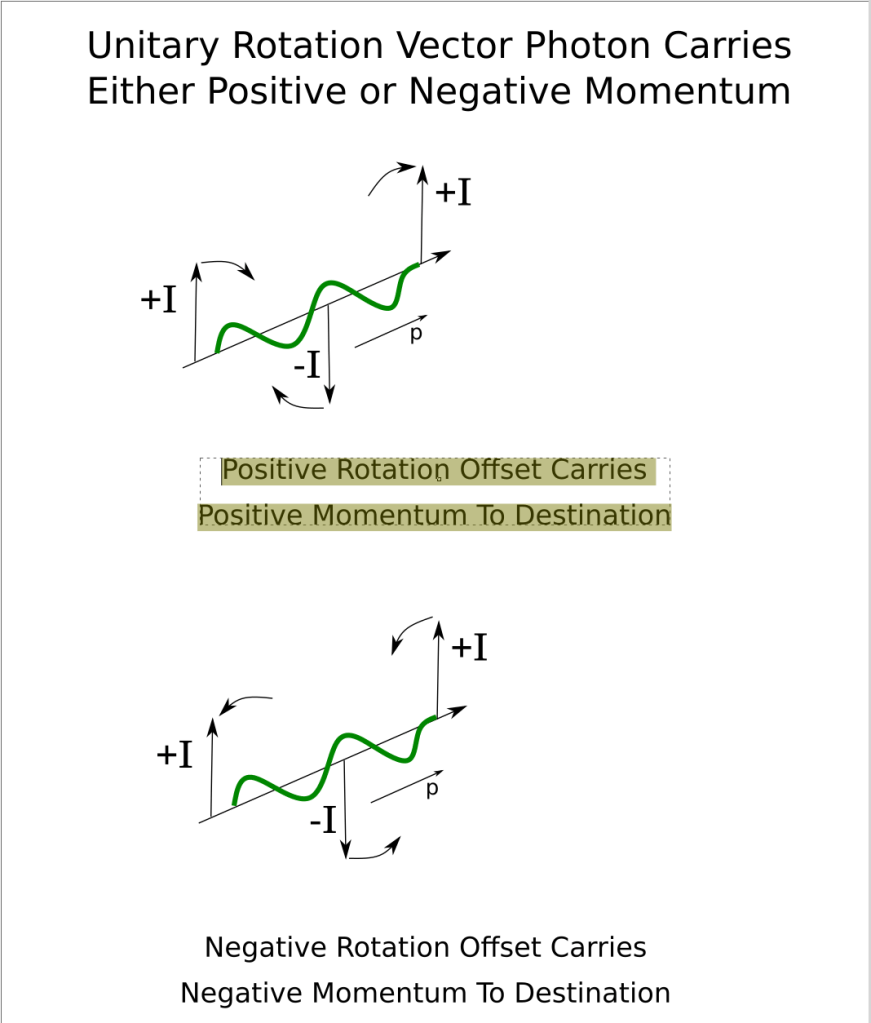
The previous post described the interaction between electrons and photons from both the quantum field theory and the unitary rotation vector field point of view. That post then showed how the unitary rotation vector field predicts that photons carry both positive and negative momentum–a photon has no mass of its own but at emission, converts linear momentum from the emitting particle to angular momentum. You cannot have a particle carry negative linear momentum, but you can have a photon carry negative angular momentum. At the time of absorption, the negative angular rotation converts to negative linear momentum and the target moves toward the source.

This is why a proton can emit photons that cause an electron to move toward the photons flight path source (attraction to the proton). In the previous post, I detail why that happens using the behavior shown in the unitary rotation vector field approach.

QFT, on the other hand, gets this result mathematically from solving the LaGrangian. We interpret that result by creating virtual (off-mass-shell) particles. When confronted with the momentum paradox (shooting photons at a target should always cause the target to recoil away from the photon source), we say that the EM field absorbs the momentum change to cause the target to move toward the photon source.

You can see why I think the QFT interpretation is overly complicated and what I really don’t like is the invocation of YAP–yet another particle–to patch up logical inconsistencies. But here is where the unitary rotation vector field really leads to new insights: We are taught in basic physics that photons are their own antiparticle. We know this cannot be true, because the photons emitted from a proton to a target electron have to somehow be different than photons emitted from an electron–one stream of photons causes the target to move toward the source (electrostatic attraction), and another stream of particles causes the target to move away (electrostatic repulsion). Unitary rotation vector field theory says that in one case the linear momentum to angular momentum conversion generates negative angular momentum, and the other case, positive angular momentum conversion.

This is so interesting because linear momentum is dependent on the direction of particle travel, and thus can never carry negative momentum. But a massless particle such as a photon can carry either positive or negative angular momentum independent of direction of travel. In order for oppositely charged particles to not violate momentum conservation due to attraction, negative linear momentum must be carried via photons and then converting to negative linear momentum at absorption!

This means the old adage that there is no antiphoton, photons are their own antiparticle, has to be wrong. As mentioned above, we already know it is wrong because oppositely charged particles attract each other. Negative momentum must be transported to the other particle regardless of the virtual particle activity along the interaction path. The unitary rotation vector field says there must be photon antiparticles, and thus it should be possible to set up an experiment where correctly generating a stream of negative momentum photons at a target will cause the target to move toward the source.

Physics discoveries are generally worthless without making a prediction of new previously unobserved behavior, and this is my prediction. I think if you could create an emitter, for example, bremsstrahlung from antiparticles such as positrons, you could measure negative photon pressure at a target and prove the existence of antiphotons.

Now here is where this discovery would become incredibly interesting. Photon pressure is a result of the solar wind; it’s behind the concept of a solar sail that could push a spacecraft out of the solar system. It’s also at the very foundation of a star’s existence–photon pressure prevents a star from collapsing into a black hole. Why are there no antimatter stars? Because now the photon pressure is negative (attractive due to emission of antiphotons)–the same direction as gravitational force. There is no equal but opposite force to create a stable equipotential. Antimatter stars must always collapse into a black hole.

Agemoz