Posts Tagged ‘physics’

First Unitary Twist Field Sim Output–It’s a Three Ring Circus! (Update)

December 24, 2017

UPDATE:  errors in the sim calculations are distorting the expected output–it’s too early to make any conclusions yet.  Corrected results coming soon–the CUDA calculations work in 3D blocks over the image, including overlap borders.  As you might expect, the 4D computation gets complex when accounting for the overlap elements.  I had the blocks overlapping incorrectly, which left holes in the computation that caused the soliton image to be substantially distorted.  I still see strong indications that there will be stable solitons in the results, but need to correct a variety of issues in the sim before drawing any conclusions.  Stay tuned…

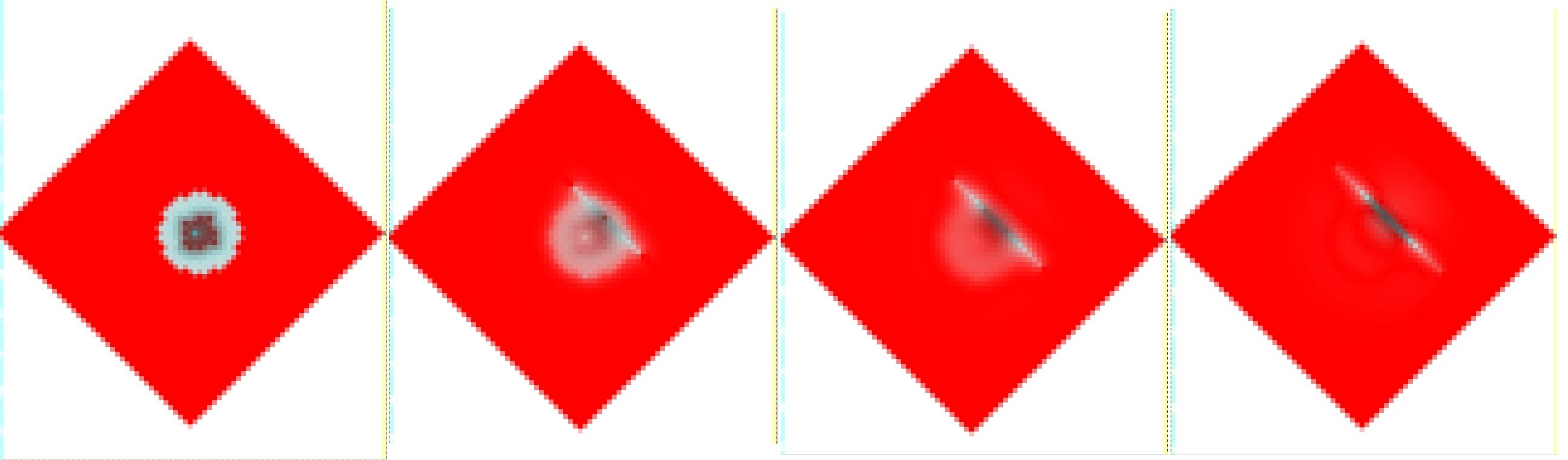
The first results from the Unitary Twist Field Theory are in, and they are showing a three ring circus! Here are the sim output pictures. The exciting news is that the field does produce a stable particle configuration that is very independent of the initial boundary conditions and strength of the background state and the neighborhood connection force–the same particle emerges from a wide variety of startup configurations. Convergence appears visible after about 20 iterations, and remains stable and unchanging after 200000 steps. So–no question that this non-linear field produces stable solitons, thus validating my hypothesis that there ought to be some field that can produce the particle zoo. Will this particular field survive investigation into relativistic behavior, quantum mechanics and produce the diversity of particles we see in the real world? I created this theory based on the E=hv constraint that implies a magnitude-free field and a background state, a rotation vector field that includes the +/-I direction, and many other things discussed in previous posts, so I think this field is a really good guess. However, it wouldn’t surprise me at all that I don’t have this right and that changes to the hypothetical field will be necessary.  As usual, as in any new line of research work, it’s quite possible I’m doing something stupid or this is the result of some artifact of how I am doing the simulation–it doesn’t look like it to me, but that’s always something to watch out for.  However, here I am seeing good evidence I have validated this line of inquiry–looking for a non-linear precursor field that produces the particles and force-exchange particles of the Standard Model.

It’s very hard to visualize even with the 4D to 2D projected slices I show here. I color coded the +I (background state) dimension as red, -I direction as black, and combined all three real dimensions to blue-green. Note there is no magnitude in a unitary twist field (mathematicians probably would prefer I call this a R3+I rotation unitary vector field), so intensity here simply indicates the angular proximity to the basis vector (Rx, Ry, Rz, or +/-I). For now, you’ll have to imagine these images all stacked on top of each other, but I’ll see if I can get clever with Mathematica to process the output in a 3D plot.

Studying these pictures shows a composite structure of two parallel R3 rings and an orthogonal interlocking -I ring, and something I can’t quite identify, kind of a bridge in the center between the two rings, from these images. These pictures are the 200000 step outputs.  You can ignore the image circles cursors in some of the screen capture shots, I should have removed those!

More investigation results to come, stay tuned!

Agemoz

Unitary Twist Field Sim Update

December 3, 2017

I have been developing and refining CUDA code that runs a simulation of the Unitary Twist Field theory. This theory essentially says that all particles and exchange particles have an underlying “precursor” field. Put another way, I’m positing that U(1) x SU(2) x SU(3) will emerge from a single unitary rotation field in R3 + I. The proposed field is non-linear because it also has a background state rotation vector potential. This quantizes twists in the field, and provides a mechanism for twist propagation to curve, thus enabling closed loop twists. The work on the simulation is designed to allow observation of the behavior of such a field in a variety of boundary condition situations.

This work is very much in its infancy, but has already yielded some very interesting insights. The crucial question I want to answer at this point is whether this field can yield stable closed loop twists. The background state potential is crucial for distinguishing this theory from any that are based on linear equations such as Maxwell’s field equations. The background state concept emerged from the need to quantize field behavior geometrically via unit twists in the field. Conceptualizing the behavior of a rotation space in two or even three dimensions appears to show that it should be possible to create stable solitons, but is this true in four dimensions over time–the R3 of our existence plus the +/- I dimension needed for the background state orientation.

I have been working hard to work out the rules for the R3 + I field, but four dimensions is very hard to visualize and work out a geometry of theorems. The simulation environment is designed to assist with this effort.

The sim work has already exposed some pretty critical understanding of what a twist ring would look like. I had originally envisioned a ring of twisting vectors surrounded by the background rotation state +I. However, it turns out things are a lot more complicated than that. If the twisting vectors are in R3 and not in I (the current hypothesis for the simplest closed loop particle), this cannot be stable unless the center of the ring is pointing to -I. The surprising result was that both the +I and -I are stable states when a +I potential is applied! By itself, the -I state would be metastable but any neighborhood connection would make both +I and -I stable–in 2 dimensions and possibly in 3 dimensions–still thinking through the latter case. But the theory requires 4 dimensions, is the ring stable in that case? My mind cannot swallow the 4 dimensional case, but the sim work showed some fascinating elaboration of the R3 + I case.

The -I center must be surrounded by a shell of real (R3) rotations (see illustration below). There must be a transition from +I to R3 to -I and back again, but in all dimensions of R3. There is only one possible way to create a surface of contiguous R3 vectors. I was able to rule out the normal vectors on the surface, because there appears to be no way to transition contiguously to +I or internally to -I without creating a discontinuity. But a surface of tangental vectors would work, provided that the tangental vectors at the equator of the sphere point in the same circumerential (eg, x-y) direction, gradually pointing up to the normal direction, which would be -I at the center, +/- Z at the poles of the surface, and +I outside of the surface. In essence, this work is showing there is only one possible way to form a ring and it actually is enclosing the -I center with a surface of real vectors. Essentially the ring looks like a complementary pair of vortexes with the ring being the common top of the vortexes. It should be possible to create more complex structures with multiple -I poles, but right now the important question is this: is this construct stable. I’m hoping that the sim will verify if this rotation vector model of the ring dissipates in some way. I can envision that the -I core cannot unwind, that it is locked and stable, but it is really hard to prove that in my mind in four dimensions. The sim should show it, I’ll keep you posted.

Agemoz

Simulating the Universe

November 6, 2017

That title is a bit of a tease, although it is what I’m trying to do, at least on some level. I went through a major redo of my physics simulation software because it was based on the Unity environment, which, while easy to get working and makes use of physics intrinsics built into the Unity graphics environment, turned out not to be suitable for my sim runs. Even with a fairly highpowered PC and some level of optimization work, it was too slow and could not realistically process a large enough field array memory. I could have eventually learned enough about Unity to overcome my initial findings, but I am several orders of magnitude off from the performance I needed, so I did a massive learning curve effort and switched to CUDA programming. This turned out to be pretty close to ideal for what I needed, because in the end the physics provided in Unity wouldn’t work anyway–I would have had to write my own physics, never mind the performance and memory limitations. CUDA is turning into a fantastic environment for what I want to do.

This did get me thinking about the big-picture view of what I am doing. I can imagine the overarching intelligent being or beings (either God or real physicists) overlooking what I am doing–“Oh look, a little doofus putzing around on a computer thinking he will find new physics, God and the meaning of existence!” Yup, that’s exactly what I’m doing, although there’s been a huge amount of guided thinking before initiating the sim process.

There has to have been hundreds of thousands of real physicists who have created field sims with various ideas for algorithm kernels and nobody has found something that’s even close to a match for observed science. What makes me think I can do what so many have already tried? Here’s what I think: it’s partly because of what we know of EM field central force behavior. I’m betting that a large percentage of people think the underlying field that gives rise to EM fields, gravity and particles must have central force behavior, and set up field kernels that dissipate over distance. As I’ve noted in a previous post, this cannot work for a bunch of reasons, one of the strongest being that QFT interactions never work this way (all forces are mediated by quantized exchange particles that do not dissipate). So why do EM fields and gravity have central force behavior? It’s not because the underlying field is central force. I discovered several years ago something that’s probably obvious to any physicist–any point source granular emission system will look like a central force system if the far-field perspective is taken. This means that the underlying precursor field has to be far different than the obvious guesses based on experiment.

Some realistic means for providing field quantization must be built into the field kernel for QFT to work. I thought for a long time and realized the only geometric means to get quantization specified by E=hv is to provide a modulus function on the precursor field with a preferred state. What I mean by that is that field elements cannot have magnitude, they can only rotate, and in addition have a preferred “lowest energy” rotation state. This rotation can propagate in either a line or in some system of closed loops, but must have an integer number of turns (or twists, thus forming the name of the theory: Unitary Twist Field). Now, for a particle such as an electron or photon or proton to be stable in our existence (R3), the lowest energy direction must point in another direction dimension than in R3, otherwise our universe would have sampling noise detectable by radio telescopes, the Michelson Morley ether detector, or similar sensors. I arbitrarily point this dimension in the I direction. When I set up this list of constraints on a precursor field, I can analytically show that there are two “wells” of field states that should form stable states and hence solitons in the field. Once I lad locked down the constraints necessary for an underlying field, I was able to develop a field kernel that should give rise to a particle zoo, and then I was ready to set up a sim or see if more analytic work could be done.

I’m guessing that most physicists have access to simulation tools like mine (actually likely far better), but I would be pretty surprised if someone has taken the path I have taken. I am very fond of using the “million physicist tool”–that is, it’s been around 100 years and no smart physicist has come up with an underlying field kernel, so any scheme I come up with *must* be “out-of-the-box” thinking. That is, a good rule for investigations that aren’t worth doing is an investigation that has likely been done by 1 or more of a million physicists. As I said, I suspect a lot of people have gone down various central force paths because of EM and gravitational field behavior–but I discovered years ago that a precursor field cannot be central force, and cannot be linear, along with a bunch of other painfully worked out constraints I just mentioned.

In other words, I don’t think anybody else has been in this room I’m standing looking around in. I see promise here (the two energy wells provided by this field kernel) and am hopeful that a CUDA sim will shine light on it.

Agemoz

Discovery: Precursor Field has Two Stable Potential Wells

October 14, 2017

potential_wellMy work described on this blog can be summarized as trying to find and validate a field that could sustain a particle zoo. Previous posts on this blog detail the required characteristics and constraints on one such field, which I call a precursor field. When I began building the mathematical infrastructure needed to analyze this field, I made an absolutely critical discovery that strongly validates the whole field-to-particles approach.

I give it the “precursor” name because there are many fields in known physics, and this precursor field has to form a foundation for all of them. I’ve pursued many paths in my investigation, described in many of my previous posts, and in summary have determined the following:

The precursor field must be single valued, unitary (directional only, no magnitude), continuous, but not necessarily analytic. It must form from a basis of three real (physical) dimensions but the field element can also point in an imaginary dimension. Because the field value is unitary with no magnitude component, it can be modeled as a rotation field.      The field must have a background state pointing in the imaginary direction. I also discovered that the precursor field and its operators cannot be one of the existing fields in physics such as the EM field. It’s a new field that creates the basis for something like the quantized photon mediated EM field or the strong and weak force interactions in quarks.

If you question any of these requirements, I’d recommend looking back in previous posts where I justify my thinking–this simple paragraph just summarizes much of the work I have done in the past. I don’t want to revisit that right now, but to give you new news of a big discovery I have made about this field in the last few weeks.

I have been preparing both an analytic infrastructure and a computer sim that will hopefully provide some level of validation or refutation of the precursor field concept. The analytic work sets up the algebra that the sim will follow.
There are many issues with assuming that a continuous field will produce a particle zoo, but the biggest is what might be called the soliton problem. You can easily prove that Maxwell’s field equations cannot produce a stable particle, so historically, many efforts to quantize or otherwise modify these equations have been done without success. Compton and DeBroglie are famous for attempting this using an EM field (waves around a ring, sphere of charge, etc.) but no one has succeeded in a theory that successfully confines the EM field potentials into a stable soliton. I’ve long been convinced that you cannot use an EM field as a particle basis, and the QFT model of exchange particles (quantized photons in the case of EM field interactions) supports this way of thinking.

I discovered that the aforementioned precursor field can form either of two types of stable potential wells. The fact that the precursor field is directional only, thus field values cannot go to zero, combined with the omnipresent tendency to go to the default background state, leads both to quantization (only full integer twists out of and then back into the background state are stable) and to the formation of stable potential wells around either the background state or its opposite. I found that the background state tendency can be described as a force that is strongest when an element’s direction is normal to the background state, but is zero at either the background state or its opposite! It turns out it is nearly linear and thus forms a potential well near both zeroes. Thus a stable particle can form around a negative background state pole. You could also form a stable positive pole in a negative background state region (think antiparticles), and could even link together or overlap multiple particles in a chain or set of rings and have the result be stable. I can even visualize spontaneous formation of particle/antiparticle pairs so crucial to QFT, but that’s jumping the gun a bit right now.

It’s such an incredibly important step forward to find a field with a set of operators that could form stable particles, and I believe I’ve done that. The key is having the scalar field be unitary and having a preferential orientation–this set of field characteristics appears to succeed at producing solitons where all others have failed.

UPDATE: While this was an important finding, further work has shown that the background force has to be accompanied by a neighborhood connection, otherwise a discontinuity or possibly other cases may destabilize the particle.  To truly prove that this field can produce stable particles, all issues and details need to be fully flushed out. I suspect that the idea is on the right path but I have more work to do.

Agemoz

CP Parity in the Unitary Twist Field

July 31, 2017

In the last post, I showed how the unitary twist field theory enables a schematic method of describing quark combinations, and how it resolved that protons are stable but free neutrons are not. I thought this was fascinating and proceeded to work out solutions for other quark combinations such as the neutral Kaon decay, which you will recognize as the famous particle set that led to the discovery of charge parity violation in the weak force. My hope was to discover the equivalent schematic model for the strange quark, which combined with an up or down quark gives the quark structure for Kaons. That work is underway, but thinking about CP Parity violation made me realize something uniquely important about the Unitary Twist Field Theory approach.

CP Parity violation is a leading contender for an explanation why the universe appears to have vastly more matter than antimatter. Many theories extend the standard model (in the hopes of reconciling quantum effects with gravity). Various multi-dimensional theories and string theory approaches have been proposed, but my understanding of these indicates to me that no direct physical or geometrical explanation for CP Parity violation is built in to any of these theories. I recall one physicist writing that any new theory or extension of the standard model had better have a rock-solid basis for CP Parity violation, why CP symmetry gets broken in our universe, otherwise the theory would be worthless.

The Unitary Twist Field does have CP Parity violation built in to it in a very obvious geometric way. The theory is based on a unitary directional field in R3 with orientations possible also to I that is normal to R3. To achieve geometric quantization, twists in this field have a restoring force to +I. This restoring force ensures that twists in the field either complete integer full rotations and thus are stable in time (partial twists will fall back to the background state I direction and vanish in time).

But this background state I means that this field cannot be symmetric, you cannot have particles or antiparticles that orient to -I!! Only one background state is possible, and this builds in an asymmetry to the theory. As I try to elucidate the strange quark structure from known experimental Kaon decay processes, it immediately struck me that because the I poles set a preferred handedness to the loop combinations, and that -I states are not possible if quantization of particles is to occur–this theory has to have an intrinsic handedness preference. CP Parity violation will fall out of this theory in a very obvious geometric way. If there was ever any hope of convincing a physicist to look at my approach, or actually more important, if there was any hope of truth in the unitary twist field theory, it’s the derivation of quantization of the particle zoo and the explanation for why CP Parity violation happens in quark decay sequences.

Agemoz

The Mystery of Particle Quark Combinations

July 27, 2017

Whenever I lose my car keys, I look in a set of established likely places. If that doesn’t work, I have two choices–look again thinking I didn’t look closely enough, or decide the keys are not where I would expect and start looking in unusual places.

There is a huge amount of data about quarks and the particle zoo, more specifically the collection of quark combinations forming the hadron family of particles. We have extensive experimental data as to what quarks combine to form protons, neutrons, mesons and pions and other oddities, many clues and data about the forces and interactions they create–but no underlying understanding about what makes quarks different or why they combine to form the particles they do–or why there are no known free quarks.

I could travel down the path of analyzing the quark combinations for insights, but I can absolutely guarantee that has already been tried by every one of the half million or so (guess on my part) physicists out there, all of whom have probably about twice my IQ. This is an extremely important investigative clue–I assume everything I’ve done has already been tried. Like the car keys, I could try where so many have already been, or I could work hard to do something unique, especially in the case of an unsolved mystery like quark combinations.

In my work simulating the unitary twist field theory, I have a very unusual outcome that perhaps fits this category–an unexpected (and unlikely to have been duplicated) conclusion. Unitary twist theory posits that there is an underlying precursor single valued field in R3 + I (analogous to the quantum oscillator space) that is directional only, no magnitude. This field permits twists, and restores to the background state I. Out of such a field can emerge linear twists that propagate (photons) the EM field (from collections of photons) and particles (closed loop twists). Obviously, photons cannot curve (ignoring large scale gravitational effects), so unitary twist theory posits that twists experiences a force normal to the twist radius. The transverse twists of photons experience that force in the direction of propagation, but the tangental twist must curve, yielding stable closed loop solutions.

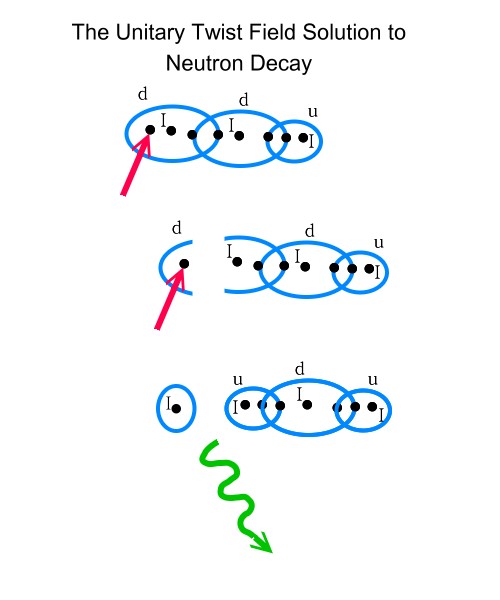
Now let’s examine quarks in the light of unitary twist theory. In this theory, electrons are single loops with a center that restores to I (necessary for curvature and geometric quantization to work. The last few posts describe this in more detail). Quarks are linked loops. The up quark has the usual I restoring point, and an additional twist point that passes through it which I will call poles. This point is the twist from another closed loop. It’s not possible for this closed loop to be an electron, which has no poles other than I, but it could be any other quark. The down quark is a closed loop with two such poles.

The strong force is hypothesized to result from the asymptotic force that results when trying to pull linked quarks apart–no force at all until the twists approach each other, then a rapidly escalating region of twist crossing forces.

So far, so good–it’s easy to construct a proton with this scheme. But a neutron is a major problem–there’s no geometric way to combine two down quarks and an up quark in this model.

Here is where I have a potentially unique answer to the whole quark combinations mystery. Up to this far I can guarantee that every physicist out there has gotten this far (some sort of linked loop solution for quarks–the properties of the strong force scream for this type of solution). But it occurred to me that the reason a free neutron is unstable (about 15 seconds or so) is because the down quark in the unitary twist version of a neutron is unstable. It does have a pole left over, with nothing to fill it, no twist available. The field element at this pole is pointing at Rx, but there’s nothing to keep it there. It eventually breaks apart–and look at how beautifully the unitary twist field shows how and why it breaks up into the experimentally observed proton plus electron. Notice that the proton-neutron combination that forms deuterium *is* stable–somehow the nearby proton does kind of a Van Der Waals type resolution for the unconnected down quark pole. No hypothesis yet on the missing neutrino for the neutron decay, but still, I’m hoping you see some elegance in how unitary twist field theory approaches the neutron problem.

A final note–while I’m extremely reluctant to perform numerology in physics, note the interesting correlation of mass to the square of the number of poles. It might be supportive of this theory, or maybe just a numerical coincidence.

Agemoz

Renormalization

June 25, 2017

I’m working on the math for the Unitary Twist Field Theory sim. The first sim to run is the easiest I know of, the electron/photon interaction, and if the theory doesn’t yield some reasonably good results, the theory is dead, there’s no point in going further. If that happens, hopefully there will be an indication of how to modify it to make it work, but this will be a defining moment for my work. Just recently, something quite astonishing came out of this work to find the equations of motion for the precursor field of this theory.

In the process of working out the force computations, I’ve been able to winnow down the range of possible equations that will rule the components of the interaction. Note first that the sim I am doing is discrete while the theory is continuous, simply to allow a practical implementation of a computer sim. I can add as many nodes as I want to improve accuracy, but the discrete implementation will be a limitation of the approach I am taking. In addition, forces can be local neighborhood only since according to the theory there is only one element to the precursor field, you can’t somehow influence elements through or outside the immediate neighborhood of an element. The field is also incompressible–you cant somehow squeeze more twist elements into a volume.

To express a twist with all of the required degrees of freedom in R3 + I, I use the e^i/2Pi(theta t – k x) factor. Forces on these twists must be normal to the direction of propagation–you can’t somehow speed it up or slow it down. Forces cannot add magnitude to the field–in order to enforce particle quantization (for example E=hv) the theory posits that each element is direction only, and has no magnitude. I use the car-seat cover analogy–these look like a plane of wooden balls, which can rotate (presumably to massage or relieve tension on your back while driving), but there is no magnitude component. The theory posits that all particles of the particle zoo emerge from conservative variations and changes in the direction of twist elements. To enforce rotation quantization, it is necessary that there be a background rotation state and a corresponding restoring force for each element.

In the process of working out the neighborhood force for each field element, I made an interesting, if not astonishing, discovery. At first, it seemed necessary that the neighborhood force would have a 1/r^n component. Since my sim is discrete, I will have to add a approximation factor to account for distances to the nearest neighbor element. Electrostatic fields, for example, apply force according to 1/r^2. This introduces a problem as the distance between elements approaches zero, the forces involved go to infinity. This is particularly an issue in QFT because the Standard Model assumes a point electron and QFT computations require assessing forces in the immediate neighborhood of the point. To make this work, to remove the infinities, renormalization is used to cancel out math terms that approach infinity. Feynman, for example, is documented to have stated that he didn’t like this device, but it generated correct verifiable results so he accepted it.

I realized that there can be no central (1/r^n) forces in the unitary twist field (this is the nail in the coffin for trying to use an EM field to form soliton particles. You can’t start with an EM field to generate gravitational effects–a common newbie thought partly due to the central force similarity, and you can’t use an EM field to form quantized particles either). Central force fields always result from any granular quantized system of particles issued from a point source into Rn, so assuming forces have a 1/r^n factor just can’t work. The granular components don’t dissipate, after all, where does the dissipated element go? In twist theory, you can’t topologically make a twist vanish. Thus the approximation factor in the sim must be unitary even if the field element distance varies.

Then a powerful insight hit me–if you can’t have a precursor field force dependent on 1/r^n, you should not need to renormalize. I now make the bold assertion that if you need to renormalize in a quantized system, something is wrong with your model. And, of course, then I stared at what that means for QFT, in particular the assumption that the electron is a point particle. There’s a host of problems with that anyway–in the last post I mentioned the paradox of an electron ever capturing a photon if it is a point with essentially zero radius. Here, the infinite energies near the point electron or any charged point particle have to be managed by renormalization–so I make the outrageous claim that the Standard Model got this part wrong. Remember though–this blog is not about trying to convince you (the mark of a crackpot) but just to document what I am doing and thinking. I don’t expect to convince anyone of this, especially given the magnitude of this discovery. I seriously questioned it myself and will continue to do so.

The Unitary Twist Field theory does not have this problem because it assumes the electron is a closed loop twist with no infinite energies anywhere.

Agemoz

Special Relativity and Unitary Twist Field Theory–Addendum

February 2, 2017

If you read my last post on the special relativity connection to this unitary twist field idea, you would be forgiven for thinking I’m still stuck in classical physics thinking, a common complaint for beginning physics students. But the importance of this revelation is more than that because it applies to *any* curve in R3–in particular, it shows that the composite paths of QFT (path integral paradigm) will behave this way as long as they are closed loops, and so will wave functions such as found in Schrodinger’s wave equation. In the latter case, even a electron model as a cloud will geometrically derive the Lorentz transforms. I believe that what this simple discovery does show is that anything that obeys special relativity must be a closed loop, even the supposedly point particle electron. Add in the quantized mass/charge of every single electron, and now you have the closed loop field twists to a background state of the unitary field twist theory that attempts to show how the particle zoo could emerge.

Agemoz

Special Relativity and Unitary Twist Theory

January 30, 2017

I’ve been working diligently on the details of how the quantizing behavior of a unitary twist vector field would form loops and other topological structures underlying a particle zoo. It has been a long time since I’ve talked about its implications for special relativity and the possibilities for deriving gravity, but it was actually the discovery of how the theory geometrically derives the time and space dilation factor that convinced me to push forward in spite of overwhelming hurdles to convincing others about the unitary twist theory approach.

In fact, I wrote to several physicists and journals because to me the special relativity connection was as close as I could come to a proof that the idea was right. But here I discovered just how hard it is to sway the scientific community, and this became my first lesson in becoming a “real” scientist. Speculative new theories occupy a tiny corner in the practical lives of scientists, I think–the reality is much reading and writing, much step-by-step incremental work, and journals are extremely resistant to accept articles that might cause embarrassment such as the cold-fusion fiasco.

Back in my formative days for physics, sci.physics was the junk physics newsgroup and sci.physics.research was the real deal, a moderated newsgroup where you could ask questions and get a number of high level academic and research scientists to respond. Dr. John Baez of UC Riverside was probably one of the more famous participants–he should be for his book “Gauge Fields, Knots and Gravity”, which is one of the more accessible texts on some of the knowledge and thinking leading to thinking about gravity. But on this newsgroup he was the creator of the Crackpot Index, and this more than anything else corrected my happy over-enthusiasm for new speculative thinking. It should be required reading for anyone considering a path in the sciences such as theoretical physics. Physicists 101, if you will–it will introduce you hard and fast to just how difficult it will be to be notable or make a contribution in this field.

I’m not 100% convinced, as I’ve discussed in previous posts, that there isn’t a place for speculative thinking such as mine, but this is where I discovered that a deep humility and skepticism toward any new thinking is required. You *must* assume that speculation is almost certainly never going to get anywhere with journal reviewers or academic people. Nobody is going to take precious time out of their own schedule to investigate poorly thought-out ideas or even good ideas that don’t meet an extremely high standard.

So, I even presented my idea to Dr. Baez, and being the kind and tolerant man he is, he actually took the time review what I was thinking at that time–has to be 20 years ago now! Of all the work I have done, none has been as conclusive to me as the connection to special relativity–but it did not sway him. I was sure that there had to be something to it, but he only said the nature of special relativity is far reaching and he was not surprised that I found some interesting properties of closed loops in a Lorentzian context–but it didn’t prove anything to him. Oh, you can imagine how discouraged I was! I wrote an article for Physical Review Letters, but they were far nastier, and as you can imagine, that’s when my science education really began.

But I want to now to present the special relativity connection to unitary twist theory. It still feels strongly compelling to me and has, even if the theory is forever confined to the dustbin of bad ideas in history, strongly developed my instinct of what a Lorentzian geometry means to our existence.

The geometry connection of unitary twist field theory to special relativity is simple–any closed loop representation of a particle in a Lorentzian systen (ie, a geometry that observes time dilation according to the Lorentz transforms) will geometrically derive the dilation factor beta sqrt(1 – v^2/c^2). All you have to do to make this work is to assume that the loop represention of a particle consists of a twist that is propagating around the loop at speed c, and the “clock” of this particle is regulated by the time it takes to go around the loop. While this generalizes to any topological closed system of loops, knots, and links (you can see why Dr. Baez’s book interested me), let’s just examine the simple ring case. A stationary observer looking at this particle moving at some speed v will not see a ring, but rather a spiral path such that the length of a complete cycle of the spiral will unroll to a right triangle. The hypotenuse of the triangle by the Pythagorean theorem will be proportionate to the square root of v^2 + c^2, and a little simple math will show that the time to complete the cycle will dilate by the beta value defined above.

When I suddenly realized that this would *also* be true in the frame of reference of the particle observing the particles of the original observer, a light came on and I began to work out a bunch of other special relativity connections to the geometry of the unitary twist theory. I was able to prove that the dilation was the same regardless of the spatial orientation of the ring, and that it didn’t matter the shape or topology of the ring. I saw why linear twists (photons) would act differently and that rest mass would emerge from closed loops but not from linear twists. I went even as far as deriving why there has to be a speed of light limit in loops, and was able to derive the Heisenberg uncertainty for location and momentum. I even saw a way that the loop geometry would express a gravitational effect due to acceleration effects on the loop–there will be a slight resistance due to loop deformation as it is accelerated that should translate to inertia.

You can imagine my thinking that I had found a lodestone, a rich vein of ideas of how things might work! But as I tried to share my excitement, I very quickly learned what a dirty word speculation is. Eventually, I gave up trying to win a Nobel (don’t we all eventually do that, and perhaps that’s really the point when we grow up!). Now I just chug away, and if it gives somebody else some good ideas, then science has been done. That’s good enough for me now.

Agemoz

Quantum State Superposition in the Precursor Field

January 1, 2017

I’ve been continuing to work on what a field would have to look like if it were the underlying mechanism for the particle zoo and force fields. One thing I haven’t discussed that will be noticed instantly by anyone who studies physics–this precursor field must allow quantum state superposition. I’ve so far posted a geometrical set of constraints, but I’ve always had an awareness that the model is incomplete–or won’t work at all–if I can’t provide some means for state superposition.

The trouble with inventing a theory like this is that the job is truly humongous. The number of details that have to be verified as correct is really beyond the reach of one person or even a team of people, so I’ve had to trudge on knowing that this whole thing will be laughed off in seconds by experienced theoreticians who spot a missing or wrong claim. This is definitely one of them, if I don’t provide a believable mechanism for quantum state superposition, nobody will bother to look.

So–I’ve spent some time thinking on this. I actually have enough worked out that I want to try a sim of the model, but then I thought–no, make sure quantum states can work with the model. Otherwise the sim will be a waste of time and probably not really even interesting. Probably the easiest and simplest quantum state superposition to think about is electron spin, which I’m going to take the liberty of modelling with a twist ring. There are two spin parameters in a twist ring, one of which is degenerate by rotation(*). To isolate the true degrees of freedom in a gauge invariant system, I will set the ring rotation direction as clockwise, for example, and then see just one degree of freedom in the axial twist direction along the rotation direction–it can be either clockwise or counterclockwise. I will call this the spin of the particle, either up or down.

Now, to specify a quantum state superposition, the particle spin can be either up or down or a linear combination of spin-up and spin-down. Does the unitary twist field theory precursor field allow this? I believe it is easy to say yes. Treat the loop as a transmission line with a discontinuity sheath surrounding the twist. The twist itself is a Fourier construction of standing waves that can encapsulate such a linear composition of the up and down spin. If the particle encounters a spin detector, an operator acts on the linear composition to filter the wave composition and resolve the spin state.

There’s my hand-wavy analysis, no proof by any stretch of the imagination. That is a chore that will have to wait. It looks viable to me, but I have so many other alligators in this swamp that this will have to do for now.

Agemoz

*Note that it’s only degenerate in R3 for purposes of this example. In reality, the R3 + I background state will be different for the two loop rotations, thus providing the required degrees of freedom for both spin and the particle/antiparticle duality.