Posts Tagged ‘physics’

Quantizing Fields–Twist Field vs. Semiclassical and Canonical Field Quantization

August 28, 2016

I’ve done all this work/discussion here about this unitary twist field scheme and how it uses quantized rotations to a background imaginary axis. While my primary intent is for my benefit (keep track of where I am and to organize my thinking) I’ve tried to make it readable and clear for any readers that happen to be following my efforts. I try to be lucid (and not too crack-potteryish) so others could follow this if they wanted to. To be sure, my work/discussion on the unitary twist field is very speculative, a guess on why we have the particle zoo. However one big thought has been running through my head–if any of you are following this, you would be forgiven for wondering why I’m doing this field quantization work given that there is already plenty of well established work on first and second quantization of fields such as the EM field.

This is going to be a very tough but valid question to elaborate on. Let me start with a synopsis: my work on this precursor field, and quantum mechanics/field theory work are operating on very different subjects with the unfortunate common concept name of quantization. Quantum theory uses quantization to derive the wavelike behavior of particles interacting with other particles and fields. Unitary Twist Field theory uses a different form of quantization to help define an underlying basis field from which stable/semistable particles and fields (such as the EM field) can form.

Let me see if I get the overall picture right, and describe it in a hopefully not too stupidly wrong way.

Both quantum theory and my Unitary Twist Field work reference quantization as a means to derive a discrete subset of solutions concerning fields and particles from an infinite set of possible system solutions. Quantum theory (mechanics, field theory) derive how particles interact, and quantization plays a big part in constraining the set of valid interaction solutions. Unitary Twist Field theory (my work) involves finding a field and its properties that could form the particles and field behavior we see–an underlying field that forms a common basis for the particles and the interactions we see in real life. Quantum theory and the Standard Model currently provide no clear way to derive why particles have the masses and properties that they do, Unitary Twist Theory attempts to do that by defining a precursor basis field that creates solitons for both the stable/semistable particles and force exchange particles required by the Standard Model and quantum theory.

Standard Model particle/field interactions in quantum mechanics (first quantization) is a semiclassical treatment that adds quantization to particles acting in a classical field. Quantization here means extending the classical equations of motion to include particle wavelike behavior such as interference. Second quantization (either canonical or via path integrals, referred to generally as quantum field theory) extends quantization to fields by allowing the fields to spontaneously create and annihilate particles, virtual particles, exchange particles, fields, etc–it’s a system where every force is mediated by particles interacting with other particles. This system of deriving solutions gets generalization extension via gauge invariance constraints, this work gave rise to antiparticles and the Higgs Boson. Quantization here means that particle/field interactions interfere like waves, and thus there is generally a discrete set of solutions with a basis that could be called modes or eigenstates (for example quantized standing waves in electron orbitals about an atom).

The quantization I am using as part of the defining of the Unitary Twist Field is a completely different issue. I’ve done enough study to realize that the EM field cannot be a basis for forming particles, even by clever modification. Many smart minds (DeBroglie, Compton, Bohr, etc) have tried to do that but it cannot be done as far as anyone has been able to determine. I think you have to start with an underlying field from which both particles and the EM field could emerge, and it has to be substantially different than the EM field in a number of ways. I’ve elaborated on this in extensive detail in previous posts, but in a nutshell, quantization here means a orientable, unitary, 3D + I (same as the quantum oscillaor) field that has a preferred lowest energy direction to the positive imaginary axis. This field should produce a constrained set of stable or semistable solitons. If all goes well and this is a good model for reality, these soliton solutions should then match the particle zoo set and exhibit behavior that matches the EM field interactions with particles described in quantum theory and the Standard Model.

I am attempting to keep in mind that a twist field theory also has to be gauge invariant at the particle level, and has to be able to absorb quantum theory and the Standard Model. That’s to be done after I first determine the viability of the unitary twist field in producing a set of particles matching the known particle zoo. This is a truly enormous endeavor for one not terribly smart fellow, so just one step at a time…

Don’t know if that makes things clearer for readers, it does help narrow down and add clarity in my own mind of what I’m trying to do.

Agemoz
More Details on the Precursor Field

August 25, 2016

I’m getting ready to start some detailed analysis work on the proposed precursor field. This effort is intended to show how the quantized particle zoo and the EM and strong forces could emerge given a field with an underlying (“precursor”) set of properties I’ve worked out in previous posts. I am taking the liberty of using this post as a placekeeper for keeping track of the details–this might help a reader understand better what I’m proposing but this particular post is not really intended to be especially profound. If it gets freshly pressed, that would be funny in an ironic way!

This precursor field, as described in previous posts, has unitary magnitude and rotates in R3 + I, or 4 dimensions. This will map to a rotation group (SO(4)) and will embed two types of field connections. I think of the connections as forces, although forces actually are a particle concept (ignoring general relativity for now) and technically this word probably shouldn’t be used here. There’s a semantic issue here which right now I want to ignore as I try to prove the concept, so I’m going to use the word force here to describe the required connections.

The necessity for these two connections is described in previous posts and consist of the quantizing force and the rotation force. The first is a force that attempts to restore an element of the field to the imaginary dimension. It has no effect on neighborhood elements. The second is a true connection from one element rotation velocity to neighborhood element rotation states. I will experiment with various specific functions for each of these forces, but will start with some simple guesses. For the quantizing force, I will use a linear restoring force (to the I dimension) that gets stronger as the angle from the imaginary axis increases.

The rotation force is tricky. It is tempting to use a central force (1/r^2) where the rotation velocity of an element will cause a proportionate weighted delta rotation to neighborhood elements, dropping as 1/r^2. This force must be normalized to a finite value at zero–but 1/r^2 has a pole there, that won’t work. A workable solution that avoids renormalization would be to use a Gaussian, but doesn’t have as good a physical justification.

The central force approach can easily be justified as linearly proportional to the number of elements present at the function’s radius, which grows as r^2 in the R3 space. (Dont let the I dimension fool you–that is only a direction dimension. The real part, which is the only part that the radius value r is dependent on, is what determines the magnitude of the rotation force). Nevertheless, right now I see no way to use this because of the pole at zero, so I will just take the gaussian as a guess for a function that is finite at zero r and declines to zero at infinity. If this guess yields the expected stable particle zoo or something resembling it, then work to exactly derive the rotation force function will need to be done.

There you have it–that is a mathematical definition of the Precursor Field that should yield a particle zoo and the EM and Strong force interactions. I’m setting up a sim and some analysis to see what this construct will yield. I’ve yakked for a long time why this twist field thing makes sense, now it’s time to fish or cut bait…

Agemoz

PS, note that I’m ignoring quantum wave functions for right now and treating the precursor field elements as actual physical states. If the concept pans out, the math will have to be generalized to composite states (wave functions). It will also be necessary to generalize to relativistic speeds. It’s my guess that neither of these are necessary to explain the particle zoo, although once shown, refinement for quantitative analysis would then have to be done.

One Rule To Rule Them All: The One Question Every Human Being Must Ask

August 18, 2016

I’ve been doing a great deal of thinking and analysis on what the precursor field would have to be.  I’ve had some discussions and conclusions about the precursor field that I’ll get into shortly here–but I wanted to digress a little because one of the discussions homed in on why I’m doing this work.  The discussion was extensive but revealed a crucial point about humanity’s search for meaning.  Let’s see if I can summarize the extensiveness of this conversation down to the bare essentials in a clear way:

The main driver for the approach I am taking is that this universe emerged from nothing.  To put it another way by using a popular physics aphorism, it’s not turtles all the way down, the first turtle emerged from nothing.  As I detailed in several previous posts, I see how this could happen–essentially a massive generalization of the principle that infinity times zero can give a finite number.  This drives many of the requirements of the precursor field that I am developing which causes emergence of quantized particles and emergence of particle motion and the EM field, the strong force, and related properties.

This question–did the universe emerge from nothing–is *the* most fundamental question a human being can ask, and is beautiful and elegant in its own right.  It encompasses many issues, especially the question “Is there a God”.  It’s rare that a question can be formed with such simplicity in our language.  The whole study of philosophy of all forms spends a lot of time clarifying what is a “real” question versus what is semantics, i.e, an artifact of the language we choose to work in.

For example, the common philosophical study of “I seek the Truth” raises semantic questions like “what do you mean by truth?”  “What does the concept of seeking mean?”  Or, the question “What is the meaning/purpose of life?”  Well, what does “meaning” mean to you?  How do you define life?  Does it involve consciousness?  Memory?  A tree is alive, and on a very long timescale likely has the same stimulus/response capability as faster moving animals or humans.  It’s really tough to extract the various philosophical issues out of the semantics of most questions.

But the question “did the universe emerge from nothing”, while not immune from semantics, cuts to the core issue easily and elegantly.  It asks whether the observed rules of our existence are intrinsic or not.  If there is even just one rule that has to be there in addition to nothing (and yes, there are semantic issues with “nothing”, so we do have to tread carefully even here)–then the universe didn’t emerge from absolutely nothing.  Then you are forced to ask what caused that rule to emerge, and with a lot of thought I think you have to declare that there is a God–an intellect, a being, or other organized structure that formed the universe.  Then you have to ask what formed those.  It is a recursion of thought that leads some to say “it’s turtles all the way down”, that there is no beginning.  But if you do that, you still are saying there is a God, I think.  This question is so elegant because the dividing line is so precise.  Either the universe emerged from nothing, or else there is no point in continuing because a God or Being or Computer or *something* takes a turtle, puts it there, and voila, we as humans emerge.

The assumption of a God is so problematic in my mind–you simply cannot answer the question of how did this universe get created, you also *cannot ask the question why are we here*!!!  By defining a God, we have taken that question out of our hands and put it in the hands of an unknowable entity.  By saying it’s turtles all the way down (similar to saying there is no beginning, the universe has always existed), we throw up our hands and say these questions cannot be answered.

On the other hand, if we study the approach that we came from nothing, there is a path that can truly be followed, and that is exactly what I am trying to do.  I assume this precursor field had to emerge from nothing and that constrains the characteristics of the field in many ways.  For example, the particle zoo has to emerge from it, so a geometrical basis should exist.  Or, getting on the subject I’ve been focusing on, the precursor field has to emerge from nothing, so it cannot have extra degrees of freedom, which implies rules preceded the field–a no-no in forming the field description.  If there are rules, there has to be a God of some form.

The astonishing thing to me is how clear the path for humanity has to be.  There really is only one study worth doing–how could we emerge from nothing.  Any other explanation for our existence appears to have no fundamental value in investigating!

I hope you find this digression fascinating and helpful why I am doing this study.   It has so far led to the following conclusions, some of which I’ve described in previous posts:

The precursor field cannot require continuity (differentiability) otherwise quantized twists are not possible, and such twists are required for the formation of stable particles in the particle zoo

The field has no vector magnitude, it is a unitary directional field with an R3 + I dimension plus time.  This means that the field elements are orientable (that is, there is a property of the field element that distinguishes from other field elements both by physical location and by direction)

The elements of the field do not move.  They can only rotate.  Movement is an emergent concept that results from the formation of rotation structures that can propagate through the field

Rotation of a field element induces rotation of neighborhood field elements.  This induction is infinity elastic otherwise the field would be forced to be continuous and differentiable, which is contradictory to enabling field twists

Field elements are quantized by creating a preferred orientation to the imaginary dimension direction.  This, combined with the ability to form field twists, is what allows the formation of stable particles

There are other properties I am uncovering, but this list is a good starting point for setting up a computer simulation and for analytic derivations.  My goal is to uncover the specific quantized states available and see if they match with what we see in the particle zoo.

Agemoz

Basis Field–NYAEMFT (Not Yet Another EM Field Theory)

July 19, 2016

If you’ve been following along in my effort to work out details of the Unitary Twist field, you will have seen the evolution of the concept from an original EM field theory to something that might be described as a precursor field that enables quantized sub-atomic particles, Maxwell’s field equations, relativity, and other things to emerge .  I’ve worked out quite a few contraints and corollaries describing this field–but I need to make it really clear what this field is not.  It cannot be an EM field.

My sidebar on this site calls it an EM field but now is the time to change that, because to achieve the goal of enabling the various properties/particles I list above, this field has to be clearly specified as different from an EM field.  Throughout physics history there have been efforts to extend the EM field description to enable quantization, General Relativity, and the formation of the particle zoo.  For a long time I had thought to attempt to modify the Maxwell’s field equations to achieve these, but the more I worked on the details, the more I realized I was going at it the wrong way.

The precursor field (which I still call the unitary twist field)  does allow EM field relations to emerge, but it is definitely not an EM field.  EM fields cannot sustain a quantized particle, among other things.  While the required precursor field has many similarities to an EM field that tempt investigators to find a connection, over time many smart people have attempted to modify it without success.

I now know that I must start with what I know the precursor field has to be, and at some point then show how Maxwell’s field equations can arise from that.

First, it can readily be shown that quantization in the form of E=hv forces the precursor field to have no magnitude component.  Removing the magnitude component allows a field structure to be solely dependent on frequency to obtain the structure’s energy.   This right here is why EM fields already are a poor candidate to start from.   It took some thinking but eventually I realized that the precursor field could be achieved with a composition of a sea of orientable infintesimal “balls” in a plane (actually a 3D volume, but visualizing as a 2D plane may be helpful).

The field has to have 3 spatial dimensions and 1 imaginary dimension that doesn’t point in a spatial direction (not counting time).  You’ll recognize this space as already established in quantum particle mechanics–propagators have an intrinsic e^i theta (wt – kx) for computing the complex evolution of composite states in this 3D space with an imaginary component, so I’m not inventing anything new here.  Or look at the photon as it oscillates between the real and imaginary (magnetic) field values.

Quantization can readily be mapped to a vector field that permits only an integer number of field rotations, easy to assign to this precursor field–give the field a preferred (lower energy) orientation in the imaginary direction called a default or background state.  Now individual twists must do complete cycles–they must must turn all the way around to the default orientation and no more.  Partial twists can occur but must fall back to the default orientation , thus allowing integration of quantum evolution over time to ultimately cause these pseudo-particles to vanish and contribute no net energy to the system.  This shows up in the computation of virtual particles in quantum field theory and the emergence of the background zero-point energy field.

Because of this quantized twist requirement, it is now possible to form stable particles, which unlike linear photons, are closed loop twists–rings and knots and interlocked rings.  This confines the momentum of the twist into a finite area and is what gives the particle inertia and mass.  What the connection is to the Higg’s field, I candidly admit I don’t know.  I’m just taking the path of what I see the precursor field must be, and certainly have not begun to work out derivations to all parts of the Standard Model.

The particle zoo then results from the tree of possible stable or semi-stable twist topologies.   Straight line twists are postulated to be photons, rings are electrons/positrons differentiated by the axial and radial spins, quark combinations are interlocked rings where I speculate that the strong force results from attempting to pull out an interlocked ring from another.  In that case, the quarks can pull apart easily until the rings start to try to cross, then substantial repulsion marks the emergence of the asymptotic strong force.

Quantum entanglement, speed of light, and interference behavior results from the particle’s group wave characteristics–wave phase is constant and instantly set across all distance, but particles are group wave constructions that can only move by changing relative phase of a Fourier composition of waves.  This geometry easily demonstrates behavior such as the two-slit experiment or Aharonov’s electron.  The rate of change of phase is limited, causing the speed of light limit to emerge.  What limits this rate of change?  I don’t know at this point.

All this has been extensively documented in the 168 previous posts on this blog.  As some point soon I plan to put this all in a better organized book to make it easier to see what I am proposing.

However, I felt the need to post here, the precursor field I call the Unitary Twist Field is *not* an EM field, and really isn’t a modified or quantized EM field.  All those efforts to make the EM field create particles, starting with de Broglie (waves around a ring), Compton, Bohm, pilot wave, etc etc just simply don’t work.  I’ve realized over the years that you can’t start with an EM field and try to quantize it.  The precursor field I’m taking the liberty of calling the Unitary Twist Field has to be the starting point if there is one.

Agemoz

The Arrow of Time and Misuse of Statistics

June 5, 2016

As an amateur physicist I try to avoid disputing established science, but one place I believe science has it wrong is the dimensionality of time.  If you read this blog at all, you’ll see I am trying to create a self-consistent world-view that conforms with peer-reviewed science.  My world-view attempts to add analysis and conclusions on some of the unanswered questions about our universe such as why are there so many elementary particles or how can quantum entanglement work.  I try never to dispute established science and to accept that my world-view is a belief system, not fact that must be forced on others–that is the mark of a crackpot that has just enough knowledge to waste other peoples’ time.

However, one place I break my rules of good behavior is this concept that time is one-dimensional.  For a long time, I’ve recoiled at the notion that the observer’s timeline could physically intersect a particular local spacetime neighborhood of an object event  multiple times.  I discussed this in a previous post, but now I want to discuss this disagreement from another angle–the claim for an existence of an Arrow of Time.

The Arrow of Time is a concept that describes the apparent one way nature of the evolution of a system of objects.  We see a dropped wine glass shatter on the floor,  but we never see a shattered wine glass re-assemble itself and rise up back onto a table.  We record a memory of events in the past, but never see an imprint of the future on our brain memory cells.  This directional evolution of systems is a question mark given that the math unambiguously allows evolution in either direction.  To put it in LaGrange equation of motion terms, the minimum energy path of an object such as a particle or a field element is one dimensional and there are two possible ways to traverse it.  The fundamental question is–why is one way chosen and not the other?

The standard answer is to invoke statistics in the form of the Laws of Thermodynamics, and I have always felt that was not the right answer.  Here is why I have trouble with that–statistics are mathematical derivations for the probability something will happen, and cannot provide a force that makes a particle go one way or the other on a *particular* LaGrangian minimum energy path.  It’s a misuse of statistics to use the thermodynamics laws to define what happens here.  In the case of the shattered wine glass, there are vastly more combinations of paths (and thus far higher probability) for the glass pieces to stay on the floor than there are for the glass shards to reassemble themselves–but that is not why they stay there!

The problem with the Arrow of Time interpretation comes from thinking the math gives us an extra degree of freedom that isn’t really there.  The minimum energy path can truly be traversed in either the time-forward or time-backward path, but it is an illusion to think both are possible.  Any system where information cannot be lost will be mathematically symmetric in time, creating the illusion of an actual path in time if only the observer were in the right place to observe the entirety of that path.  Einstein developed the equations of special relativity that were the epitomy of the path illusion by creating the concept of spacetime.  Does that mean the equations are wrong?  Of course not–but it exemplifies the danger of using the math to create an interpretation.  Just because the math allows it does not mean that the Arrow of Time exists–any relativistic system where information cannot be destroyed will allow the illusion of a directionality of time.

So what really is going on?  I’ll save that for a later post, but in my world-view, time is a property of the objects in the system.  There is only ONE copy of our existence, it is the one we are in right now, and visits to previous existences is simply not possible.  Our system evolves over time and previous existences no longer exist to visit.   Relativity does mean that time between events has to be carefully analyzed, but it does not imply its dimensionality.

Agemoz

Something-From-Nothing, Incompressible Fluids, and Maxwell’s Equations

May 22, 2016

I have made the claim that our universe must have emerged from nothing via the infinity times zero equation, and that we can derive the behavior of our universe from the geometry of a something-from-nothing system.  The something-from-nothing basis (which I’m going to start abbreviating as SFN) suggests an incompressible fluid, and two really cool consequences result from an incompressible fluid–Maxwell’s equations and three dimensions.

The assumption that a SFN system results in an incompressible fluid is a step of negative logic–you cannot have a compressible fluid as the basis of a SFN system because it implies density variation as a fundamental property–an extra rule on top of a nothing existence.  Then the question has to be asked, what is the origin of that rule, how did it come from nothing–and we’ve lost the deductive power of assuming a SFN system.  You can eventually create compressible fluids but you have to start assuming no density variations (incompressible fluid) and show how such a thing could emerge.

Why assume a fluid at all from a SFN?  That’s a much more complex question that I really want to flesh out later.  For now I would like to state that a fluid is just the result of the emergence of movement of elements of a field from an SFN system.  Developing that step is crucial to making a workable SFN theory, but for right now I want to show what results when you take that step.

An incompressible fluid is a really interesting concept that has no equivalent in real life.  Even an idealized steel bar with no internal atomic flexing is compressible by special relativity–apply a force to one end, and relativity dictates that the bar will compress slightly as the effect of the force propagates at the speed of light across the bar.  But an incompressible fluid violates special relativity and cannot exist as an entity with mass in real life.  However as a basis of a SFN system it turns out it can exist–and the very rules of special relativity have to emerge in the form of Maxwell’s Equations and three spatial dimensions.

You can see this when you realize that an infinite volume of an incompressible fluid cannot be pushed in the direction of an applied force.  Not because of infinite mass (mass emerges from an SFN system, but you can’t use it yet else you will engage in circular reasoning) but because an incompressible fluid won’t move without simultaneous displacement of an adjacent region.  Another way to state it is that incompressible fluids require a complete path for movement to happen.  In addition, movement of that path of fluid cannot initiate unless the limit of the size of the region containing the path approaches zero.  You can see that such a requirement eliminates movement in the direction of the force, only a transverse loop is possible.  You cannot have movement in either a one or two dimensional system–both would require movement to occur in the direction of the force in the infinitesimal limit.  You must have three dimensions*.  And, more profoundly, it is easy to see that Maxwell’s field equations are nothing more than the description of the motion of a fluid that rotates around the axis of an applied force (or vice versa).

Wait–I just said the incompressible fluid cant exist in real life, and is limited to an infinitesimal neighborhood?  Doesn’t that sound pretty useless as a basis for the universe?  No, because we use calculus all the time to integrate infinitesimal effects into a macroscale result.  Think Huygen’s principle, or better yet, Feynman path integrals, and the summing of all possible particle paths of LaGrange motion equations and QFT.  Even quantum entanglement has a geometrical explanation in this model–let me save those for a later post, this is about 10 times longer than anybody will read already!

Agemoz

*You must have at least three dimensions, but this analysis does not prove that more aren’t possible.  I’m thinking at this point that since more dimensions aren’t necessary, LaGrange type minimum energy paths eliminate their existence–although at gravitational scales we start to see evidence of spacetime curvature (more dimensions?).  There’s also arguments for more tiny scale dimensions when QFT is merged with relativity–but on an everyday macro scale of our existence, its quite clear that SFN system educes three dimensions.

Relativity and Something From Nothing Dimensions

May 20, 2016

The main guiding principles of the theories proposed in this blog is that this universe we observe have intrinsic principles of geometry that emerged from nothing.  This process of thinking generally leads logically to verifiable conclusions about how the universe works, but also points to some notable exceptions that conflict with currently established peer-reviewed science.  The question of whether a scientist/theoretician should take the time to look at the proposed conflicting theories or just label them as speculative or crackpot is a subject often covered in this blog, but I’m not going to go there today.  Two something-from-nothing conclusions that conflict with established science are the emergence of particles from field twists, and the time-is-a-property concept.  Both conclusions are accepted by no working theoretician, but I have seen reason to consider them and have discussed the former at length in this blog.  I don’t often talk about the relativity/gravity area but have been doing some thinking here lately.

I want to discuss special relativity in the context of the something-from-nothing principle because it leads me to conclude that time and space are not the same concept just observed from different frames of reference.  It will take me a bunch of posts here to flesh out my thinking on this, but in summary, I am suspecting that the interconnectedness of space and time does not mean that time is a dimension in the same way that space is.  In particular, I have come to the conclusion that time is a property of objects in space, and that means that once an object has exhibited a particular time event by an observer, it is not possible to physically revisit that event–by physically revisit, I mean exist in the same arbitrarily small spacetime neighborhood of the event where the observer’s time clock has two different non-local neighborhood times.  In other words, it is not possible for an observer to go back or forward in time to revisit an event he has already observed.  He can certainly observe photons that have traveled from the past or even the future depending on how frames of reference are set up, but not physically revisit as I’ve described here.

Let me elaborate in the next few posts, because knowledgeable relativist theorists will object that there are ways to bend spacetime in pretty extreme ways. The math of special relativity shows a duality between space and time that appears to show that time can be called a dimension.  For this reason, the standard interpretation has been to call time a dimensional quality, which implies that for some observer it is possible to arbitrarily visit any point on the timeline description of events for an object.

I’ve always questioned this.  There has never been a provable instance of actual dimensional behavior of time when defined this way (observer with two different timeline points in the same local spacetime neighborhood of an event).  I suspect that this is not possible for any observer because we are interpreting the math to mean time is a dimensional concept when in fact it is a property of an object that has a direct mathematical coupling to the objects location in space.  Or, to put it another way–they both seem to have dimensional behavior but that is an artifact that both are something-from-nothing concepts.

I’ve discussed the whole something-from-nothing emergence many times in posts on this blog, it essentially means that in a “universe” where there is nothing, it is possible or even certain that certain concepts including the emergence of objects, space, and time must happen–come into existence.  I’ll detail why in future posts (you can go back to previous posts to see discussion there too)–in its simplest form, my thinking is that an infinite emptiness things emerge because the multiplication of zero (nothing) times infinity does not remain zero.   All it takes is a fold, a density change of one of an infinite range of substances, over an infinite distance, over an infinite amount of time–and a contortion of unimaginable size and energy, a big bang could emerge.  Not possible in a finite world, but a nothing by definition, is infinite–no boundary conditions (otherwise you have a something!).  Uggh, you say–what a misappropriation of a mathematical equation!  Maybe so, you might be right–but to me, I see an open door (infinite emptiness) as to how our existence could form without the need for some intelligence of some sort to willfully create it.

I’ve always felt that this has to be true–I think it is a logical starting point to assume that the universe started from nothing.  The problem with assuming anything else, such as a creator, is obvious–what created the creator, and what created the infrastructure that allowed a creator to form.  There really is only one way that does not get into the recursive problem of creation–the formation of something from nothing.   This is the basis, the fundamental rule, of all of my thinking*–I assume the universe evolved from nothing and ask what kinds of physical structures could emerge given that constraint.

What does that say about the philosophical question of is there a God and a purpose or meaning of life?  I think quite a lot, but my focus is much more on what does this mean for the mechanics, the physics, of this existence in the hope of finding a provable and observable confirmation, something new that would prove or disprove my thinking process.

Will I be able to prove this idea?  Will I be able to convince you?  Probably not–I am nothing in the world of theoreticians and thinkers, and do not have the infrastructure access that would allow review and development of these ideas.  Extraordinary ideas require extraordinary proof, and I’m not equipped to provide that.  But I can still present the concepts here and a reader can think for themselves if there’s a possibility here and what to do about it.

More to come

*Note, there actually is a whole realm of beginning-of-universe alternatives I am skipping over due to the fact that I am making a specific set of assumptions about time.  The concept of creation is, of course, intrinsically connected to the interpretation of the observation of time.  There will be a variety of other possibilities of the formation of the universe based on different interpretations of what time means.  So far, I’ve not really investigated those because the something-from-nothing concept appears to be a very solid approach that takes time at face-value and does not require any unintuitive approaches to how time works or things like time as a dimension, which as I said above, does not have experimental confirmation.

Mathematical Basis for Twist Theory

September 28, 2015

The field twist theory I’ve been working on is designed to provide a geometrical basis for the particle zoo as well as provide a non-bizarro explanation of quantum entanglement.  I’ve had a bit of a breakthrough thinking that provides a mathematical foundation for the theory.

The theory posits that particles arise from electromagnetic fields (there, I said it, I’ve lost 95% of you already!).  For that to be a tenable hypothesis, I have to modify Maxwell’s equations to provide quantization.  A preposterous proposition since that has already been done successfully and particles predicted with the renormalizable Yang-Mills gauge invariant extension/generalization of Maxwell’s equations and the Lorentz force equations.

The problem is that half of Maxwell’s equations, the particle terms, are empirical.  According to my studies, there is currently no known means, not even the Higg’s field, for explaining why the masses are what they are.  The twist field theory attempts to derive the particle zoo by positing a variation of Maxwell’s field equations that replaces the particle terms.  Geometrically, quantization can be mapped to a rotation of a field vector where there is a preferential background state, that is, there is a potential to go to a background ground state.  For this to be achievable using Maxwell’s equations and maintain gauge invariance, there is only one possible such state–the imaginary vector of the EM field.  A quantized packet of energy would require a specific energy to complete one and only one rotation–a twist–to this background state.  The remaining issue is field dissipation–there is only one way that a twist rotation would not dissipate.  It must move axially at the speed of light and must not have a diffuse axial radius.

Once these criteria are met, it is possible to construct a variety of rings and knots and links that should give rise to the particle zoo and the required masses.  The simplest non-linear case is a ring, which has counteracting magnetic field interactions to quantize the loop size (the twist provides one term, the loop itself provides the counteracting term).  As I mentioned, this can all be achieved by replacing the particle terms in Maxwell’s equations with a potential to the imaginary background state.  Such a modification could answer the question of “if this is a valid modification to Maxwell’s equations, why hasn’t it been experimentally observed” because there is no ability to create a sensor made of particles capable of directly observing this background state.  It is this background state potential that shows up when E=hv is measured.  The requirement that the twist axis diameter be non-diffuse would be the explanation for why elementary particles such as the electron are showing zero radius within observable limits.

Interesting investigation for me–I suppose science fiction for the vast majority of you!  But that’s fine–I never said I was doing any great, just some interesting thinking with the studies I’ve done.

Agemoz

Symmetry Breaking Particle Basis

September 14, 2015

If you have any remote connection to physics, and read any of this blog, a logical question I’d expect you to ask is why are you writing about this twist theory thing?  Don’t you know that all the action (eg, Higgs Boson) is all about symmetry breaking and the mass/massless particles that are predicted by it?  The complex interchange/absorption of mass properties to massless particles to explain or predict particles such as the Higgs?

Definitely a good question I ask myself–why do I write on this blog, why waste my time spouting silly thoughts that won’t be read by anyone–and even if it is, why not just write about the current mainstream stuff going on?

I thought about that and here’s why.  I know that there are big efforts to uncover the particle zoo participants.  People a zillion times smarter than me are working on that and there is no way I would have anything to add.  I am going where it seems there is less written about and that I have a personal interest in–the basis system for the particle zoo.  We’ve come up with all these particles and force mediators but the question of how can they exist in our universe doesn’t seem to get much attention (I’m sure it does, I just don’t see much about it).  So I write some of my ideas.  I see a way to tweak the assumption set around Maxwell’s field equations to form particles at the quantum level–see the previous post.

I think this is a fair thing to write about–I’m not pretending to be a research scientist (see sidebar where I make it clear that I’m an amateur).  There’s 163 posts over the last 15 years or so, plus or minus some, talking about lots of physics ideas from the “something from nothing” concept of universe formation all the way up to this twist field thing that I talk about as a basis for particle formation and variations.

If by some stroke of luck you see something in this blog that gives you ideas for research or a paper, go for it!  I don’t need or want credit for it–just use what you see.

Thanks for reading!

Agemoz

Geometry of the Twist Sim Math

January 5, 2015
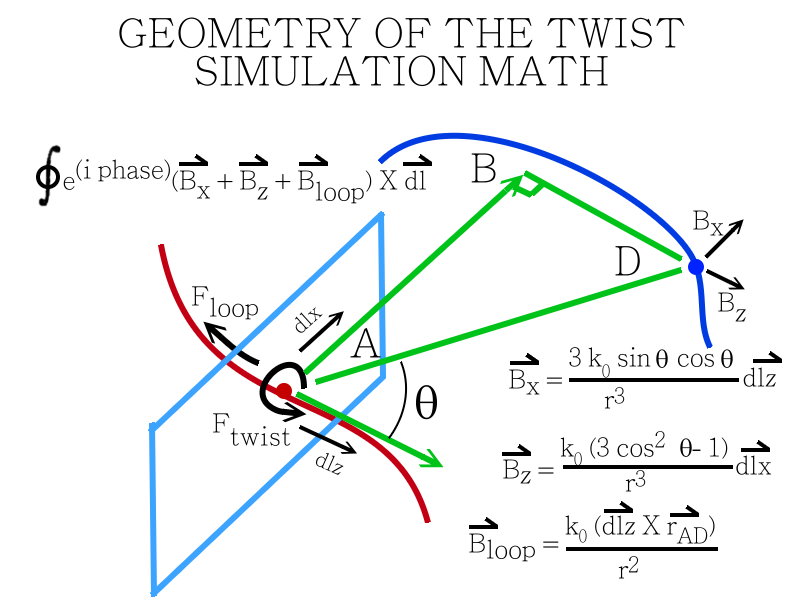
Here is a drawing of the forces on the twist path that the simulator attempts to model.

Here is a drawing of the forces on the twist path that the simulator attempts to model.

I created a picture that hopefully shows the geometry of the simulation math described in the previous post (see in particular the PPS update).  This picture attempts to show a generator twist path about point A in red, with the two force sources F(loop) and F(twist), which are delta 1/r^2 and 1/r^3 flux field generators respectively.  The destination point D path is shown in blue.  The parametric integral must be computed for every source point on each destination point–this will give a potential field.  When the entire set of curves lies on an equipotential path, one of many possible stable solutions has been found (it’s already easy to establish that any topologically unique closed loop solution will not degenerate because the 1/r^3 force will repel twist paths from crossing each other).  There probably is a good LaGrange method for finding stable solutions, but for now I will work iteratively and see if convergence for various linked or knotted loops can be achieved.


Agemoz