Posts Tagged ‘physics’

Using Emergent Fields to Simplify Quantum Field Theories

September 4, 2024

In my last post, I described how quantum field theories use perturbative methods to evaluate particle interactions, and posited that a better way will come from using the emergent field concept. Emergent fields are a type of field that has the creation/annihilation operator properties built in, and in the last post I began to describe what such a field would look like as well as the impact it would have on existing thinking about the standard model. This immediately opened a line of thinking where I think I see a better way to construct quantum field theories that doesn’t depend on particles. I still question whether this is right–but it seems to work, it is consistent with existing physics, and I think this might be a step forward.

One of the principle properties resulting from an emergent field is the embedding of the particle definition within the field as a group composition of waves rather than the standard model way of assuming particles among fields. In my last post (https://wordpress.com/post/agemozphysics.com/1860) I gave an example of a spin twist in a vector field that has rotations quantized to a lowest energy background direction such as toward the time dimension. In this light, when you look at quantum field theories, a lot of really interesting ideas pop out–I think the most important is that separating out particles (virtual or real) from fields is a mistake. Yes, you can calculate with incredible accuracy this way, but it is a big hurdle to really understanding what is going on.

Let’s look at the very simplest quantum field case, the electron emitting and absorbing a virtual photon, one of the components of the electron’s self energy that resists its motion.
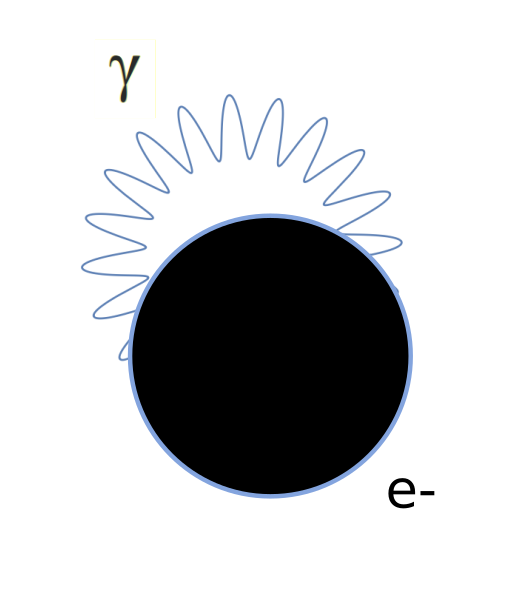
In the standard model, we compute electron equations of motion (LaGrangian minimum energy paths for the electron’s probability distribution) by assuming a random emission of a virtual photon particle, and then add in the contribution due to its re-absorption. There is an electron momentum change at emission and re-absorption, and all the possibilities of when and where and how much effect are all summed in as probability amplitudes. Not surprisingly, we can get infinite values in some cases, so we sum everything up anyway, cancel out what infinities we can, and then renormalize the probability distribution to get back finite answers (I’m glossing over a lot of the complexity of this, but that’s the idea). We also have to add in the smaller possibility of electron/positron pair formation, even the possibility of quark/gluon formation for whatever level of accuracy we are aiming for. This perturbative approach to particle interaction computations is extremely effective and works for both leptons and quarks, but this way of thinking where we separate out the field and particle aspects of such systems shuts down any further thinking about the underlying analytic form of quantum field theories.

If we imagine an emergent field like the dual-spin method I described earlier, things look very different and appear to lead to a more precise way of understanding quantum field effects. In the emergent field approach, there are only waves, no mysterious random appearance of particles. Note that in the electron self energy case shown above, the only time there is an effect on the electron’s momentum is at emission and re-absorption.
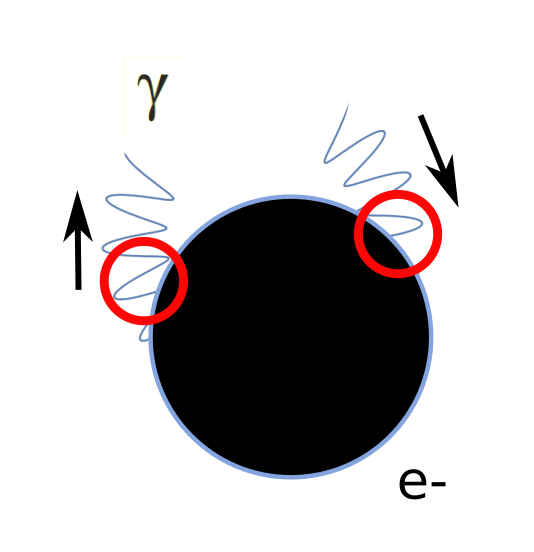
The rest of the time, we can assume the virtual particle doesn’t exist, which means that quantum field effects can be entirely described as momentum change pairs of equal magnitude. In the standard model, this doesn’t help you, you might as well call the whole path a virtual photon particle. That’s all she wrote. We don’t currently have a picture in the standard model and current quantum field theories of what is happening at the virtual particle level, we just know the math comes out.

In the emergent field methodology, these points are “spin-off”waves from the electron wave construct. These waves will interfere with the group wave electron construct, and cause a momentum change. Just like the sum of particle paths in the standard model, you can sum all of the potential momentum changes, but something different happens if the electron is moving. Since the emergent field approach now treats the quantum field effect as waves rather than particles, the doppler shift effect comes into play along the direction of electron motion. Emissions still occur in all directions and will have identical effects on the electron (resulting in a net zero effect on its momentum), but the resulting re-absorption momentums will be different depending on direction because now we are dealing with waves that doppler shift. There will be no net effect normal to the direction of electron travel, but forward re-absorptions will be stronger and reverse re-absorptions will be weaker due to doppler shifting, and the electron will slow down. The quantum field behavior will have a net effect on the electron’s momentum, and we don’t need virtual particles to describe it.

There is a lot more to come. Let’s see if this holds up.

Agemoz

Proposing a New Mathematical Tool for Quantum Field Theories

September 2, 2024

Quantum Electrodynamics and Quantum Chromodynamics invoke perturbative methods to evaluate LaGrangian motion calculations. I have a vision that a new mathematical object, a field with emergent behavior built in, would, at minimum, substantially enhance the range and generality of the computations we can do in these subjects, and additionally make new theoretical predictions possible.

When I was young, I explored the Taylor series and was completely captivated by its ability to approximate transcendental functions such as trigonometric, logarithmic, and exponential functions and reveal some of the properties of these transcendental functions. That memory has stuck with me and has awakened anew while studying quantum electrodynamics and quantum chromodynamics, and I wondered what analytic function is hiding behind the perturbative computations we now do in both fields with extraordinary complexity and accuracy. I have no doubt I am far from the first to ask this question, but this has led me to realize something important about our current mathematical knowledge of fields.

Sometimes some of the best breakthroughs in a subject have their basis in the discovery of new tools that aid in analysis, detection, or construction. Our ability to mathematically manipulate fields of all types, scalar, vector, spin, frequency domain, and momentum space has ascended to dizzying heights. Fields can be mathematically constrained to special relativity and even equations of motion on curved manifolds is now routine. We can even do accurate computations when all we have are fields of probability distributions.

What we don’t appear to have is a type of field that has the creation/annihilation operators built in, and it reminds me so much of the thought processes I went through in my exploration of the Taylor series so many years ago. Since then I have learned that most series do not have an analytic representation, and many properties cannot be determined from the series representation–so it is not given that there exists an analytic solution to the summing of Feynman paths we now do for quantum field theories. Nevertheless, I have spent some time thinking how we might come up with an object called an emergent field, and what kinds of mathematical methods could be derived for it.

The first step in constructing a new mathematical tool has to begin simple just to see if something sticks. Like the list of integrals with analytic solutions, we may end up with a very small list compared to the overall infinite number of integrable functions. So, I started with a couple of principles that should limit the complexity of an emergent field type. There is no reason why we have to start in 4D spacetime, we can develop principles from a 2D space or even a 1D space with a 2D spin rotation, and see if a LaGrangian equation of motion can be computed that intrinsically has the creation and annihilation operators built in. Since an emergent particle can appear randomly at any time and place, I am proposing we work in a probability space with wave functions rather than physical representations. Another important principle is that the field must consist entirely of waves, and that any localized particle that forms in this field must decompose into a group wave. I did a lot of work a bunch of years ago that showed that such a system will always obey special relativity (see this paper: https://agemozphysics.com/wp-content/uploads/2020/12/group_wave_constant_speed.pdf). It uses a Green’s function type of derivation to show that any classical system of group waves will obey the constant speed property of special relativity.

There are other constraints that could be added–for example, you can quantize particles into stable solitons if you do something like the dual-spin particles I have spent a lot of time with (see https://wordpress.com/post/agemozphysics.com/1820 and https://wordpress.com/post/agemozphysics.com/1839). It turns out this, or something like this, is required if you want to successfully create an emergent field object.

How is this new field object going to be different than what we now do in existing quantum field theories? First and foremost, we can’t think in terms of sums of virtual particle contributions or we will be right back where we started with perturbative theory. It has become clear that the field is going to have to have a more general representation of both particles and virtual particles, and thus this field object cannot have particles in it (I already know that from the constant speed research I mentioned above). The particle definition we get in quantum field theories has to come from the field itself. I believe one good candidate is a spin rotation with a lowest energy background state (pointing in the time direction, to use the 4D dual-spin particle as an example). Here we can represent real particles as a complete quantized rotation, but virtual particles would be partial rotations that fall back due to not having sufficient rotation energy to complete the twist past the background state. All we need now is a mathematical description of the probabilities that such spins, either virtual or real, will emerge. I think you can see where I am going with this, and I’ll share more of my thought process and analysis in upcoming posts.

It is my vision that someday soon some really brilliant mathematician is going to come along and finally create an emergent field object, and he or she will develop a full set of rules how this object behaves. I’m obviously not that mathematician, but I do clearly see that future coming…

Agemoz

4D Dual Spin Point Particle Quark-AntiQuark Annihilation

July 16, 2024

Edit: Looking at the LaGrangian (equation of motion) for the strong force, which has been developed and refined over decades, I kind of noped out on the dual-spin idea for quark/gluon interactions. I did get a good sense of what chromodynamic color is–it’s not a property of quarks or gluons, but a mathematical device that ensures which particles can interact with each other. One way to determine this is the fact that all color quarks interfere, and all color pair gluons interfere. I thought the coupling number tensor field adds a crazy degree of complexity that something simple like the 4D dual-spin point concept cannot begin to cover. It’s worth it to study the LaGrangian and SU(3) in more detail, but all this really does throw a monkey-wrench in the works for dual-spin point particles.

Edit #2: Added note that shows that the 4D dual-spin point particle concept not only shows a clean explanation (conversion of angular to linear momentum) for annihilation products of electron or quark particle/antiparticle collisions, but it also shows why those are the only direct products of the collision.

In the last post (https://agemozphysics.com/2024/05/12/spin-wave-functions-in-the-e-p-dual-spin-annihilation/), I showed how the analysis of 4D dual-spin point particle/anti-particle annihilation gives an elegant picture where annihilation is the process where one of the dual spins’ angular momentum components gets converted to the linear momentum of, for example, the resulting photons. This analysis then shows how to derive the quantized angular momentum /h (reduced Planck’s constant) of the source particles.

While this derivation was shown for the electron/positron annihilation case, there is nothing in the formula that limits to the electron/positron annihilation case. In fact, some beautiful results occur when you apply the same work to quarks. Unfortunately, there is a rather stinky fly in the ointment to this line of thinking.

Unlike lepton/antilepton annihilation, which can only annihilate to two photons, quarks can annihilate directly to either a pair of photons or a pair of gluons. Like photons, gluons have a transverse polarization angle, and like photons, they have no rest mass and thus move on the lightcone at the speed of light. Quarks have charge magnitude of either 1/3 or 2/3, and in the dual-spin point particle representation, this means that one of the two spins has a 1/3 ratio to the other.

The beautiful thing about this representation is that in quark annihilation, you can annihilate (convert to linear momentum) either the 1/3 spin, giving a photon pair result, or the 1 spin, giving a gluon pair result. Thus, the 4D dual spin point particle concept makes a case for covering all three annihilation cases, the lepton and both of two quark particle/antiparticle annihilation cases. Since the lepton case only involves 1/1 ratios, you never get a 1/3 spin result and hence never see annihilation into two gluons.

Edit: Note that a quark-antiquark annihilation has no other direct result products–all other collision products require intermediate particles within the collision neighborhood. That is a nice affirmation of the validity of the 4D dual-spin point particle concept–it not only shows an elegant and simple way to get the observed collision products for both electron and quark annihilation, but it also shows why those are the only results.

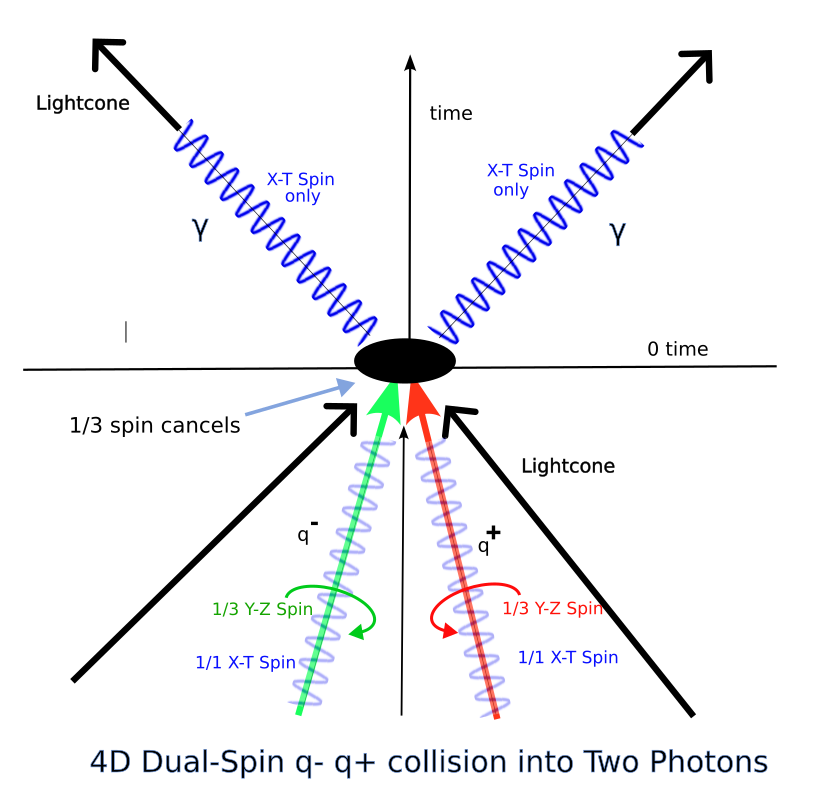
e-/p+ annihilation into two photons
q+/q- annihilation into two photons
q+/q- annihilation into two gluons

Unfortunately, the quark situation is actually not this simple–this does not show why we have chromodynamic color constraints on quark interactions.

In the Standard Model, we represent reality by two overlapping fields, the electromagnetic field covered by U(1), and the strong force field, covered by SU(3). The strong force field can be represented by a unitary constrained 8 dimensional real-valued adjoint (diagonally antisymmetric) matrix with eight orthogonal eigenvectors. The EM and strong force fields are clearly not completely independent, or else we could not have particles that stay in the same place on both fields when either electromagnetic or strong forces are applied. As a consequence, unification of the EM and strong force fields seems to imply there should be a single field representation, and with these annihilation analysis results, I had thought the 4D dual spin point particle concept would get us there.

However, I currently see no way that the 4 dimensional dual-spin point particle representation could be sufficient to constrain chromodynamic quark/gluon interaction characteristics. I’ve studied this for a while and think something has to be added to make the 4D dual-spin point particle concept fully work for quarks and gluons.

In summary, I do think that the four-dimensional dual-spin vector field is a good starting point for unifying the electromagnetic and strong forces–it certainly seems to provide an elegant view of several fermion/antifermion annihilations and pointing to how to get the quantized moments–but as is, it is not sufficient to cover quark/gluon chromodynamic color constraints.

Agemoz

Spin Wave Functions in the e-/p+ Dual Spin Annihilation

May 12, 2024

[edit: math corrections]

[edit: NOTE: dual-spin of 4D point particles is not superposed states on a single spin–see addendum below]

Four dimensional point particles in R3 + T spacetime have unique properties, in particular, the ability to have two independent spins, that appear to make them good candidates for a deeper understanding of what happens when a particle and anti-particle annihilate. I detailed this in the previous post (agemozphysics.com/2024/04/19/creation-annihilation-of-dual-spin-point-particles/).

I’ve made some additional progress, in particular, I see a fairly simple way to show the quantized angular moment of the electron from the details of the collision. I started by putting on my skeptic’s hat (actually, I try to make sure that stays on at all times), and posed a couple of questions:

Why do we need 4D point particles when the current Standard Model works fine with 3D spin wave functions for particles?

There is no measurable radius in a point particle such as an electron, so how are you going to compute an expected angular moment for the electron?

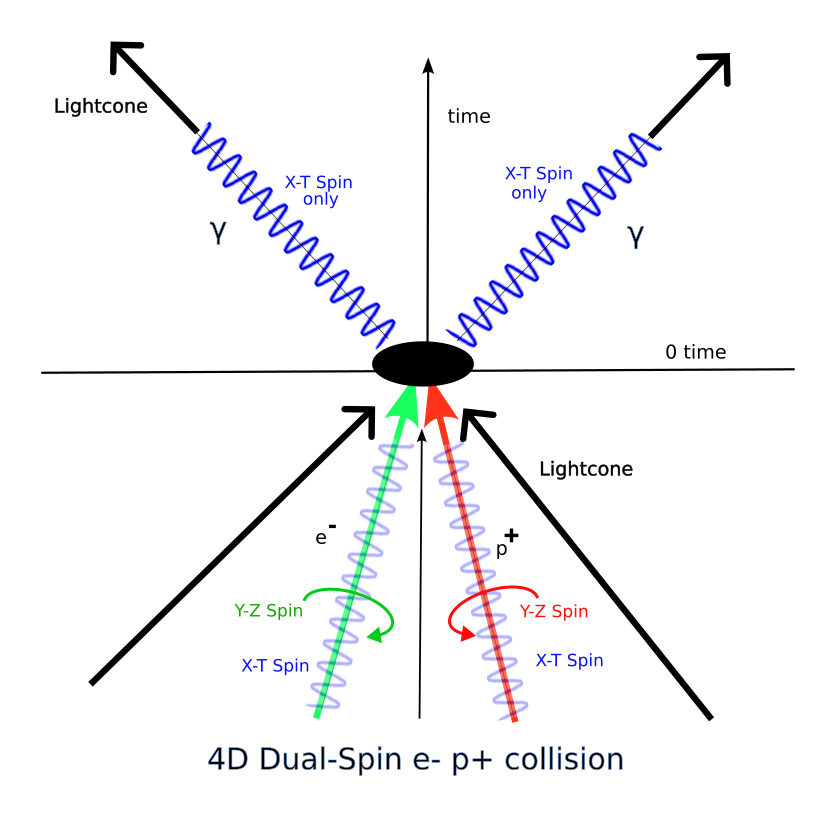
Let me do a quick summary from the previous post to start off: We have substantial experimental evidence that elementary particles such as the electron and quarks are point particles. From a idealized geometric point of view, point particles in three dimensional space are relatively uninteresting with only one possible spin axis and no internal structure. However, we also have significant experimental evidence of four dimensions including curvature in the time dimension, so it is very reasonable to assume that spin angles can point in that direction. In fact, point particles in four dimensions can have two independent spin planes, one in the X-T plane and one in the Y-Z plane, for example. When you examine the e-/p+ collision shown in the figure, we see a better view how the two point particles annihilate into two photons, where the mass and charge of the point particles vanish.

We know that quantum wave interference is present at the same wavelength in both the before and after cases, and the only way for a point particle to produce a wave is to oscillate in some way, which for a point particle can only be induced by some kind of spin. Therefore, the fact that mass and charge disappear after the collision cannot be due to that spin disappearing. But there is nothing else that can be added to a 3D point particle without giving it a radius of some sort–but 4D point particles can have two independent spins, and this is why I saw a door opening as to how the collision transformation would work. The second orthogonal spin encodes the mass and charge effects without changing the geometrical point particle concept. The collision can be explained simply as the transformation of the point particle Y-Z spin angular momentum entirely into the photons’ X momentum (and vice-versa for the e-/p+ pair creation). We get interesting insights when we set the dual-spin point particle angular momentum at some radius re to the linear momentum of the resulting annihilation photons.

However, point particles have no measurable radius, which fails to reasonably explain the actual measured angular moment of the electron. You would have to have an infinite mass to get a finite moment. How did I think this was going to work?

Quantum theory comes to our rescue here–we can’t think classically when working with elementary particles. I bet every good quantum scientist would immediately see the obvious solution–the electron is a point particle, but its location is always defined as a probability distribution–a wave function with a constant normalized magnitude radius, just like an electron orbiting a hydrogen nucleus. Now you can do a simple computation from the annihilation that looks like this:

Ee = h freq = p c (one of the pair of photons)

so then pphoton = h freq / c

In the dual spin situation, the Y-Z angular moment of the point particles must equal the photon moment at quantum radius re, so for one particle transformation:

me omega re = h freq /c

Let’s assume equal dual spins for the electron, where omega = freq * 2 Pi

so then me c re = (h / 2 Pi)

This is a nice way of saying the angular moment of the electron probability distribution is quantized to the quantum angular moment /h of the electron. Thus, the properties of a 4D dual spin point particle lead directly to the quantization of the electron moment.

Agemoz

Addendum: I realized that the dual-spin property of 4D point particles could be misconstrued as some variation of superposed states on a single spin property of a particle. In the Standard Model, quantum spin of elementary particles have two states such as +1 and -1. Until the spin of a particle is detected, the spin will generally be a superposition of these two states, and the orientation of the detector will determine the probability of decohering into one or the other state. Dual-spin point particles refers to something completely different, that is, the presence of two spin properties in a particle–either one of which could have superposed spin states.

Creation/Annihilation of Dual-Spin Point Particles

April 19, 2024

We have substantial experimental evidence that elementary particles such as the electron and quarks are point particles. From a idealized geometric point of view, point particles in three dimensional space are relatively uninteresting with only one possible spin axis and no internal structure. However, we also have significant experimental evidence of four dimensions including curvature in the time dimension, so it is very reasonable to assume that spin angles can point in that direction. In fact, point particles in four dimensions can have two independent spin planes, one in the X-T plane and one in the Y-Z plane, for example. A simple thought experiment that proves this possibility: You can imagine a top spinning in the Y-Z plane and then rotate yourself as an observer through the X-T plane. This proof works identically for quantum spin wave functions, so no objection there–and since there is no physical or timewise displacement, dual-spin point particles will not violate any aspect of special relativity. There is clearly nothing in this geometry that prevents this from happening in reality, so I recall the comment from the Interstellar movie that Murphy’s Law posits that “anything that can happen, will happen”. In my opinion, I think that point particles in four dimensions would mostly likely form with spins in both of the independent spin planes–setting one of the spin rotations to a constant seems really improbably in a relativistic universe.

Dual-spin point particles are particularly interesting to think about in context of creation and annihilation of elementary particles. Examining the details of the electron-positron annihilation exercise, assuming dual-spin particles, looks like this:

Before the collision, there are two massive particles with charge, and after the collision, there are two particles with no rest mass and no charge. The idealized case can be analyzed by assuming there is near zero electron/positron momentum so that all of the momentum (minus some epsilon amount) is in a momentum wave traveling in the T dimension direction. After the collision, the momentum is split between the X direction and the T direction such that the X rate of change in T equals the speed of light–it travels on a path lying on the collision point light cone.

Now, let’s do an ansatz that the point particles are dual-spin point particles and see where that goes. Let’s assume that the X-T spin sets the momentum of the point particles both before and after the collision. Now assume that the Y-Z rotation only exists before the collision–the annihilation cancels out this spin because the anti-particle positron has the opposite Y-Z spin of the electron. We can then see that the X wave displacement after the collision cannot coexist with the Y-Z rotation before the collision. The 4-momentum of the photons must equal the sum of the 4-momentum of the particles and the angular momentum of the massive part of the electron and positron prior to the collision. The collision is the cause of an exchange of all of the Y-Z spin to all of the X displacement of the transformed point particles, you cannot have a mixture of both.

This thinking gives me several insights. The X displacement of the resulting photons is fixed at the speed of light, so this must quantize the possible Y-Z spin–thus giving an explanation why we get a single possible mass of the electron or other elementary particles, depending on the dual spin ratio (see previous posts such as agemozphysics.com/2023/12/28/the-higgs-field-and-r3t-dual-spin-point-particles/). As the universe cooled from the Big Bang, this quantization gives us a phase transition, a symmetry breaking, at the energy wavelength of electrons or quarks. It also hints at why photons have no rest mass and must move at the speed of light. It also suggests that inertial mass and charge result from the Y-Z rotation, which disappears after the annihilation.

Does this fit with the Standard Model, such as the how it derives the Higgs particle interation or the strong force interactions between quarks and nucleons? Does it show why the phase transition point for protons is 1836 times the energy of electrons? Well, no–if it did I would have an actual discovery to report… !

Agemoz

Do Elementary Particle Conservation Laws Work for Dual-Spin Particles?

February 15, 2024

There are several conservation laws that define constraints on how elementary particles interact, and I’ve been looking at what they say about the R3+T dual-spin particle concept that I have studied (latest is at https://agemozphysics.com/2023/12/28/the-higgs-field-and-r3t-dual-spin-point-particles/). The idea here is to better determine whether dual-spin particles could work as a model for the Standard Model particle zoo.

If you have followed my study as shown in recent posts (e.g., https://agemozphysics.com/2023/12/17/properties-of-dual-spin-elementary-point-particles/), you know that I have found a number of properties of point particles that exist in our R3+T four dimensional spacetime. I believe it is indisputable that an elementary point particle in a four dimensional system can have two independent spins (for example, one spin in the X-Y plane, and another spin pointing within the Z-T plane). This fact, coupled with the fact that interactions in R3+T spacetime are confined to a 3D hypersurface slice that moves along the T dimension, results in quite a few very interesting properties that I list in previous posts. One very important property is the discovery that a single R3+T dual-spin particle can actually appear to us (as an observer within our hyperspace slice of R3+T) as two or three independent particles.

Up to this point, the work appears to be solid but does not prove if it is a basis for reality, that is, work as a structure for the interactions and particles defined by the standard model. One fairly quick way to make this determination is to see whether dual-spin particles conform to the standard model conservation laws. These laws constrain what particles can exist, and they also constrain decay paths. If dual-spin particles are a valid construct for reality, there should be no contradictions or impossible interactions.

The first conservation I looked at is the conservation of baryon number. This is the easiest one–since R3+T dual-spin particles are single particles that appear to us as multiple pseudo particles (see posts linked above), and quantization always limits the pseudo-particle count to either 2 or 3, baryon number will always be conserved in the dual-spin particle case. In fact, Noether’s principle states that this conservation law comes from the symmetry that actually implies a single particle (from some point of view within R3+T, not our hypersurface) for all quark combinations. I think that conservation of baryon number, combined with the requirement of relativistic invariance as applied to elementary point particles, directly points to the validity of the dual-spin structure. Looking good so far, at least to me.

Lepton number conservation also seems to work in the dual-spin system. There are quantized spin ratios of either two or three, and these cannot mix without dramatically changing the energy/mass of at least one of the pseudo particles–thus violating the conservation of energy of the system of interacting particles.

Fermion conservation is a somewhat general statement of momentum conservation, and I don’t see it affecting the argument of whether dual-spin particles would work or not.

I haven’t addressed muon number conservation because I don’t know what class of dual-spin ratios define muons. Similarly, isospin conservation requires a dual-spin ratio definition for the different pions and other particles. If I make progress by studying decay paths, I should see symmetries emerge here and how dual-spin structures fit within the isospin conservation constraint.

The crossing symmetry where an interaction can be transformed by taking the antiparticle of one of the components and placing it on the other side of the interaction equation should not affect the dual-spin validity.

Chirality needs more study. I don’t see anything that limits parity–dual-spin structures do not appear to favor one or the other reflection of an interaction. This would imply there is some other symmetry breaking activity taking place here, but does not rule out dual-spin as a valid representation of reality.

So, I am currently concluding that the conservation laws (other than the unknown case of muon and isospin conservation) do not lead to contradictions. In fact, baryon number conservation strongly points to the validity of the dual-spin structure as a basis for the particle zoo–in my opinion, for whatever that is worth…

Agemoz

The Higgs Field and R3+T Dual Spin Point Particles

December 28, 2023

UPDATE: chart of all possible dual-spin combinations, both unquantized and quantized.

In our four dimensions (three space and one time), a single point particle can have two independent spins within two orthogonal planes, such as the plane lying in R1+R2 and another lying in R3+T. This fact, coupled the fact that our existence and interactions are confined to a R3 hypersurface “activation layer” within the R3+T universe, gives point particles a lot of interesting properties that point to why we have the particle zoo in real life, see https://wordpress.com/post/agemozphysics.com/1784. The most important property is the ratio of the two spin rates–when these are described as spin wave functions, we get quantization of the probability distributions. When combined with the activation layer, a single R3+T dual spin particle will pop in and out of existence, and it will appear to observers as multiple pseudo particles.

Dual-Spin point particles. Quantized spins must start and end in the R3+T background state (see text), especially note that there are only two possibilities regardless of the chosen spin ratios: two equal-mass particles, or three particles composed of two equal-mass particles and one particle with twice the mass of the other two (this assumes mass correlates to immersion time in real space, see text)

This system gives us the necessary degrees of freedom to specify charge and the different particle types such as the four electron-class particles (spin-up electron, spin-down electron, and their positron anti-particles). When the spin ratio has a factor of three, we get the degrees of freedom necessary for color charges and electric charges of several quarks, including the excited quark combinations of the various Delta particles. Even the particle masses due to the binding energy of quarks have a workable mechanism because force on particles is dependent on the percentage of time the particle spends in the activation layer. The higher the dual spin ratio, the less time external forces can affect each pseudo particle, and thus the higher the apparent mass of the particles.

One really nice thing about dual-spin point particles is that being a point particle, it is immune to concerns about relativistic invariance–with no time or spatial distance in the particle definition, the metric is always zero. All the properties I discovered so far do not have any danger of violating relativity.

One of the strongest reasons I think these dual-spin point particles match reality comes from the known behavior of half-spin particles. I was fortunate to attend one of Professor Feynman’s last lectures before he died, and I remember him discussing that half-spin particles do not have classical spin, but require two complete revolutions before returning to the original state. He used his hands to model how one quantum twist rotated the spin axis normal to the spin direction, and that two twists were required to return to the starting position of his hands. If ever there was a clearer example of the multiple dimensional nature of quantum particle spin, I haven’t seen it!

All of these R3+T point particle properties seemed to work fairly well matching the necessary degrees of freedom present in the Standard Model until I started evaluating the Higgs field. There are a lot of questions still, such as how we get the strong force/electric force counterbalancing within a nucleon or particle decay times, but nothing has really shut things down as much as trying to integrate the Higgs field into the dual-spin point particle idea.

The Higgs field, which is a constant scalar field regardless of the chosen frame of reference or the presence or absence of neighborhood particles, applies a drag to the motion of particles and is responsible for the apparent inertial mass of the particles. There are some relativistic invariance problems here–first, the Higgs force only emits a Higgs boson to resist motion when the particle accelerates in some way, not when it is moving at a constant velocity. Thus calling it “drag” is not a good label, it only “drags” changes in motion–how does the field know the difference? And secondly, there is no Higgs boson emission when observed in the frame of reference of the accelerating particle, so the field itself must be accelerating in that case–and then you really run into relativistic invariance problems because Higgs bosons are massive, and you just caused the mass to disappear!

The Higgs field is really treading dangerous ground given that the luminiferous ether was proven not to exist (see the Michelson-Morley experiment). A model having a constant scalar field which applies drag to particles sounds a lot like something that would break relativistic invariance no matter what mathematical hijinks are done.

Something feels off here in my understanding, and until I get past that, I won’t have a way to match the Standard Model mass effect. I like to think that the dual-spin point particle idea doesn’t need the Higgs field, but that fails when trying to understand why scientists have already detected the Higgs boson.

Agemoz

Properties of Dual-Spin Elementary Point Particles

December 17, 2023

UPDATE (12/19/2023): summary of findings below.

As mentioned in previous posts, it is possible in our four-dimensional space time R3+T for dual-spin point particles to exist. Rotations in either two or three dimensional space must lie within a plane, but in R3+T, it is possible to have two orthogonal planes, and point particles can have simultaneous independent spins lying in each of the two planes. This gets a lot more interesting in real life because interactions only lie within the three dimensional hypersurface slice of R3+T. This causes the spin traversal of point particles to pop in and out of (interactable) existence.

An important property of elementary point particles in R3+T is quantization. If one spin lies in both the T dimension direction and one of the three R3 dimensions, for example, this spin must be quantized to one complete rotation. We see this quantization in photons, where E=hv means that for any given wave frequency, there is only one allowable energy. This quantization maps geometrically to a single vector rotation, starting and stopping into the background state pointing in the T dimension direction (for this quantization to work, the background state has to be a lowest energy state for the particle rotation). I have several posts that elaborate on this, such as: https://wordpress.com/post/agemozphysics.com/1722

Combining these two principles, the point particle appears to observers living in our hypersurface as multiple independent point particles. For example, a dual-spin ratio of 3:1, a R3+T projection of a single point particle will appear as three point particles, and one of the three particles will exist in the hypersurface twice as long as the other two, see the figure:

The hypersurface immersion time is very important, because that is the only time that the R3+T point particle will interact with other particles and fields in the hypersurface (which is why I call our R3 existence within R3+T an “activation layer”). I did a comparison of this immersion time for the 1:3 point particle with the 1:1 point particle, and discovered that the two smaller point particles have half the immersion time as the larger 1:3 particle, and one quarter of the 1:1 immersion time.

A point particle that is heavier than another point particle means that it either has more mass, or spends less time in the activation layer (an inertial force has less average time to move the particle). Since dual-spin particles pop in and out of the activation layer, the immersion times will affect the observable mass of the particle as well as the observable charge force on the particle. My analysis shows that dual-spin point particles in R3+T should have immersion time ratios of 1x, 2x, and 4x for the 1:1 and 1:3 ratio cases. If dual-spin point particles are reality, there should be a set of spin ratios that result in the mass and charge ratios between electrons and quarks. Gluons could have something to do with the connections between the immersion times of the observable R3 particles, but that is speculation at this point.

UPDATE: The original post wasn’t clear on what these results mean: to summarize, I conclude that dual-spin point particles in R3+T appear to observers to project into multiple pseudo particles due to our existence within the R3 hypersurface activation layer. All particles have one of the quantized spins in (for example) the Z-T dimension plane, but massive particles also have an independent spin in the X-Y dimension plane. The ratio of spins affects the properties and the number of observed pseudo-particles in R3. This ratio causes the apparent mass to increase as the X-Y spin factor goes up because its immersion time decreases proportionately (making less time for the particle to be affected by forces and thus causing the particle to seem heavier).

However, charge is generated as a wave (quantum field theory of virtual photons), so charge is solely a function of the number of pseudo-particles, independent of their apparent mass, because a wave is induced when the Z+T spin passes through the activation layer hypersurface (the T dimension spin direction goes to 0). The number of pseudo-particles is determined by the X-Y spin factor relative to the Z-T spin factor.

When pseudo particles annihilate, the X-Y spin factor cancels out, leaving only the Z-T spin factor and these are massless (photons) since in this scenario both mass and charge are due to the dual-spin particle’s X-Y spin (see https://wordpress.com/post/agemozphysics.com/1722).

In other words, I am positing that dual-spin particles in R3+T form a basis for all of the particles we see in real life by altering the spin ratios in the particle. I will continue to investigate R3+T particle ratios to see if the families of elementary particles (for example, the lepton sets of 3) result.

To the best of my ability, I have so far been speaking the truth about dual-spin point particles and their properties. What I don’t have at this time is proof that these point particles map to real life particles, so the investigation continues. The “holy grail” of this study is to find that proof.

Agemoz

Quantum Chromodynamics and R3+T Dual-Spin Elementary Particles

December 12, 2023

Since we live in a four dimensional spacetime, I have long known that it is possible for elementary point particles to have simultaneous independent spins on two orthogonal planes, for example, one rotation axis normal to the x-y plane, and another axis normal to the z-t plane. I discovered that when combined with the R3 hypersurface we live in within the R3+T universe, the projection of dual-spin particles onto the R3 hypersurface causes a single elementary particle to appear as (for example) two or three independent particles from our point of view.

This seemed like a great way to make progress on why we have bound systems of quarks but never see isolated quarks. I recently posted on this (see https://wordpress.com/post/agemozphysics.com/1754, for example). I had hoped that this approach would allow a more analytic view of quantum quark behavior than the perturbative methods we currently use in quantum chromodynamics, why we have bound quark systems that are color-charge neutral, and why we have the SU(3) color charge behavior of quarks and gluon interactions.

Alas, I found that dual-spin doesn’t lead directly to the SU(3) solution of chromodynamics or any of the rest of it. The observation in R3 of R3+T dual-spin particles yields three identical particles (see the 3:1 dual spin ratio shown in the figure) rather than two up quarks and one down quark, and gives no hint why most of the quark combinations in real life are unstable. It doesn’t explain conservation of baryon number, the large mass of the bound quarks in a proton, or any of the other things we see in quantum chromodynamics. Nor do I see nothing that points to where the different gluon color charge pairs come into play, for that matter, why we have gluons at all.

Here is the corrected (from the previous post) projection in R3 of a single R3+T dual spin elementary particle. Note this displays the spin direction only, there is no actual physical displacement. (You cannot have physical displacement within an elementary particle as it would cause all kinds of consistency problems in a relativistic environment). Each of these three R3 pseudo particles lie on an axis with a positive and negative direction shown.

I did a bit of research to see if anyone had looked at spins in four dimensions, or even if someone had published the fact that elementary particles in R3+T can have two simultaneous and independent spins that project onto our R3 hypersurface reality, and so far, it doesn’t look like anybody has considered this. There is no reason why a product of Pauli matrices couldn’t describe a real particle in R3+T, which I think gives the degrees of freedom we need for color charge in quantum chromodynamics. Indeed, the solution I found in the previous post listed above looks like it gives us the colors we need for quarks (red, green, blue). The fact that real-life elementary particles only have color neutral combinations (e.g., protons must have each of a red, green, and blue quark) to me hints strongly that the bound quark system making a proton is a single dual-spin elementary particle in R3+T.

So, I don’t want to give up. I still think I might be on the right track, or close to it. Do any of you agree or am I doomed to crackpot purgatory?

Agemoz

Mass of R3+T Dual Spin Particles

December 1, 2023

UPDATE: it turns out, due to a ColorFunction bug in Mathematica, my conclusion from the previous post is incorrect, and the idea of using dual-spin particles in R3+T may not work as a simple model for bound quarks–see the addendum below.

ORIGINAL POST:Our existence lies in a three dimensional slice of spacetime called a hypersurface that I have chosen to call the “activation layer”, since interactions, whether quantum or relativistic, can only happen here. I have discovered that point particles in R3+T spacetime can have two simultaneous spin axes, for example one in the R1-R2 plane and one in the R3+T plane. This is different than spins in 2 or 3 dimensions, which can only spin on one axis.

I’ve recently created a number of posts on this blog detailing some of the basic properties of “dual-spin” particles, and showed how such particles form a hypothetical foundation for why we have the real-life particle zoo of our existence. The fact that electrons form a class of four identical mass and charge particles (spin-up, spin-down, and their antiparticles) falls nicely out of the dual-spin concept, and recently I found that some ratios of the dual spins turn a single point particle in R3+T into two or three distinct particles in R3 (see https://wordpress.com/post/agemozphysics.com/1754). It is easy to think that this is why we see bound quarks–in R3+T–it is a single particle and cannot break apart.

I think there is a lot going for this idea, but it makes me really nervous to postulate a concept that is so distant from the known and verified quantum field theory and the standard model we now use. For example, in the dual-spin concept, where are the gluons? How do you get the very high ratio of proton mass to electron mass if both are single point particles (with different dual-spin ratios)? How do we describe the strong force in a dual-spin system? What is the difference between a proton and a neutron when built from dual-spin particles? What stabilizes the neutron when in the presence of a proton? What are neutrinos and muons? What explains the parity violation? When an idea like the dual-spin point particle is this far removed from known science, there is just a ton of work thinking about all the connections that have to be established, before even thinking about any new science. And without new science, I am just spitting in the wind.

So, I take each aspect one at a time, and first look to see if there is a fit or if the model simply won’t work no matter what.

It was a major revelation to discover that the dual-spin point particle creates the illusion of three particles in our activation layer hypersurface. The projection onto R3, the only place where interactions can occur, creates some unexpected consequences that do seem to point to a match to reality. I then realized that this revelation has a really important corollary in how the point particle will respond to acceleration. In other words, different dual-spin ratios have to have a significant impact on the apparent mass of the R3 activation layer pseudo particles.

There are two ways to increase the mass of a particle. The obvious one is to increase the rest mass by adding mass to it–attaching more particles, connecting to a field via bosons, and so on. But there is another way that is enabled by the four dimensional nature of dual-spin point particles. If an inertial force is accelerating a particle that constantly pops in and out of the activation layer, the force only gets a fraction of the time to accelerate the particle. The effect is exactly identical to if the particle has proportionately more mass, and in the case of the dual-spin representation of quarks, I see several ways we could get the expected mass ratios to the electron (.511Mev electrons to 2.2Mev up quarks and 4.8MeV down quarks). Yes, that is numerology, a no-no in physics, but the procedure is definitely mathematically sound. The big question is whether this represents reality, and for that, I have to continue this study.

UPDATE 12/6/2023: The various dual spin ratio cases do indeed have some instances where a single R3+T particle become visible to us as two or three particles in R3 due to the activation layer hypersurface we live in, but they are all identical in mass. There is a bug in Mathematica where the ColorFunction method does not correctly track in a parametric3D plot, which caused me to observe an incorrect property for one of the three particles in R3. I found a workaround in Mathematica that correctly shows three identically spaced particles where the observed mass in R3 will all be identical. Unfortunately that won’t work as a model for the quarks in a proton. So, I have to back up a few steps in this hypothesis. Maybe the dual-spin idea will still work in some way, but it’s not there yet. I now have categorized all of the bound particle combinations that result from dual-spin particle ratios. While dual-spin particles are an interesting mathematical concept, I’m no longer seeing a clear path to the particle structures we have in real life.

Agemoz