The Unitary Twist Field theory posits that the particle zoo and corresponding exchange particles could form from a rotation (unitary magnitude) vector field. I have put together a simulation of this field and appear to have confirmed it can form stable particles of various sorts, including a qualitative model using linked closed loops for quarks and the strong force. Now I see a possible mechanism for the weak force in this theory.
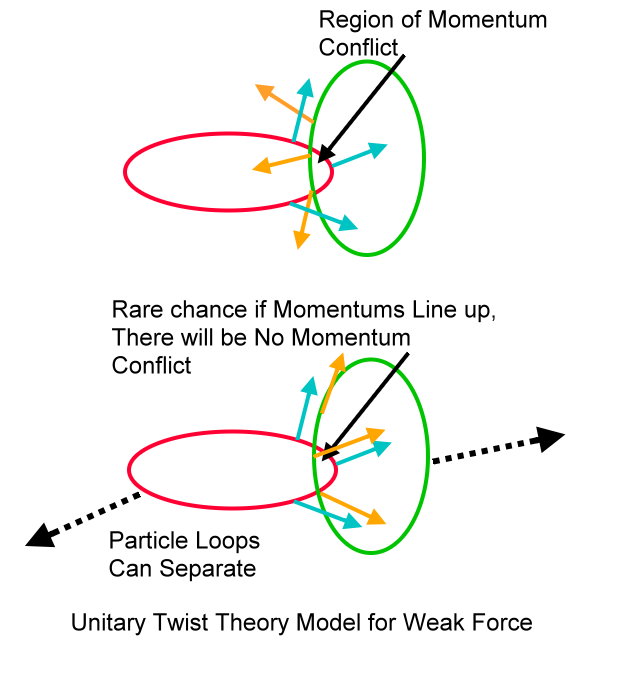
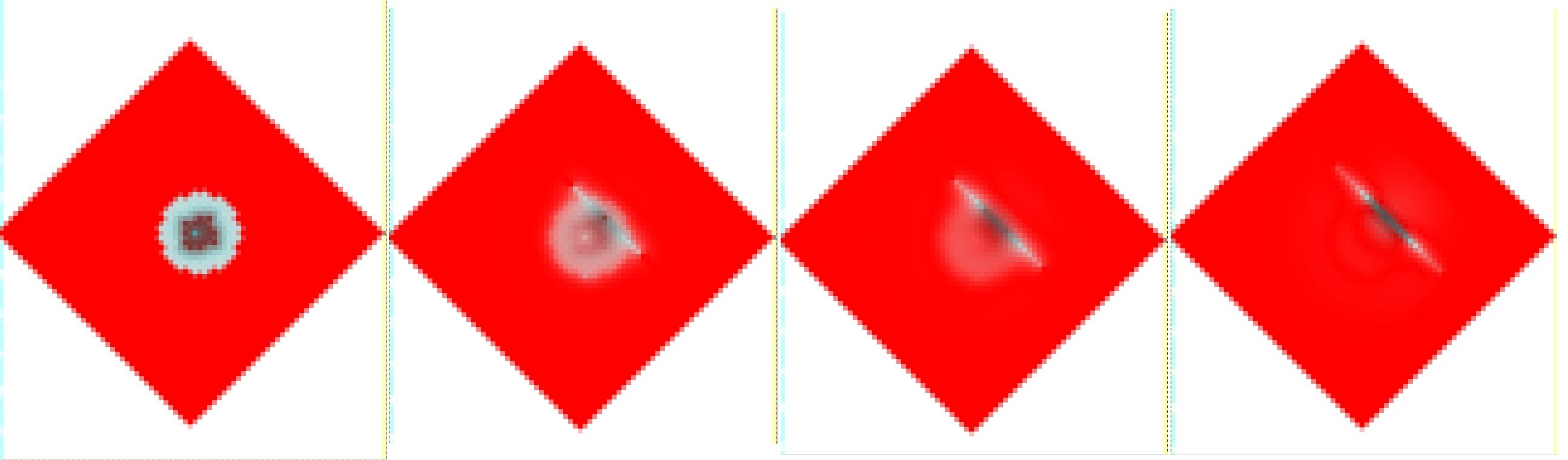
The sim work clearly shows that if two closed loops such as rings are pulled apart to the point where the twists of each ring approach each other, there are dramatic effects on the rings that will separate or destroy both rings. I was hoping to have the sim show that such linked rings will try to avoid (ie, push away from each other) what might be called a momentum collision as the twists approach each other, but right now I am running into a problem with the sim code. I call this problem “momentum splitting”, and it results from the lattice computation of momentum progression in the sim. Since momentum almost never transfers exactly into an adjacent sim cell, either the conserved momentum must be split between two or more cells, or all of it must be sent to one of the adjacent cells, with the result that some of the momentum location information is lost or rapidly spreads throughout the array. In both cases, the sim results go badly awry from actual expected results. I am working on a solution that enforces conservation of momentum by using the second option, but keeping a separate array of momentum parameters such as exact location in each cell.
So–a roadblock to getting good sim results, but often working out details of the sim yield insights to the actual model. One thing I noticed about the twist field model (not the sim of the model) is that there is a very small probability that two twist rings will collide in such a way that the twist rotation angle happens to be identical. If this happens, there is sort of a quantum tunneling effect where the two rings can separate if a random jiggling of the rings hits this coinciding angle rotation. At that point, the rings would have to disintegrate or form other loop combinations (my hypothesis) because the ring energies are not correct for stability on their own. I originally thought this was a fatal flaw in the linked ring idea for quarks–but then I realized that the vast majority of quark combinations are not stable, they decay via the weak force. Up to now, I couldn’t see any way to get the Unitary Twist Field to model the random effect of the weak force, but this is a great solution, I think! The random thermal motion of our existence would be constantly pulling and pushing the linked rings in a very chaotic way, and every once in a while the ring rotations at the point of collision would line up and cause a dramatic breakup of the linked structure. Just about all of the linked quark combinations experience decay in varying amounts of time, and this model of the unitary twist field provides a means for this to happen.
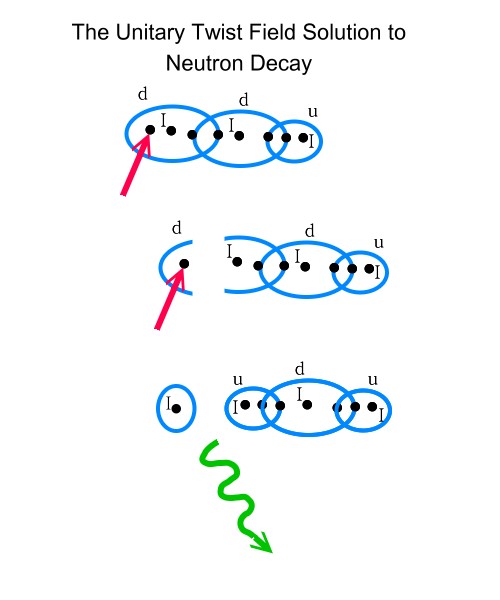
So–how do I explain the stability of the proton? And why does the nearby presence of a proton make a neutron stable? I suspect that in the case of the proton, even if this ring tunneling happens, the decay must result in something else that the separated rings can decay into (to conserve momentum, among other things). If there isn’t something to decay into, the proton component tunneling of quark rings won’t occur even if the rotations at the collision point line up correctly.
The neutron case is a lot more interesting, I don’t have an answer but I continue to think about it. My leading hypothesis is that the proton-neutron combination is actually some unique combination of linked rings that can decay into separate particles (free neutron and proton).
Agemoz




 My work described on this blog can be summarized as trying to find and validate a field that could sustain a particle zoo. Previous posts on this blog detail the required characteristics and constraints on one such field, which I call a precursor field. When I began building the mathematical infrastructure needed to analyze this field, I made an absolutely critical discovery that strongly validates the whole field-to-particles approach.



 Agemoz's Physics Blog