Posts Tagged ‘qft’

What Electrostatics Tells Us

June 7, 2012

I am attempting to work out a viable unitary twist field approach for the attraction and repulsion of charged particles.  I’ve discovered symmetry requires that the vector field would have to have a median plane where there is only a background state, which leads to problems describing how one particle would communicate via the field to another particle (so that the particles, if identically charged, would experience a force of repulsion.   It appears that this problem would also be experienced by QFT since it mediates by virtual photons, which are best described as partial field components that mathematically sum to get the desired result, but individually do not obey various properties such as conservation of energy or momentum.

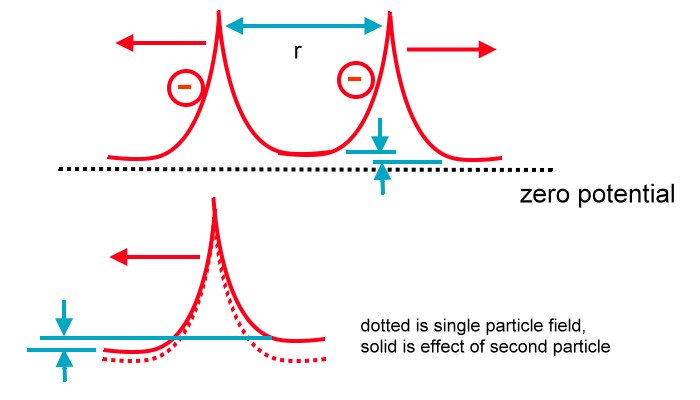
It will be instructive and potentially guiding to look at the two particle system from an electrostatics point of view.  Here are two figures, one for the two-electron case of repulsion, and one for the electron-positron case of attraction.  Note that the receiving particle experiences a force in the direction that is closest to the ground state potential in both cases.  If the field adjacent to a particle is radially unequal, the particle tries to move so that the field is closer to the ground state on every side of the particle.  It is interesting that in one case (the two electron repulsion state) the median plane is *not* at the ground potential, but in the attraction state, it is.  I see that from an electrostatics point of view, the median plane state, whether background or not, does not affect particle communication, whether by virtual photons in QFT or by bend of the imaginary vector in unitary twist field theory.  It is the field neighborhood, particularly the unequal, or unbalanced, aspect of the field near a particle that has to be responsible for forces on the particle.  It is not clear if the force is due to trying to minimize the overall field neighborhood to be close to the ground state, or if the force is merely trying to equalize the neighborhood (in fact, it is likely that both explanations mean the same thing given the relative nature of electrostatic potential).

The field near an electron when near another electron. Note how the force on a particle moves it toward a more equal field neighborhood.


Electrostatic field for the electon-positron attraction case. Once again, the particle moves to a field neighborhood closer to the ground state.

I will think on this, this means something for both QFT and unitary twist field theory–but exactly what is not clear in my mind yet.

Agemoz

Symmetry Constraint on Charged Particle Geometry

June 5, 2012

In working out the details of how the complex unitary twist field would work on a system of two charged particles, I came across a very important discovery.  This holds true even if you don’t believe in the unitary twist field theory tooth fairy, even if you only think in terms of QFT virtual particles.

If you have two identical charged particles such as electrons separated by a distance r, symmetry geometry requires that the interaction cannot be static.  Any continuous static field in this system must have a plane perpendicular to the path between the particles that is the same as if there were no particles–that is, identical to the background field.  For standard QFT, this plane cannot have an electrostatic potential relative to the field out at infinity.  For the Complex Unitary Twist Field theory, this plane must be at the background field state in the imaginary dimension.


But if this is true, then that becomes a point where the behavior of one particle cannot affect the other–there is no field potential.  I won’t go into the QFT case, but the analogy is similar when I try to work a geometric solution in the twist field case.  I had found a way that the bend of the twist field imaginary background vector would specify the effect of charge on the second particle.  But this bend has to be symmetric in this system, with a plane in the middle where the bend is the same as the overall background field with no charges.  Oops–the problem shows up where there is no way to communicate the bend effect to the second particle without creating a paradox–an impossible field situation.


Any static field between two identical charged particles must have a plane between them that cannot pass the charge effect. The charge effect must pass dynamically across this plane

I said, uh-oh–the unitary twist field can’t work this way with bends.  Then I realized this has to be true for QFT too!  The symmetry of the system says that there is no way that the charged particle force can be conveyed within a static field.  There has to be something dynamic passing through the plane–virtual photons for QFT, and probably some type of background vector motion for the unitary twist field.  These two theories have to converge, and symmetry is going to severely constrain what has to be happening across the plane.  Even if you ignore unitary twist field theory, and just make the statement that QFT claims that virtual photons are not real (and unitary twist field theory specifies virtual photons as partial field twists that don’t complete but revert back to the background vector state), this symmetry problem forces the virtual photons to have both a physical field property and a property of motion.

Agemoz

Fine Structure Constant Hunting

May 1, 2012

Built into current QED (quantum electrodynamics) is the QFT process of pertubative accumulation of virtual photons.  Each possible virtual photon term is assigned a unitless  probability (actually,  probability amplitude capable of interfering with other terms)  of occurrence called the fine structure constant.   Searching for the reason for the value of this constant is a legendary pursuit for physicists, Feynman made the famous comment about it:

It’s one of the greatest damn mysteries of physics: a magic number that comes to us with no understanding by man.

All kinds of research, study, and guesses have gone into trying to figure out why this number is what it is, and I can guarantee you this is a fruitless pursuit.  Think about it, there have been maybe millions of physicists over the last 100 years, the vast majority with IQs well north of 150, all putting varying amounts of effort into trying to figure out where this number comes from.  If none of them have come up with the answer yet, which they haven’t, the odds of you or I stumbling across it is certifiably close to zero.  That is an effort that I consider a waste of time. For one thing, this is a no-numerology physics blog.

One bad trait of many amateur physicists is to theorize answers by mixing up various constants such as pi, e, square roots, etc, etc and miraculously come up with numbers that explain everything.  Note, no knowledge required of the underlying science–just mix up numbers until something miraculous happens, you get a match to an actual observed physical constant (well, so close, anyway, and future work will explain the discrepancy.  Yeah… riiiight).  Then you go out and proselytize your Nobel prize winning theory, to the annoyance of everyone that sees what you did.  This is also called Easter egg hunting, and really is a waste of time.  Don’t do that.  Hopefully you will never ever see me do that.

Nevertheless, physicists are desperate for reasons why the fine structure constant is what it is, and all kinds of thought, analysis, and yes, numerology, have already gone into trying to find where it comes from.  Why do I insert a post about it in the midst of my step by step procedure of working out the role of unitary twist field theory in the electron-photon interaction?  Because, as I mentioned, the fine structure constant is fundamental to mathematically iterating terms in the QFT solution to this particular QED problem.  It stands to reason that an underlying theory would have a lot to say about why the fine structure constant is what it is.

Unfortunately, it’s clear to me that it’s not going to be that simple.  Pertubative QFT is exactly analogous to the term factors in a Taylor series.  You can create amazing functions from a polynomial with the right coefficients–I remember when I was much younger being totally amazed that you could create trigonometric functions from a simple sum of factors.  Just looking at the coefficients really tells you very little about what function is going to result, and that is exactly true in pertubative QFT.  The fine structure constant is your coefficient multiplier, but what we don’t have is the actual analytic function.  The fine structure constant has a large number of ways to appear in interaction computation, but the direct connection to real physics is really somewhat abstract.  For example, suppose I could geometrically explain the ratio of the charge potential energy between two electrons separated by distance d with the energy of a photon who’s energy is defined by that same distance d, which is defined as the fine structure constant value.  But I can’t.  The fact that it takes 137 of these photons (or equivalantly a photon with 1/137 the distance) to hold together two electrons to the same distance is not physically or geometrically interesting, it is a numerology thing.  Pursuing geometric reasons for the 137 is a lost cause, because the fine structure constant is a coefficient multiplier, an artifact of pertubative construction.

Nevertheless, I do see a way that the fine structure constant might be derived from the unitary twist field theory.  Don’t hold your breath–obviously a low IQ type like me isn’t likely to come up with any real discovery here.  Even so, I should follow through.  Here’s the deal.  Take that picture in the previous post, the second “Figure 2” that shows the effect of bending the imaginary vector.  I need to go back and edit that diagram, the circle ring is the twist ring electron, and fix that to be fig 3.  Anyway, the force on that electron ring is going to be determined by one of two things–the amount of the bend or the difference delta of the bend on one side of the ring versus the other.  The bend will gradually straighten out the further you get from a remote charge.   This computation will give the motion and hence the inertia of any self-contained twist (only the linear twist, the photon, will experience no net force from an imaginary bend).  This will be a difficult computation to do directly–but remember we must have gauge invariance, which leads to my discovery that a ring with an imaginary bend must have a frame of reference with no bend.  Find this frame of reference, and you’ve found the motion of the electron ring in the first frame of reference–a much easier computation to do.  This is real analysis and logical thinking, I think–not Easter egg hunting.

Agemoz

The Quandary of Attraction, Part III

April 26, 2012

I worked quite a bit with figuring out a way to make twists work in the electron-photon case.  I had excluded partial twist bending as a means of propagating the charge field of a remote charged particle, but this really troubles me, because it is a very clean way of representing virtual photons.  Virtual photons actually come from QFT as partial terms of a total expression of interaction probabilities.  They are a mathematical artifact only in the sense that there are constraints on the sum of all virtual interaction probabilities.  Even though they aren’t really “real”, they derive from real field behavior in aggregate, so there must be some physical analog if I’m going to construct an underlying theory.  Partial twists were perfect–since they have to return to the background direction without executing a full twist (otherwise there would be a real photon there), and since they have a linearity property where multiple charge sources can create a sum of bends, there was a good match for the QFT virtual particle artifice.  Such a bend will have an effect on a remote ring (charged particle) caused by the delta bend from one side of the particle to the other.  Here’s a simple picture that illustrates what I am thinking:

Problem with bend solution to Unitary Twist Field theory in a charged particle array

If bends are correct, there’s a whole bunch of problems that show up, the Figure 2 shows one of them–it doesn’t work correctly if a third charged particle is added at an angle to the line of the first and second particles.  In addition, the bends aren’t even correct if the field due to the receiving particle is added in.  It just doesn’t work, and so I decided to throw in the towel and say that bends are not virtual particles and there is no option but to only consider full twists for real photons.  The twist model won’t have a QFT equivalant mapping with virtual photons.  Oh, I really don’t like that.  I also really don’t like the background vector in R3 in order to enforce quantization–I see a large number of problems creating such a system that is gauge invariant (what I mean by that is that the system’s behavior is independent of absolute position, rotation, and Lorentz invariant to frames of reference in space-time).

It occurred to me that all these problems could be solved if we put the background vector direction orthogonal to our R3 space.  Not really a 4th dimension because nothing will exist there, but a 4th dimension direction to point.  I think multi-particle bends will correctly sum to create an electrostatic or magnetic field that QFT would generate with virtual photons, and now there is no preferred angle in R3 that would ruin gauge invariance.

I have to think about this a lot more because now there may be too many degrees of freedom for twists.  The work on circular polarization for photons wont be affected since the background direction just provides a reference for the available twists.  But the ring solution might end up with too many possibilities, I have to figure that out.  But I see a lot of promise in this adjustment to Unitary Twist Field theory–I think it is a closer match to what we know QFT and EM fields will do, yet still preserves the quantization and special relativity behavior that makes the Unitary Twist Field idea so compelling to me.

Agemoz

The Quandary of Attraction, part II

April 23, 2012

I mentioned previously that the attraction between two opposite charged particles appears to present a conservation of momentum problem if electrostatic forces are mediated by photon exchanges.  Related to this issue is the question of what makes a photon a carrier of a magnetic field versus an electrostatic field. QFT specifies that this happens because the field (sea of electron-positron pairs/virtual particle terms) absorbs the conservation loss, but as far as I can find, does not try to answer the second question.

Part of the difficulty here is that attempting to apply classical thinking to a QFT problem doesn’t work very often.  Virtual photons in QFT do not meet the same momentum conservation rules we get in classical physics, either in direction or quantity.

But, since I hypothesize an underlying vector field structure, it is interesting to pursue how the Unitary Twist Field theory would deal with these issues.

I ruled out any scheme involving local bending of the background field vector.  This would be an appealing solution, easy to compute, and easy to see how different frames of reference might alter the electrostatic or magnetic nature.  But this doesn’t work because you must assume any possible orientation of the electron ring, and it is easy to show that a local bend would be different for two receiving particles at equal distance but different angles from a source particle.  I worked with this for a while and found there is no way that the attraction due to a delta bend would be consistently the same for all particle orientations.

The only alternative is to assume that the field consists of twists, either full or partial returning back to the background state (photons and virtual photons respectively).  Why does an unmoving electron not move in a magnetic field but is attracted/repelled in an electrostatic field?  QFT answers this simply by assuming that the electrostatic and magnetic components of the field are quantized and meet gauge invariance.   My understanding of QFT is that asking if a single photon is magnetic or electrostatic is not a valid question–the field is quantized in both magnetic and electrostatic components, composed of virtual photon terms that don’t have a classical physical analog.

I suppose the unitary twist field theory is yet another classical attempt.  Nevertheless, it’s an interesting pursuit for me, mostly because of the geometrical E=hv quantization and special relativity built in to the theory.  It seems to me that QFT doesn’t have that connection, and thus is not going to help derive what makes the particle zoo.

This underlying vector field does not have two field components real and imaginary, just one real.  Even if this unitary twist field thing is bogus, it points to an interesting thought.  If  our desired theory (QFT or unitary twist field) wants to distinguish between a magnetic field or an electrostatic field using photons, we only have one degree of freedom available to do the distinction–circular polarization.  What if polarization of photons was what made the field electrostatic or magnetic?

An objection immediately comes to mind that a light polarizer would then be able to create electrostatic or magnetic fields, which we know doesn’t happen.  But I think that’s because fields are made of much lower energy photons.  Fourier decomposition of a field would show the vast majority of frequency components would be far lower even when the field energy is very high–in the radio frequency range.  Polarizing sheets consist of photon absorbing/retransmitting atoms and would be constrained to available band jumps–I’m fairly certain that there is no practical way to construct a polarizer at the very low frequencies required–even the highest orbitals of heavy atoms are still going to be way too fast.

If polarization is the distinguishing factor, then it poses some interesting constructions for the unitary twist field approach.  If it is not, then the magnetic versus electrostatic can only be an aggregate photon array behavior, which seems would have to be wrong–a thought experiment can be constructed that should disprove that idea.  Quantization of a very distant charged particle effect, where the quantized field particle probability rate is slow enough to be measurable, could not show the distinction in any given time interval.

Supposing polarization is the intrinsic distinction in single photons.  Unitary twist fields have two types of linear twist vectors, those lying in the plane common to the background vector and normal to the direction of travel, and those lying in the plane common to the background vector and parallel to the direction of travel.  (There is a degenerate case where the direction of travel is the same as the direction of the background state, but this case still has circular polarization because there are now two twist vectors in the planes with a common background vector and a pair of orthogonal normal vectors).

Since static particles are affected by one twist type (inline or normal) and not the other, and moving particles are affected by the other twist type, one proposal would be that the particle experiences only the effect of one of the twist types relative to the path of motion and the background vector.  For example, if the particle is not moving, only twists normal to the direction of travel will alter the internal field of the receiving particle such that it moves closer or further away (attraction or repulsion).  A problem with this approach is the degenerate case, which must have both and eletrostatic and magnetic response, but both twist vectors will be inline twists, there is no twist normal to the background state that will include the background state vector.

More thinking to come…

Agemoz
Twist discontinuity and Strings

December 15, 2011

As I’ve worked through figuring out what a mathematical description of a twist with a discontinuity would look like, I found several fascinating results.  First, I realized that the sheath surface surrounding the twist would have to be as thin as possible, a long tube of epsilon width–otherwise there would be paths outside of the twist that would get pushed aside, causing potential variations.  The lowest energy state for the twist with a sheath would have to be essentially one dimensional, tied down to the background state on either end.  Oh ho, I thought–this looks an awful lot like a string!

I’ve never been a fan of string theory–not because of the model that uses strings, but because string theory is associated with rolled up extra dimensions.  I’ve felt that adding rolled up dimensions, or any form of dimensional structure hidden within our three spatial dimensions, is a deus ex machina device to cram general relativity math into QFT.  In addition, I have the more subjective view that nature finds a way–if there were other dimensions, nature would fill it with vermin that evolved to take advantage of the space.  We would observe non-conservation of mass in the dimensions we can’t see in that case.  Of course, that is no proof, but it’s my instinct that if there really were something we would call a dimension orthogonal to our R3 space, our rules of conservation wouldn’t always hold.

So, the irony is that when I allow discontinuities into my twist field theory, I see that strings have to result or the theory can’t work.  This does several things–first, the problem of photon circular polarization becomes trivial.  Second, this matches the theory premise that twists have to have a tiny width, if any.  More of why this is so can be seen in my Paradoxes paper (rather old, and getting out of date as I’ve done further research–but the basic ideas still seem to work).

But where the string model gets *really* interesting is the realization that the twist enclosed with an infinitesimally thin sheath only has one path.

Quantum Field Theory works extraordinarily well, by that I mean that doing perturbative summations of multiple paths yields extremely accurate results confirmed by experiment.  So why is there no term for an electron interacting with an electron, or a photon interacting with a photon.  You thought that the infinities to be renormalized were bad before, wait till you throw those stinkers into the mix!   It’s because those two items consist of only one path.  That is why they have fixed particle parameters that don’t vary regardless of what is nearby–they are atomic, to use a rather ironic term.  An electron can interact with another electron only via photons, there is no way to some how break down an electron so it will interact directly with another–same with a photon.  There is only one path for each.  And this twist field string, with a sheath discontinuity, provides the reason why.

If it is right.

Agemoz