In this paper https://agemozphysics.com/wp-content/uploads/2020/12/group_wave_constant_speed-1.pdf, I show how a classical (Newtonian) system that forms point particles as a Fourier sum of waves (a group wave composite) will obey the constant speed postulate of special relativity. In such a system, an observer with any relative velocity to the group wave particle will observe Doppler shifted waves that will cancel out his relative velocity, leaving only the constant velocity of the particle. Thus, the observed speed will appear to be independent of the observer’s frame of reference and we have a clean explanation of why we see the relativistic behavior of particles in our existence.
Digging deeper, however, exposes a showstopper to this hypothesis that all particles are group wave constructs. If there are two observers, spaced equidistant from the particle but positioned orthogonally from each other to form 90 degrees of separation, both must see constant speed of the particle independent of their own frame of reference. However, it is easy to construct this system such that one of the observers will not see any Doppler shifting and thus will not see the expected constant speed of the particle. The observation of constant speed must hold for all frame of reference angles simultaneously, and this is not possible with a group composite of linear plane waves.
The emergence of the special relativity constant speed postulate in a classical system has long convinced me I was on the right track, but with a lot of recent thinking, it became clear I wasn’t there yet. In a serendipitous Aha moment, I realized that plane waves were not the only possible wave solution that would Doppler shift. Any valid wave solution has to have a constant fundamental frequency in order to Doppler shift in the required way, and linear plane waves are not the only solution. Bessel functions also meet this requirement–in all directions.
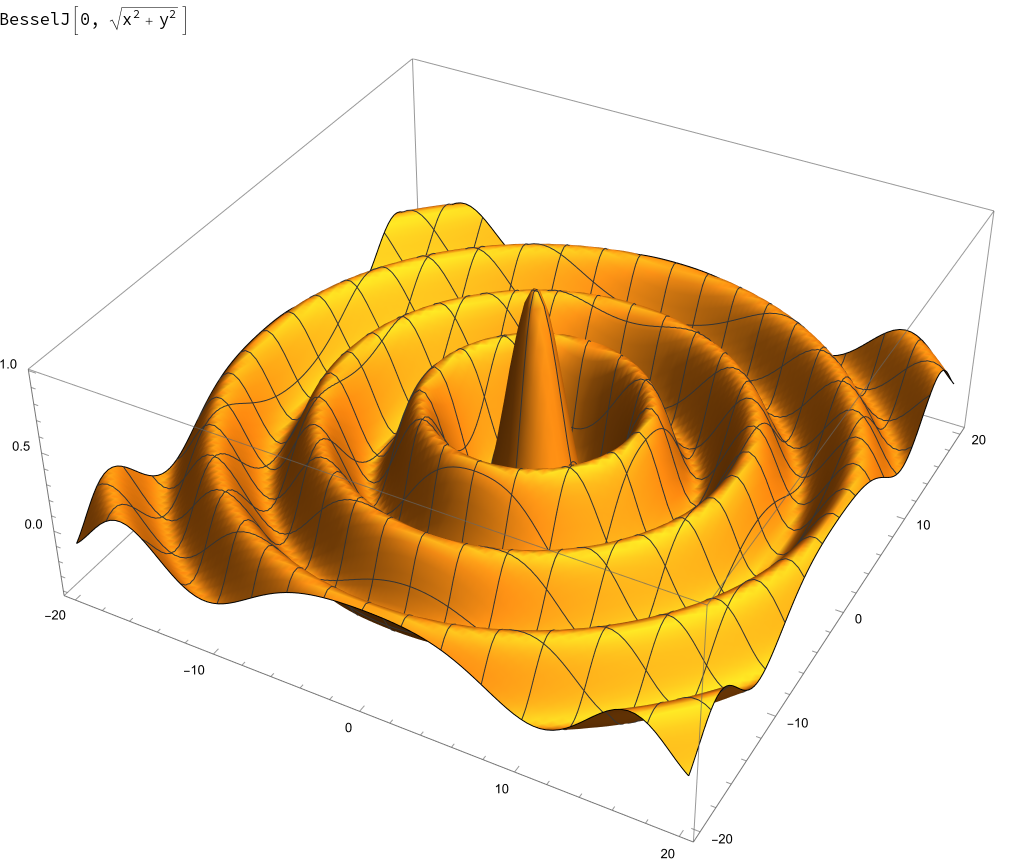
Bessel functions are a class of solutions to partial differential equations with polar (radial) boundary conditions. The most famous example is the radial vibration of a drum surface–drum surface vibrations form standing waves that look like (but not identical to) a radial sinc function (sin(x)/x). The observed periodicity of the Bessel function will Doppler shift depending on the observer’s frame of reference regardless of his relative positioning to the particle, making it a much better solution than plane waves.
Fig. 1 Example of a radial Bessel function. Note the constant oscillation frequency required for Doppler shifting to give rise to the special relativity constant speed postulate.
This is a much cleaner hypothesis than group wave formation of particles. I will go forward with this to see what new insights come from this line of thinking.
EDIT: If a physicist were to read this, I’m pretty sure he/she would say that the hypersurface activation layer concept, where our existence and all interactions are confined to a 3D time slice of 4D spacetime is incompatible with the principles of special relativity. Rest assured that I have considered this objection in depth. Special relativity denies the idea of simultaneous events for all observer frames of reference, among other things, and also proves the interchangeability of space and time in observations for a given frame of reference. This would seem to contradict the idea that we exist in a single 3D time slice activation layer of spacetime. Currently, I don’t think it does, because the observation process (receipt of particles) in different frames of reference is complicated. There will be variations of a given observation in relativistic frames of reference due to things like Doppler shifting and the corresponding shift in detection times of source particles. Observers in different frames of reference have to observe (receive source particles) events at different times, but this outcome does not then imply the existence of multiple active hyperspaces or connections between them. There is no question that this subject deserves my full attention and I will dedicate a post to analyzing this–hopefully objectively!
I have been investigating Emergent Fields, which are fields that have the creation/annihilation concept built in, in order to come up with a way to solve quantum field theory problems analytically. In current research, we do interaction computations by separating particles and virtual particles from the fields they exist in. This forces us to compute perturbative solutions–and thus significantly limits the type of interactions we can realistically compute, both for complexity and convergence reasons. By specifying stable particles as a particular manifestation of wave behavior, emergent fields should not only enable analytic solutions for more complex interactions, but yield new insights into our physical reality. For example, this work shows an elegant basis for elementary particle quantization. If you read through this, I think you will be convinced that our existence requires that all elementary particles have to be quantized.
One such wave proposal I came up with for an emergent field is a 4D vector field that can have spins pointing in both the three physical dimensions as well as the time dimension. This type of field has a number of interesting properties such as giving point particles independent dual spins (for example, one in the X-Y plane and one in the Z-T plane, see https://wordpress.com/post/agemozphysics.com/1839). By constraining this field with the fact that we exist in a 3D hypersurface of 4D spacetime, I found some elegant insights. One of the most beautiful results I see is how it enforces quantization of particles such as photons.
Einstein was able to prove that photon energy had to be quantized for a given wavelength, and from that the entire quantum theory infrastructure (quantum mechanics, quantum electrodynamics, quantum chromodynamics) was built and verified beyond a shadow of doubt. What scientists didn’t discover is why this quantization occurs, and I have found that an emergent field constrained by our 3D hypersurface existence within 4D spacetime gives us a beautiful answer.
As I discussed in these posts (https://wordpress.com/post/agemozphysics.com/1891 and https://wordpress.com/post/agemozphysics.com/1910), we exist in a 3D hypersurface of 4D spacetime I call the activation layer, and there is good reason to believe that other hypersurfaces adjacent to ours cannot exist or interact with the 3D hypersurface activation layer that we live in. This is a common portrayal of particle interactions in Minkowski spacetime:
An incorrect view of an e-/p+ annihilation depicted in 4D spacetime
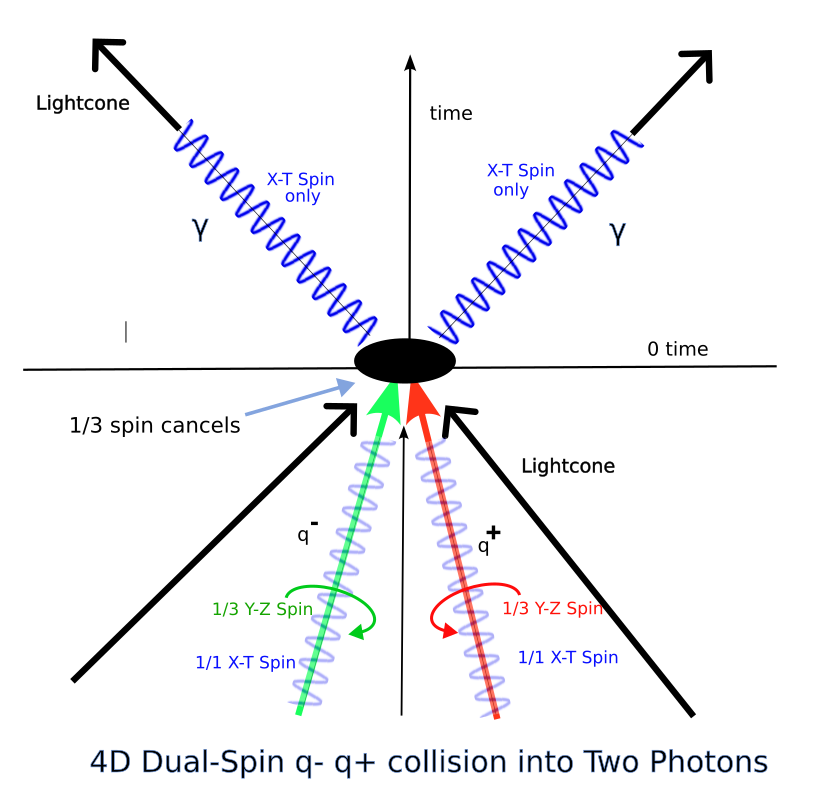
As discussed in this post https://wordpress.com/post/agemozphysics.com/1910, this cannot be correct, the 3D activation layer hypersurface view of the same interaction must actually look like this:
A more accurate view of an e-/p+ annihilation depicted in 4D spacetime
Constraining the emergent field particle view with this activation layer behavior will help define the required formula for the generalized emergent field. As I mentioned in the previous post, I didn’t like one of the specifications of the emergent field example I use–particles are defined as quantized twists such that there is a lowest energy spin state pointing in the time dimension direction. Why is there a lowest energy state for a particular spin rotation, there is no evidence of such a thing? I’m sure any of you that read that post were thinking, no, that can’t be right.
I had a wonderful insight, I realized we don’t need that lowest energy concept. The activation layer does it for us, and is why experimenters in Einstein’s time were finding good experimental evidence for particle quantization.
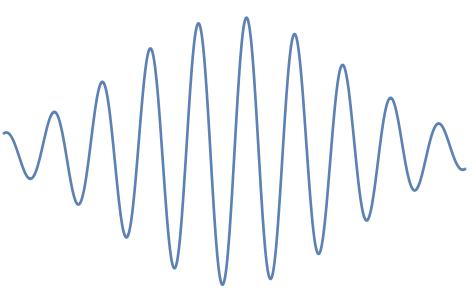
Many research papers have been written that attempted to compute the shape and length of a photon.The underlying basis for quantization and the quantum theories we have comes from extensively verified experimental evidence of particle quantization, and researchers have tried to visualize or mathematically describe what drives this quantization. It’s really dangerous–and usually completely wrong–in quantum physics to try to ascribe classical attributes such as “looks like” to quantum particles. We don’t have an answer why quantization exists, we just know it is there. Here is a typical textbook drawing of a “quantized” photon, shown with a gaussian envelope that fits the uncertainty principle constraint.
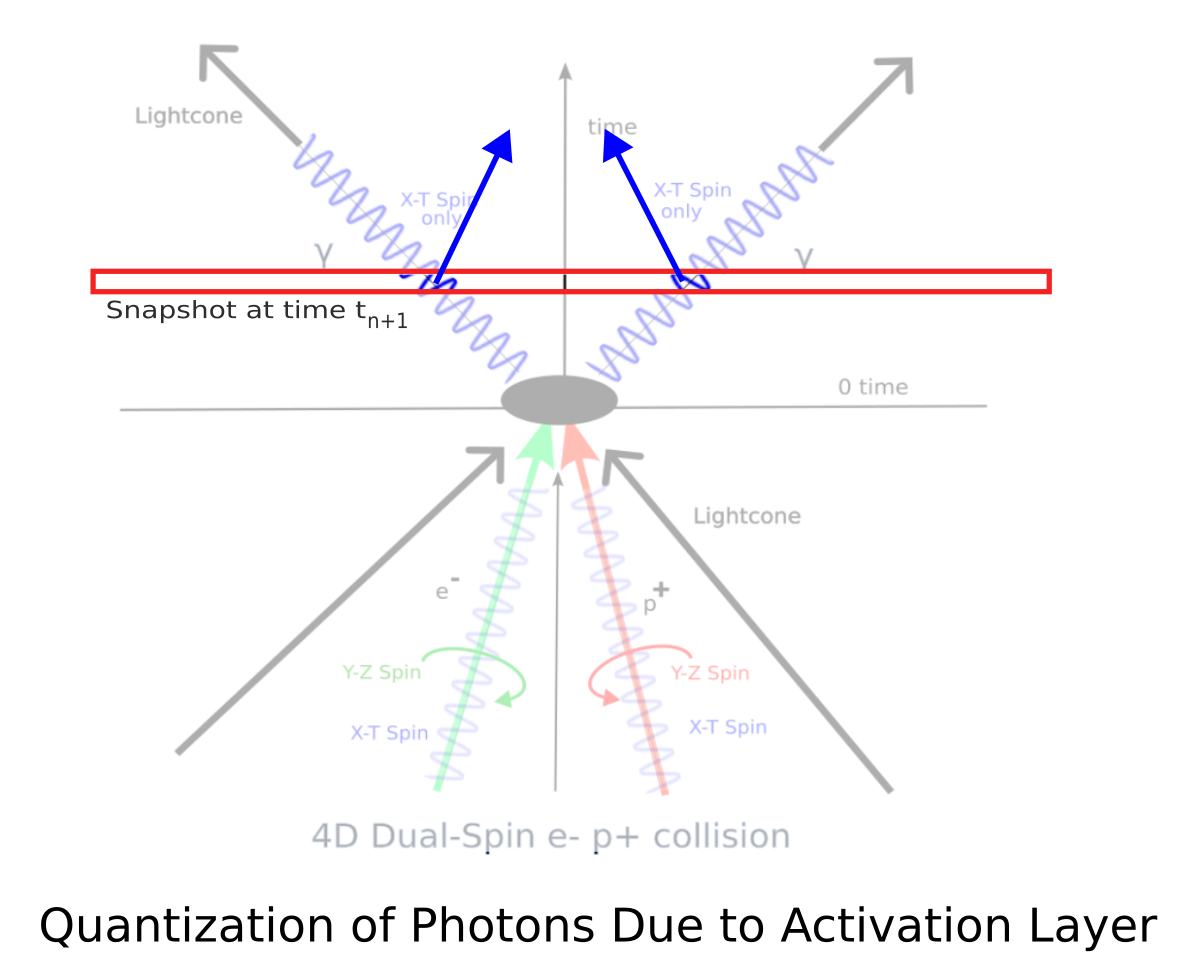
However, my annihilation diagram above gives some great insight on the why this is a bad depiction. Let’s modify the annihilation diagram above by moving our activation layer hypersurface to the photon output of the collision, it will look like this:
That gaussian picture of a photon, or any other similar depiction, has to be wrong! We exist in an activation layer, a 3D hypersurface slice in 4D spacetime–so the photon has to be nothing more than a single vector direction, rotating as time passes and the activation layer hypersurface moves forward. The confining of all particles to our existence in the 3D slice, our activation layer, is what quantizes particles!
You can increase the radiation intensity by adding more nearby rotation vectors, but this still is a quantized step. You might say, well, just increase the magnitude of the vectors, but we know we can’t do that because the photon energy is only a linear function of its frequency, E=hv. There is no magnitude degree of freedom. This isn’t just for photons–every single elementary particle has to be quantized via a single vector within our 3D slice of 4D spacetime. We don’t need the (questionable) lowest energy rotation state idea for quantization or a bogus gaussian packet description, our 3D hypersurface activation layer does the quantization for us!
Agemoz
PS: An exciting corollary is how emergent field quantized vector fields leads to why probability amplitudes add and sometimes subtract (actually, add with negative amplitudes). We’ll cover that in another post!
I did more work with my Schroedinger solver on the various quark charge configurations and ran into a dead-end–this approach does not seem to lead to any valid science.
So, I went back to the study of a 4 spatial dimensional rotation vector field (R4) with a preferred background state that enables twists without discontinuities.
Why add a fourth spatial dimension? For similar reasons that physicists add dimensions to try to make the math work for both general relativity and quantum theory–I claim that having four spatial dimensions plus time has a sufficient number of degrees of freedom to cover the observed states of matter.
Why twists (I use this word to mean a complete vector rotation cycle at a given point)? Because we know that particles such as photons are quantized (E = hv for a quantum of light), and the only way to quantize rotations geometrically is to have a preferred (lowest energy state) rotation direction. A complete rotation defines a real particle–partial rotations are off-shell (that is, temporarily violate energy/momentum conservation) and must return to the background state without completing a rotation.
There is no way in three spatial dimensions (R3) to create a twist without creating a rotation discontinuity, but four dimensions can form continuous field twists. Discontinuities are bad because all kinds of conservation issues (for example, energy potentials) break at the discontinuities. Such discontinuities will have real-world consequences that should be, but never have been, observed.
In addition, quantization requires a background state, a direction that enforces an integer number of rotation twists. In three dimensions, that background state would have to point in some direction that lies in R3, which would violate one of the most important principles of physics–gauge invariance, that is, the premise that all observations are independent of spatial rotation, displacement, and so on. Having the background state rotation point to a fourth dimension. I call it I, imaginary, since a field of that rotation state will have no detectable particles. Any complete or partial rotation away from I into R3 forms a particle–either real or virtual.
Now with that backstory of my research, we finally get to the meat of this post.
For a very long time, I tried to use this R3 + I rotation vector field to model particles. Photons are self evident since linearly propagating quantized twists were the motivator and basis of the theory. Trying to extend this idea to electrons ran into trouble, however. For a long time I believed that the electron set, the four identical variations: spin up e-, spin down e+, spin up p+, and spin down p-, forced the corresponding R3+I models to be dipoles. This runs into conflict with the experimental observation that electrons are point particles. I tried for years to work around this but in the end concluded that a Compton radius dipole cannot represent an electron–it’s too big, and predicting scattering would have to fail to match experimental observation. Whatever model I come up with has to be a point particle model, and for a while I could see no way to get the four electron variations.
I just discovered that there is a point particle solution in R3 + I that gives us four variations. The tricky part that makes this hard is that the solution has to be gauge or frame of reference invariant. You cannot have a frame of reference rotation convert a spin-up electron to a spin-down electron, which is what happens if you reposition yourself about a globe where the South to North pole direction points to a “spin-up” electron–to an upside-down observer, the pole direction then looks like a “spin-down” electron (this is why physics texts emphasize that electron spin is not to be imagined as a classically spinning particle).
In R3, you cannot create a model that gives the four variations, but I discovered that in R3 + I, you can. And better yet, no variation will overlap the photon model, thus giving five independent models. Let’s stop this (long) post here, and I will describe my solution with pictures in my next post.
I took the time to update the sidebar describing a summary of the unitary twist field theory I’ve been working on. I also paid to have those horrid ads removed from my site–seems like they have multiplied at an obnoxious rate on WordPress lately.
One problem with blogs describing research is the linear sequence of posts makes it really hard to unravel the whole picture of what I am doing, so I created this summary (scroll down the right-hand entries past the “About Me” to the Unitary Twist Field Theory) . Obviously it leaves out a huge amount, but should give you a big picture view of this thing and my justification for pursuing it in one easy-to-get place.
The latest: I discovered that the effort to work out the quark interactions in the theory yielded a pretty exact correlation to the observed masses of the electron, up quark and down quark. In this theory, quarks and the strong force mediated by gluons is modeled by twist loops that have one or more linked twist loops going through the center. This twist loop link could be called a pole, and while the twist rotation path is orthogonal to the plane of the twist loop, the twist rotation is parallel and thus will affect the crossproduct momentum that defines the loop curvature. Electrons are a single loop with no poles, and thus cannot link with up or down quarks. Up quarks are posited to have one pole, and down quarks have two. A proton, for example, links two one-pole up quarks to a single two-pole down quark.
The twist loop for an up quark has one pole, a twist loop path going through the center of it. This pole acts with the effect of a central force relation similar (but definitely is not identical to an electromagnetic force) to a charged particle rotating around a fixed charge source–think an atom nucleus with one electron orbiting around it. The resulting normal acceleration results from effectively half the radius of the electron loop model, and thus has four times the rotation frequency and thus 4 times the mass of an electron. The down quark, with two poles, doubles the acceleration yet again, thus giving 8 times the mass of an electron.
It will be no surprise to any of you that this correlates to the known rest masses of the electron, up quark, and down quark: .511MeV, 2.3MeV, and 4.8MeV.
I can hear you screaming to the rafters–enough with the crackpot numerology! All right, I hear you–but I liked seeing this correlation anyway, no matter what you all think!
Happy New Year with hope for peace and prosperity for all!
I now have the sim working for one class of particles, the linear twist. I fixed various problems in the code and now am getting reasonable pictures for both the ring and the linear twist. Something is still not right on the ring, but the linear twist is definitely stable with one class of test parameters. This is an important finding because my previous work seemed to be unable to create a model of a photon (linear twist), so I had focused on the ring case. However, last night (New Year’s Eve, what a great way to start the New Year!) I realized the problem was my assumptions on how to set up the linear twist initial conditions.
Discrete photons are always depicted as a spiral rotation of orthogonal field vectors in a quantized lump. I could not make my sim do this, both ends of the lump would not dissipate correctly no matter how I set up the initial conditions and test parameters–the clump always eventually disappeared. I suddenly realized this picture of a photon is not correct–you have to go to the frame of reference of the photon motion to see what’s really going on. The correct picture in the photon’s frame of reference is not a clump nor a spiral, but simply a column of vectors all in phase from start to finish (emission and absorption). It’s the moving frame of reference at light speed that makes the photon ends appear to start and stop in transit. The sim easily simulates the column case indefinitely. It also should correctly simulate the ring case for the same reason–and in this case since the frame of reference goes around the ring, the spiral nature of the twist becomes apparent in the sim. It should also create an effective momentum (wants to move in a straight line) to counteract the natural tendency to shrink into non-existence, but I don’t have the correct test parameters that that is happening yet.
One thing that should please some of you–all of you? 🙂 The background state so far is not necessary to produce these results! That concept was necessary to produce a quantized lump for the linear photon, but as I noted, that’s not how photons work in their frame of reference. That simplifies the theory–and the sim computation. And, most importantly as I suggested in the previous post, seems to validate the concept of assuming that a precursor rotation (twist) vector field can form particles.
UPDATE: errors in the sim calculations are distorting the expected output–it’s too early to make any conclusions yet. Corrected results coming soon–the CUDA calculations work in 3D blocks over the image, including overlap borders. As you might expect, the 4D computation gets complex when accounting for the overlap elements. I had the blocks overlapping incorrectly, which left holes in the computation that caused the soliton image to be substantially distorted. I still see strong indications that there will be stable solitons in the results, but need to correct a variety of issues in the sim before drawing any conclusions. Stay tuned…
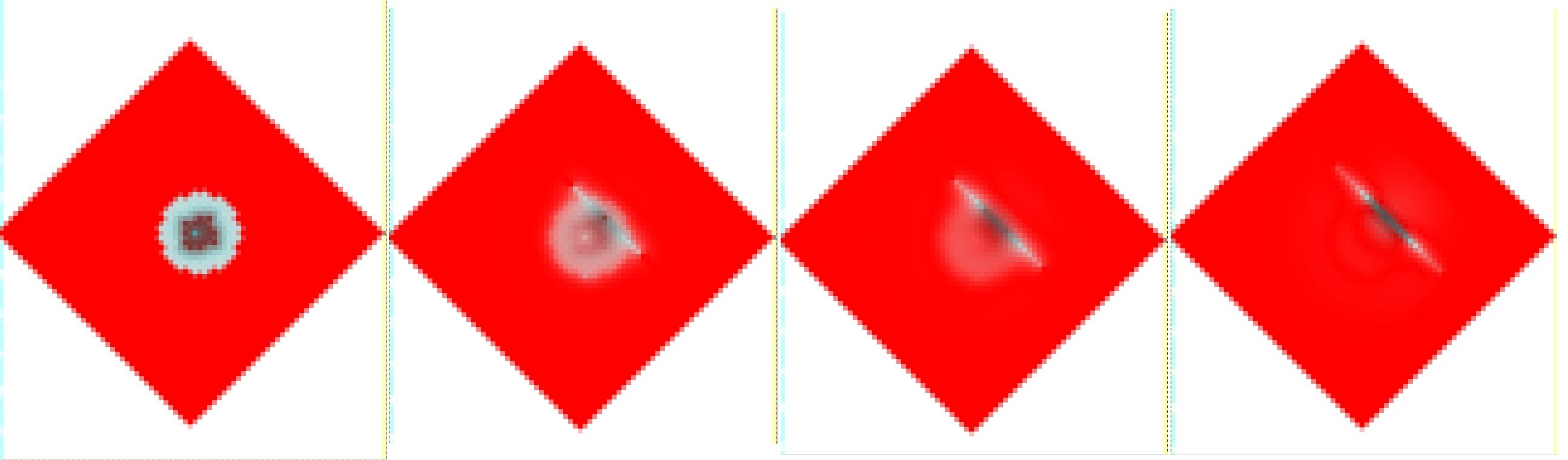
The first results from the Unitary Twist Field Theory are in, and they are showing a three ring circus! Here are the sim output pictures. The exciting news is that the field does produce a stable particle configuration that is very independent of the initial boundary conditions and strength of the background state and the neighborhood connection force–the same particle emerges from a wide variety of startup configurations. Convergence appears visible after about 20 iterations, and remains stable and unchanging after 200000 steps. So–no question that this non-linear field produces stable solitons, thus validating my hypothesis that there ought to be some field that can produce the particle zoo. Will this particular field survive investigation into relativistic behavior, quantum mechanics and produce the diversity of particles we see in the real world? I created this theory based on the E=hv constraint that implies a magnitude-free field and a background state, a rotation vector field that includes the +/-I direction, and many other things discussed in previous posts, so I think this field is a really good guess. However, it wouldn’t surprise me at all that I don’t have this right and that changes to the hypothetical field will be necessary. As usual, as in any new line of research work, it’s quite possible I’m doing something stupid or this is the result of some artifact of how I am doing the simulation–it doesn’t look like it to me, but that’s always something to watch out for. However, here I am seeing good evidence I have validated this line of inquiry–looking for a non-linear precursor field that produces the particles and force-exchange particles of the Standard Model.
It’s very hard to visualize even with the 4D to 2D projected slices I show here. I color coded the +I (background state) dimension as red, -I direction as black, and combined all three real dimensions to blue-green. Note there is no magnitude in a unitary twist field (mathematicians probably would prefer I call this a R3+I rotation unitary vector field), so intensity here simply indicates the angular proximity to the basis vector (Rx, Ry, Rz, or +/-I). For now, you’ll have to imagine these images all stacked on top of each other, but I’ll see if I can get clever with Mathematica to process the output in a 3D plot.
Studying these pictures shows a composite structure of two parallel R3 rings and an orthogonal interlocking -I ring, and something I can’t quite identify, kind of a bridge in the center between the two rings, from these images. These pictures are the 200000 step outputs. You can ignore the image circles cursors in some of the screen capture shots, I should have removed those!
I have been developing and refining CUDA code that runs a simulation of the Unitary Twist Field theory. This theory essentially says that all particles and exchange particles have an underlying “precursor” field. Put another way, I’m positing that U(1) x SU(2) x SU(3) will emerge from a single unitary rotation field in R3 + I. The proposed field is non-linear because it also has a background state rotation vector potential. This quantizes twists in the field, and provides a mechanism for twist propagation to curve, thus enabling closed loop twists. The work on the simulation is designed to allow observation of the behavior of such a field in a variety of boundary condition situations.
This work is very much in its infancy, but has already yielded some very interesting insights. The crucial question I want to answer at this point is whether this field can yield stable closed loop twists. The background state potential is crucial for distinguishing this theory from any that are based on linear equations such as Maxwell’s field equations. The background state concept emerged from the need to quantize field behavior geometrically via unit twists in the field. Conceptualizing the behavior of a rotation space in two or even three dimensions appears to show that it should be possible to create stable solitons, but is this true in four dimensions over time–the R3 of our existence plus the +/- I dimension needed for the background state orientation.
I have been working hard to work out the rules for the R3 + I field, but four dimensions is very hard to visualize and work out a geometry of theorems. The simulation environment is designed to assist with this effort.
The sim work has already exposed some pretty critical understanding of what a twist ring would look like. I had originally envisioned a ring of twisting vectors surrounded by the background rotation state +I. However, it turns out things are a lot more complicated than that. If the twisting vectors are in R3 and not in I (the current hypothesis for the simplest closed loop particle), this cannot be stable unless the center of the ring is pointing to -I. The surprising result was that both the +I and -I are stable states when a +I potential is applied! By itself, the -I state would be metastable but any neighborhood connection would make both +I and -I stable–in 2 dimensions and possibly in 3 dimensions–still thinking through the latter case. But the theory requires 4 dimensions, is the ring stable in that case? My mind cannot swallow the 4 dimensional case, but the sim work showed some fascinating elaboration of the R3 + I case.
The -I center must be surrounded by a shell of real (R3) rotations (see illustration below). There must be a transition from +I to R3 to -I and back again, but in all dimensions of R3. There is only one possible way to create a surface of contiguous R3 vectors. I was able to rule out the normal vectors on the surface, because there appears to be no way to transition contiguously to +I or internally to -I without creating a discontinuity. But a surface of tangental vectors would work, provided that the tangental vectors at the equator of the sphere point in the same circumerential (eg, x-y) direction, gradually pointing up to the normal direction, which would be -I at the center, +/- Z at the poles of the surface, and +I outside of the surface. In essence, this work is showing there is only one possible way to form a ring and it actually is enclosing the -I center with a surface of real vectors. Essentially the ring looks like a complementary pair of vortexes with the ring being the common top of the vortexes. It should be possible to create more complex structures with multiple -I poles, but right now the important question is this: is this construct stable. I’m hoping that the sim will verify if this rotation vector model of the ring dissipates in some way. I can envision that the -I core cannot unwind, that it is locked and stable, but it is really hard to prove that in my mind in four dimensions. The sim should show it, I’ll keep you posted.
In the last post, I showed how the unitary twist field theory enables a schematic method of describing quark combinations, and how it resolved that protons are stable but free neutrons are not. I thought this was fascinating and proceeded to work out solutions for other quark combinations such as the neutral Kaon decay, which you will recognize as the famous particle set that led to the discovery of charge parity violation in the weak force. My hope was to discover the equivalent schematic model for the strange quark, which combined with an up or down quark gives the quark structure for Kaons. That work is underway, but thinking about CP Parity violation made me realize something uniquely important about the Unitary Twist Field Theory approach.
CP Parity violation is a leading contender for an explanation why the universe appears to have vastly more matter than antimatter. Many theories extend the standard model (in the hopes of reconciling quantum effects with gravity). Various multi-dimensional theories and string theory approaches have been proposed, but my understanding of these indicates to me that no direct physical or geometrical explanation for CP Parity violation is built in to any of these theories. I recall one physicist writing that any new theory or extension of the standard model had better have a rock-solid basis for CP Parity violation, why CP symmetry gets broken in our universe, otherwise the theory would be worthless.
The Unitary Twist Field does have CP Parity violation built in to it in a very obvious geometric way. The theory is based on a unitary directional field in R3 with orientations possible also to I that is normal to R3. To achieve geometric quantization, twists in this field have a restoring force to +I. This restoring force ensures that twists in the field either complete integer full rotations and thus are stable in time (partial twists will fall back to the background state I direction and vanish in time).
But this background state I means that this field cannot be symmetric, you cannot have particles or antiparticles that orient to -I!! Only one background state is possible, and this builds in an asymmetry to the theory. As I try to elucidate the strange quark structure from known experimental Kaon decay processes, it immediately struck me that because the I poles set a preferred handedness to the loop combinations, and that -I states are not possible if quantization of particles is to occur–this theory has to have an intrinsic handedness preference. CP Parity violation will fall out of this theory in a very obvious geometric way. If there was ever any hope of convincing a physicist to look at my approach, or actually more important, if there was any hope of truth in the unitary twist field theory, it’s the derivation of quantization of the particle zoo and the explanation for why CP Parity violation happens in quark decay sequences.
If you read my last post on the special relativity connection to this unitary twist field idea, you would be forgiven for thinking I’m still stuck in classical physics thinking, a common complaint for beginning physics students. But the importance of this revelation is more than that because it applies to *any* curve in R3–in particular, it shows that the composite paths of QFT (path integral paradigm) will behave this way as long as they are closed loops, and so will wave functions such as found in Schrodinger’s wave equation. In the latter case, even a electron model as a cloud will geometrically derive the Lorentz transforms. I believe that what this simple discovery does show is that anything that obeys special relativity must be a closed loop, even the supposedly point particle electron. Add in the quantized mass/charge of every single electron, and now you have the closed loop field twists to a background state of the unitary field twist theory that attempts to show how the particle zoo could emerge.
I’ve been working diligently on the details of how the quantizing behavior of a unitary twist vector field would form loops and other topological structures underlying a particle zoo. It has been a long time since I’ve talked about its implications for special relativity and the possibilities for deriving gravity, but it was actually the discovery of how the theory geometrically derives the time and space dilation factor that convinced me to push forward in spite of overwhelming hurdles to convincing others about the unitary twist theory approach.
In fact, I wrote to several physicists and journals because to me the special relativity connection was as close as I could come to a proof that the idea was right. But here I discovered just how hard it is to sway the scientific community, and this became my first lesson in becoming a “real” scientist. Speculative new theories occupy a tiny corner in the practical lives of scientists, I think–the reality is much reading and writing, much step-by-step incremental work, and journals are extremely resistant to accept articles that might cause embarrassment such as the cold-fusion fiasco.
Back in my formative days for physics, sci.physics was the junk physics newsgroup and sci.physics.research was the real deal, a moderated newsgroup where you could ask questions and get a number of high level academic and research scientists to respond. Dr. John Baez of UC Riverside was probably one of the more famous participants–he should be for his book “Gauge Fields, Knots and Gravity”, which is one of the more accessible texts on some of the knowledge and thinking leading to thinking about gravity. But on this newsgroup he was the creator of the Crackpot Index, and this more than anything else corrected my happy over-enthusiasm for new speculative thinking. It should be required reading for anyone considering a path in the sciences such as theoretical physics. Physicists 101, if you will–it will introduce you hard and fast to just how difficult it will be to be notable or make a contribution in this field.
I’m not 100% convinced, as I’ve discussed in previous posts, that there isn’t a place for speculative thinking such as mine, but this is where I discovered that a deep humility and skepticism toward any new thinking is required. You *must* assume that speculation is almost certainly never going to get anywhere with journal reviewers or academic people. Nobody is going to take precious time out of their own schedule to investigate poorly thought-out ideas or even good ideas that don’t meet an extremely high standard.
So, I even presented my idea to Dr. Baez, and being the kind and tolerant man he is, he actually took the time review what I was thinking at that time–has to be 20 years ago now! Of all the work I have done, none has been as conclusive to me as the connection to special relativity–but it did not sway him. I was sure that there had to be something to it, but he only said the nature of special relativity is far reaching and he was not surprised that I found some interesting properties of closed loops in a Lorentzian context–but it didn’t prove anything to him. Oh, you can imagine how discouraged I was! I wrote an article for Physical Review Letters, but they were far nastier, and as you can imagine, that’s when my science education really began.
But I want to now to present the special relativity connection to unitary twist theory. It still feels strongly compelling to me and has, even if the theory is forever confined to the dustbin of bad ideas in history, strongly developed my instinct of what a Lorentzian geometry means to our existence.
The geometry connection of unitary twist field theory to special relativity is simple–any closed loop representation of a particle in a Lorentzian systen (ie, a geometry that observes time dilation according to the Lorentz transforms) will geometrically derive the dilation factor beta sqrt(1 – v^2/c^2). All you have to do to make this work is to assume that the loop represention of a particle consists of a twist that is propagating around the loop at speed c, and the “clock” of this particle is regulated by the time it takes to go around the loop. While this generalizes to any topological closed system of loops, knots, and links (you can see why Dr. Baez’s book interested me), let’s just examine the simple ring case. A stationary observer looking at this particle moving at some speed v will not see a ring, but rather a spiral path such that the length of a complete cycle of the spiral will unroll to a right triangle. The hypotenuse of the triangle by the Pythagorean theorem will be proportionate to the square root of v^2 + c^2, and a little simple math will show that the time to complete the cycle will dilate by the beta value defined above.
When I suddenly realized that this would *also* be true in the frame of reference of the particle observing the particles of the original observer, a light came on and I began to work out a bunch of other special relativity connections to the geometry of the unitary twist theory. I was able to prove that the dilation was the same regardless of the spatial orientation of the ring, and that it didn’t matter the shape or topology of the ring. I saw why linear twists (photons) would act differently and that rest mass would emerge from closed loops but not from linear twists. I went even as far as deriving why there has to be a speed of light limit in loops, and was able to derive the Heisenberg uncertainty for location and momentum. I even saw a way that the loop geometry would express a gravitational effect due to acceleration effects on the loop–there will be a slight resistance due to loop deformation as it is accelerated that should translate to inertia.
You can imagine my thinking that I had found a lodestone, a rich vein of ideas of how things might work! But as I tried to share my excitement, I very quickly learned what a dirty word speculation is. Eventually, I gave up trying to win a Nobel (don’t we all eventually do that, and perhaps that’s really the point when we grow up!). Now I just chug away, and if it gives somebody else some good ideas, then science has been done. That’s good enough for me now.
I'm an amateur physicist. I've studied physics and philosophy for a very long time, and have investigated some of the unanswered questions in physics with an intent of finding some possible explanations or theories on how they might work. Two of the most interesting questions for me are whether there is a geometrical basis for quantization and special relativity, and why there is a particle zoo (that is, is there an underlying structure that results in the particle zoo). I'm well aware of the danger of crackpot theories (usually characterized by just enough knowledge to get things wrong or silly), but allow myself to pursue ideas anyway as long as I'm clear about their speculative nature. I don't pretend that I have any significant discoveries to report, but thoroughly enjoy pursuing various ideas about how the universe works. To faciliate this study, I've created a lattice simulator that allows me to test a variety of ideas.
Archives
Unitary Twist Field Theory
A long description and justification for the thinking that has led to the Unitary Twist Field Theory. Note, IANAP (I am not a Physicist). This is long and describes the historical evolution of the Unitary Rotation Vector Field. The latest work has changed several parts, I am in the process of updating this.
Summary: A unitary rotation vector field is investigated as an underlying field that gives rise to the particles and fields of the Standard Model. The underlying field is single-valued, waves cannot pass through other waves. This is the means by which quantum interference redirects particle paths. The simulation work has revealed a new principle:
Quantum interference is responsible for redirecting particles along wave interference peaks–and also for creating those particles.
Long description: This effort to work out the details of this unitary twist field is based on the underlying assumption that our existence can emerge from nothing, and posits a reductionist approach to explaining the particle zoo. The theory basically says that there is a continuous rotation field in R3 + I that can produce stable solitons. Here is a list of the steps I have taken to arrive at this theory:
a: If existence does not require an intellect to form, the existence must arise from nothing, both space and time.
b: If existence does require an intellect (e.g, God) then further investigation isn’t really necessary because the rules for existence are set in a place we do not have access to.
c: One way to determine if the creating intellect exists would be to determine if the existence could not come into being without at least two rules, and such rules would have to come into existence from a creator. Saying that existence formed with one and only one rule is equivalent to saying that existence could arise from nothing and God is not required.
d: Finding God seems to be pretty much unanswerable without clear direct communication from God, whereas coming up with a way that existence could form from nothing seems to be an alternative possible approach for a human mind to answer the question about the existence of God.
e: Such an approach could start with the limits of current human knowledge, the known existence of the particle zoo. If a reductionist approach could be taken as to why the particles exist, we may be a step closer to saying that an intellect is not needed to create this existence. Conversely, if we can show with reasonable probability that it’s impossible to form particles from some continuous field, that’s an argument in favor of the necessity of an intellect in creating our existence.
f: I am assuming that a continuous field that can create stable particles is a reductionary step–that is, a step in the direction of finding a single rule defining this existence.
g: Now I start applying known physics to this field to determine what it must look like. I am assuming that this field is opaque, that is, there aren’t any parallel overlapping fields. This is clear because multiple rules are necessary to form two fields.
h: I assume that this field has elements that can only rotate. No displacement or magnitude can be applied to any field element. This assumption comes from the E = hv relation for particles, which basically says that particles are described only by frequency, there is no field degree of freedom equivalent to field magnitude.
i: when objects move, the field elements pass rotations via three types of momentum to adjacent elements. In this theory, no field element ever “moves”, instead particles move because field rotations pass as momentum from one field element to the next.
j: In order for E = hv to work, there has to be a means of ensuring that no partial or multiple count of rotations can exist. This is a form of field quantization, and I have proposed a background lowest energy state. In such a system, field rotations called twists start and stop at the background state rotation angle.
k: To ensure that R3 does not have an observable resonance (which would be experimentally discernable) that would undermine gauge theory symmetries, this background states points to an imaginary dimension. It is not possible to have the background state point to a basis vector in R3.
l: If the field has a crossproduct momentum transfer as well as the more standard linear translation of angular momentum of field rotation elements, this becomes a necessary and sufficient condition for forming stable linear particles of arbitrary frequency. UPDATE: simulation work shows that quantum interference is responsible for particle formation.
m: the crossproduct rule for momentum displacement allow a particle to start a single twist, and allows the particle to end the twist after one full rotation.
n: The crossproduct rule also allows the formation of twists that move along a curve. This is possible due to the vector combination of the crossproduct that is normal to the current element rotation orientation and speed. UPDATE: simulation work shows that quantum interference is responsible for path curvature.
o: If twists can curve, there are some twists that will form stable closed loops. There are many possible stable curve solutions, which I am proposing is the basis for the particle zoo.
p: A single free linear twist models a photon of some energy and length defined by the frequency of twist rotation.
q: Since the twist moves from +I background state to an R3 direction and continuing to rotate through to the +I direction, polarization of this twist arises as a linear combination of the two R3 vectors normal to the direction of twist travel. UPDATE: new simulation data suggests that quantum interference and momentum provide a basis for polarization, this will be revised.
r: The crossproduct momentum translation is necessary to allow a twist to start and to stop, otherwise field symmetry would propagate in both directions simultaneously at every point in the twist, and stable particles could not form (they would dissipate). In other words, the quantization of the field is ensured with the background state, and the ability to start and stop a twist arises from the crossproduct momentum translation. Thus it can be stated that to form stable particles from a field, it is necessary that a field capable of forming stable particles must have a handedness that can only come from a crossproduct momentum property. UPDATE: simulation results show this and following sections needs to be revised.
s: This handedness thus must be ingrained in any field solution that produces stable particles. This handedness of the field will show up in some cases as a chirality violation.
t: In order for the twist propagation to be stable, the only possible momentum transfer via crossproduct relation is at the speed of light, where the leading and trailing edge of the twist cannot be affected or connected to neighboring element rotations.
u: Any closed loop rotation sequence thus will be limited to the speed of light. If one were to unravel the cylindrical spiral path this loop takes in Minkowski space, a single quantized twist will form a right triangle where the hypotenuse is the speed of light times the time of one rotation of the twist, one side is the particle travel distance, and the other side of the triangle is the radius of the loop. This right triangle enforces a relation between the loop travel speed and the speed of light. This relation computes to the beta factor of special relativity and is the means by which special relativity geometrically arises from the twist theory.
v: A corollary to u: above is that time dilation for every particle results from the constrained stretching of the spiral helix in Minkowski space as the particle increases speed proportionate to the speed of light. In other words, each particle’s relativistic clock is implied by the time to complete a single twist. Observing from different frames of reference will alter the apparent time to complete a twist and thus affect the relative passage of time between particle and observer.
w: A single closed loop models the electron of one type of spin. The twist direction relative to direction of travel defines a spin-up or spin-down electron, whereas the loop curvature relative to the handedness of the field defines the particle vs the antiparticle version of the electron. Note that a linear twist does not have these degrees of freedom, so there is no antiparticle to the linear twist photon.
x: Quarks are posited to be linked twist loops, the up quarks have a single link going through its center and the down quark has two. The strong force results when linked twist loops are pulled apart such that twist momentums approach each other with an asymptotic direction conflict. The passage of a twist through the center of a loop affects the rotation of the loop by increasing the crossproduct momentum of the loop. Note that since electrons are modeled by a loop with no central twist going through it, electrons (and positrons) cannot combine with quarks.
z: This modeling of quarks seems to correlate to the masses of the up and down quarks–the twist going through the center of a up quark loop acts with a central force that causes the loop radius to reduce by half. The doubling of the resultant normal (to direction of twist travel) acceleration results in a loop that is 1/4 the size of the electron loop model. Similarly, a down quark has two twists going through its center, doubling again the normal acceleration of twist travel and causing that loop to be 1/8 in size. The rest masses of the electron, up quark and down quark correlate to this geometric analysis of particle loops. Electrons have a .511MeV mass, up quarks are 2.3MeV, and down quarks are 4.8MeV. Admittedly this may all be numerology, but I was surprised to find this mass correlation to loop length.
y: A possible model for the weak force results because there is a small chance for linked twist loops to tunnel through each other. If the rotation of one twist loop matches the rotation of a linked loop right at the point where linked loops are being pulled apart, the loops can separate. This is proposed as particle decay and would model the randomizing effect of the weak force.
Glossary
3D + T: the three spatial and 1 time-wise dimensions of our existence. Equations usually are set up for solutions in this space.
Causal: Causality: The property where a particle or field changes according to special relativity, that is, changes cannot propagate faster than the speed of light.
Dirac Equation: Relativistic equations using operators that effectively describes electron behavior in an atom and relativistic interactions of particles
Electron, Positron: charged fundamental quantum particles with spin (no known substructure with a fixed rest mass)
EM: EM Field: Electromagnetic Field.
Entangled Particles: A property of a system of particles where resolving a state of one of the particles instantly (non-causally) affects the remaining particles
Frame of Reference: Used in Special Relativity, refers to the observer's position relative to a system being observed. Special Relativity describes how a system (for example, a set of particles) will appear to the observer that is dependent on how fast and in what direction the observer is moving in relation to the system.
General Relativity: Einstein's theory describing the stress-energy tensor, which details the equivalence of acceleration and gravity and describes how dimensions distort and forces apply when objects are accelerated, especially as speeds approach the speed of light. For example, it describes how a particle's mass increases as it is accelerated.
Interference: Quantum interference: The property at small (quantum) scale where the probability of a particle state or location varies according to wave superposition, the trait of waves interfering with each other
Lorentz Transform: equations that describe how dimensions of time and space distort in different frames of reference (special relativity)
QFT: Quantum Field Theory: theory of how fields, such as the electromagnetic field, are quantized.
Quantum, Quanta: property where fields or particles have a property that can only have a particular value from a set (the set of real or complex numbers, for example)
Quantum Mechanics: the equations that describe the wave-like behavior of particles in various systems, such as a particle in a box.
Photon: quantum of light. Only one possible value of energy, depending on frequency.
Planck's Constant: The lower bound for simultaneous measurement of two orthogonal properties such as a particle's position and momentum.
Relativistic: Usually refers to particles or interactions of particles with velocities that approach the speed of light
Rest mass: Since any particle with mass will have that mass increase as it is accelerated, rest mass is defined as an intrinsic property of a particle that is not moving
Schroedinger Equation: Wave Equation: second order differential equation that describes the probability distribution of (for example) an electron around an atom
Special Relativity: Einstein's theory that describes how dimensions (space and time) interconnect and vary according to an observer's frame of reference. It specifies causality of all particles or field components, and that the speed of light is the same constant in every frame of reference.
Twist: Field Twist: Author's idea of how photons and electrons (twist rings) substructure could be described
Uncertainty relation: Heisenberg uncertainty principle: the lower bound (planck's constant) for resolving two orthogonal properties of a system.
Unitary: in transforms, the property that preserves magnitude (such transforms can cause rotation or displacement, but cannot change the size or shape of objects). In vector spaces (such as fields), unitarity implies that all vectors have a constant magnitude, only direction varies.






 Agemoz's Physics Blog