Posts Tagged ‘quantum electrodynamics’

Proposing a New Mathematical Tool for Quantum Field Theories

September 2, 2024

Quantum Electrodynamics and Quantum Chromodynamics invoke perturbative methods to evaluate LaGrangian motion calculations. I have a vision that a new mathematical object, a field with emergent behavior built in, would, at minimum, substantially enhance the range and generality of the computations we can do in these subjects, and additionally make new theoretical predictions possible.

When I was young, I explored the Taylor series and was completely captivated by its ability to approximate transcendental functions such as trigonometric, logarithmic, and exponential functions and reveal some of the properties of these transcendental functions. That memory has stuck with me and has awakened anew while studying quantum electrodynamics and quantum chromodynamics, and I wondered what analytic function is hiding behind the perturbative computations we now do in both fields with extraordinary complexity and accuracy. I have no doubt I am far from the first to ask this question, but this has led me to realize something important about our current mathematical knowledge of fields.

Sometimes some of the best breakthroughs in a subject have their basis in the discovery of new tools that aid in analysis, detection, or construction. Our ability to mathematically manipulate fields of all types, scalar, vector, spin, frequency domain, and momentum space has ascended to dizzying heights. Fields can be mathematically constrained to special relativity and even equations of motion on curved manifolds is now routine. We can even do accurate computations when all we have are fields of probability distributions.

What we don’t appear to have is a type of field that has the creation/annihilation operators built in, and it reminds me so much of the thought processes I went through in my exploration of the Taylor series so many years ago. Since then I have learned that most series do not have an analytic representation, and many properties cannot be determined from the series representation–so it is not given that there exists an analytic solution to the summing of Feynman paths we now do for quantum field theories. Nevertheless, I have spent some time thinking how we might come up with an object called an emergent field, and what kinds of mathematical methods could be derived for it.

The first step in constructing a new mathematical tool has to begin simple just to see if something sticks. Like the list of integrals with analytic solutions, we may end up with a very small list compared to the overall infinite number of integrable functions. So, I started with a couple of principles that should limit the complexity of an emergent field type. There is no reason why we have to start in 4D spacetime, we can develop principles from a 2D space or even a 1D space with a 2D spin rotation, and see if a LaGrangian equation of motion can be computed that intrinsically has the creation and annihilation operators built in. Since an emergent particle can appear randomly at any time and place, I am proposing we work in a probability space with wave functions rather than physical representations. Another important principle is that the field must consist entirely of waves, and that any localized particle that forms in this field must decompose into a group wave. I did a lot of work a bunch of years ago that showed that such a system will always obey special relativity (see this paper: https://agemozphysics.com/wp-content/uploads/2020/12/group_wave_constant_speed.pdf). It uses a Green’s function type of derivation to show that any classical system of group waves will obey the constant speed property of special relativity.

There are other constraints that could be added–for example, you can quantize particles into stable solitons if you do something like the dual-spin particles I have spent a lot of time with (see https://wordpress.com/post/agemozphysics.com/1820 and https://wordpress.com/post/agemozphysics.com/1839). It turns out this, or something like this, is required if you want to successfully create an emergent field object.

How is this new field object going to be different than what we now do in existing quantum field theories? First and foremost, we can’t think in terms of sums of virtual particle contributions or we will be right back where we started with perturbative theory. It has become clear that the field is going to have to have a more general representation of both particles and virtual particles, and thus this field object cannot have particles in it (I already know that from the constant speed research I mentioned above). The particle definition we get in quantum field theories has to come from the field itself. I believe one good candidate is a spin rotation with a lowest energy background state (pointing in the time direction, to use the 4D dual-spin particle as an example). Here we can represent real particles as a complete quantized rotation, but virtual particles would be partial rotations that fall back due to not having sufficient rotation energy to complete the twist past the background state. All we need now is a mathematical description of the probabilities that such spins, either virtual or real, will emerge. I think you can see where I am going with this, and I’ll share more of my thought process and analysis in upcoming posts.

It is my vision that someday soon some really brilliant mathematician is going to come along and finally create an emergent field object, and he or she will develop a full set of rules how this object behaves. I’m obviously not that mathematician, but I do clearly see that future coming…

Agemoz
Unitary Rotation Vector Field Mimics Electron-Photon Interaction

May 20, 2020

I set up a quantum interference unitary rotation vector field sim with a very basic idealized representation of a two pole “electron” and a much lower frequency one pole “photon” along the z-axis, and here is what I found:

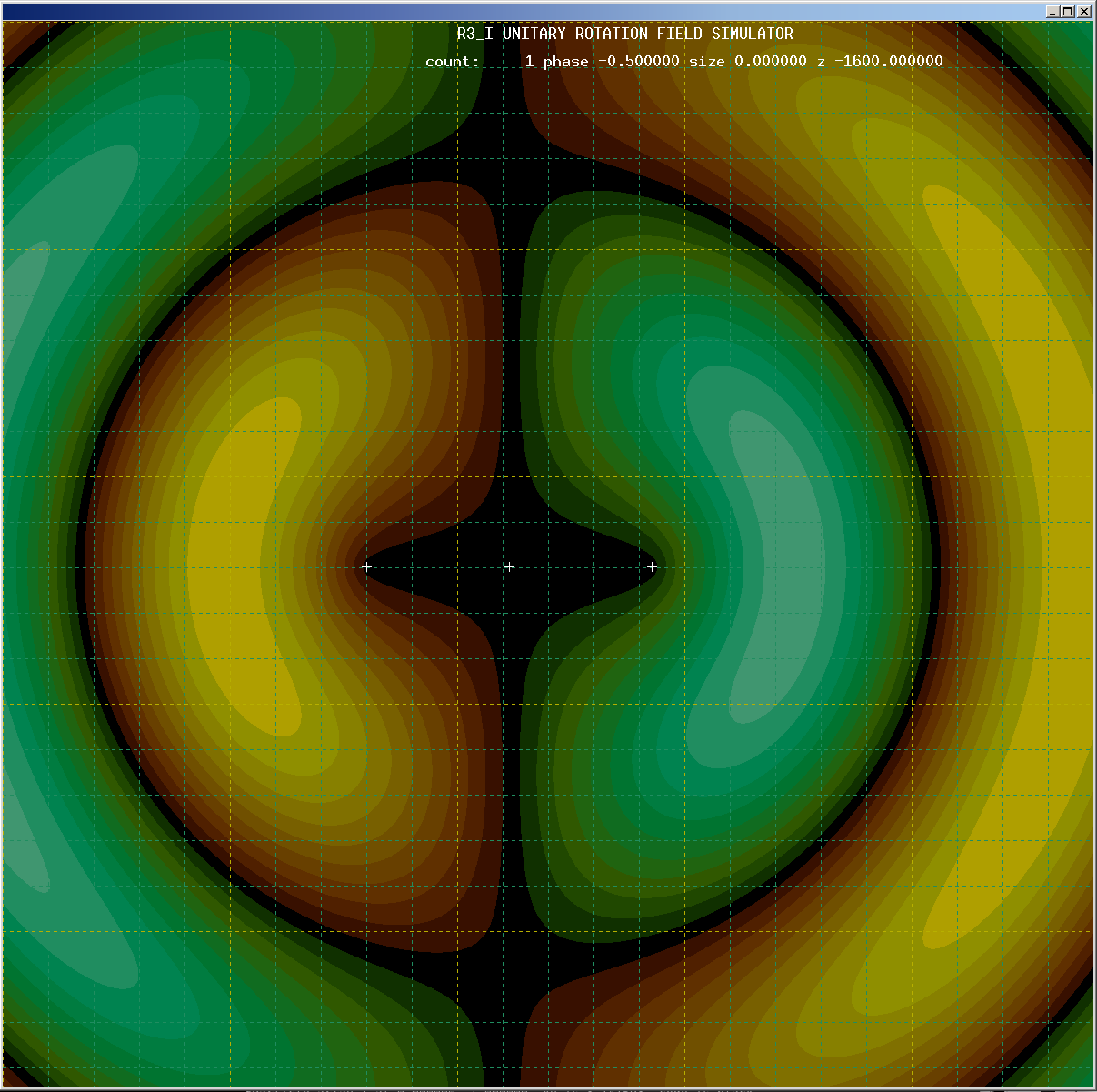
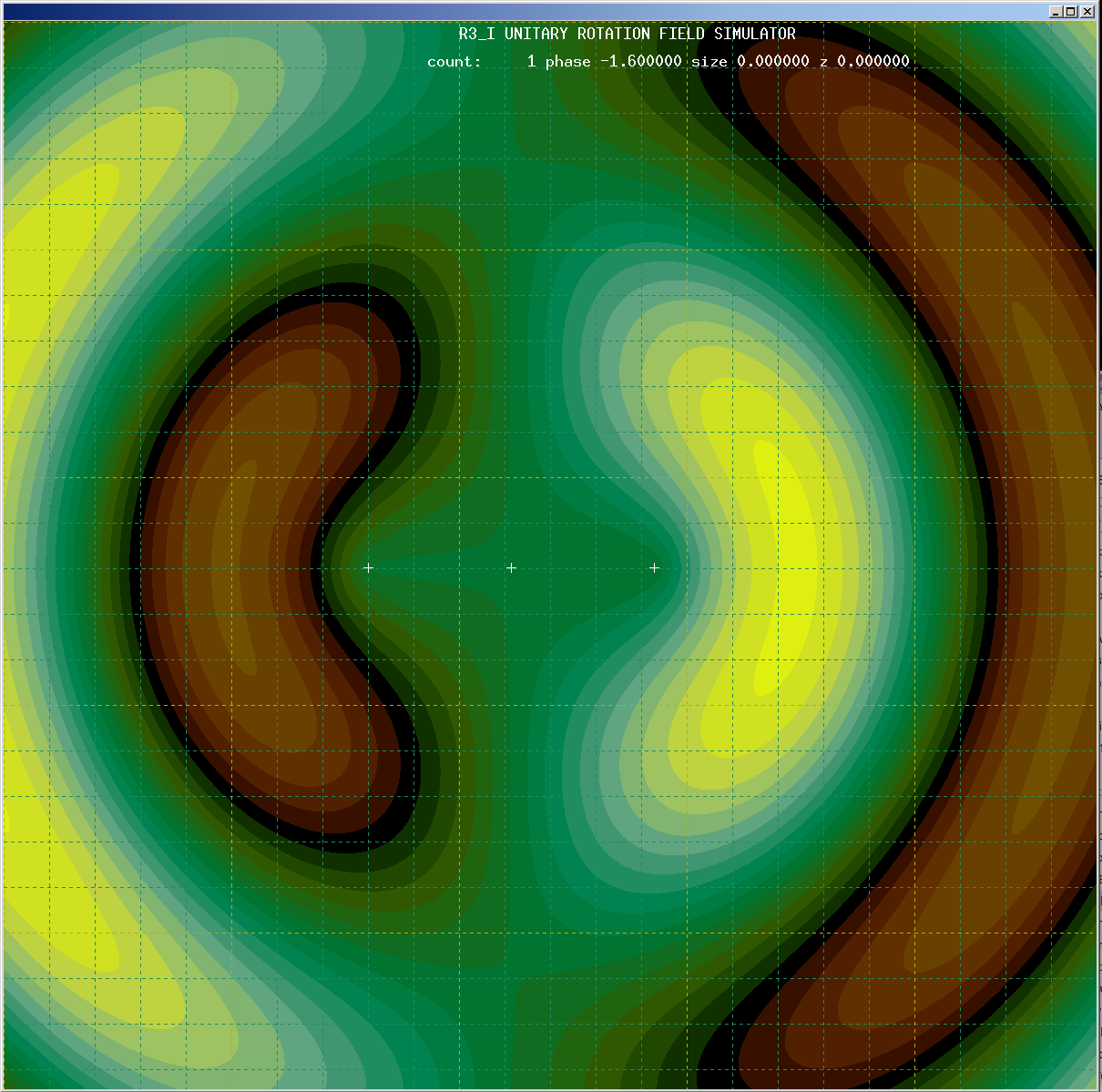
a: The “photon” wave (photon meaning the sim model of a photon in this post) makes the two pole electron unstable at the z = 0 axis position. Instead, the stability region moves along the z-axis depending on the phase of the photon pole. As a result, the quantum interference pattern from all three poles appears to force the electron to translationally move along the axis of the photon z displacement, which matches the expected electron-photon interaction behavior.

b: Depending on the phase of the incoming one-pole photon, I found that the stability region for the two-pole electron can either be below (away from) OR above (toward the photon). Could we at last have an explanation for why electrostatic fields emitted from a source can either repel or attract?

There is a momentum paradox in electrodynamics–if photons have momentum toward an electron, how can momentum be conserved if the electron ends up (due to charge attraction) with momentum in the opposite direction (toward the photon)? Quantum field theory computes that the field itself absorbs the momentum difference (and yes, mathematically that works) but intuitively I rebel at that analysis. The unitary rotation vector field appears to be providing a very elegant solution–quantum interference directs where the electron stability region has to go via wave interference, and in some phase cases it exists toward the photon rather than away from it.

c: It doesn’t matter where you put the photon. I get the same results regardless of the photon offset in the x-y plane (although as mentioned, the z offset causes the electron stability region to move along the z axis).

d: It doesn’t matter what frequency is used for the photon, although the stability region displacement above or below the electron initial position will vary linearly as 1/photon frequency. Higher frequencies cause the photon phase change and hence the change in z displacement to occur at a faster rate, lending credence to the idea that higher momentum photons will induce a larger momentum change in the electron.

e: The only thing the sim seems to get wrong is the absorption of the photon, which should disappear after encountering the two-pole electron. This will require more investigation.

So, in summary, at least on this first pass of testing, the hypothesis that quantum interference in a unitary rotation vector field is responsible for particle formation and particle interactions appears to behave correctly for the electron/photon interaction test.

That by no means is saying that my hypothesized unitary rotation vector field represents reality (if a real physicist were reading about my efforts, he/she probably would wish my efforts would die in a fire if I said something like that) but it looks pretty promising right now. In time and with more work, who knows where this will go–but the real test will be for some qualified researcher to confirm what I am seeing. Until that happens, you should assume that this is unreviewed work (by one author, the kiss-of-death for a research paper) and take it with a bucket of salt…

Agemoz

Here is a picture with the photon in the center, and the z plane is at zero (note this picture cannot be stable, the outside crosses are not in zero delta phase regions)

twopole_z_1_6_phase_unstable

Looking at the same image, the region of stability has relocated closer to the photon (representing electrostatic attraction).

twopole_z_1_6_phase_stable

The region of stability displacement linearly varies as the phase shift induced by the photon, notice the region for a smaller phase shift has not relocated as far from the original electron position:

twopole_z_0_4_phase_stable

Fine Structure Constant Hunting

May 1, 2012

Built into current QED (quantum electrodynamics) is the QFT process of pertubative accumulation of virtual photons.  Each possible virtual photon term is assigned a unitless  probability (actually,  probability amplitude capable of interfering with other terms)  of occurrence called the fine structure constant.   Searching for the reason for the value of this constant is a legendary pursuit for physicists, Feynman made the famous comment about it:

It’s one of the greatest damn mysteries of physics: a magic number that comes to us with no understanding by man.

All kinds of research, study, and guesses have gone into trying to figure out why this number is what it is, and I can guarantee you this is a fruitless pursuit.  Think about it, there have been maybe millions of physicists over the last 100 years, the vast majority with IQs well north of 150, all putting varying amounts of effort into trying to figure out where this number comes from.  If none of them have come up with the answer yet, which they haven’t, the odds of you or I stumbling across it is certifiably close to zero.  That is an effort that I consider a waste of time. For one thing, this is a no-numerology physics blog.

One bad trait of many amateur physicists is to theorize answers by mixing up various constants such as pi, e, square roots, etc, etc and miraculously come up with numbers that explain everything.  Note, no knowledge required of the underlying science–just mix up numbers until something miraculous happens, you get a match to an actual observed physical constant (well, so close, anyway, and future work will explain the discrepancy.  Yeah… riiiight).  Then you go out and proselytize your Nobel prize winning theory, to the annoyance of everyone that sees what you did.  This is also called Easter egg hunting, and really is a waste of time.  Don’t do that.  Hopefully you will never ever see me do that.

Nevertheless, physicists are desperate for reasons why the fine structure constant is what it is, and all kinds of thought, analysis, and yes, numerology, have already gone into trying to find where it comes from.  Why do I insert a post about it in the midst of my step by step procedure of working out the role of unitary twist field theory in the electron-photon interaction?  Because, as I mentioned, the fine structure constant is fundamental to mathematically iterating terms in the QFT solution to this particular QED problem.  It stands to reason that an underlying theory would have a lot to say about why the fine structure constant is what it is.

Unfortunately, it’s clear to me that it’s not going to be that simple.  Pertubative QFT is exactly analogous to the term factors in a Taylor series.  You can create amazing functions from a polynomial with the right coefficients–I remember when I was much younger being totally amazed that you could create trigonometric functions from a simple sum of factors.  Just looking at the coefficients really tells you very little about what function is going to result, and that is exactly true in pertubative QFT.  The fine structure constant is your coefficient multiplier, but what we don’t have is the actual analytic function.  The fine structure constant has a large number of ways to appear in interaction computation, but the direct connection to real physics is really somewhat abstract.  For example, suppose I could geometrically explain the ratio of the charge potential energy between two electrons separated by distance d with the energy of a photon who’s energy is defined by that same distance d, which is defined as the fine structure constant value.  But I can’t.  The fact that it takes 137 of these photons (or equivalantly a photon with 1/137 the distance) to hold together two electrons to the same distance is not physically or geometrically interesting, it is a numerology thing.  Pursuing geometric reasons for the 137 is a lost cause, because the fine structure constant is a coefficient multiplier, an artifact of pertubative construction.

Nevertheless, I do see a way that the fine structure constant might be derived from the unitary twist field theory.  Don’t hold your breath–obviously a low IQ type like me isn’t likely to come up with any real discovery here.  Even so, I should follow through.  Here’s the deal.  Take that picture in the previous post, the second “Figure 2” that shows the effect of bending the imaginary vector.  I need to go back and edit that diagram, the circle ring is the twist ring electron, and fix that to be fig 3.  Anyway, the force on that electron ring is going to be determined by one of two things–the amount of the bend or the difference delta of the bend on one side of the ring versus the other.  The bend will gradually straighten out the further you get from a remote charge.   This computation will give the motion and hence the inertia of any self-contained twist (only the linear twist, the photon, will experience no net force from an imaginary bend).  This will be a difficult computation to do directly–but remember we must have gauge invariance, which leads to my discovery that a ring with an imaginary bend must have a frame of reference with no bend.  Find this frame of reference, and you’ve found the motion of the electron ring in the first frame of reference–a much easier computation to do.  This is real analysis and logical thinking, I think–not Easter egg hunting.

Agemoz