Posts Tagged ‘quantum field theory’

Proposing a New Mathematical Tool for Quantum Field Theories

September 2, 2024

Quantum Electrodynamics and Quantum Chromodynamics invoke perturbative methods to evaluate LaGrangian motion calculations. I have a vision that a new mathematical object, a field with emergent behavior built in, would, at minimum, substantially enhance the range and generality of the computations we can do in these subjects, and additionally make new theoretical predictions possible.

When I was young, I explored the Taylor series and was completely captivated by its ability to approximate transcendental functions such as trigonometric, logarithmic, and exponential functions and reveal some of the properties of these transcendental functions. That memory has stuck with me and has awakened anew while studying quantum electrodynamics and quantum chromodynamics, and I wondered what analytic function is hiding behind the perturbative computations we now do in both fields with extraordinary complexity and accuracy. I have no doubt I am far from the first to ask this question, but this has led me to realize something important about our current mathematical knowledge of fields.

Sometimes some of the best breakthroughs in a subject have their basis in the discovery of new tools that aid in analysis, detection, or construction. Our ability to mathematically manipulate fields of all types, scalar, vector, spin, frequency domain, and momentum space has ascended to dizzying heights. Fields can be mathematically constrained to special relativity and even equations of motion on curved manifolds is now routine. We can even do accurate computations when all we have are fields of probability distributions.

What we don’t appear to have is a type of field that has the creation/annihilation operators built in, and it reminds me so much of the thought processes I went through in my exploration of the Taylor series so many years ago. Since then I have learned that most series do not have an analytic representation, and many properties cannot be determined from the series representation–so it is not given that there exists an analytic solution to the summing of Feynman paths we now do for quantum field theories. Nevertheless, I have spent some time thinking how we might come up with an object called an emergent field, and what kinds of mathematical methods could be derived for it.

The first step in constructing a new mathematical tool has to begin simple just to see if something sticks. Like the list of integrals with analytic solutions, we may end up with a very small list compared to the overall infinite number of integrable functions. So, I started with a couple of principles that should limit the complexity of an emergent field type. There is no reason why we have to start in 4D spacetime, we can develop principles from a 2D space or even a 1D space with a 2D spin rotation, and see if a LaGrangian equation of motion can be computed that intrinsically has the creation and annihilation operators built in. Since an emergent particle can appear randomly at any time and place, I am proposing we work in a probability space with wave functions rather than physical representations. Another important principle is that the field must consist entirely of waves, and that any localized particle that forms in this field must decompose into a group wave. I did a lot of work a bunch of years ago that showed that such a system will always obey special relativity (see this paper: https://agemozphysics.com/wp-content/uploads/2020/12/group_wave_constant_speed.pdf). It uses a Green’s function type of derivation to show that any classical system of group waves will obey the constant speed property of special relativity.

There are other constraints that could be added–for example, you can quantize particles into stable solitons if you do something like the dual-spin particles I have spent a lot of time with (see https://wordpress.com/post/agemozphysics.com/1820 and https://wordpress.com/post/agemozphysics.com/1839). It turns out this, or something like this, is required if you want to successfully create an emergent field object.

How is this new field object going to be different than what we now do in existing quantum field theories? First and foremost, we can’t think in terms of sums of virtual particle contributions or we will be right back where we started with perturbative theory. It has become clear that the field is going to have to have a more general representation of both particles and virtual particles, and thus this field object cannot have particles in it (I already know that from the constant speed research I mentioned above). The particle definition we get in quantum field theories has to come from the field itself. I believe one good candidate is a spin rotation with a lowest energy background state (pointing in the time direction, to use the 4D dual-spin particle as an example). Here we can represent real particles as a complete quantized rotation, but virtual particles would be partial rotations that fall back due to not having sufficient rotation energy to complete the twist past the background state. All we need now is a mathematical description of the probabilities that such spins, either virtual or real, will emerge. I think you can see where I am going with this, and I’ll share more of my thought process and analysis in upcoming posts.

It is my vision that someday soon some really brilliant mathematician is going to come along and finally create an emergent field object, and he or she will develop a full set of rules how this object behaves. I’m obviously not that mathematician, but I do clearly see that future coming…

Agemoz

Antiphotons and Charge Force

August 29, 2020

One of the interesting asymmetries in physics involve photons and charged forces. Photons have been observed to carry positive momentum from an atom to a detector (for example, another atom with electrons that can be knocked free, forming an electric current that can be measured). We can also measure the radiation pressure of photons, always exerting force away from the source. Finally, we can observe photon interactions in the form of electromagnetic forces between particles.

Charged forces are attributed to photons, both real and virtual, and are measured to be either attractive or repulsive. By symmetry, I would expect photons could also carry negative momentum, observable in antimatter atoms emitting antiphotons or as negative radiation pressure toward the source emitter.

We see negative momentum via charge attraction forces, but we don’t see attractive radiation pressure. Hence, I thought it logical to assume the existence of negative momentum photons–antiphotons.

I actually arrived at this conclusion from a different path–the photon model in the unitary rotation vector field theory has neither mass or momentum of its own but can carry either positive or negative momentum from a source to a destination. For this reason, I predicted the existence of antiphotons, but shortly thereafter realized that even if you don’t believe the unitary rotation vector field theory, antiphotons should exist by symmetry.

That was a daring statement to make–and it makes me nervous, because we’ve done enough high-energy particle collisions with antiparticles that I would have suspected we would have seen evidence of antiphotons. Both the asymmetry of the photon mediating charged interactions and the promising studies of the unitary rotation vector field suggest that antiphotons should be common in antiparticle interactions. In addition, the lack of antimatter in the universe strongly suggests an asymmetry in how gravity and radiation pressure affect formation of stars. Stars cannot exist without a balance of radiation pressure and gravity–if radiation pressure is negative, it will not form a stable state with gravity to form stars.

So, lots of good evidence that antiphotons should exist–so why don’t we see them? Either they are really hard to distinguish from photons, or are really hard to generate, or they don’t exist. I’ve put a lot of thought into this, and realized that studying charge forces using the unitary rotation vector field might suggest the correct answer.

According to quantum field theory, electric and magnetic forces are mediated by photons. Looking at the LaGrange equations of motion for electron/photon interactions, you can get both positive and negative momentum solutions for the photon wave equation, and in the standard model, attractive forces are interpreted to be photons interacting with an EM field via constructor/annihilator operators. In addition, virtual photons can exist for bounded spacetime neighborhoods that don’t conserve momentum.

The crucial question here is–why the asymmetry? Why couldn’t you interpret this in a symmetric way simply by saying the negative LaGrange solutions are simply photons carrying negative momentum–antiphotons? As mentioned previously, there’s many good reasons to think antiphotons should exist. But we don’t! Why not? We have negative momentum charge (attractive forces), but no observed negative radiation pressure, even though both are mediated by photons. We see no antimatter stars in astronomy, strongly suggesting that such stars do have negative radiation pressure, yet we see no evidence of an antimatter protostar cloud collapsing rather than assuming a stable state in the form of a star.

One answer is that antiphotons are hard to detect. An experiment to observe an anti-atom emit an antiphoton is going to be difficult to set up. You would have to have a detector that could tell the difference between an antiphoton and a photon. As I suggested in a previous post, this might be a positron brehmstrallung experiment that measures the tiny radiation pressure from antiphotons generated by positrons travelling through a magnetic field. Maybe the reason has simply been that no one has looked for an antiphoton, after all, we’ve been taught for so long that photons are their own antiparticle, there is no such thing.

Although I thought the derivation of antiphotons from the unitary rotation vector field was clever, I really have doubts. I think we would have seen antiphotons in high energy collisions creating a negative momentum collision track. There’s good reason to believe that antiphotons should exist, yet there has to be a reason why we don’t see negative momentum carrying photons, but do see negative carrying charge forces.

For this to make sense, the answer may be much more controversial: that photon mediated charge forces and photon radiation pressure forces involve photon particles that are different in some way. If photons cannot carry negative momentum, we are forced to conclude that charge forces are not mediated by the same particles as radiation particles–a theory that goes against the well tested Standard Model. Alternatively, we could decide the issue has to do with the difference between photons and virtual photons (or similarly, quantized photons versus the quantized EM field), but it is very clear to me that neither case can explain the observed asymmetry in photon mediated interactions.

I think insight into the question of antiphoton existence and the charge force asymmetry question can be found by looking at the way the unitary rotation vector field addresses these photon interactions. Since this post is already long, I’ll present my observations in my next post.

Agemoz

Comparison of Quantum Field Theory and the Unitary Rotation Vector Field Theory

May 30, 2020

UPDATED with more details on the unitary rotation vector representation of the test interaction (see section UPDATE below)

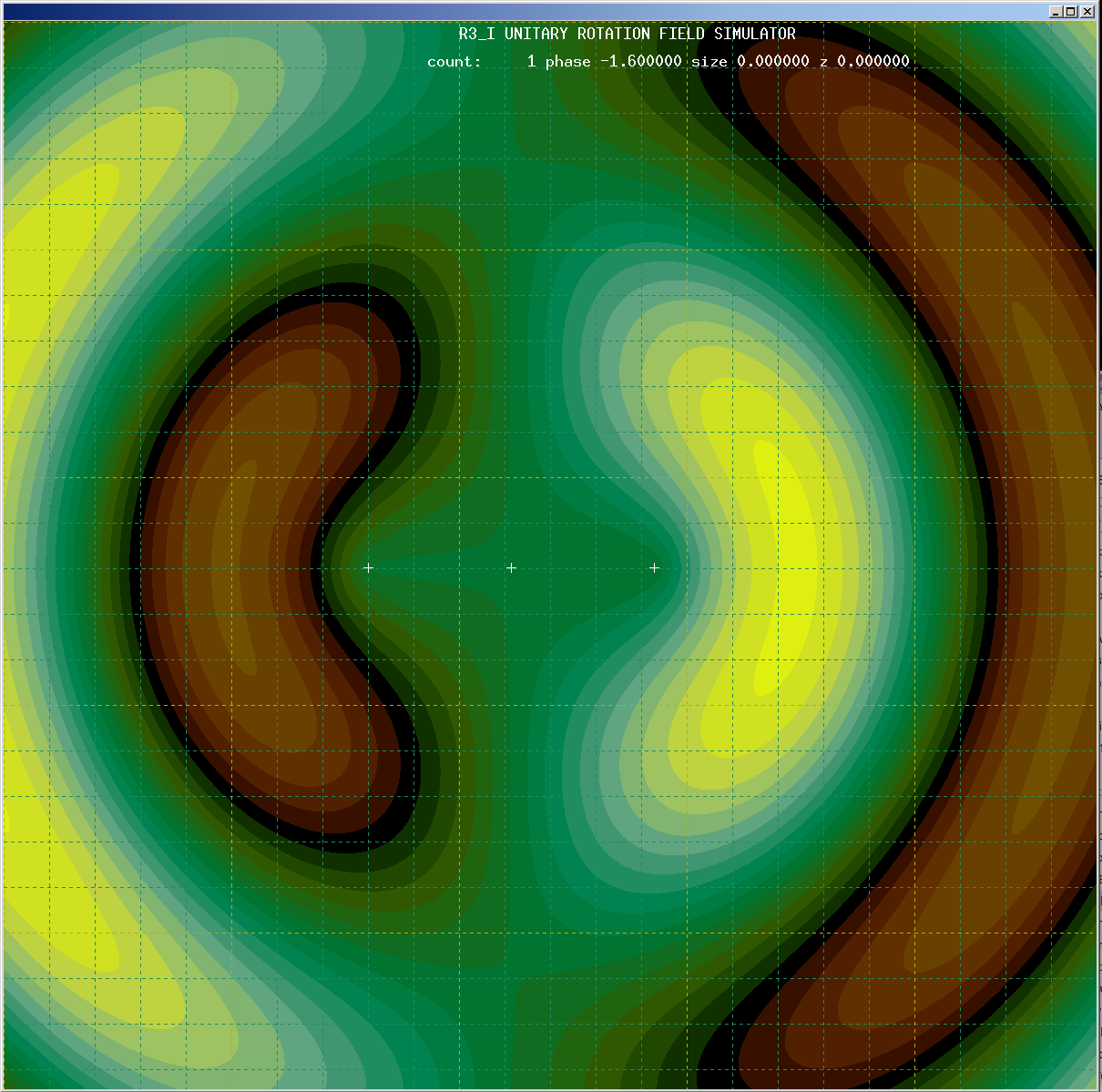
The latest simulations have shown some wonderfully interesting results. The last post showed how the Unitary Rotation Vector Field theory demonstrates particles that can both repel and attract due to quantum interference effects that relocate the stability region of particles. You can read about these results in previous posts, here is a schematic diagram of what happens, along with some sim output pictures demonstrating the principle:

stability_region

I never intended to create a theory that competes with quantum field theory, but the principle of charge attraction and repulsion traditionally is derived directly from quantum field theory methods. So, it seems well worth the effort to compare the two approaches, and what I hope to gain by analyzing the properties of the unitary rotation vector field. While I have run unitary rotation vector field simulations of many particle types and interactions, I think it will be illustrative to compare how each theory handles the simplest interaction of a pair of electrons (charge repulsion).

Quantum field theory solves interactions like these by using LaGrangian mechanics, that is, minimizing the action scalar. Doing a path integral of the LaGrangian over all paths, and setting the the derivative of the action at all points over time to zero yields a motion equation for the particles in the system. This computation will find the path of minimum action and thus will correctly represent reality. More specifically, the interaction of the two electrons is mediated by virtual photons–particles that do not reside on the surface of valid position/momentum solutions in space and time (off mass shell). By prepending a creation operator to the photon wave equation and appending an annihilation operator after it, quantum field theory creates a solution where the time evolution of the electrons go in opposite directions (repulsion).

On the other hand, the unitary rotation vector field (nearly identical to a Pauli spin matrix representation) gets repulsion and attraction in a different way. Both theories do sums of wave paths to find regions of quantum interference, but the wave equation is different. In quantum field theory, the wave equation is the Hamiltonian–the sum of energies such as kinetic energy and the voltage potential in an electromagnetic field. The creation/annihilation operators are probability functions for emergence of virtual particles. The integral is computed over sufficient time so that an operator isn’t left stranded (virtual particles wont conserve momentum in that case).

The unitary rotation vector field is different–it is single valued with only one rotation possible at any given point, and this constrains where particles can exist (the stability region) because the particle phase and the wave phase must match (see the above schematic).

The wave equations in quantum field theory have wave solutions that propagate over time (for example, the propagator in the La Grange equation of action). Solutions depend on virtual particles that don’t obey classical physics. Quantum field theory can’t work without them because on-mass-shell particles will induce the momentum paradox described in the previous post. Nothing propagates in the unitary rotation vector field–each point just rotates, so conservation of momentum works without inducing the paradox.

Probably the biggest reason I pursue the unitary rotation vector field, rather than just sticking with the established science of quantum field theory? The rotation vector field seems to give another possible view of the underlying mechanics of particle interactions that might yield answers not covered by quantum field theory. The most significant possibility comes from how it postulates a formation of elementary particles from quantum interference in a field. There are other reasons, such as the theory doesn’t require renormalization methods, it doesn’t depend on off-mass-shell particles to work, and doesn’t have a probabilistic dependence on when virtual particles form.

Since quantum field computations work, it’s arguable my efforts are a waste of time (and certainly could be wrong, or not even wrong). But my curiosity is here, and so for now I will continue.

Agemoz

UPDATE:  I need to clarify the Unitary Rotation Vector Field representation of the particles involved so you can see exactly how I set up the simulation.  There may be other schemes that work, but this is the approach I used in my simulations.

The unitary rotation vector field is continuous and only rotates a unitary vector (like the Pauli spin matrix).  It can point in any of the three real dimensions in R3 or in one imaginary direction (the background state of the theory).  This is the same vector space as the continuous quantum oscillator field, except that there is no variation in magnitude and you cannot have a zero length rotation vector.

Being single valued, a rotation cannot pass thru from one location to another without affecting each location in the path.  As a result, particles must have the same phase as the sum of wave rotations (that is, quantum interference computed as a path integral) at each particle’s location, this is called the particle’s stability region, shown in black on my simulation images.  A particle cannot exist anywhere except in a stability region, otherwise the location would have to simultaneously have two different rotations. Particles are forced to move when the stability region moves–a well tested example is quantum interference resulting from a single particle passing through two slits.

Each field location can be represented by a set of three rotation values–one straightforward basis is a rotation set that resides in the plane that includes the I dimension and the X direction, a rotation that includes both the X and Y directions, and finally one rotation that includes both the X and Z directions.  My simulation uses this basis.  All rotations are modulo 2*Pi (the simulation values go from -Pi to +Pi).

A photon in this theory is modelled with a single quantized vector rotation from the +I direction thru -I and then continues to +I (see the image figure below).  There is a lowest energy state at +I and -I, so once the rotation does one rotation, it stops. The photon also has a translation along some real dimension axis.

photon_carries_momentum

In the interaction of a photon and electron shown in the above simulation pictures, the photon induces either a positive or negative rotation offset to the receiving electron, which causes the electron stability region (via quantum interference) to displace either above or below (attraction or repulsion respectively).  The photon must be able to carry a positive or negative momentum.  You can see that the rotation must lie in the plane that includes both the +I and the translation direction vector (otherwise you will not have photon polarization using any other rotation scheme).  Note that there are two possible rotation directions–either rotation begins moving toward the direction of travel, or away from it, corresponding to the two possible rotation offset directions intercepted by the electron.

The really interesting thing about this configuration is that the photon becomes a momentum carrier, but intrinsically does not have any actual momentum due to its translation.  The source particle emitted momentum is carried by the photon’s rotation but the photon has no momentum of its own (consistent with the fact that photons are massless particles).  This is what allows photons to pass along either negative or positive momentum without inducing the momentum paradox.  That is, shooting a massive particle at a destination particle cannot ever cause attraction, but photons can.

This seems to be a much better scheme for how photons carry electrostatic force than the virtual particle scheme used in quantum field theory.  Virtual particles are just assumed to not obey momentum/position conservation from creation to annihilation, which means I can’t simulate it.  I can only define the interaction as a black box.  It computationally works, (there’s no way ever that I would say quantum field theory is wrong!!!)  but my goal is that the unitary rotation vector approach could lead to a deeper understanding of particle interactions.

Agemoz