Posts Tagged ‘quantum interference’

Unitary Rotation Vector Field Mimics Electron-Photon Interaction

May 20, 2020

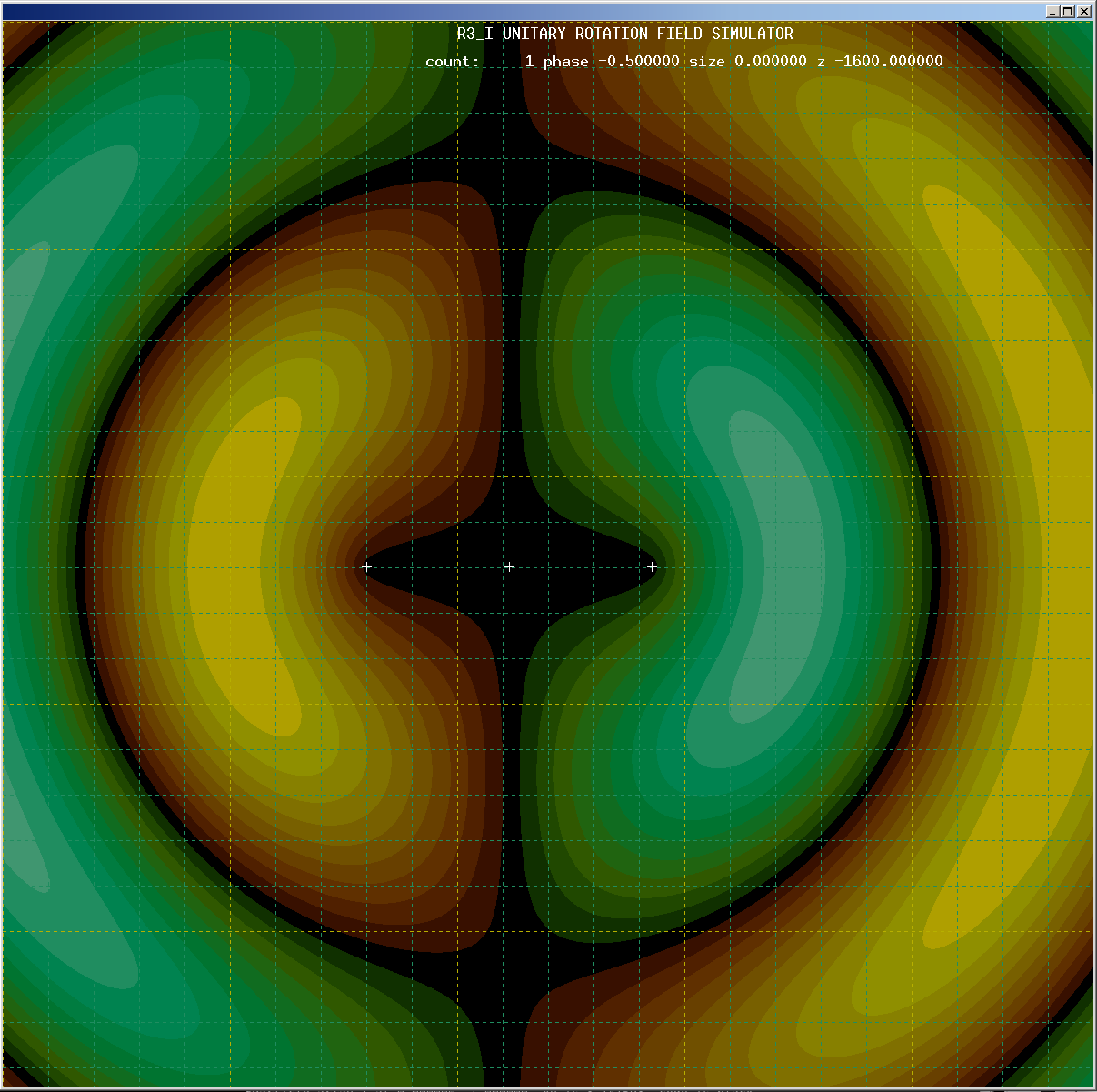
I set up a quantum interference unitary rotation vector field sim with a very basic idealized representation of a two pole “electron” and a much lower frequency one pole “photon” along the z-axis, and here is what I found:

a: The “photon” wave (photon meaning the sim model of a photon in this post) makes the two pole electron unstable at the z = 0 axis position. Instead, the stability region moves along the z-axis depending on the phase of the photon pole. As a result, the quantum interference pattern from all three poles appears to force the electron to translationally move along the axis of the photon z displacement, which matches the expected electron-photon interaction behavior.

b: Depending on the phase of the incoming one-pole photon, I found that the stability region for the two-pole electron can either be below (away from) OR above (toward the photon). Could we at last have an explanation for why electrostatic fields emitted from a source can either repel or attract?

There is a momentum paradox in electrodynamics–if photons have momentum toward an electron, how can momentum be conserved if the electron ends up (due to charge attraction) with momentum in the opposite direction (toward the photon)? Quantum field theory computes that the field itself absorbs the momentum difference (and yes, mathematically that works) but intuitively I rebel at that analysis. The unitary rotation vector field appears to be providing a very elegant solution–quantum interference directs where the electron stability region has to go via wave interference, and in some phase cases it exists toward the photon rather than away from it.

c: It doesn’t matter where you put the photon. I get the same results regardless of the photon offset in the x-y plane (although as mentioned, the z offset causes the electron stability region to move along the z axis).

d: It doesn’t matter what frequency is used for the photon, although the stability region displacement above or below the electron initial position will vary linearly as 1/photon frequency. Higher frequencies cause the photon phase change and hence the change in z displacement to occur at a faster rate, lending credence to the idea that higher momentum photons will induce a larger momentum change in the electron.

e: The only thing the sim seems to get wrong is the absorption of the photon, which should disappear after encountering the two-pole electron. This will require more investigation.

So, in summary, at least on this first pass of testing, the hypothesis that quantum interference in a unitary rotation vector field is responsible for particle formation and particle interactions appears to behave correctly for the electron/photon interaction test.

That by no means is saying that my hypothesized unitary rotation vector field represents reality (if a real physicist were reading about my efforts, he/she probably would wish my efforts would die in a fire if I said something like that) but it looks pretty promising right now. In time and with more work, who knows where this will go–but the real test will be for some qualified researcher to confirm what I am seeing. Until that happens, you should assume that this is unreviewed work (by one author, the kiss-of-death for a research paper) and take it with a bucket of salt…

Agemoz

Here is a picture with the photon in the center, and the z plane is at zero (note this picture cannot be stable, the outside crosses are not in zero delta phase regions)
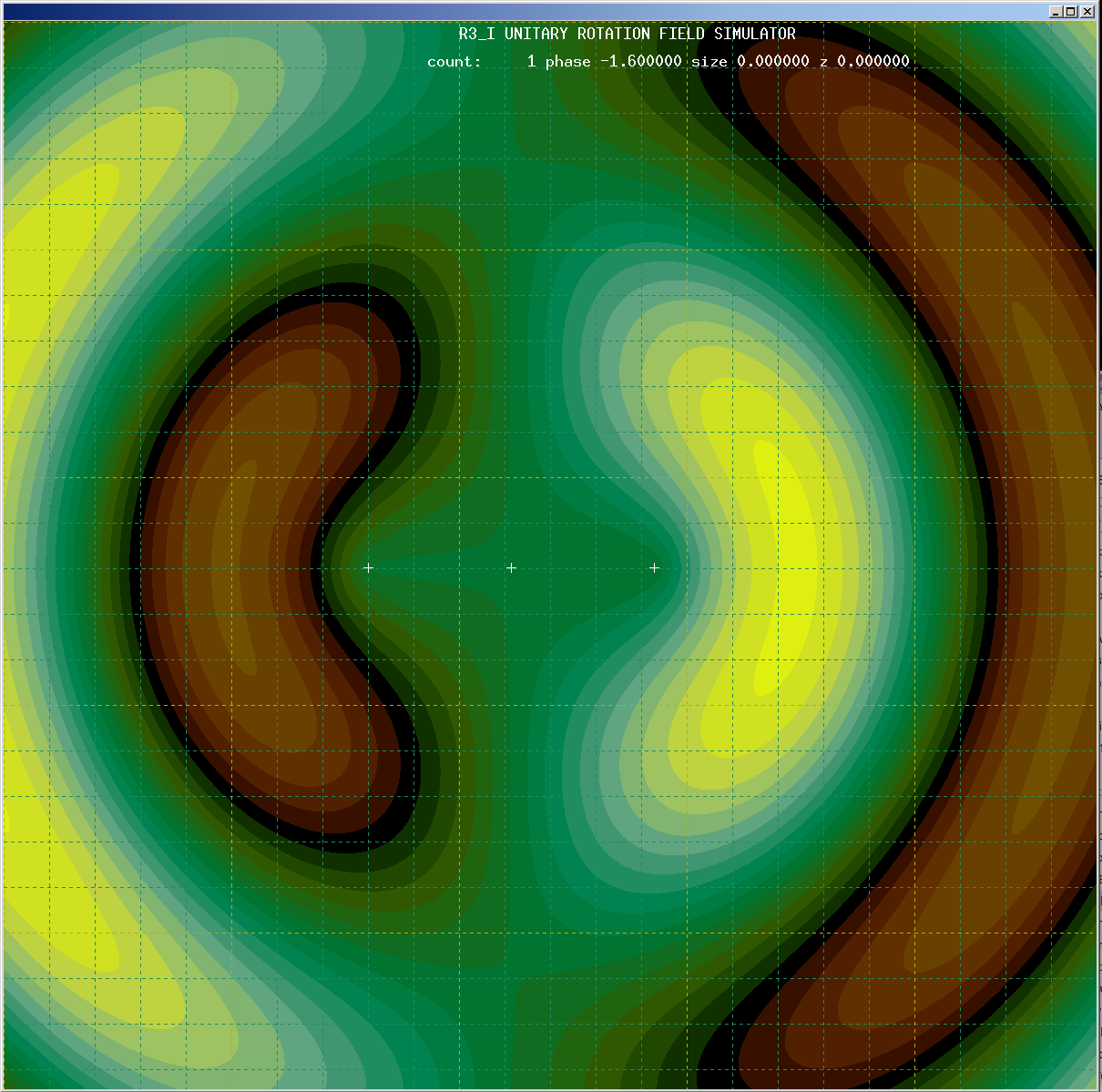
twopole_z_1_6_phase_unstable

Looking at the same image, the region of stability has relocated closer to the photon (representing electrostatic attraction).

twopole_z_1_6_phase_stable

The region of stability displacement linearly varies as the phase shift induced by the photon, notice the region for a smaller phase shift has not relocated as far from the original electron position:
twopole_z_0_4_phase_stable

Quantum Interference in a Unitary Rotation Vector Field Simulation Induces Circular Motion

May 5, 2020

UPDATE: While the validity of the claim (quantum interference will induce stable particle formation in a unitary rotation vector field) is still holding up, the math used to compute the original image was wrong, and hence the image below needs to be updated.  I’ve changed the rotation color mapping to make it easier to see the stable trajectory locations.  The phase matching points (delta phase from all sources that sum to zero) now are shown as black rather than yellow, and I now have the sim actually draw the particle points (little white crosses) rather than me post drawing dots in the wrong place on the original image.  The trouble with doing research is ensuring that everything is executed without mistakes, and that takes a lot of due diligence.  Nevertheless, even with the mistakes corrected and a healthy dose of skepticism, I still am finding that the conclusion (stable particle formation in a unitary rotation field) is correct.  Updated image:

twopole_updated

ORIGINAL POST:  Another step forward for the premise that quantum interference is responsible for the creation of particles.  The same principle that redirects particles in the two-slit experiment is shown here to induce circular motion of quantum interfering poles, provided you are willing to assume that our existence arises from a single-valued unitary rotation vector field–a field that can only assume a rotation angle but does not have any variation in magnitude.

Here is a sample output of the simulator that shows two vertically spaced, oppositely rotated poles spaced at the right distance that the propagated rotation waves output from one pole match the phase of a second pole.  In the unitary rotation field, the wave rotation from one pole must match the rotation of the second pole because the field is single valued, only one possible rotation is possible at any given point.  You can see the interference pattern from two poles spaced such the phase of one particle matches the phase of the propagated wave from the other.  Since the field is single-valued, the poles must follow the circular interference pattern produced by the simulator.  Note that the yellow region shows wave phases where rotations would not match, no particle can reside here.

The poles are clearly bounded to travel in a circular path within the regions matching the pole phase (either brown or green).  Note that quantum interference far from the actual pole positions do not affect the motion of the actual pole positions I have marked as oppositely colored dots (they actually must be the same rotation and hence the same color) on the sim.  Based on a variety of sim results, I believe there are many valid solutions consisting of different pole configurations (see previous post for a three pole solution).

twopole_quantum_interferenceAgemoz

A Solution for a Quantum Interference Soliton

September 29, 2019

Quantum interference will redirect particle paths due to wave interference effects, so it seems reasonable to assume that quantum interference could form an orbiting pair of group wave particles.  It is fairly easy to show that a pair of oscillating wave sources will generate an interference pattern such that if the sources follow the pattern peak amplitude path, the paths will orbit each other (see several recent previous posts on this topic).

However, in real life, there are only a very limited set of wavelengths that could produce actual particles–electrons, for example, could be the results of such orbiting internal wave structures, but why do rest-frame electrons have precisely the wavelength they have, and no other?  We know that geometry alone cannot form any specific wavelength soliton solution, because geometry by itself is scaleless–there is nothing in geometry that specifies that an orbiting pair of particles has to have a specific size.  The only fixed constants we have that could form solitons are the constants of physics–speed of light c, charge q, Planck’s constant, and so on.

I’ve thought for years about what could constrain the geometry to a single soliton size, and so have many others, including DeBroglie, Compton, and others who generally tried to use the obvious candidate–charge attraction.  But since EM fields are central force fields and produce unstable solutions involving infinities, no one accepts that approach anymore.

I think I have an answer.  It comes from quantum interference, speed c, and Planck’s constant–let’s see if you agree or think this is just another futile exercise in numerology or wishful thinking.

We will assume that on some tiny scale, electrons consist of a dual pair of oscillating wave peaks (see image).  Quantum interference determines that the peaks will orbit with a radius proportionate to the wavelength.  So far, there is nothing that constrains how big this orbit is–the larger the wavelength, assuming they all move at speed c, the longer the path time, which corresponds to the longer wavelength.   There are no unique solutions here.  We need to determine what could constrain this orbit radius.

We know that wave particle momentum is inversely proportionate to wavelength, but directly proportionate to orbit size.  In other words, the smaller the wavelength, the smaller the orbit–but conversely, the smaller the wavelength, the higher the momentum, and consequently, the larger the orbit.  There is only one wavelength where the orbit is the same for both.

I computed it this way.   Radius r of an orbit is equal to mass * velocity^2 divided by the force Fn (reference centripetal force) applied normal to the orbit path.  This is the quantum interference force and is independent of r (quantum interference does not obey the central force derivation used for charge or gravity, reference the Aspect experiment and similar).  Now, the wavelength must also define the radius; here, the radius r is equal to the wavelength wrapped around the orbit, that is, lambda/2 Pi.  We assume the velocity of the waves is always c, so for non-relativistic particles, E = m c^2 = hv.  Substituting into the first equation for r and using v = 2 Pi f, we obtain h c/(Fn lambda) = lambda / 2 Pi.

Therefore, there is only one wave solution for a dual pole orbit (yes, I did unit checking to make sure I didn’t goof something up on this):

lambda = Sqrt( 2 Pi h c / Fn)

Other wave peak geometries in R3 will produce similar solutions.  It’s not clear what Fn would be yet–more work to do here, but one thing is for sure–such a construct will only produce one solution.  The proposed soliton only works if Fn is independent of dipole spacing.  This works if we use the proposed idea that poles are Fourier sums of waves (see previous posts and this paper:  group_wave_constant_speed).  Quantum interference alters the wave sum to guide the poles.  No actual force is needed (the big drawback of the guiding pilot wave used in the Bohm quantum interpretation is the need for a new force not shown by experimental observation).

I will investigate further for specific particles such as an electron,  and report back.

Agemoz

dipole

dipole structure

sum_radials_00


Corrected Tilted Slit Experiment

August 11, 2019

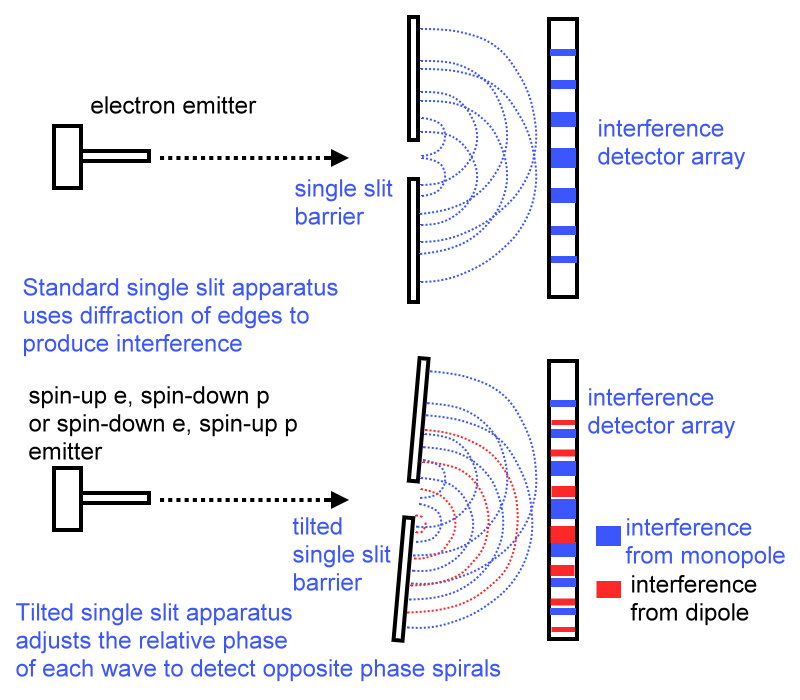
CORRECTED UPDATE 19/08/10:  further analysis shows that the proposed experiment isn’t going to work as proposed.  I obtained a 1.1 nanometer electron wavelength for a static electron, but this is wrong.  Unlike photons, fermions have a wavelength that varies as their kinetic energy, but I did this incorrectly.  I recently recomputed the wavelength in a different way, simply by using E=hv.  Using E=.511MeV, or 8.2^10-14 J, and Planck’s constant as 6.6^10^34 J*s, I get an electron wavelength c / v or 2.998 10^8 m/s / 1.2 10^20cyc/s, which gives a wavelength for the static electron as 0.024 nanometers.  This is good news and bad news:  This wavelength now means that quantum interference could be the confining property for solitons, as I originally proposed a few posts back.  The bad news is that making a tilted two-slit experiment is probably not possible–the wavelength of the atoms composing the barrier is twice the length of the electron wavelength, so I think there is no realistic way to make an electron tilted two-slit barrier where the tilt could discern the electron interference pattern.  Since a single slit has two edges which will cause diffraction of the electron wave on both edges, it might be possible to create a barrier of layers of cold solid hydrogen (such a barrier would have to require some sort of atomic sublayer as a base since hydrogen forms only one bond) with a single slit that generates two interfering electron diffraction waves.  Tilting this barrier may be sufficient to discern whether electrons and positrons (or up-spin and down-spin electrons) produce two different interference patterns.  I’m tempted to submit an NSF research grant for such a research project just to see if I get anything besides a desk rejection!

The good news part of it means I want to return to my work using quantum interference as the cause of soliton particle formation.  This corrected wavelength computation now means quantum interference should produce self contained paths.  I do have to assume that any particle such as the electron has to have a dipole (or more) structure, as there will be no interference pattern from a monopole.  Waves, yes, but no interference that will define an orbiting path.  It’s really too bad that the tilted slit experiment is beyond the reach my lab skills and equipment–it would have been great to try to answer whether the electron structure is a monopole (concentric circle waves) or a dipole (spirals or antispirals).  My hunch based on all my investigative work is that it is a dipole, which means that the quantum interference redirection will produce sufficiently small paths to confine the electron waves.  It’s clear to me that investigation is now the way to go.

Stay tuned!tilted_single_slit

An Experiment to Determine Subatomic Particle Structure from Quantum Interference

July 20, 2019

UPDATE 19/08/02:  further analysis shows that the proposed experiment may be harder to do than I thought.  The 1.1 nanometer electron wavelength is for a static electron–unlike photons, fermions have a wavelength that varies as their kinetic energy.  To do the experiment, the electrons and positrons have to have some velocity, so the reduced wavelength and thus the experiment’s sensitivity to the different interference patterns may be out of reach of today’s technology.   If we could propel the electron at very low speeds and still discern a quantum interference pattern, the experiment should still give us a distinguishable decision on the electron’s internal structure.  It’s a little like using measurable quantum interference waves as a tomography scan to observe internal details too small to directly project to a detector.  Unfortunately, now secondary effects such as the atomic effects of the barrier slit will start to predominate and the experiment will become more difficult to do and perhaps less conclusive.

It’s interesting to note the proposed electron structure in context of an atomic orbital.  The first s orbital in a hydrogen atom has an energy of 13.6 eV, or a wavelength of about .46 nanometers.  But the measured size of the atom including s orbital is around 1/20 of a nanometer, so quantum interference due to the electron is 10 times too big to determine orbital path.  Suppose we use the proton wavelength as an interference wave–it does roughly match the orbital radius.  But now the problem is that the proton is a different particle than the electron, it will not quantum interfere!  In any event, the Schroedinger equation derivation of orbital path uses electromagnetic charge, or photon exchange, so quantum interference can’t be the cause of orbitals.

Now translate down to the much smaller size of the electron itself.  These simple calculations show a scaling problem: quantum interference seems really unlikely to confine the electron wave to a soliton that is much smaller than the hydrogen orbital path, and smaller still than the electron wavelength.  We could hypothesize that at the electron size, a dipole would orbit at relativistic speeds to allow very high frequency quantum interference waves to confine the orbit path, but this isn’t really anything other than pure speculation.

In spite of all this, quantum interference analysis should still be a theoretical basis for the electron structure experiment–the scale problem doesn’t invalidate the strategy for inferring internal structure.  We just have to find a way it can be done in a practical lab environment.  If it could be done, that would just be the beginning of learning how to use measurable quantum interference patterns to probe deep into the structure of all subatomic particles.  I see an analogy in the X-ray crystallography method.

Separate from all that–to me it’s an interesting curiosity that quantum interference should produce a soliton wave solution.  I wonder if this actually does show up in nature in some different way that I don’t see yet.

end of UPDATE

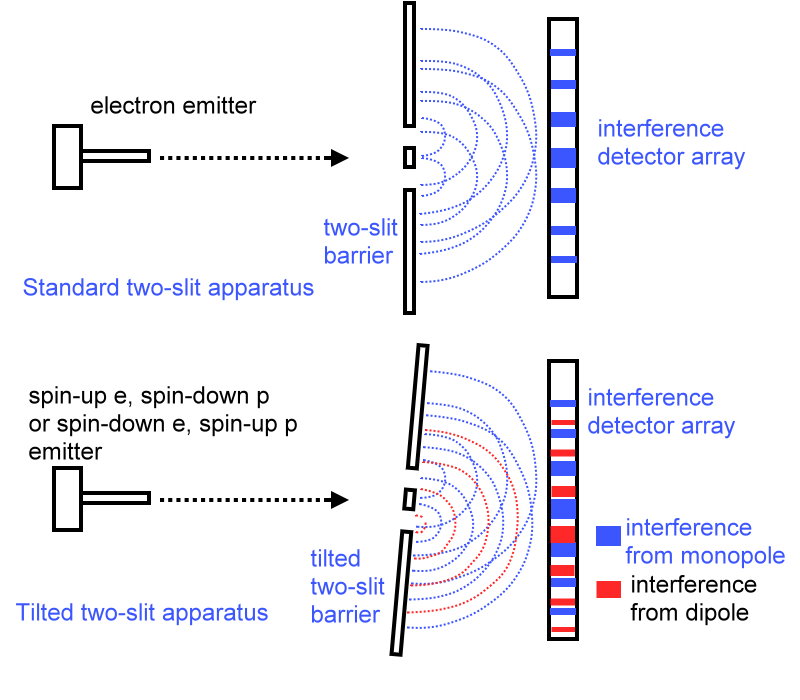
In previous posts, I have proposed several ways to determine subatomic particle structure using quantum interference.  One such structure question is whether the electron is a monopole that oscillates or twists in place, or is a dipole consisting of two nodes that orbit around each other.  I came up with a tilted two-slit experiment that should allow finding which structure matches reality.

However, one problem with this tilted two-slit experiment described in the previous post is the need to figure out what interference pattern corresponds to the monopole (concentric circle) and dipole (spiral) wave patterns.  While some computation or calibration could be done to make the experiment work, I realized there is a much better way to do this.

With a great Aha moment, I realized nature has already provided us with the means to distinguish the two cases.  There are four particles including the electron that will quantum interfere:  the spin-up electron, the spin-down electron, the spin-up positron, and the spin-down positron.  If the wave pattern derives a spiral from the dipole case, the four cases will spin in opposite direction spirals relative to the particle moment.   If the particles derive a concentric circle pattern from a monopole, you should get the same wave pattern regardless of particle type.

There will be two pairs of particles with the same wave pattern (the spin-up electron with the spin-down positron–and the spin-down electron with the spin-up positron).  Set the two-slit apparatus tilt for Pi/2 phase offset tilt off vertical  (I computed this tilt as offset_angle  = arccos(1/4 * 1.1 nm / 7 nm), or about 2.5 degrees, for a 7 nanometer two-slit barrier).  Now shoot sets of particles from one or the other pair at the barrier (see the figure).tilted_two_slitIf you get two distinct interference patterns, one for each pair, the conclusion is unmistakable–the particles have a spiral wave pattern and form from a dipole.  If the pattern is the same for all particles, they have concentric circle wave patterns and form from an oscillating or twisting monopole.

Anybody want to make me a 7 nanometer two-slit barrier apparatus?   🙂

Agemoz