Posts Tagged ‘quantum theory’

Creation/Annihilation of Dual-Spin Point Particles

April 19, 2024

We have substantial experimental evidence that elementary particles such as the electron and quarks are point particles. From a idealized geometric point of view, point particles in three dimensional space are relatively uninteresting with only one possible spin axis and no internal structure. However, we also have significant experimental evidence of four dimensions including curvature in the time dimension, so it is very reasonable to assume that spin angles can point in that direction. In fact, point particles in four dimensions can have two independent spin planes, one in the X-T plane and one in the Y-Z plane, for example. A simple thought experiment that proves this possibility: You can imagine a top spinning in the Y-Z plane and then rotate yourself as an observer through the X-T plane. This proof works identically for quantum spin wave functions, so no objection there–and since there is no physical or timewise displacement, dual-spin point particles will not violate any aspect of special relativity. There is clearly nothing in this geometry that prevents this from happening in reality, so I recall the comment from the Interstellar movie that Murphy’s Law posits that “anything that can happen, will happen”. In my opinion, I think that point particles in four dimensions would mostly likely form with spins in both of the independent spin planes–setting one of the spin rotations to a constant seems really improbably in a relativistic universe.

Dual-spin point particles are particularly interesting to think about in context of creation and annihilation of elementary particles. Examining the details of the electron-positron annihilation exercise, assuming dual-spin particles, looks like this:

Before the collision, there are two massive particles with charge, and after the collision, there are two particles with no rest mass and no charge. The idealized case can be analyzed by assuming there is near zero electron/positron momentum so that all of the momentum (minus some epsilon amount) is in a momentum wave traveling in the T dimension direction. After the collision, the momentum is split between the X direction and the T direction such that the X rate of change in T equals the speed of light–it travels on a path lying on the collision point light cone.

Now, let’s do an ansatz that the point particles are dual-spin point particles and see where that goes. Let’s assume that the X-T spin sets the momentum of the point particles both before and after the collision. Now assume that the Y-Z rotation only exists before the collision–the annihilation cancels out this spin because the anti-particle positron has the opposite Y-Z spin of the electron. We can then see that the X wave displacement after the collision cannot coexist with the Y-Z rotation before the collision. The 4-momentum of the photons must equal the sum of the 4-momentum of the particles and the angular momentum of the massive part of the electron and positron prior to the collision. The collision is the cause of an exchange of all of the Y-Z spin to all of the X displacement of the transformed point particles, you cannot have a mixture of both.

This thinking gives me several insights. The X displacement of the resulting photons is fixed at the speed of light, so this must quantize the possible Y-Z spin–thus giving an explanation why we get a single possible mass of the electron or other elementary particles, depending on the dual spin ratio (see previous posts such as agemozphysics.com/2023/12/28/the-higgs-field-and-r3t-dual-spin-point-particles/). As the universe cooled from the Big Bang, this quantization gives us a phase transition, a symmetry breaking, at the energy wavelength of electrons or quarks. It also hints at why photons have no rest mass and must move at the speed of light. It also suggests that inertial mass and charge result from the Y-Z rotation, which disappears after the annihilation.

Does this fit with the Standard Model, such as the how it derives the Higgs particle interation or the strong force interactions between quarks and nucleons? Does it show why the phase transition point for protons is 1836 times the energy of electrons? Well, no–if it did I would have an actual discovery to report… !

Agemoz

The Higgs Field and R3+T Dual Spin Point Particles

December 28, 2023

UPDATE: chart of all possible dual-spin combinations, both unquantized and quantized.

In our four dimensions (three space and one time), a single point particle can have two independent spins within two orthogonal planes, such as the plane lying in R1+R2 and another lying in R3+T. This fact, coupled the fact that our existence and interactions are confined to a R3 hypersurface “activation layer” within the R3+T universe, gives point particles a lot of interesting properties that point to why we have the particle zoo in real life, see https://wordpress.com/post/agemozphysics.com/1784. The most important property is the ratio of the two spin rates–when these are described as spin wave functions, we get quantization of the probability distributions. When combined with the activation layer, a single R3+T dual spin particle will pop in and out of existence, and it will appear to observers as multiple pseudo particles.

Dual-Spin point particles. Quantized spins must start and end in the R3+T background state (see text), especially note that there are only two possibilities regardless of the chosen spin ratios: two equal-mass particles, or three particles composed of two equal-mass particles and one particle with twice the mass of the other two (this assumes mass correlates to immersion time in real space, see text)

This system gives us the necessary degrees of freedom to specify charge and the different particle types such as the four electron-class particles (spin-up electron, spin-down electron, and their positron anti-particles). When the spin ratio has a factor of three, we get the degrees of freedom necessary for color charges and electric charges of several quarks, including the excited quark combinations of the various Delta particles. Even the particle masses due to the binding energy of quarks have a workable mechanism because force on particles is dependent on the percentage of time the particle spends in the activation layer. The higher the dual spin ratio, the less time external forces can affect each pseudo particle, and thus the higher the apparent mass of the particles.

One really nice thing about dual-spin point particles is that being a point particle, it is immune to concerns about relativistic invariance–with no time or spatial distance in the particle definition, the metric is always zero. All the properties I discovered so far do not have any danger of violating relativity.

One of the strongest reasons I think these dual-spin point particles match reality comes from the known behavior of half-spin particles. I was fortunate to attend one of Professor Feynman’s last lectures before he died, and I remember him discussing that half-spin particles do not have classical spin, but require two complete revolutions before returning to the original state. He used his hands to model how one quantum twist rotated the spin axis normal to the spin direction, and that two twists were required to return to the starting position of his hands. If ever there was a clearer example of the multiple dimensional nature of quantum particle spin, I haven’t seen it!

All of these R3+T point particle properties seemed to work fairly well matching the necessary degrees of freedom present in the Standard Model until I started evaluating the Higgs field. There are a lot of questions still, such as how we get the strong force/electric force counterbalancing within a nucleon or particle decay times, but nothing has really shut things down as much as trying to integrate the Higgs field into the dual-spin point particle idea.

The Higgs field, which is a constant scalar field regardless of the chosen frame of reference or the presence or absence of neighborhood particles, applies a drag to the motion of particles and is responsible for the apparent inertial mass of the particles. There are some relativistic invariance problems here–first, the Higgs force only emits a Higgs boson to resist motion when the particle accelerates in some way, not when it is moving at a constant velocity. Thus calling it “drag” is not a good label, it only “drags” changes in motion–how does the field know the difference? And secondly, there is no Higgs boson emission when observed in the frame of reference of the accelerating particle, so the field itself must be accelerating in that case–and then you really run into relativistic invariance problems because Higgs bosons are massive, and you just caused the mass to disappear!

The Higgs field is really treading dangerous ground given that the luminiferous ether was proven not to exist (see the Michelson-Morley experiment). A model having a constant scalar field which applies drag to particles sounds a lot like something that would break relativistic invariance no matter what mathematical hijinks are done.

Something feels off here in my understanding, and until I get past that, I won’t have a way to match the Standard Model mass effect. I like to think that the dual-spin point particle idea doesn’t need the Higgs field, but that fails when trying to understand why scientists have already detected the Higgs boson.

Agemoz

Properties of Dual-Spin Elementary Point Particles

December 17, 2023

UPDATE (12/19/2023): summary of findings below.

As mentioned in previous posts, it is possible in our four-dimensional space time R3+T for dual-spin point particles to exist. Rotations in either two or three dimensional space must lie within a plane, but in R3+T, it is possible to have two orthogonal planes, and point particles can have simultaneous independent spins lying in each of the two planes. This gets a lot more interesting in real life because interactions only lie within the three dimensional hypersurface slice of R3+T. This causes the spin traversal of point particles to pop in and out of (interactable) existence.

An important property of elementary point particles in R3+T is quantization. If one spin lies in both the T dimension direction and one of the three R3 dimensions, for example, this spin must be quantized to one complete rotation. We see this quantization in photons, where E=hv means that for any given wave frequency, there is only one allowable energy. This quantization maps geometrically to a single vector rotation, starting and stopping into the background state pointing in the T dimension direction (for this quantization to work, the background state has to be a lowest energy state for the particle rotation). I have several posts that elaborate on this, such as: https://wordpress.com/post/agemozphysics.com/1722

Combining these two principles, the point particle appears to observers living in our hypersurface as multiple independent point particles. For example, a dual-spin ratio of 3:1, a R3+T projection of a single point particle will appear as three point particles, and one of the three particles will exist in the hypersurface twice as long as the other two, see the figure:

The hypersurface immersion time is very important, because that is the only time that the R3+T point particle will interact with other particles and fields in the hypersurface (which is why I call our R3 existence within R3+T an “activation layer”). I did a comparison of this immersion time for the 1:3 point particle with the 1:1 point particle, and discovered that the two smaller point particles have half the immersion time as the larger 1:3 particle, and one quarter of the 1:1 immersion time.

A point particle that is heavier than another point particle means that it either has more mass, or spends less time in the activation layer (an inertial force has less average time to move the particle). Since dual-spin particles pop in and out of the activation layer, the immersion times will affect the observable mass of the particle as well as the observable charge force on the particle. My analysis shows that dual-spin point particles in R3+T should have immersion time ratios of 1x, 2x, and 4x for the 1:1 and 1:3 ratio cases. If dual-spin point particles are reality, there should be a set of spin ratios that result in the mass and charge ratios between electrons and quarks. Gluons could have something to do with the connections between the immersion times of the observable R3 particles, but that is speculation at this point.

UPDATE: The original post wasn’t clear on what these results mean: to summarize, I conclude that dual-spin point particles in R3+T appear to observers to project into multiple pseudo particles due to our existence within the R3 hypersurface activation layer. All particles have one of the quantized spins in (for example) the Z-T dimension plane, but massive particles also have an independent spin in the X-Y dimension plane. The ratio of spins affects the properties and the number of observed pseudo-particles in R3. This ratio causes the apparent mass to increase as the X-Y spin factor goes up because its immersion time decreases proportionately (making less time for the particle to be affected by forces and thus causing the particle to seem heavier).

However, charge is generated as a wave (quantum field theory of virtual photons), so charge is solely a function of the number of pseudo-particles, independent of their apparent mass, because a wave is induced when the Z+T spin passes through the activation layer hypersurface (the T dimension spin direction goes to 0). The number of pseudo-particles is determined by the X-Y spin factor relative to the Z-T spin factor.

When pseudo particles annihilate, the X-Y spin factor cancels out, leaving only the Z-T spin factor and these are massless (photons) since in this scenario both mass and charge are due to the dual-spin particle’s X-Y spin (see https://wordpress.com/post/agemozphysics.com/1722).

In other words, I am positing that dual-spin particles in R3+T form a basis for all of the particles we see in real life by altering the spin ratios in the particle. I will continue to investigate R3+T particle ratios to see if the families of elementary particles (for example, the lepton sets of 3) result.

To the best of my ability, I have so far been speaking the truth about dual-spin point particles and their properties. What I don’t have at this time is proof that these point particles map to real life particles, so the investigation continues. The “holy grail” of this study is to find that proof.

Agemoz

Quantum Chromodynamics and R3+T Dual-Spin Elementary Particles

December 12, 2023

Since we live in a four dimensional spacetime, I have long known that it is possible for elementary point particles to have simultaneous independent spins on two orthogonal planes, for example, one rotation axis normal to the x-y plane, and another axis normal to the z-t plane. I discovered that when combined with the R3 hypersurface we live in within the R3+T universe, the projection of dual-spin particles onto the R3 hypersurface causes a single elementary particle to appear as (for example) two or three independent particles from our point of view.

This seemed like a great way to make progress on why we have bound systems of quarks but never see isolated quarks. I recently posted on this (see https://wordpress.com/post/agemozphysics.com/1754, for example). I had hoped that this approach would allow a more analytic view of quantum quark behavior than the perturbative methods we currently use in quantum chromodynamics, why we have bound quark systems that are color-charge neutral, and why we have the SU(3) color charge behavior of quarks and gluon interactions.

Alas, I found that dual-spin doesn’t lead directly to the SU(3) solution of chromodynamics or any of the rest of it. The observation in R3 of R3+T dual-spin particles yields three identical particles (see the 3:1 dual spin ratio shown in the figure) rather than two up quarks and one down quark, and gives no hint why most of the quark combinations in real life are unstable. It doesn’t explain conservation of baryon number, the large mass of the bound quarks in a proton, or any of the other things we see in quantum chromodynamics. Nor do I see nothing that points to where the different gluon color charge pairs come into play, for that matter, why we have gluons at all.

Here is the corrected (from the previous post) projection in R3 of a single R3+T dual spin elementary particle. Note this displays the spin direction only, there is no actual physical displacement. (You cannot have physical displacement within an elementary particle as it would cause all kinds of consistency problems in a relativistic environment). Each of these three R3 pseudo particles lie on an axis with a positive and negative direction shown.

I did a bit of research to see if anyone had looked at spins in four dimensions, or even if someone had published the fact that elementary particles in R3+T can have two simultaneous and independent spins that project onto our R3 hypersurface reality, and so far, it doesn’t look like anybody has considered this. There is no reason why a product of Pauli matrices couldn’t describe a real particle in R3+T, which I think gives the degrees of freedom we need for color charge in quantum chromodynamics. Indeed, the solution I found in the previous post listed above looks like it gives us the colors we need for quarks (red, green, blue). The fact that real-life elementary particles only have color neutral combinations (e.g., protons must have each of a red, green, and blue quark) to me hints strongly that the bound quark system making a proton is a single dual-spin elementary particle in R3+T.

So, I don’t want to give up. I still think I might be on the right track, or close to it. Do any of you agree or am I doomed to crackpot purgatory?

Agemoz

Mass of R3+T Dual Spin Particles

December 1, 2023

UPDATE: it turns out, due to a ColorFunction bug in Mathematica, my conclusion from the previous post is incorrect, and the idea of using dual-spin particles in R3+T may not work as a simple model for bound quarks–see the addendum below.

ORIGINAL POST:Our existence lies in a three dimensional slice of spacetime called a hypersurface that I have chosen to call the “activation layer”, since interactions, whether quantum or relativistic, can only happen here. I have discovered that point particles in R3+T spacetime can have two simultaneous spin axes, for example one in the R1-R2 plane and one in the R3+T plane. This is different than spins in 2 or 3 dimensions, which can only spin on one axis.

I’ve recently created a number of posts on this blog detailing some of the basic properties of “dual-spin” particles, and showed how such particles form a hypothetical foundation for why we have the real-life particle zoo of our existence. The fact that electrons form a class of four identical mass and charge particles (spin-up, spin-down, and their antiparticles) falls nicely out of the dual-spin concept, and recently I found that some ratios of the dual spins turn a single point particle in R3+T into two or three distinct particles in R3 (see https://wordpress.com/post/agemozphysics.com/1754). It is easy to think that this is why we see bound quarks–in R3+T–it is a single particle and cannot break apart.

I think there is a lot going for this idea, but it makes me really nervous to postulate a concept that is so distant from the known and verified quantum field theory and the standard model we now use. For example, in the dual-spin concept, where are the gluons? How do you get the very high ratio of proton mass to electron mass if both are single point particles (with different dual-spin ratios)? How do we describe the strong force in a dual-spin system? What is the difference between a proton and a neutron when built from dual-spin particles? What stabilizes the neutron when in the presence of a proton? What are neutrinos and muons? What explains the parity violation? When an idea like the dual-spin point particle is this far removed from known science, there is just a ton of work thinking about all the connections that have to be established, before even thinking about any new science. And without new science, I am just spitting in the wind.

So, I take each aspect one at a time, and first look to see if there is a fit or if the model simply won’t work no matter what.

It was a major revelation to discover that the dual-spin point particle creates the illusion of three particles in our activation layer hypersurface. The projection onto R3, the only place where interactions can occur, creates some unexpected consequences that do seem to point to a match to reality. I then realized that this revelation has a really important corollary in how the point particle will respond to acceleration. In other words, different dual-spin ratios have to have a significant impact on the apparent mass of the R3 activation layer pseudo particles.

There are two ways to increase the mass of a particle. The obvious one is to increase the rest mass by adding mass to it–attaching more particles, connecting to a field via bosons, and so on. But there is another way that is enabled by the four dimensional nature of dual-spin point particles. If an inertial force is accelerating a particle that constantly pops in and out of the activation layer, the force only gets a fraction of the time to accelerate the particle. The effect is exactly identical to if the particle has proportionately more mass, and in the case of the dual-spin representation of quarks, I see several ways we could get the expected mass ratios to the electron (.511Mev electrons to 2.2Mev up quarks and 4.8MeV down quarks). Yes, that is numerology, a no-no in physics, but the procedure is definitely mathematically sound. The big question is whether this represents reality, and for that, I have to continue this study.

UPDATE 12/6/2023: The various dual spin ratio cases do indeed have some instances where a single R3+T particle become visible to us as two or three particles in R3 due to the activation layer hypersurface we live in, but they are all identical in mass. There is a bug in Mathematica where the ColorFunction method does not correctly track in a parametric3D plot, which caused me to observe an incorrect property for one of the three particles in R3. I found a workaround in Mathematica that correctly shows three identically spaced particles where the observed mass in R3 will all be identical. Unfortunately that won’t work as a model for the quarks in a proton. So, I have to back up a few steps in this hypothesis. Maybe the dual-spin idea will still work in some way, but it’s not there yet. I now have categorized all of the bound particle combinations that result from dual-spin particle ratios. While dual-spin particles are an interesting mathematical concept, I’m no longer seeing a clear path to the particle structures we have in real life.

Agemoz

R3+T Dual Spin Point Particle Appears as 3 Unique Particles in R3

November 21, 2023

We live in a 4 dimensional universe, three spatial dimensions and one time dimension. Point particles can have spin directions in all 4 dimensions, but because we perceive only an R3 slice of our R3+t existence (the “Activation Layer” hypersurface), there are surprising implications for point particle spins. One in particular is that a point particle can have two independent spins with integer ratios for spin cycle time. A 2:3 ratio of these spins in R3+T will cause the particle to appear to be three unique particles in R3!

Point particles that spin in 2 or 3 dimensions must rotate within a plane, but in 4 dimensions, there are two possible independent planes of rotation, for example in R1 + R2, and in the R3 + T directions. Thus, it is possible to have two simultaneous but independent spins in a 4 dimensional point particle, requiring no external angular forces to sustain the two independent angular momentums. In the last post, I created some images that demonstrate some of the possible rotation direction paths (these are directions, there is no physical displacement for a point particle spin):

A four dimensional dual spin particle with 1:1 rotation. Color represents the T direction
A dual spin particle with 1:3 rotation
A dual spin particle with 2:3 rotation

However, these pictures are misleading. It is very difficult for my mind to truly grasp what is happening when a four dimensional point particle spins in R3+T. These pictures shows the entire path in R3, with the part pointing in the fourth (T) direction represented by color, but in fact a 4 dimensional dual spin point rotation direction will actually appear and disappear from the R3 activation layer that we live in. Here is what the 2:3 case actually looks like:

Yes, you see what I see–in R3, a single 2/3 ratio dual spin particle looks like 3 stable, but unique spin directions over a time interval! The whole path is shown as a light color, but the locations where the spin direction (again, remember, these are spin directions, not displacements from a center point) lies in or close to R3 are shown in red. The path that lies in R3 show three separate components over time. The 1/3 ratio dual spin particle similarly show two different directions, but the 1:1 ratio case only shows 1.

I shamelessly speculate this is why we experimentally observe the appearance of three bound quarks in a proton and two bound quarks in a kaon, yet never observe isolated quarks. Dual spin particles rotating in the four dimensions of R3 and T provide a possible path to modeling the internal behavior of bound quarks. This is only the beginning–there are many possible rotation ratios that I think enables the entire particle zoo (both fermions and hadrons), and things like the 1/3 and 2/3 charge values emerge from this model.

UPDATE: The three “pseudo particles” that lie in the R3 plane are not all identical. I have previously hypothesized (see https://wordpress.com/post/agemozphysics.com/1722) that the second of two spin rates of an R3+T point particle (that does not include the T dimension) has to be responsible for both charge value and mass. Indeed, one of the three pseudo particles has double the angular momentum as the other two. Protons consist of two up quarks and one down quark with double the mass and half the charge, so the analysis of the dual-spin point particles continues to support the idea that the dual spins of R3+T point particles are responsible for the quark behavior of real-world hadrons.

Amazing stuff comes from thinking about point particles with dual spin in R3+T, I hope you think so too!

Agemoz

The Quantizing of Dual-Spin Elementary Particles

September 13, 2023

In the last post, I discussed how point particles in R3+T dimensions have the ability to form 4D rotations, opening the door to why we have four “electron-class” (i.e., spin-up electron, spin-down electron, spin-up positron, and spin-down positron), and also enabling elementary particle quantization. What I mean by that is that only certain dual-spin combinations are stable, just like only certain orbital energies are possible in the atom. This quantization comes about because the ratio of the two spins on a single directional vector must be a rational fraction in order that these spin wave functions will have stable solutions.

As you all know, in 2D and in 3D, the possible rotations (assuming no external angular forces) will always lie in a plane, but in 4D systems like our R3+T existence, the rotations trace out an infinite number of path possibilities. This is because a single spin will lie in a plane, and 4D spaces allow a point particle to have two independent spins. For all you skeptics (and I really hope all of you who study physics are very skeptical of any new claims, including mine–that is a prerequisite in this field) I was able to prove that dual-spin particles are real and do not require any external forces to sustain the point particle. Here, I used Mathematica to create 4D projections to demonstrate what happens in a dual-spin point particle when different ratios are selected.

First, I created a number of sequenced views of dual rotations in 4D, here are a couple:

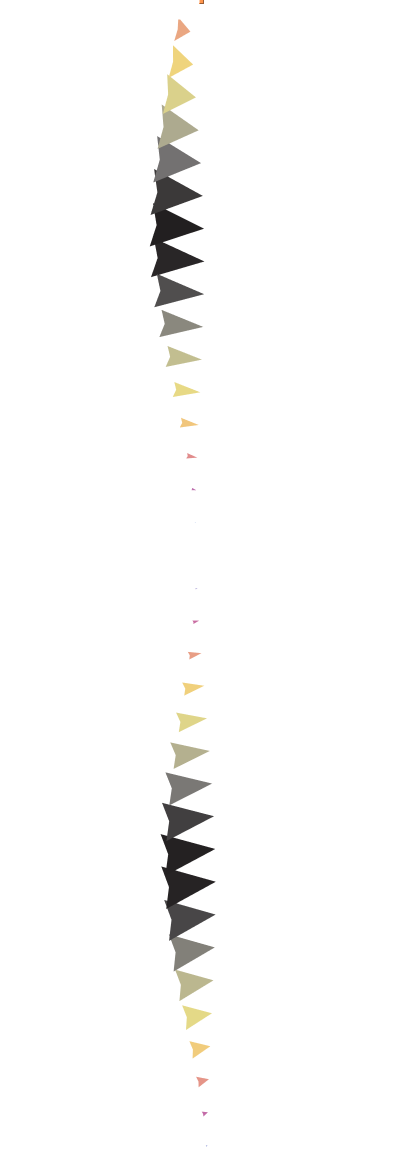
time projection of dual-spin in 4D with 1:1 ratio
time projection of dual-spin in 4D with 1:2 ratio

Note, these are timewise (positive time direction up) 4D projections for a couple of rotation ratios in x, y, z, and t. The colors are the phase of the base frequency (the quantization frequency of my hypothesis), while t dimension component (not the progression of time) is displayed here by varying the magnitude of the projection vector. You can see (sort of) the variation in time of the x, y, and z components. Note that these are all point particle pictures, so there is no displacement–just the progression of the composite spin for the particle. This turns out to be a hard way to visualize what is happening in 4D, so I tried a different way.

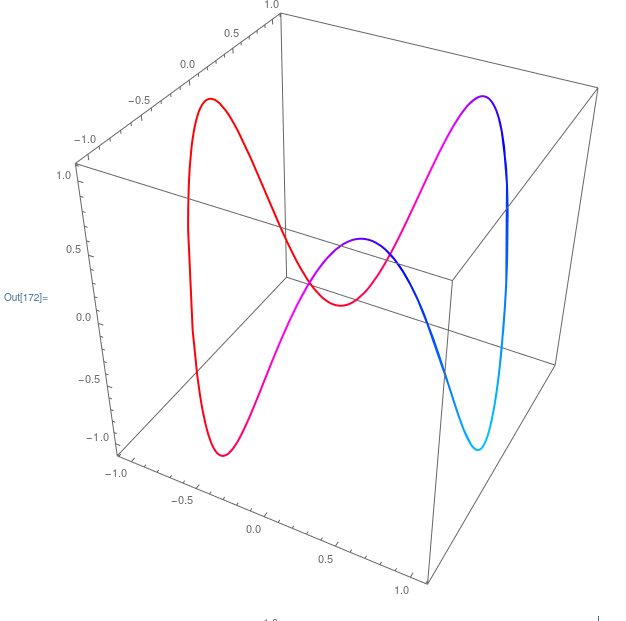
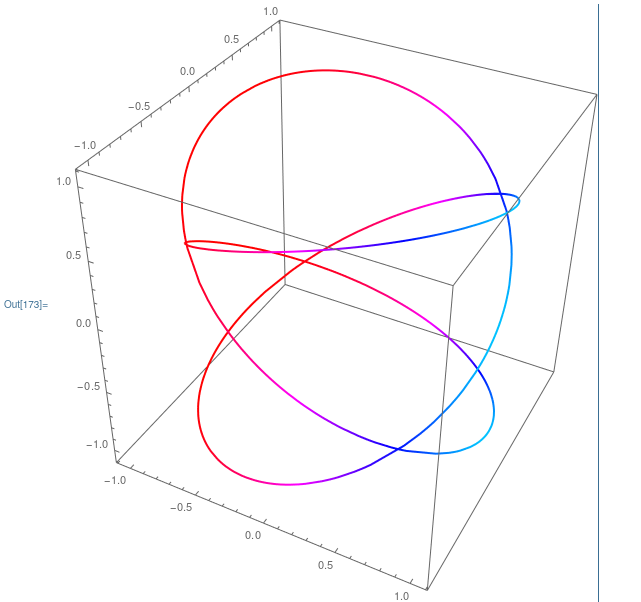
Here’s a much easier way to see how the spins are behaving–note that the curves represent a single (combined dual spin) vector direction from the center, there is no physical displacement shown. You see here x, y, z directions as represented, while t (the t dimension vector component, *not* actual time passage) is represented by the color (red is +1, blue is -1). As might be expected, a 1:1 phase will always generate a circle just like in 2D or 3D, but other rational fraction ratios generate true–and interesting! 4D curves.

Dual-spin with 1:1 ratio
dual-spin with 1:2 ratio
dual-spin with 1:3 ratio
dual-spin with 1:2/3 ratio
dual-spin with non-integer ratio, about 1:2.4433

As you can see, 4D dual-spin particles open up an entire world of possible point-particle solutions! It is important to note that the spins are independent of each other in regard to angular momentum, so all of these combinations, including the unstable one, require no external force to sustain the spin.

Agemoz

Quantum Precession of Elementary Particles

August 21, 2023

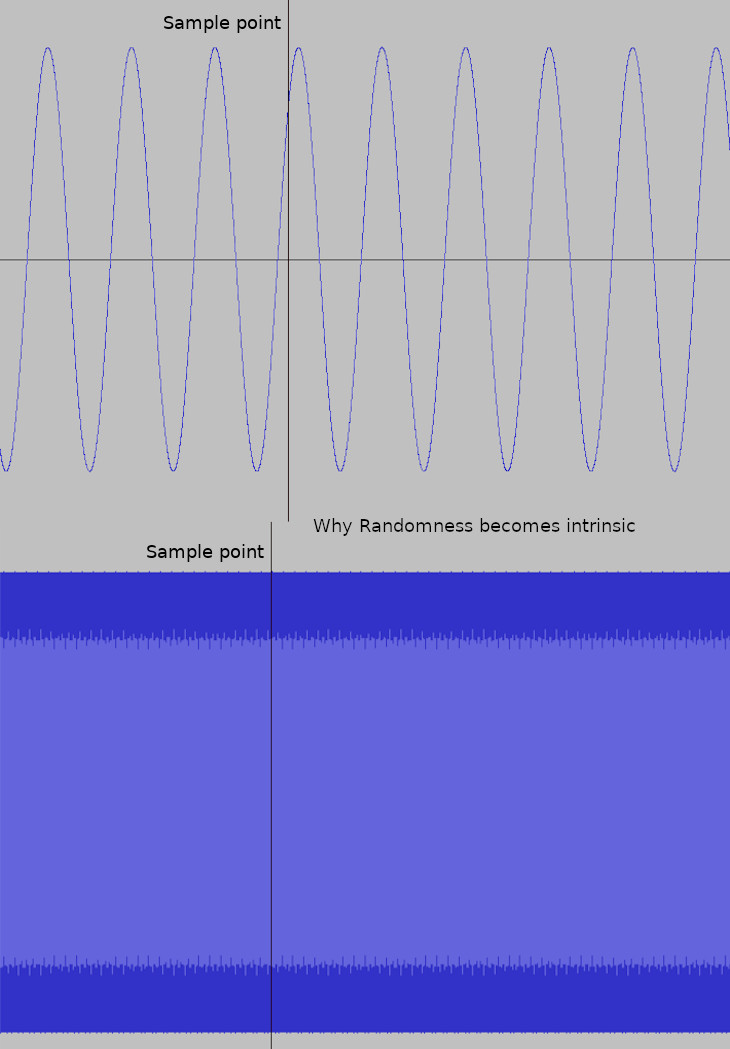
Every physics student knows that quantum physics interactions are computed using wave functions as probability distributions. Rather than computing time evolving waves, we compute time evolving probability distributions, which has led to the conclusion that probability is an intrinsic property of elementary particles. We are taught to avoid applying classical mechanics to quantum events, but Einstein struggled with this conclusion and made the famous claim that “God does not play dice”. As I mentioned in the last post, there’s a simple explanation for why we cannot observe deterministic time evolving of waves and particles–waves result from zero time oscillations.

I think that a faulty assumption could have been made here (that quantum particles have an intrinsic random property). Every quantum experiment we can do shows the probabilistic nature of wave interference–but that doesn’t necessarily mean that we can never apply classical mechanics principles and laws (“shut up and calculate”). What these experiments really show is that we as observers cannot observe anything but a probability that something will have a given outcome. This can happen if particles have truly intrinsic randomness, or, it can mean that the rotation of a particle state takes epsilon or zero time and we can’t determine the phase of a rotation at any given point in time. Our instruments require a time interval and can’t catch a zero time wave phase. I think we have to choose one of those two assumptions, it’s not necessarily the case that randomness is truly intrinsic to quantum interactions.

To me, another part of established science confirms the idea of zero rotation time: the magnetic moment of an electron. As I described in a previous post, a inertial moment of an object is the integral sum of all point elements (such as a delta mass or charge) times its radius from a rotation axis, times the frequency of rotation. For a point particle, the angular moment results from a zero radius, and thus requires an infinite rotation frequency (zero rotation time) to get a finite inertial moment that appears when a magnetic field is applied to an electron. Just like the wavefunction probability distributions of quantum theory, this supports the idea of zero-time rotations.

So, I looked at this more, and combined it with the idea that particles are quantized unitary rotations, or vector twists, in 3D+T dimensions, where the T dimension direction is a background state. In previous posts I show that it is not possible to do a twist rotation in 3D without incurring a field discontinuity, but it is possible in four dimensions.

Now, if rotations occur in zero time, how do we get the non-zero wave time of the electron’s quantum interference property? A rotation of a vector that takes 0 time forms a disk, but we need to be mindful of the zero point size and zero rotation time, so this disk could be treated as an epsilon size and time while applying another classical property, precession. If the disk rotation plane (of epsilon size) does not line up with the inertial moment plane normal to its axis, the disk will precess at a rotation rate inversely proportional to its mass. I think this is where the quantum interference wavelength comes from. From previous posts, you can see that the elementary particle twist rotation occurs in the 3D+T plane that lies in one of the R3 dimensions and the T dimension direction (because this quantizes the rotation, see many previous posts). However, the particle’s magnetic moment lies in either the other two dimensions of R3, or in one of the other dimensions of R3 and the T direction. This particle of epsilon size and epsilon rotation time will precess in the plane normal to both the twist plane and the inertial plane. In this approach, photons are similar but the twist lies in the plane formed by one of the R3 directions along with the T dimension direction. Polarization is a degree of freedom set in the other two R3 dimension directions. Photons do not have the zero-time rotation and thus do not precess.

Now we can look at what happens when an electron and a positron collide to form two photons. It is established science that the collision removes the mass and charge of the incoming particles, and redirects the photon paths to lie on the lightcone (mass and kinetic energy is converted to frequency). If e- and p+ are precessing twists, note that the base frequency of the twist has to remain. You don’t have to assume twist theory to know that the photon energy frequency and the quantum interference frequency of the electron and positron are the same if there is epsilon-zero kinetic energy. The only thing that is cancelled out is the zero time twist! Therefore, both charge and rest mass then would have to be due only to the zero-time twist behavior of the elementary particles e- and p+. The photons have neither, so the precession of the zero-time twist becomes a non-zero time twist in the same R3+T plane but now moving on the lightcone.

Is this reality? Dunno, but it’s definitely a different way of thinking how quantum particles interact that doesn’t require intrinsic randomness.

Agemoz

The Creation Operator and the Quantized Properties of Elementary Particles

June 3, 2023

I’ve always been amazed and intrigued by the universe’s vast array of electrons (and other particle types) that all have precisely the same rest mass, magnetic moment, and quantum interference wavelength. As I discussed in the previous post, the constants are exact regardless of location in space or time, of observer relative frames of reference, presence within electromagnetic fields, and even of gravitationally induced spacetime curvature. I’ve tried to come up with any geometrical construction that would convey this constant behavior over all spacetime, and ruled out any pure geometrical construct that would do this. I also ruled out any scheme dependent on the constant speed of light–in fact, I was able to convince myself that this could not come from any internal property of the activation layer, our current time slice called a 3D hyperspace in 4D spacetime. The only workable hypothesis is that these constant properties of particles are invoked upon creation, that is, when the probability in the creation operator in quantum field theory generates a path to a particle-antiparticle pair.

However, as I showed in the previous post, the creation operator needs to be constrained to provide a quantized particle (quantizing to a specific rest mass, for example), and I hypothesized that nature really only provides one way to do this, via a rotation that has a background state. We see this kind of behavior when looking at atomic orbitals, where the probability distribution must be continuous and thus only allows these quantized states–integer fractions of the time to follow one orbit, one complete rotation. This doesn’t really work the same way for point particles like the electron, though, and while it is clear that this quantization has to occur during the activation of the quantum creation operator, I had to come with new ideas how this could work for point elementary particles.

I believed that the quantized rotation is a big part of why the resulting elementary particles have a constant set of properties no matter where in spacetime the creation operator probability activates, but with no constraint on how long the creation process takes, it seemed like even a quantized rotation could not fully define the particle wavelength and hence mass. We see this in photons–any possible wavelength can result depending on the transition times between atomic excitation levels. It seemed like any possible mass could result from a creation operator activation, and thus electron creation could not explain the constant electron rest mass we see through all of spacetime.

A really nice clue comes from the magnetic moment of the electron. We are taught in physics class not to take spin literally for quantum particles, but I’ve always been disturbed by the magnetic moment paradox of elementary particles. Moments are proportionate to the radius of the center of mass times the angular rotation rate. However, elementary particles have essentially zero radius, so no finite angular rotation rate will give anything but a zero angular momentum. I suddenly realized, here was how the creation operator could produce an absolutely constant mass for the electron no matter where or when it occurs in the universe. The angular rotation rate is infinite! That is, the creation process produces a single complete rotation of a point particle in zero time. Now the radius times angular rate can produce a finite value, and now we don’t need to include passage of time to get the particle rest mass from the creation operator activation.

We aren’t done yet, though, there’s still some issues with this thinking. First, if the rotation rate is infinite, then how do we get the particle’s quantum wavelength? For this, you can go back to previous posts on this website how I propose explaining the apparent non-causal behavior of entangled particles or the dual slit paradox. In the case of entangled particles, the detection of one particle instantaneously enforces the complementary state detection of the other particle. In the dual slit paradox, a particle going through a barrier with two slits will cause an interference pattern on a target detector screen, such that there are places on the screen where the single particle will never go. But close one of the slits, and now the particle can go there. You can time this closing such that there is not enough time for the closing to affect the path of the particle, and yet we still get the corresponding presence or absence of interference region particle detection.

These experiments have caused all kinds of discussions and interpretations such as the EPR (Copenhagen) interpretation, Everett many worlds, and the two variations of the Bohm pilot wave approach. I have long since believed in a new interpretation that no-one else appears to have proposed. This interpretation provides a useful means for understanding the particle-antiparticle creation I’ve been discussing.

In this proposal, particles are group wave constructs. The group waves propagate instantaneously but the phase change of these waves are limited by the speed of light. This means that interference effects such as demonstrated by entangled particles or the dual slit experiment propagate instantaneously, but the particle (the group wave construct) cannot move faster than the speed of light.

Now back to our creation operator activation of a quantized rotation in zero time. The rotation completes in zero time, resulting in a fixed angular moment, but the phase change of this rotation generates the electron particle wavelength. It’s the rotation rate of the background state that sets the quantum interference wavelength (and hence its mass and magnetic moment). I like this idea a lot because it provides not only a means to get the electron constants regardless of spacetime curvature or observer frames of reference, but also provides a definitive answer why we can’t use the DeBroglie or Compton methods for modeling an electron, that is, of wrapping that wavelength around a ring like an atomic orbital–we always knew from experimental evidence that this wavelength was too big to represent any internal structure of the electron. This methodology (retrieving quantum wavelengths of a particle from phase shifting of a zero-time rotation spin rate) is a great explanation for why quantum mechanics works in wave functions and probability amplitudes rather than the math of propagating waves. This electron point particle model at last has a workable geometric construct and gets us much closer to why its properties never vary throughout our universe.

Agemoz

Particle Mass Quantization

May 29, 2023

One of the great mysteries of the universe is why particles have precisely constant properties such as mass and magnetic moment for an electron everywhere in the universe, regardless of whether we are at the scale of electrodynamics or in the vast scale of electron jets from giant black holes. I have uncovered how the creation operator of quantum field theory may hold the secret as to why this happens.

I am definitely not the first to propose that gravity is an illusion, but I think I make the best case for it that I have seen. Einstein showed how space (R3) and time both act as interconnected dimensions, from which their curvature successfully derives gravitational effects. Since we only experience one moment in time, I have made the case ( see https://agemozphysics.com/2023/02/14/gravity-and-the-activation-layer/ and agemozphysics.com/2023/03/25/elementary-particles-and-gravity/ ) that this moment we experience is a 3D hyperspace in 4D spacetime, and that this hyperspace is moving along the time dimension. The effect we call gravity results in curved paths for object motion, but the fact that even static objects experience gravitational forces leads me to conclude that the hyperspace motion along the time dimension of curved spacetime is responsible for all gravitational effects. If we can answer why mass and energy curve spacetime, we can show how gravity becomes an illusory effect similar to centrifugal force even for stationary objects.

To do this, we have to have a detailed description for particles that doesn’t currently exist. By far the most important question I have ever considered is why particles such as the electron all have precisely the same mass, charge, and magnetic moment. From the scale of subatomic interactions all the way to electron jets in giant black holes, the properties of the electron (and quarks, and so on) never change. Something is enforcing this constant property set throughout all the known universe over all known time. Another way to say this is that the electron rest mass is quantized to one and only one value. The rest mass of any collection of electrons is an exact multiple the mass of a single electron.

I used to think that the answer could be found in geometry and the constant speed of light, but after decades of study I have finally determined that particle property quantization cannot come from geometry. It can’t come from the speed of light either–there is always a rotating frame of reference for which the elementary particle will have a different velocity or rotation, yet have the same constant particle properties.

There is only one way in nature to achieve quantization like this: a rotation from and to a default lowest energy background state (ground state). The background state cannot lie in R3 without inducing observable frequencies while moving or rotating, so the only remaining workable candidate is if the background state lies in the time dimension.

I had hoped that uncovering the principles of the activation layer would point to why this quantization occurs–and indeed, it points the way–but it’s not the activation layer that does it. We need to look at Einstein’s prize winning discovery that photons are quantized to get a powerful clue as to what is happening. Photon energy is precisely defined by its wave frequency. Normally, a wave has both frequency and amplitude, but photons cannot have a variable amplitude while still conforming to E=hv. From this, and the realization that nature only does quantization via a background state rotation, I conclude that photons are unitary vector rotations from and to the background state. Polarization results from the photons rotation axis orientation relative to its direction of travel.

To get a constant electron mass, the same thing must happen, but it took quite a while to figure out how it could work. One of many ideas I considered was when I attempted to build in the activation layer a pulse or constant rate of rotation that would define the electron mass through all the universe (imagine the activation layer expanding in all directions as a result of the big bang, and that particles in R3 are like the iridescent interactions on the surface of a soap bubble)–but this doesn’t work. For one thing, how could this pulse stay precisely constant in all directions for all time, and be unchanged by the spacetime curvature induced by masses such as black holes? How can this effect remain even in different frames of reference? After a fruitless search for any way that could work, I finally came to the conclusion that the activation layer alone cannot hold the reason for quantization of particle properties.

The answer has to lie in the creation operator of quantum field theory. This operator can only produce a quantized mass particle if it causes a single rotation to and from the same background state as photons. It can do this if momentum and energy are conserved over an interval of time. Photons only have one twist in R3 as well as T to conform to the single rotation rule, but particles such as electrons will be induced where more dimensions of R3 are involved. Electrons have to form along with positrons–and would normally recombine unless there are impacts that separate the masses. We already know this happens by observing Hawking radiation. At the time of the big bang, there would be huge masses of collisions that prevent great masses of particle-antiparticle pairs from recombining. It can also happen in our current time whenever an electron-positron pair form in a high energy magnetic field or amidst a concentrated photon beam.

If there is sufficient energy, even combined sets of particles, such as quark configurations and more complex particle combinations, can form as long as the net result of a creation operator results in a single background state rotation. We see hints of this combined particle set subrotations with the +1/3, -2/3 charge of quarks in a proton. This would have happened en masse during the sea-of-quarks phase after the big bang, where the presence of massive quantities of energy in the form of photons and other particles would have blocked many quark-antiquark recombinations.

I think that the quantum field creator operator has to hold the secret why the values of particle masses and other properties could arise with such vast and precise consistency.

Agemoz