Posts Tagged ‘quantum theory’

Why Protons have Much More Mass Than Electrons

June 15, 2022

There’s a clickbait title if there ever was one! Nevertheless, as I worked on an iterative Schroedinger solver for the three elementary particle (u,d,u) proton case, it became immediately obvious that even if you ignore strong force, gluon masses, and the Higgs boson interactions within a proton, the proton has to have a lot more mass than an electron. Here’s why I think that:

Every physics freshman level student goes through the exercise of solving the Schroedinger equation for a hydrogen atom, yielding solutions that are quantized and form 3D probability distributions for each energy eigenstate. Quantization of these solutions are entirely dependent on the boundary conditions that apply, which for the hydrogen atom include the width of the potential energy quantum well. We also require real solutions and that the probability distribution go to zero at infinite distance, but the one that gives us quantization of the probability distribution shells (s, p, etc) is the physical width of the quantum well potential energy.

The proton is heavy, so we assume that the electron moves about a center-of-mass point that doesn’t move, which yields sinusoidal solutions whose frequencies are essentially integer multiples of the width of the electron-proton charge quantum well.

When I began work on the iterative Schroedinger solver, it immediately became clear that the quantum well width for the three-particle u,d,u case is a whole lot smaller, thus yielding sinusoidal wavelengths that also were much smaller by about a factor of 20 or so. Here is a comparative picture of the electron-proton quantum well vs. the u,d,u proton quantum well:

Quantum Well comparison between electron-proton (blue) and u,d,u proton (orange)

This has direct implications for the required mass of the proton (three particles rather than one, and each particle has to have at least 20 times as much mass). It’s so interesting to discover that the u,d,u three-particle Schroedinger solution requires much more mass for a proton than an electron–at least a factor of 40 to 60–even if there is no strong force, no massive gluons, and no Higgs boson, only charge potential.

Agemoz

u,d,u Schroedinger Derivation Attempt

June 10, 2022

As discussed in my previous post, I see that there are multiple statically stable charged elementary particle configurations. There obviously are static configurations for configurations that are based on a massive center set of particles and orbiting light particles (e.g., the hydrogen atom). There is no static configuration for two elementary particles (thus strongly suggesting that the electron cannot be a dipole at the Compton radius, an idea I pursued for a long time). However, as indicated in the previous post, there are static solutions of three and four elementary particles. I just found a 3D solution that allows a static 5 particle solution with three + charged particles and 2 – charged particles.

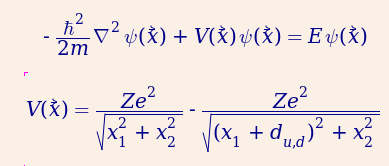
Some of these solutions have required charges that appear to match relative quark configurations, so I wondered if Schroedinger solutions for these configurations would reveal anything useful. I set up the u,u,d configuration of a proton and see a quantum well similar to the massive center potential energy configuration of the hydrogen atom (see previous post for the computed potential energy along the u,u,d configuration axis). The equation I want to use is this:

u particle Schroedinger equation for the u,d,u elementary particle configuration

where d_u,d is the statically stable spacing required and Z is the number of charge particles in the interaction configuration. In the three particle case u,d,u, Z = 1. I want to see if this quantizes like the hydrogen atom, and if so, what are the energy eigenstates.

Since I’m pretty sure that analytic solutions are not going to be found, I am going to take advantage of computing horsepower to attempt a brute-force Schroedinger solver engine that could come up with eigenstates for any Schroedinger equation I choose such as this. I do recognize that this equation is symmetric about the inline axis of the u,u,d static configuration, so choosing a cylindrical LaPlacian is probably a good idea. I’m sure there are a variety of iterative solvers out there, but I thought I would first try some of my own ideas. Since this Schroedinger equation is similar to the hydrogen atom case, I’m going to iterate through a chosen range of energies E by step, and in each case compute an array of second-order derivative constants for each x,y position (that is, x_1 and x_2), or radius r and angle phi if I use cylindrical coordinates. Once I have that, I’ll use boundary conditions to set the first derivative starting points and try to reconstruct the amplitude Psi from that. We know Psi has to go to zero at infinite distance (otherwise we would not have bound states), and it must also go to zero at the quantum well and the poles of the u particle positions (on either side of the center d particle). Psi continuity requires that the first derivative must not have discontinuous steps, so this forms another boundary condition on the iteration process.

I’m guessing that non-eigenstate energies will fail to converge in the iteration process, so I’m hoping eigenstates will fall out of this solver and then lead to some interesting information about required masses of the u,d,u particles. It would be great if I get some information that shows why the quarks or the proton as a whole have the masses they have. There is nothing in this model about the strong force or gluons or Higgs bosons, so I admit I’m skeptical I will get anything out of this effort–but there’s no question that there will be some kind of Psi probability distribution for three particles u,d, and u, and I want to see what that looks like.

Agemoz

Schroedinger Solution for u,u,d Quark Model

June 5, 2022

A lot of research has led me to several conclusions that have changed the course of my thinking. First, I have finally abandoned the dipole twist solution for the electron, at least on a scale larger than the Planck length. It’s so tempting because a lot of interesting things come out of that approach (see all the previous posts on the subject here), but all the reading and research I have done seems to instead confirm the point size of the electron. I’m still a believer in the quantum interference approach, that is, quantum interference is involved in a lot more than just adjusting space-time locations of quantum decoherence.

So, to make a long story short, I now accept the point particle nature of electrons and quarks. I still believe that special relativity must arise if all particles are solely comprised of waves (see paper:https://agemozphysics.com/wp-content/uploads/2020/12/group_wave_constant_speed-1.pdf). I suspect that two additional principles are also true but I don’t have proof: that E=hv implies quantized twists in R3 from a background state vector I normal to R3, and that particles exist where quantum interference of waves sum to a peak value (see previous posts on this subject). This peak value moves according to how waves interfere over time.

Having abandoned attempts to solve for an internal electron wave dipole structure, I turned my attention to quarks, a substantially more complex particle set. I noted that there is only one stable way in an EM field to physically align three point particles where one particle has 1/2 the negative charge of the other two particles (a u,u,d proton configuration) such that there is no net force on any of the particles–in a straight line with the negatively charged particle is in the center. There are analogous solutions with a center negatively charged particle surrounded by n equally spaced positive charges in any of the polygon or Platonic polyhedra configurations. Also note the vice versa solutions where charge polarity is reversed.

Note that this discovery reinforced the thought that the electron cannot be a +,- charged dipole–such a configuration can never statically exist, it will always collapse. As far as I can determine, there no other statically stable particle configurations.

So, I decided to attempt a Schroedinger wave solution of the u,u,d solution. Since now the potential V is dependent not just on r (the case of the hydrogen atom), cylindrical coordinates are required where the radial eigenstates are independent but the x and y displacements will have composite eigenstates. All the tricks we use to solve for the hydrogen atom won’t work here. However, it’s clear that this Hamiltonian is closely related to the hydrogen atom–it’s clearly bounded even though there’s a pole at the third particle (when solving for the first particle). If it is bounded, there has to be fixed energy eigenstates. I am now in the process of trying to find out what they are–I’m pretty sure the ground state has to be the in-line solution that is statically stable. One way or the other, the u,u,d case definitely has a quantum well (see image) and thus should have time independent quantum eigenstates. This is a complex problem that is taking all my research time right now.

I also noted that the d,d,u configuration does not have a statically stable state, but if you assume a quantum linear combination of two symmetric isosceles triangles, I do see a statically stable configuration–maybe. If I make any progress on the u,u,d case, I’ll apply the same approach to the d,d,u Schroedinger.

If I do end up finding eigenstates, that’s just the beginning–what confines these quarks to a “bag” and why is the rest mass of the proton so much greater than the electron? How do gluons derive from this Schroedinger equation and why do they carry mass given that emission from quarks would not conserve mass (and hence energy)? If they are virtual, how does that factor in a Schroedinger model?

Agemoz

Geometry Model

January 13, 2022

If you are a scientist, be aware this is amateur work and there is nothing for you here. I use this site to help me keep track of my own thinking, which tries to adhere to known science but explores some “out-of-box” thinking to help synthesize my own world view of how I think things might work to explain subatomic particle existence. If physics is your profession, skip this, it’s not worth your time here.

There are previous posts from before the pandemic, there’s a lot of ideas there most of which I think are wrong. However, I’ve done a lot of thinking and some research since then, and am going to list here some that I think hold up to scrutiny. These foundational elements still seem to hold up and will form the basis for further work.

a: I am starting with the assumption that there is an underlying geometric basis for particles such as photons, electrons, and quark composites. This doesn’t necessarily hold true but for the purposes of my study I am assuming this.

b: Any group wave construction moving at some fixed speed in an observer’s frame of reference will classically doppler shift in such a way that an observer in some other frame of reference moving at some relative velocity will see the same group wave velocity. I wrote a paper on this that proves this, you can easily derive it yourself–take the Fourier transform of the group wave of a delta function deconstruction, then classically doppler shift these components before returning the group wave to the time domain. You will find that the velocity seen by the original observer is the same as that seen by the moving observer. Additional derivations show that any geometrical model of a particle that obeys special relativity must be composed entirely of waves, any non-wave components will not move at the same relative speed as the group wave and the particle will dissociate. Therefore, I am assuming that all elementary particles are formed entirely of some form of waves.

c: E=hv for all elementary particles describes a translation from a single unbreakable quantum of energy to a specific frequency. Therefore, at this frequency, only integer multiples of this energy are possible, and the only geometrical way to construct such quantization is by unitary vector rotations to and from a background state. I assume that elementary particles such as photons, electrons, and quarks consist of a single rotation in this background unitary vector rotation field.

d: I assume this background state cannot lie in R3, an additional imaginary dimension is required. If the background state were in R3, we would not see consistent particle behavior independent of the observer’s frame of reference (in particular, his rotation), and a cosmic background radiation would then become detectable that was dependent on the observer’s relative rotation. We do not see this, so therefore, I assume that elementary particles must consist of a vector wave rotation from and to the I part of an R3 + I vector field.

e: We already know from the standard model that every elementary particle emits a field of waves in the form of quantized virtual particles. Interference of these waves, for example in a two slit experiment, creates probability amplitudes for how the particle moves. However, these waves by themselves cannot define an elementary particle location. There must be a way to define the particle’s existence (within the constraints of the uncertainty principle) without introducing a non-wave entity (see assumption b above). I see that the only way to meet assumptions b and c is if the particle emits waves polarized in some direction v normal to the background state I, but the particle itself is defined by a complete integer twist normal to this set of polarized waves. Since this is essentially the second Bohm pilot wave model which is considered a leading model for quantum interference and entanglement, I am going to assume that this is the right construct for elementary particles.

f: Twists are not possible within a continuous field without introducing potential discontinuities, but are possible in a granular (quantized) field. I am assuming that the vector field allows this quantization and thus twists without causing energy discontinuities.

f: Photons travel linearly and have no rest mass, so I am going to assume that all of their energy is contained in the angular momentum of this wave twist normal to the I background state and the direction of travel. This defines the photon’s polarization.

g: All particles with mass are confined to a physical neighborhood, and because of the previous assumptions must consist of one or more wave twists as described in assumption e. A closed loop system of twists must move at the same speed c (otherwise the sum of their confined masses would vary).

h: At sufficiently high temperatures (more specifically, within a sea of high-energy photons since there are no known vibrational modes for electrons), electrons are known to dissociate into at least two photons, never a single one (because of momentum conservation). However, at rest, such dissociation will cause two photons of half the energy of the electron, and thus twice the wavelength of the electron energy wave. I am assuming that it is not possible to generate waves with this wavelength (unlike atomic emission, there are no vibrational states of the free electron that could generate longer wavelength photons). Therefore, I assume that electrons have to consist of two twists with doubled wavelength and hence half energy. I’m well aware that this contradicts the known point-particle behavior of the electron and currently am proposing that this two twist solution is completely inelastic and cannot exhibit any vibrational states.

i: If quantum interference defines the allowable probabilistic positions of these twists, and if these twists must always move at speed c (else their momentum would spontaneously change), there are only two possible stable constructions of twists. The first constraint forces the particle to lie in the region that is either 1/2 wave (for oppositely charged twists) or full wave (for identically charged twists), and the second constraint means that all twists in the system are moving in the same direction. I see only two solutions, both lying on a circle: the dipole, and a tripole. The dipole is obvious, but to enforce the tripole solution, there must be a pair of + twists separated by a full wavelength and a single – twist separated from the other two by a half wavelength that is a multiple of the full wavelength for the + twists. No other solutions in R3 are possible, although frequency multiples of these two solutions are possible. Note, this is not an EM field solution–no central force field can yield solitons on its own.

This ends the list of assumptions that I believe are sufficiently logical that I will base my model on them. What follows are attempts to find further constructions that will hold up.

I’m going to stop now and continue to add to this post in a bit.

Virtual Photons

February 22, 2021

I did some research to understand the apparent difference between real and virtual photons. This has to be understood since radiation pressure and charge repulsion are models of each, respectively, and are fundamentally different from each other. Radiation pressure is quantized by E=hv and charge repulsion is not–a great example of the particle vs. wave dichotomy. My effort to find a basis for the particle zoo entities has to model this correctly. I have been trying to force-fit the unitary twist vector field into a particle zoo model, but ran into the issue of how to model charge and radiation pressure, or more precisely, the particle vs. wave behavior in real or virtual particles.

I had suspected that I was running into a definition problem: the difference has to do with the mistake of trying to describe real and virtual particles classically. At this tiny scale, defining a point can only be done with probability distributions–a more concrete definition doesn’t work because the actual entity doesn’t exist that way. QFT has various means of computing expected interactions in spite of that, but those of us insisting on a more detailed underlying structure are going to find ourselves without an infrastructure to derive results (and rolled eyes from the researches who understand this). I think I get the picture. The two types of interaction are different, but attempting to model the difference must take into account that geometric definitions such as the unitary twist vector field can’t model the entities very well if at all–the best we can do is the diffuse equations of probability distributions. I got hung up on trying to explain charge and virtual photons and the apparent point size of electrons via the unitary twist vector field, but now I see I really can’t do that.

Unfortunately, probability distributions have yet to show us why we have the particle masses and charge forces of reality. It will require a different approach than what I am doing to get there, though–a unitary rotation vector field might be a starting point, but I’m going to have to rethink the model. The only two clues I have found, other than what we already know from the Standard Model and quantum field theory, is that everything must consist of some type of wave (see this paper):

and the quantization implied from E=hv (see this post):

agemoz.wordpress.com/2021/01/23/unifying-the-em-interactions/

It’s back to square one. I suppose the one good thing is now I know a little more than I did before…

Agemoz

Prediction: Why We Have a Matter, Not AntiMatter, Universe and an Experiment to Prove it

July 1, 2020

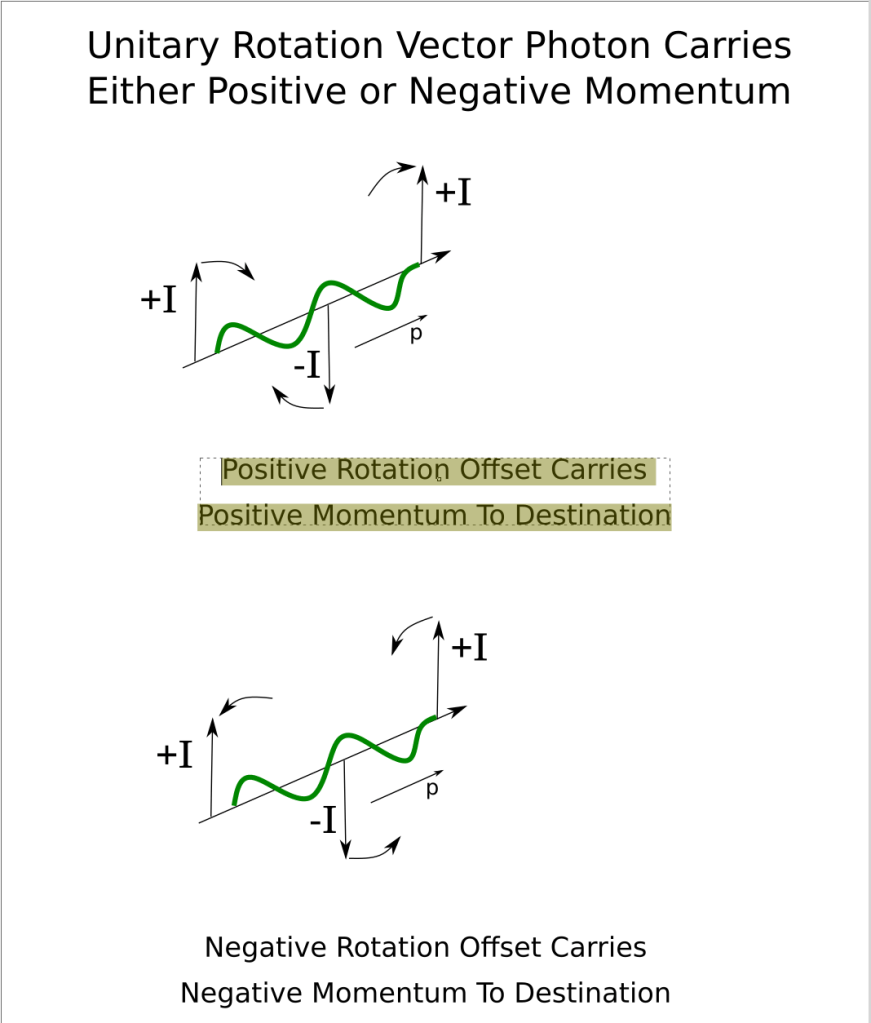
The previous post described the interaction between electrons and photons from both the quantum field theory and the unitary rotation vector field point of view. That post then showed how the unitary rotation vector field predicts that photons carry both positive and negative momentum–a photon has no mass of its own but at emission, converts linear momentum from the emitting particle to angular momentum. You cannot have a particle carry negative linear momentum, but you can have a photon carry negative angular momentum. At the time of absorption, the negative angular rotation converts to negative linear momentum and the target moves toward the source.

This is why a proton can emit photons that cause an electron to move toward the photons flight path source (attraction to the proton). In the previous post, I detail why that happens using the behavior shown in the unitary rotation vector field approach.

QFT, on the other hand, gets this result mathematically from solving the LaGrangian. We interpret that result by creating virtual (off-mass-shell) particles. When confronted with the momentum paradox (shooting photons at a target should always cause the target to recoil away from the photon source), we say that the EM field absorbs the momentum change to cause the target to move toward the photon source.

You can see why I think the QFT interpretation is overly complicated and what I really don’t like is the invocation of YAP–yet another particle–to patch up logical inconsistencies. But here is where the unitary rotation vector field really leads to new insights: We are taught in basic physics that photons are their own antiparticle. We know this cannot be true, because the photons emitted from a proton to a target electron have to somehow be different than photons emitted from an electron–one stream of photons causes the target to move toward the source (electrostatic attraction), and another stream of particles causes the target to move away (electrostatic repulsion). Unitary rotation vector field theory says that in one case the linear momentum to angular momentum conversion generates negative angular momentum, and the other case, positive angular momentum conversion.

This is so interesting because linear momentum is dependent on the direction of particle travel, and thus can never carry negative momentum. But a massless particle such as a photon can carry either positive or negative angular momentum independent of direction of travel. In order for oppositely charged particles to not violate momentum conservation due to attraction, negative linear momentum must be carried via photons and then converting to negative linear momentum at absorption!

This means the old adage that there is no antiphoton, photons are their own antiparticle, has to be wrong. As mentioned above, we already know it is wrong because oppositely charged particles attract each other. Negative momentum must be transported to the other particle regardless of the virtual particle activity along the interaction path. The unitary rotation vector field says there must be photon antiparticles, and thus it should be possible to set up an experiment where correctly generating a stream of negative momentum photons at a target will cause the target to move toward the source.

Physics discoveries are generally worthless without making a prediction of new previously unobserved behavior, and this is my prediction. I think if you could create an emitter, for example, bremsstrahlung from antiparticles such as positrons, you could measure negative photon pressure at a target and prove the existence of antiphotons.

Now here is where this discovery would become incredibly interesting. Photon pressure is a result of the solar wind; it’s behind the concept of a solar sail that could push a spacecraft out of the solar system. It’s also at the very foundation of a star’s existence–photon pressure prevents a star from collapsing into a black hole. Why are there no antimatter stars? Because now the photon pressure is negative (attractive due to emission of antiphotons)–the same direction as gravitational force. There is no equal but opposite force to create a stable equipotential. Antimatter stars must always collapse into a black hole.

Agemoz

Unitary Rotation Vector Field Mimics Electron-Photon Interaction

May 20, 2020

I set up a quantum interference unitary rotation vector field sim with a very basic idealized representation of a two pole “electron” and a much lower frequency one pole “photon” along the z-axis, and here is what I found:

a: The “photon” wave (photon meaning the sim model of a photon in this post) makes the two pole electron unstable at the z = 0 axis position. Instead, the stability region moves along the z-axis depending on the phase of the photon pole. As a result, the quantum interference pattern from all three poles appears to force the electron to translationally move along the axis of the photon z displacement, which matches the expected electron-photon interaction behavior.

b: Depending on the phase of the incoming one-pole photon, I found that the stability region for the two-pole electron can either be below (away from) OR above (toward the photon). Could we at last have an explanation for why electrostatic fields emitted from a source can either repel or attract?

There is a momentum paradox in electrodynamics–if photons have momentum toward an electron, how can momentum be conserved if the electron ends up (due to charge attraction) with momentum in the opposite direction (toward the photon)? Quantum field theory computes that the field itself absorbs the momentum difference (and yes, mathematically that works) but intuitively I rebel at that analysis. The unitary rotation vector field appears to be providing a very elegant solution–quantum interference directs where the electron stability region has to go via wave interference, and in some phase cases it exists toward the photon rather than away from it.

c: It doesn’t matter where you put the photon. I get the same results regardless of the photon offset in the x-y plane (although as mentioned, the z offset causes the electron stability region to move along the z axis).

d: It doesn’t matter what frequency is used for the photon, although the stability region displacement above or below the electron initial position will vary linearly as 1/photon frequency. Higher frequencies cause the photon phase change and hence the change in z displacement to occur at a faster rate, lending credence to the idea that higher momentum photons will induce a larger momentum change in the electron.

e: The only thing the sim seems to get wrong is the absorption of the photon, which should disappear after encountering the two-pole electron. This will require more investigation.

So, in summary, at least on this first pass of testing, the hypothesis that quantum interference in a unitary rotation vector field is responsible for particle formation and particle interactions appears to behave correctly for the electron/photon interaction test.

That by no means is saying that my hypothesized unitary rotation vector field represents reality (if a real physicist were reading about my efforts, he/she probably would wish my efforts would die in a fire if I said something like that) but it looks pretty promising right now. In time and with more work, who knows where this will go–but the real test will be for some qualified researcher to confirm what I am seeing. Until that happens, you should assume that this is unreviewed work (by one author, the kiss-of-death for a research paper) and take it with a bucket of salt…

Agemoz

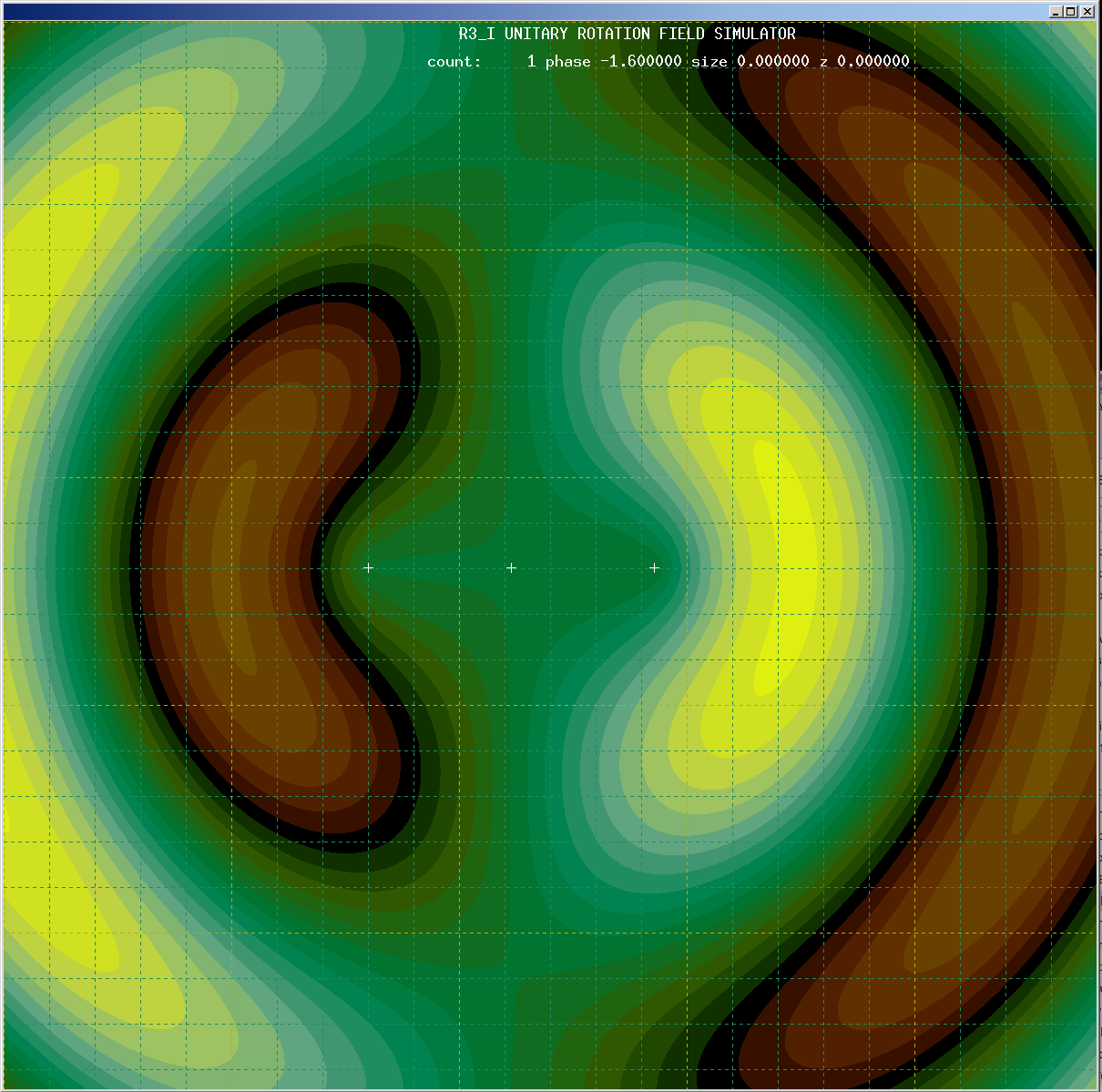
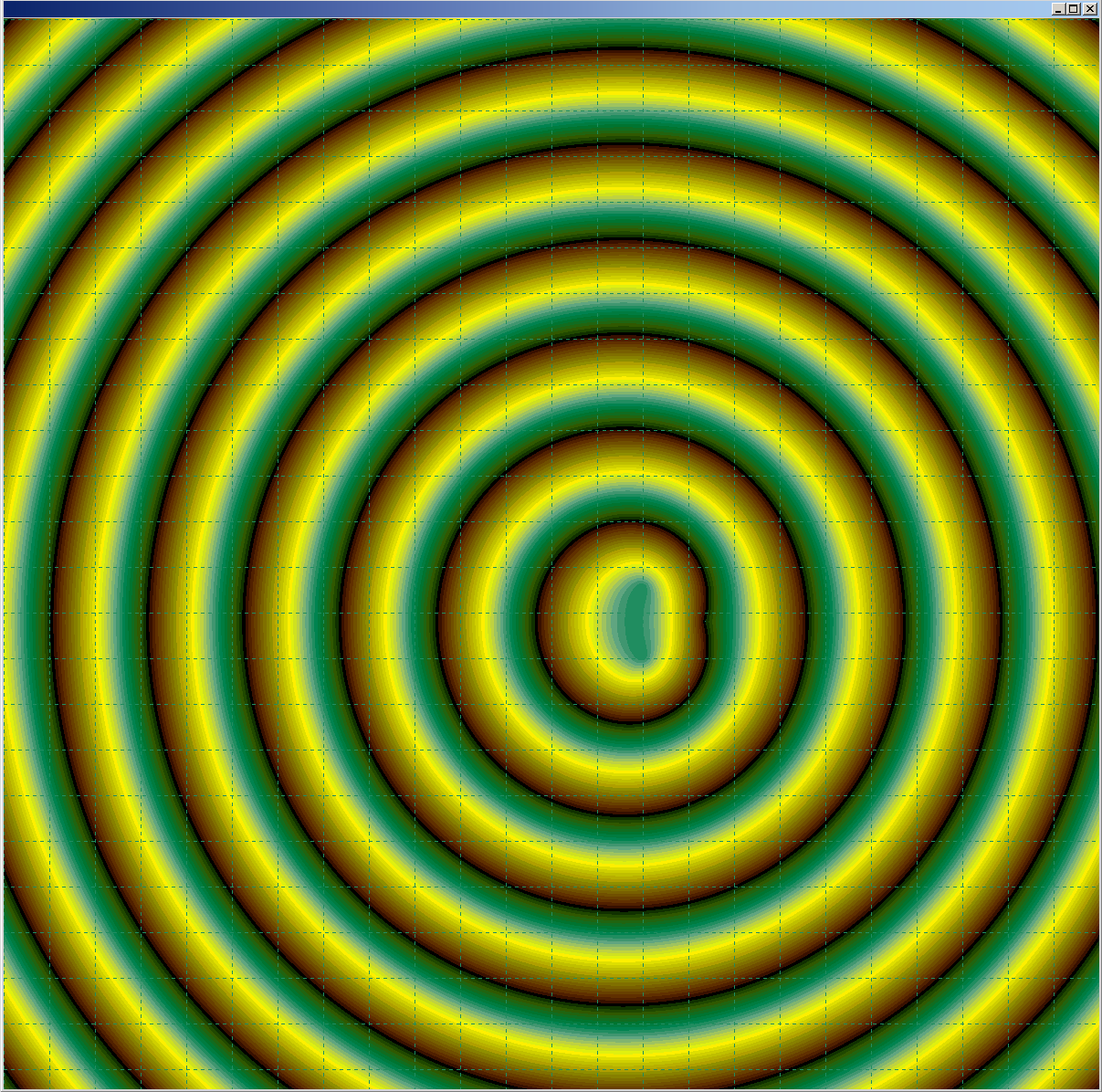
Here is a picture with the photon in the center, and the z plane is at zero (note this picture cannot be stable, the outside crosses are not in zero delta phase regions)

twopole_z_1_6_phase_unstable

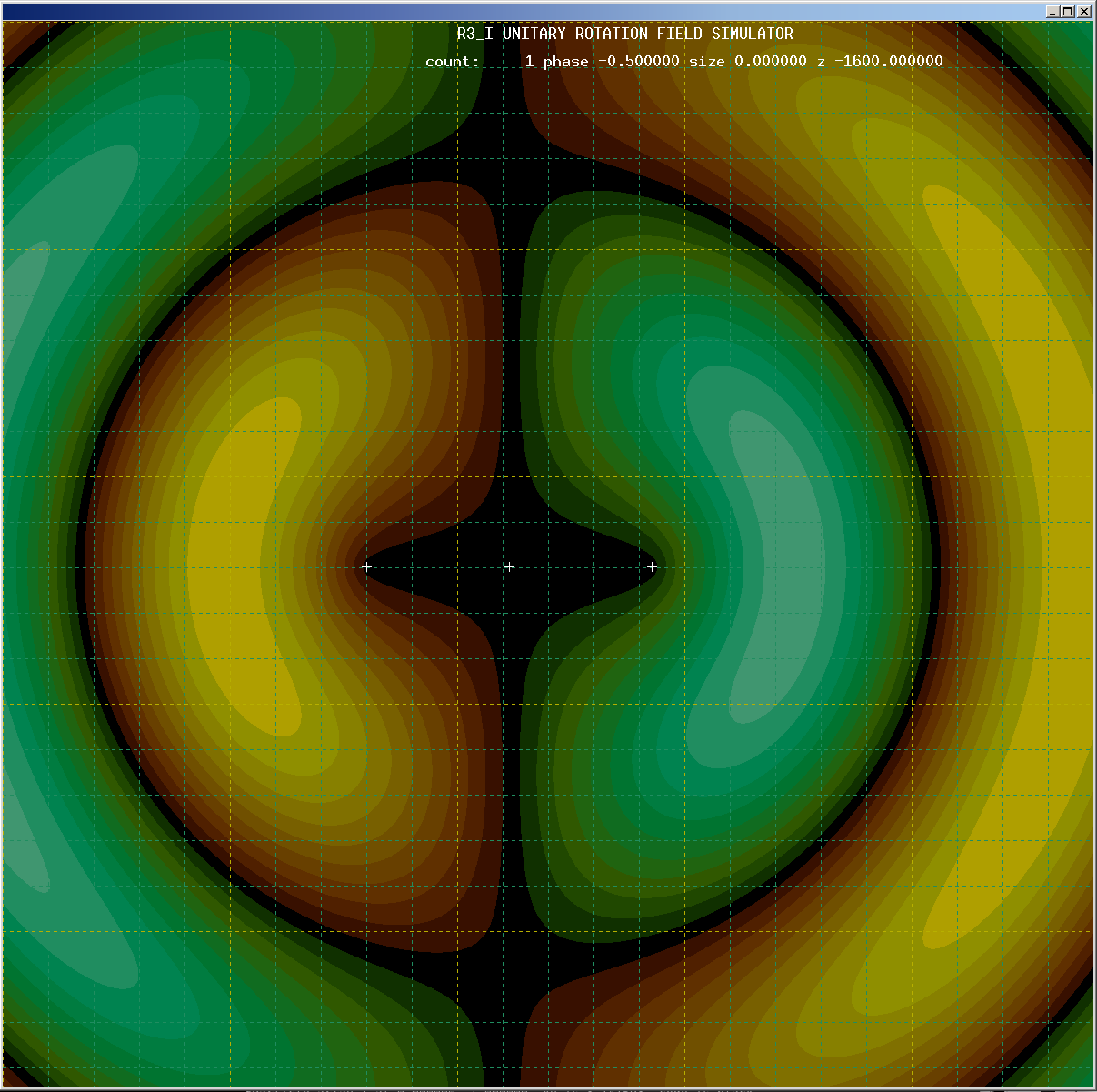
Looking at the same image, the region of stability has relocated closer to the photon (representing electrostatic attraction).

twopole_z_1_6_phase_stable

The region of stability displacement linearly varies as the phase shift induced by the photon, notice the region for a smaller phase shift has not relocated as far from the original electron position:

twopole_z_0_4_phase_stable

Only Two, Three, or Four Poles Possible in a Quantum Interference Unitary Rotation Vector Field

May 18, 2020

I’ve done extensive work trying to find all possible stable particle configurations using quantum interference, and only three combinations are showing definite stability; solutions exist for two and three poles.  There is one valid set of four poles that statically would be stable but only in three dimensions (tetrahedral shape) but I see problems that indicate such a solution wouldn’t work dynamically (have to really watch out for confirmation bias because so far there is correlation to the real-life particle set) .  It’s geometrically very clear that no 5 pole or higher can exist as a stable solution.

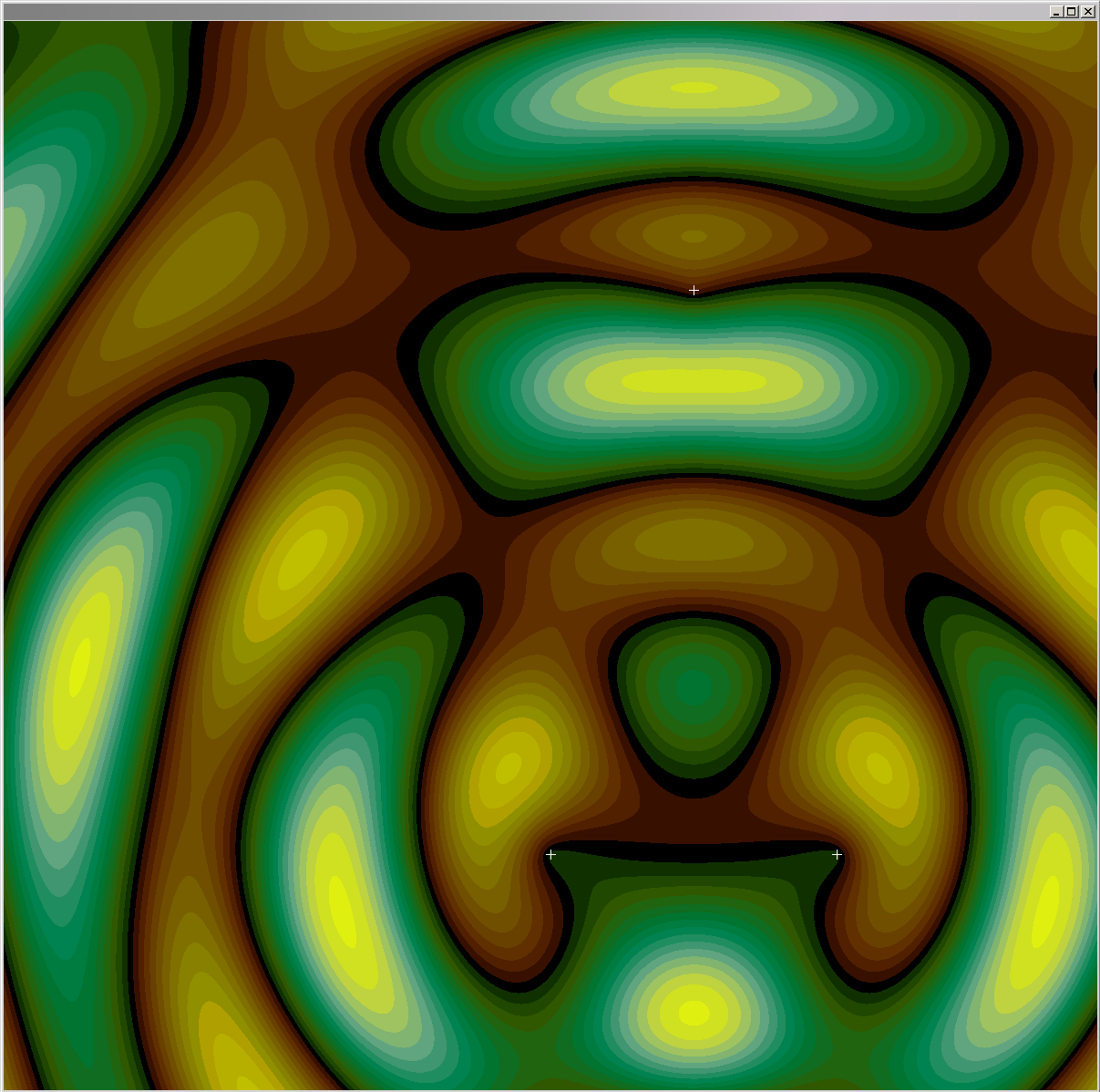
[UPDATE] More results I forgot to mention: A consequence of the 4 pole limit is that a twist ring cannot work. I approximated a twist ring with an 8-pole solution which shows no stability, and geometrically it’s easy to see why (an infinite overlap of wave phase points on every point of the ring). A ring will generate waves from all points about the ring, and there is no possible way this can exist in the single-value unitary rotation vector field. So, the twist ring, long promoted on this site as a valid field solution, bites the dust, at least for the unitary rotation vector field case. This is really interesting because it confirms the experimentally observed infinitely small point concept of current physics, and also seems to validate the Bohm interpretation of an infinitely small core with a non-causal guiding wave for particles. Here’s a picture–note the little crosses are the pole locations with stepwise increments in phase. You can tell that this is unstable because the phase delta between the sum of waves plus the particle phase must be zero and would show here as a black region–but instead many poles do not and cannot reside in a zero phase region. That is indicating that the particle phase and the wave phase are different, an impossibility in this single-valued unitary rotation vector field.

eightpole_unstable

Also, (face-palm moment as I jumped too fast to conclusions) there actually are 5 pole and greater solutions, provided all the poles lie in a line. However, another constraint is emerging where this type of solution may not be stable except in the static case. Working on that one…

Here are pictures for two and three poles:

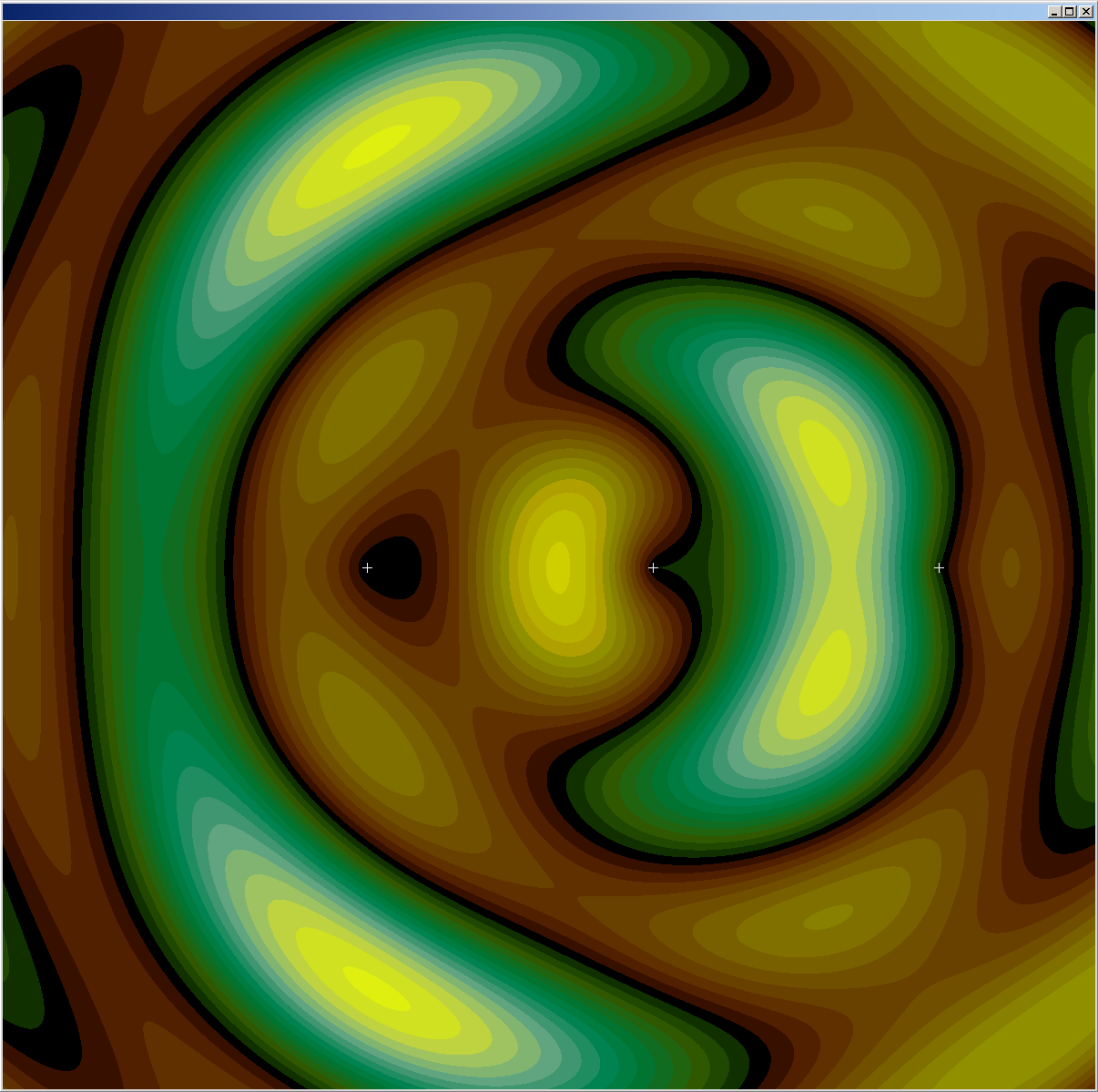
twopole_updated
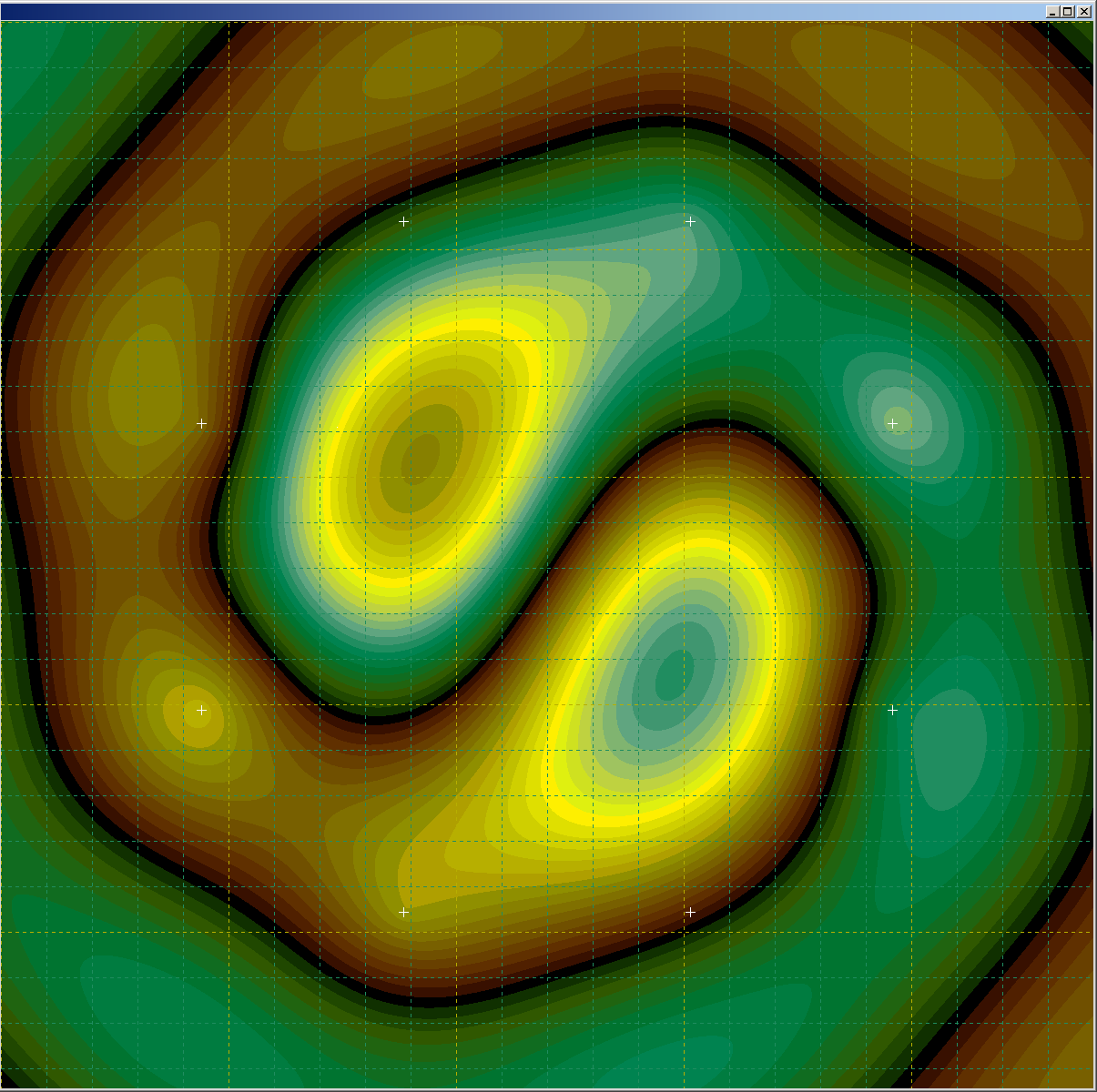
threepole_stable_221
threepole_stable_112

I’m now working on a sim where a unitary rotation vector field “photon” approaches and is captured by a field “electron”.  Results shortly–should be interesting and a fairly definitive test for whether the unitary rotation vector field can really model reality.

Agemoz

Unitary Rotation Sim Quark Combination Results

May 9, 2020

The latest sims show yet another intriguing connection between three pole simulations and experimentally observed quark combinations.  A couple of posts ago, I wrote a surprising result that only certain three pole configurations were stable.  Those combinations happen to match the valid quark combinations for protons and neutrons, but all other combinations were clearly unstable.  At first I thought, aha, a breakthrough, but after thinking about it I thought quark interactions are extremely complex and such a simple explanation shown by the sim couldn’t be the explanation for valid quark combinations.

Nevertheless, I have continued to explore three pole configurations and came up with another consistency (yes, this is confirmation bias at work here!).  There are two valid three quark configurations, u-u-d (proton) and d-d-u (neutron).  However, only one of them, the proton is stable–a free neutron will decay into a proton, an electron, and a neutrino after a while unless accompanied by a proton in an atomic nucleus.

Curiously, the three pole simulations are showing a similar disparity.  The geometry of the two long wavelengths plus one 1/2x short wavelength is easy to see, you can set it up as an isosceles  triangle.  Here is the sim stability test for that case:

threepole_224_stability

But the opposite case using one long wavelength and two 1/2 short wavelengths cannot produce a valid configuration, there is no way to lay this out such that wave phases match (try to lay out a triangle with two short sticks and one 2X longer stick, you can’t–they form a line).  I have tried a number of sim configurations to get a valid configuration, and haven’t found one yet–just thinking about the geometry seems to show there cannot be one.  Trying to line up the poles in any spaced combination gives unstable results:

threepole_442_stability

What if we set up a known stable quark configuration (a neutron and a proton, three up quarks and three down quarks?)  This requires 6 poles, but I haven’t found any configuration that works, at least in the 2D plane.  You have to set up the poles so all 6 locations have identical phase matches for three up wavelengths and three down wavelengths (due to the unitary rotation field requirement, every location must be single valued, that is, have identical wave phase rotation values from every pole).  Locating the poles so the long wave poles (up particles) are points on an equilateral triangle, and placing the short wave poles (down particles) on a nested upside-down triangle looked promising but doesn’t work.  There are pairs going from the up poles to the opposite down poles that have a phase change of sqrt(3)/2, and phases won’t match.  If there is a solution, maybe in 3D, I haven’t figured it out yet.  And, it’s quite likely that stability in this configuration (an ionized iosotope of hydrogen with one neutron, technically ionized deuterium) conferred due to a particle property not modeled in the sim.

Or I’m certainly open to the possibility that the sim doesn’t model reality at all.  It is intriguing, though, how many real-life quark properties are showing up in the sim.  I’ll continue to investigate.

Agemoz

Quantum Interference in a Unitary Rotation Vector Field Simulation Induces Circular Motion

May 5, 2020

UPDATE: While the validity of the claim (quantum interference will induce stable particle formation in a unitary rotation vector field) is still holding up, the math used to compute the original image was wrong, and hence the image below needs to be updated.  I’ve changed the rotation color mapping to make it easier to see the stable trajectory locations.  The phase matching points (delta phase from all sources that sum to zero) now are shown as black rather than yellow, and I now have the sim actually draw the particle points (little white crosses) rather than me post drawing dots in the wrong place on the original image.  The trouble with doing research is ensuring that everything is executed without mistakes, and that takes a lot of due diligence.  Nevertheless, even with the mistakes corrected and a healthy dose of skepticism, I still am finding that the conclusion (stable particle formation in a unitary rotation field) is correct.  Updated image:

twopole_updated

ORIGINAL POST:  Another step forward for the premise that quantum interference is responsible for the creation of particles.  The same principle that redirects particles in the two-slit experiment is shown here to induce circular motion of quantum interfering poles, provided you are willing to assume that our existence arises from a single-valued unitary rotation vector field–a field that can only assume a rotation angle but does not have any variation in magnitude.

Here is a sample output of the simulator that shows two vertically spaced, oppositely rotated poles spaced at the right distance that the propagated rotation waves output from one pole match the phase of a second pole.  In the unitary rotation field, the wave rotation from one pole must match the rotation of the second pole because the field is single valued, only one possible rotation is possible at any given point.  You can see the interference pattern from two poles spaced such the phase of one particle matches the phase of the propagated wave from the other.  Since the field is single-valued, the poles must follow the circular interference pattern produced by the simulator.  Note that the yellow region shows wave phases where rotations would not match, no particle can reside here.

The poles are clearly bounded to travel in a circular path within the regions matching the pole phase (either brown or green).  Note that quantum interference far from the actual pole positions do not affect the motion of the actual pole positions I have marked as oppositely colored dots (they actually must be the same rotation and hence the same color) on the sim.  Based on a variety of sim results, I believe there are many valid solutions consisting of different pole configurations (see previous post for a three pole solution).

twopole_quantum_interferenceAgemoz