Posts Tagged ‘quantum theory’

Unitary Rotation Vector Field Three Pole Solutions Exactly Mimic Quark Combinations

April 25, 2020

I apologize for overposting here–I’m definitely going to be overdoing it–but I just felt like I had one more result to post (UPDATE below).

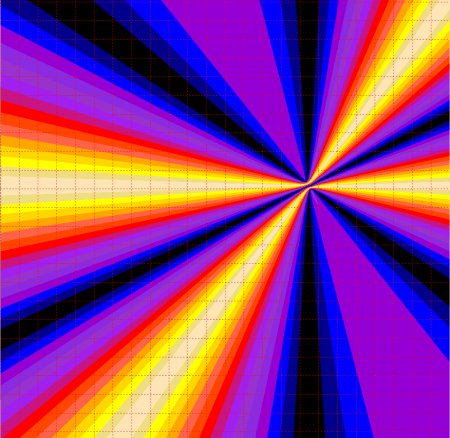
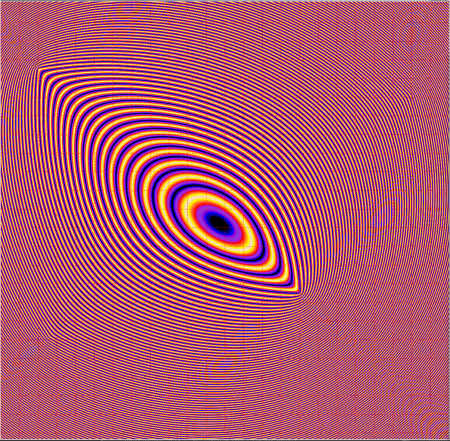
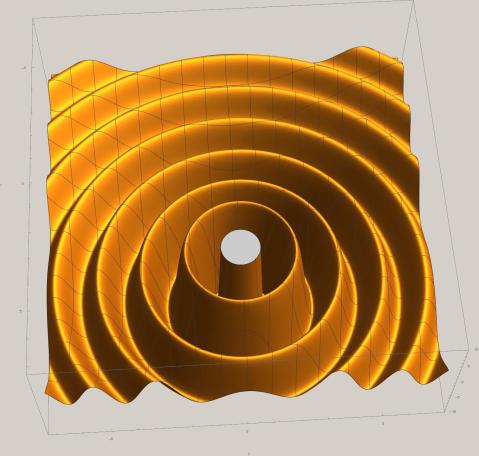
Most three pole solutions just produce the infinite wave results that are not sustainable as a real representation of particles, I just see the infinite series of wave rings.  But I thought, what if I tried to duplicate the three quark up/down configurations?  I place three poles in a triangle, and gave them all the same energy.  Nope, infinite rings.  Next, gave one of the poles half the frequency like an up quark.  Nope, still infinite rings.  Now, give it an antipole rotation: voila!  a stable particle configuration:

three_pole_m2_4_m2

In fact, I tried all combinations of “up” particles and “down” particles, and guess what–only two produced particles, the anti-up, down, down and the up, anti-down,anti-down configuration!  Yow–that was exciting.

However, Feynman’s ghost is here, and he says: be skeptical.  This may just have a stupidly simple reason, not a physics breakthrough.  It could just simply be the fact that 1 + 1 – 2 = 0, and -1 -1 + 2 = 0.

{update}:  quark sets have extremely complicated interactions and I now doubt that this configuration directly represents them (for example, where is the mass of the gluons).  It might give a clue of internal details of a quark set, but there has to be more to it.

Something much more significant is showing up with these sim results–the hypothesis that a testable principle exists.  It is this:

Quantum interference is responsible for redirecting particles along wave interference peaks–and also for creating those particles.

It doesn’t matter that we are talking wave functions (probability distributions) rather than actual waves, the redirection still happens.

It’s becoming very clear from these sim results that at certain wave frequencies, the effect of quantum interference must control the motion of poles because in the unitary rotation vector field, every field location is single valued (only one possible rotation at each point).  As a result, the quantum interference redirection that occurs in the two-slit experiment can also cause poles to encircle each other in a stable pattern.  I’m about to set up an experiment to directly test this principle.

More pictures to come…

Agemoz

Unitary Rotation Field Simulator: More Results

April 25, 2020

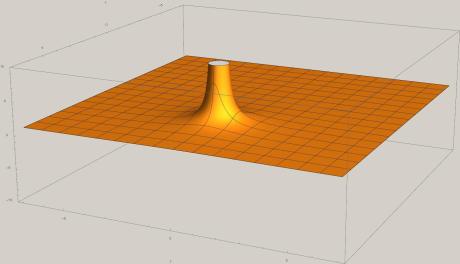
I’ll try not to post here too often, but a whole ton of results are coming back from different experiment configurations using the Unitary Rotation Vector Field simulator.  One thing that became immediately obvious is that stable solutions are not going to come from most pole configurations–the spreading waves you saw on the previous post aren’t sustainable in a universe full of particles.  I was pretty suspicious of something not right when I could make the dipole disappear entirely (see previous post).

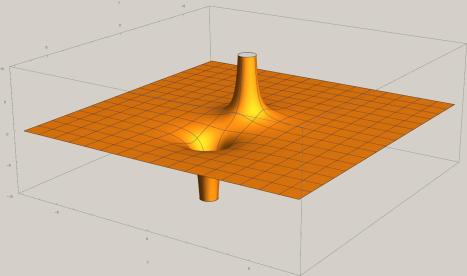
I discovered a whole new ball game when I set up opposite pole dipoles:

dipole_1

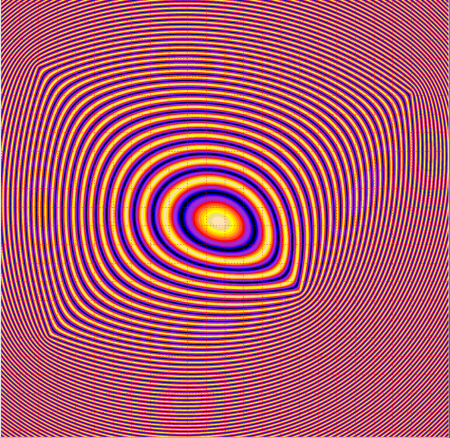
The wave pattern disappears as the poles cancel out.  The residual rotations shown occur because I have yet to apply the effect of the I dimension (the background state referred to in previous posts about the theory I’ve been working on).  Here is a picture of two such dipoles of different frequencies:

two_dipoles_1

There are wide space dipoles representing lower energy solutions:

dual_2pi_dipole

Note that I’m just barely scratching the surface of the properties of this amazing field.  I’m only using one of the rotation modes (there are three in the R3+I field of the theory), I don’t have the background state turned on yet, I am currently only studying 2D configurations, and I have not turned on any time dependent characteristics, in particular, how such particles will move.  There’s so much to do and to document!

Agemoz

Unitary Rotation Field Sim First Light

April 24, 2020

The unitary rotation vector field is a promising candidate for an underlying field that theoretically should produce solitons, quantum effects, and special relativity.  In order to see if the field really could work or is just snake oil, I wrote a simulator.  That has taken a while to get working, but now I’m starting to get results that have been truly fascinating.

I’ve posted a ton of stuff about this field in previous posts.  I’ll go over a summary:  E=hv is true for all particles, and has led to a realization that a precursor field underlying our existence would have to have one degree of freedom per field element.  In contrast, an electromagnetic field has at least two: vector direction and vector magnitude.  This precursor field must have vector direction, so I posited that existence must be based on a unitary magnitude rotation vector field.  Years of thinking have led to all kinds of insights, including that such a field has to obey special relativity–a conclusion significant enough that I wrote a paper on it.  As I worked with this field, I came to the conclusion that such a field would support formation of solitons.  I also discovered that such a field would produce quantum effects such as the two-slit experiment interference pattern.

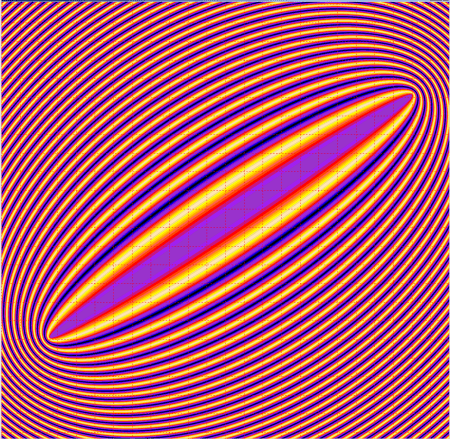
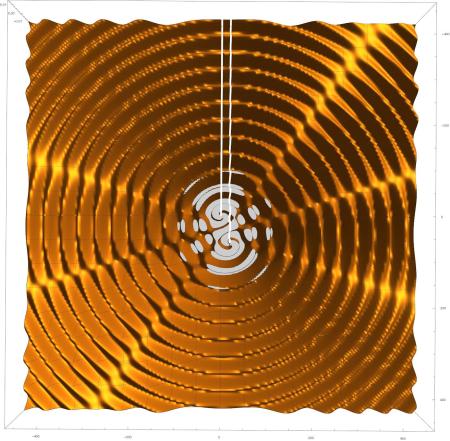
I have found a vast gold-mine of interesting consequences resulting from such a field to the extent that I felt a deeper dive into writing a simulator was worth the trouble.  After a long period of time, I now have initial results, and the very first pictures that were output made me realize what a very unique animal the unitary rotation vector field is.  Usually when we see interference effects between two oscillating sources (or the wave interference pattern that emerges from a two slit experiment barrier, we see something like this:

interference_pattern

But when I set up two sources using the unitary rotation vector field, I was so surprised that I thought there was something wrong with the simulator.  But then I thought about it for a while and realized–a unitary rotation field is a very different critter than what we are used to when we study EM theory or quantum mechanics.

Here is a picture of two identical (same wavelength) particles separated by a substantial distance.  It should be really clear that between these two particles the interference of rotation waves disappears.  The two particles are effectively entangled, and in this vector field the waves interfere along the path between them.

two_particle_1

Removing one of the two particles instantly removes the interference and the stable path between them.

one_particle_1

Now this is where things get bizarre beyond belief:  add a *third* particle nearby in space, and the wave pattern of the first two completely *disappear*!!  Going to four or more particles, the wave pattern causes a single new entity to appear in the center.  This aint your Gramma’s EM field here!

three_particle_unrelated_1

four_particle_same_1

five_particle_1

I will stop here, but I haven’t even begun–this is a 5D sim, I’m just testing 2D configurations to test it.  I am just capturing a single slice, but 3D configurations will be fascinating to uncover.  And–we are talking static configurations–wait until you see how these things move!

You may be completely skeptical that any of this connects with reality, or passes that ultimate test of new physics, that it predicts something new.  However, I am fascinated by the potential of this new tool, the unitary rotation vector field simulator, to lead to new insights about the theory I’ve worked on for so long.

Agemoz

Properties of a Unitary Rotation Field

January 6, 2020

The unitary rotation field in R3+I dimensions is part of a quantum interpretation that obeys special relativity.   Recently I was able to show that the field can produce both linear and closed loop soliton solutions that do not produce discontinuities in the field.  This is a big step forward in the hypothesis that this field is a good representation of how things work at the quantum/subatomic scale.   Note that this field is NOT the EM field, which under quantum field theory reduces to a system of quantized and virtual particles.

This unitary rotation vector field is derived from the E=hv quantization principle discovered by Einstein more than a century ago.  This principle only allows one frequency dependent degree of freedom, so I determined that only a field of unitary twists of vectors could produce this principle.  (I didn’t rule out that other field types could also produce the principle, but it’s very clear that any vector field that assigns magnitude to the vectors could not work–too many degrees of freedom to constrain to the E=hv property).  This has two corollaries:  first, no part of the field has zero magnitude or any magnitude other than unity, and, the field is blocking–you cannot linearly sum two such fields such that a field entity could pass through another entity without altering it.

Why did I determine that the rotation has to be in R3+I, that is, in four dimensions (ignoring time for now)?  Because of the discontinuity problem.  If the field were just defined as R3, you cannot have a quantized twist required to meet E=hv.  No matter how you set up the rotation vectors around a twist of vectors along an axis, there must be a field discontinuity somewhere, and field discontinuities are very bad for any reality based physical model.  That makes the field non-differentiable and produces conservation of energy problems (among many other problems) at the discontinuity.

However, all of quantum mechanics works on probability distributions that work in R3+I, so that is good evidence that adding a fourth dimension I for rotation direction is justified.  It doesn’t mean there is a spatial displacement component in I–unlike the R3 spatial dimensions, I is just a non-R3 direction.  And the I dimension does at least one other extremely important thing–it provides a default background state for all vectors.  In order for photons and particles to have quantized twists, a background starting and stopping vector rotation is necessary.  The unitary field thus normally would have a lowest energy state in this background state.

Aha, you say–that can’t work, the vacuum is presumably in this lowest energy state, and yet we know that creation operators in quantum mechanics will spontaneously produce particle/anti-particle pairs in a vacuum.  You would be correct, I have some ideas, but no answers at this point for that objection.  Nevertheless, I recently was able to take another step forward with this hypothesis.  As I mentioned, it is critical to come up with a field that does not produce discontinuities when vector twists form particles.  Unlike R3, the R3+I field has both linear and closed loop twist solutions that are continuous throughout.

This was very hard for me to show because four dimensional solutions are tough to visualize and geometrically solve.  I’m not a mathematician (whom would undoubtably find this simple to prove), so I used the Flatland two dimensional geometry analogy to help determine that there are continuous solutions for vector twists in four dimensions.  There are solutions for the linear twist (e.g., photons) and closed loop particles.  There are also solutions for linked closed loops (e.g., quarks, which only exist in sets of two or more).

I will follow up next post with a graphical description of the derivation process (this post is already approaching the TL;DR point).

Now, this is a very critical step indeed–there is no way this theory would fly, I think, if field discontinuities exist.  However, I’m not done yet–now the critical question is to show that the solitons won’t dissipate in the unitary rotation field.  If there are no discontinuities, then the solitons in a field are topologically equivalent to the vacuum field (all vectors in the +I background state).  What keeps particles stable in this field?  As dicussed in previous posts, my hypothesis has been to use the displacement properties of quantum interference–now that the discontinuity problem is resolved, a more thorough treatment of the quantum interference effects on the unitary rotation field approach is now necessary.

Regardless of how you think about my hypotheses that unitary rotation vector fields could represent subatomic particle reality, surely you can see how interesting this investigation of the R3+I unitary rotation field has become!

Agemoz

A Solution for a Quantum Interference Soliton

September 29, 2019

Quantum interference will redirect particle paths due to wave interference effects, so it seems reasonable to assume that quantum interference could form an orbiting pair of group wave particles.  It is fairly easy to show that a pair of oscillating wave sources will generate an interference pattern such that if the sources follow the pattern peak amplitude path, the paths will orbit each other (see several recent previous posts on this topic).

However, in real life, there are only a very limited set of wavelengths that could produce actual particles–electrons, for example, could be the results of such orbiting internal wave structures, but why do rest-frame electrons have precisely the wavelength they have, and no other?  We know that geometry alone cannot form any specific wavelength soliton solution, because geometry by itself is scaleless–there is nothing in geometry that specifies that an orbiting pair of particles has to have a specific size.  The only fixed constants we have that could form solitons are the constants of physics–speed of light c, charge q, Planck’s constant, and so on.

I’ve thought for years about what could constrain the geometry to a single soliton size, and so have many others, including DeBroglie, Compton, and others who generally tried to use the obvious candidate–charge attraction.  But since EM fields are central force fields and produce unstable solutions involving infinities, no one accepts that approach anymore.

I think I have an answer.  It comes from quantum interference, speed c, and Planck’s constant–let’s see if you agree or think this is just another futile exercise in numerology or wishful thinking.

We will assume that on some tiny scale, electrons consist of a dual pair of oscillating wave peaks (see image).  Quantum interference determines that the peaks will orbit with a radius proportionate to the wavelength.  So far, there is nothing that constrains how big this orbit is–the larger the wavelength, assuming they all move at speed c, the longer the path time, which corresponds to the longer wavelength.   There are no unique solutions here.  We need to determine what could constrain this orbit radius.

We know that wave particle momentum is inversely proportionate to wavelength, but directly proportionate to orbit size.  In other words, the smaller the wavelength, the smaller the orbit–but conversely, the smaller the wavelength, the higher the momentum, and consequently, the larger the orbit.  There is only one wavelength where the orbit is the same for both.

I computed it this way.   Radius r of an orbit is equal to mass * velocity^2 divided by the force Fn (reference centripetal force) applied normal to the orbit path.  This is the quantum interference force and is independent of r (quantum interference does not obey the central force derivation used for charge or gravity, reference the Aspect experiment and similar).  Now, the wavelength must also define the radius; here, the radius r is equal to the wavelength wrapped around the orbit, that is, lambda/2 Pi.  We assume the velocity of the waves is always c, so for non-relativistic particles, E = m c^2 = hv.  Substituting into the first equation for r and using v = 2 Pi f, we obtain h c/(Fn lambda) = lambda / 2 Pi.

Therefore, there is only one wave solution for a dual pole orbit (yes, I did unit checking to make sure I didn’t goof something up on this):

lambda = Sqrt( 2 Pi h c / Fn)

Other wave peak geometries in R3 will produce similar solutions.  It’s not clear what Fn would be yet–more work to do here, but one thing is for sure–such a construct will only produce one solution.  The proposed soliton only works if Fn is independent of dipole spacing.  This works if we use the proposed idea that poles are Fourier sums of waves (see previous posts and this paper:  group_wave_constant_speed).  Quantum interference alters the wave sum to guide the poles.  No actual force is needed (the big drawback of the guiding pilot wave used in the Bohm quantum interpretation is the need for a new force not shown by experimental observation).

I will investigate further for specific particles such as an electron,  and report back.

Agemoz

dipole

dipole structure

sum_radials_00


Determining Subatomic Particle Characteristics from its Quantum Interference

July 18, 2019

Edit update 190719: Addendum added see below–another possible experiment

Every subatomic fermion (non exchange particle such as an electron) has a specific mass and hence wavelength, and thus will produce quantum interference with another particle of the same type or with itself.  This quantum interference will cause particle motion to be redirected, for example to specific locations (interference pattern) on a target detector in the two slit experiment.  It seems logical that studying the quantum interference effects of a particle will lead to insights about the particle structure.

In the previous post, I showed how the quantum interference pattern could be used to make a guess about particle internal structure.  It could form a soliton if the particle were a loop whose radius matched the wavelength of the particle.  But, if the particle radius is much smaller than its characteristic wavelength, this doesn’t work and the particle cannot be constructed using quantum interference.  I showed how a ring structure could produce the tiny point collision signature but still produce waves with the particle’s characteristic wavelength.  If we were able to determine if quantum interference forms electron structure, we could answer the size and topology question for once and for all.

But there’s more we can get from quantum interference.  If an electron is truly infinitesimally small, much smaller than the electron characteristic wavelength, we will have no way to determine internal structure by experimental observation.  But we can use its quantum interference pattern, whose characteristic wavelength scale is much much larger, to indirectly figure some things out.

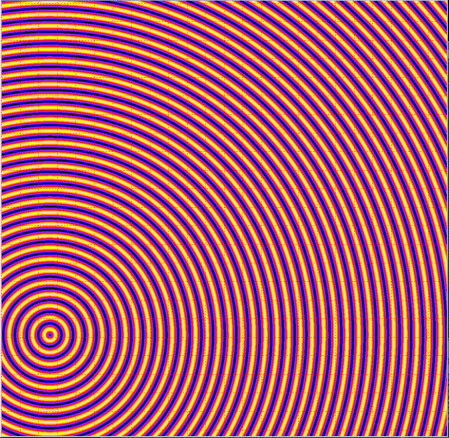
For example, one great question to ask is whether the electron is a monopole oscillating or twisting in place– or consists of two nodes, a positive and a negative node spinning in a dipole orbit.  As far as I know, there is no experimental or theoretical work that determines which is reality for any subatomic particle.  There is no possible way to distinguish these two cases directly if the electron is infinitely small, which is the current physicist consensus.  But these two cases will have different characteristic wave patterns!  The monopole case will produce waves as concentric circles about the center.  The dipole will produce a spiral and will have a radiating peak and zero path.

monopole_down

monopole oscillates in place

monopole_up

monopole oscillates in place

monopole_pattern

monopoles produce a concentric circle pattern

dipole

dipole structure in orbit

interference_well

dipole spiral interference pattern

Admittedly, conducting an experiment that observes quantum interference in this distance range will be problematic at best.  But there’s one more important difference between the patterns generated by monopoles and dipoles that should help:  in a monopole particle, the phase of waves emitted both toward and away from the particle will be the same–but the phase of of spiral waves will be different by Pi/2 (90 degrees).

This characteristic wavelength should be in reach of (very) sophisticated observation apparatus–the electron wavelength, called the deBroglie wavelength, is 1.22 e^-9 meters.   The wavelength of visible light is in the range of 400 to 700 e^-9 meters, but energetic X-rays fall into range of this characteristic wavelength. If we could match the characteristic wavelength with an X-ray emitter (using electron-positron annhiliation, perhaps?), we would see observable interference that would either be the same or different on the leading and trailing particle wave paths, leading to either a monopole or dipole determination.  If such an experiment could be made practical, we should be able to get a significant clue of the internal electron structure even if the electron is infinitesimally tiny!

Do you see why I think quantum interference could be as powerful a measuring tool for science as, perhaps, the LIGO experiment?

Agemoz

Edit Addendum:  It occurred to me that there might be a better way to detect whether electrons have a monopole or dipole structure using a diffraction grating.  Silicon processes for fabricating computer chips are at 7 nanometers–the width of 6 or 7 electron wavelengths, so we are within reach of fabricating an experimental setup for electron emitters.  When computing the expected interference pattern in a two-slit experiment, Huygen’s principle is used.   This principle conforms to the concentric circle pattern that comes from a monopole.  Unfortunately, the current typical two-slit experiment has the barrier device (with two slits) oriented perpendicular to the emitted electron’s path and will not be able to determine which interference pattern is present. The dipole structure will give the same answer as the monopole case, because the wave pattern is sampled by the two-slit apparatus at the same phase point for either of the slits.

However, if the two-slit apparatus is tilted from the normal to the electron trajectory, you will have one of the slits slightly time and space delayed from the other, and now the resulting interference pattern will be dependent on the phase shift that occurs when you encircle the particle.  In other words, the spiral will be distinguishable from the concentric structure, and this experimental setup should point to either the monopole or dipole structure.

Inferring Subatomic Particle Structure From their Quantum Interference Patterns

July 13, 2019

In the previous post, I showed a proven theorem where classical Newtonian particles composed of instantaneous phase waves must observe special relativity.  If we assume the converse is true, it becomes worthwhile to deconstruct subatomic particles, which obey the principles of special relativity, as some construction of instantaneous phase waves.

Fortunately, quantum experiments such as the two-slit experiment and the Aspect experiment already confirms this principle:  there is good evidence there are instantaneous phase waves in particles because of the experimentally observed noncausal decoherence of entangled particles.  In addition, the two-slit experiment also shows that this interference is noncausal–you can cover one of the slits in the time it takes for a particle to travel through slits to a target detector, and instantaneously alter the possible particle detection sites.  Assuming that particles are formed by nothing other than waves has significant justification, both due to experimental observation and because such particles must obey special relativity according to the theorem described in my paper (see previous posts).

So–if we assume that particles form only from composite collections of waves, can we infer from the experimentally observed quantum interference patterns what the subatomic particles must look like mathematically?

There’s a lot of reasons we might be tempted to describe electrons with a Compton radius size, but any serious physicist won’t believe such claims, here’s why.  Subatomic particles are most often measured and examined in collision experiments.  The actual collision can’t be observed in most cases, but the resulting particle trajectories and masses can be, and allows us to determine things like size, internal composition, and angular momentum of the colliding particles.  One nice way to determine internal composition is to measure elasticity.  If you hit a billiard cue ball against another billiard ball, it might bounce right back at you, whereas if you throw a water balloon at another water balloon, the whole mess of water and balloon fragments will head more or less in the direction of your throw.  In other words, we can gain a lot of information about the inelasticity of a particle by the angular distribution of the post-collision particles.  All experiments show that electrons are perfectly elastic and are measurably infinitely tiny.  Hard as a billiard ball and too small to measure any diameter.

Here’s the problem–if you test the hypothesis that particles can form group wave constructs affected by quantum interference effects, we can draw conclusions based on knowing that the particles must be composed of instantaneous phase waves.  These waves don’t have to lie in a plane–for example, waves that lie on a twisting plane obey the same Fourier composition rules as planar waves.  I hypothesized in the previous several posts that waves form a couple of opposing delta functions that follow the peaks of the self-generated quantum interference wave pattern.  We already know from the two-slit experiment that quantum interference will redirect a particle path onto the peaks of the quantum interference that results from passing the waves through two slits.  It is thus very reasonable to assume that the right setup of quantum interference would create a circular loop, and I show that in the previous two posts.

However, this wont work if the two poles of our particle are infinitesimally spaced, that is if the particle has no significant size such as a Compton radius.  The poles are too close to be able to fall into the quantum interference peak locations that guide them into a loop ring!

interference_path_size

The only way–and it seems like a tenable proposition–is to say that the electron is not an infinitesimal point, but rather, a ring whose axial diameter is infinitely small.  Now the collision cross-section is the same as the point particle and you should get the same experimentally observed angular distribution of post-collistion particles–provided that the ring does not collapse–that it is totally inelastic.  I proposed this to an experienced particle physicist, but he said that’s not possible–there should be observable characteristics of a ring that are different than for a point particle.  I tried to argue that there’s a better argument for a ring than a point, because a ring has a definite angular moment (electrons have an experimentally measurable angular moment) but a point as defined as such does not.  I see a strong case for my proposition from the quantum interference soliton point of view, the angular moment, the Planck’s constant uncertainty relation (which says that something smaller than the Compton radius cannot meet the position-momentum Heisenberg uncertainty relation), and many others.  As you can imagine, I didn’t get very far–the response was NO, subatomic particles are measurably infinitesimal points!  And that’s all he would discuss.

collision_elasticity

Regardless–it appears clear to me that examining the experimentally observed quantum interference pattern of a particle should tell us new information about what forms the particle.  Is quantum interference responsible for particle structure?  If it is, the particle has to be a lot bigger than an infinitesimal point, yet have the collision signature of a point.  The only answer I see is the ring hypothesis with an infinitesimal axial radius.  Otherwise, I will have to conclude that quantum interference must be refuted as a candidate for forming solitons, and hence, subatomic particles, from waves.

Agemoz

Quantum Interference Defines a Soliton: Part II, Computed Images

June 20, 2019

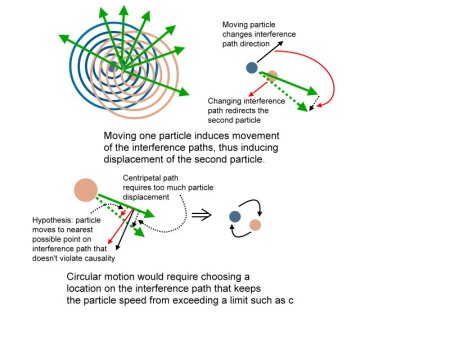
Here are actual computed results of how the interference pattern moves for a dual interference source.  In my previous post, I described how a moving interference pattern will alter the location displacement of the interference sources, which leads to the conclusion that quantum interference should enable stable solitons.  There, I showed a schematic representation of what should happen.  Here is visual computed proof that what I described actually happens:  The first picture shows no orthogonal displacement of the interference sources, so the interference paths are symmetric about the interference source X axis.  However, the following pictures demonstrate more and more successive orthogonal Y displacement, causing the interference peak paths to rotate in such a way as to displace the nearby interference source.  This assumes that the interference source will follow the rotating interference path–we know this is true due to experimental verification via the two-slit experiment as one example.  As a result, you should see that moving one interference source should cause the adjacent interference source to move in the opposite direction, causing the two sources to orbit like a binary star (see the previous post for details).

Notice the white line, this is the X axis reference direction to help assess the interference path rotation as y-axis displacement is added to one of the interference sources.  These examples show just one possible interference system–it shouldn’t be unreasonable that I conclude that all planar non-degenerate interference cases should behave the same way.  Things get really interesting when one of the sources is rotated into the Z axis, and when a third source is placed on the Z axis, and when the wavelength of one of the sources is doubled or multiplied by other factors such as 1/3 or 2/3.  More to come…

Agemoz

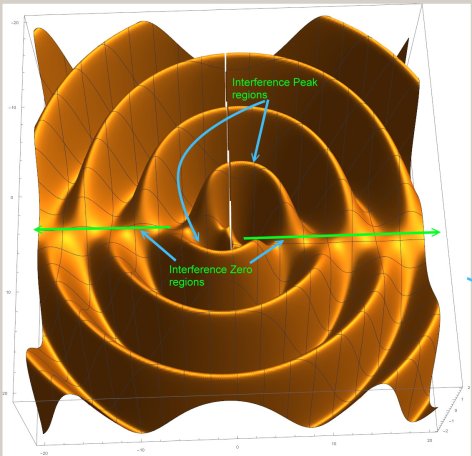
Edit:  My initial analysis (see previous post) showed that the two interfering sources would cause a rotating interference pattern if one were to move past the other in the direction orthogonal to the axis that both sources lie on.  I could show that there would be an induced motion to the second source if the first source were moved orthogonally, but did not know what would keep the second source from moving centripetally (moving away from the center).  Closer examination (see zoomed in picture) shows that there is a potential well in both the X and Y direction–the interference pattern itself is what constrains the radius of the orbiting path.  I do not need to invoke something like the speed of light to keep the orbital path confined to its radius.

sum_radials_00

sum_radials_10

sum_radials_20


sum_radials_30

Edit:  My initial analysis (see previous post) showed that the two interfering sources would cause a rotating interference pattern of rays if one were to move past the other in the direction orthogonal to the axis that both sources lie on.  I could show that there would be an induced motion to the second source if the first source were moved orthogonally, but did not know what would keep the second source from moving centripetally (moving away from the center).  I tried to bring in something, the speed of light, to confine the radius of the interference particle orbit, but soon felt like this was a flaw in my scheme for describing a soliton via interference (this is the same reason that various DeBroglie/Compton schemes using an EM field fail).  However, closer examination (see zoomed in picture) shows that the interference pattern is a potential well in both the X and Y direction–the interference pattern itself is what constrains the radius of the orbiting path.  The rays in the previous images are actually interference zeroes, not peaks–the particles will follow a path defined by the peaks.  I do not need to invoke a contrivance like the speed of light to keep the orbital path confined to its radius.

interference_well

Agemoz

Quantum Interference Defines a Soliton

June 18, 2019

In my last post, I described a quantum interpretation based on group waves with an instantaneous wave phase property, and showed how it derives a constant speed regardless of an observer’s frame of reference, setting the stage for special relativity.  I also showed how it would resolve the EPR (Einstein-Podolsky-Rosen) paradox for entangled particles in the Aspect experiment cleanly without adding some unknown force.  This is a flaw with the Bohm interpretation, among others, since it means that work is done and energy expended, causing a conservation of energy violation.  We do not need to believe in multiple parallel universes (Everett interpretation) or try unsuccessfully to create a logically consistent causality using the Copenhagen interpretation.

I then showed how a instantaneous phase group wave particle could self-interfere in the two-slit experiment to logically explain the target interference pattern distribution.  In this explanation, I show the very nature of the group wave will cause particle displacement due to the summation of interfering wave components.  No pilot wave guiding, with its implied force and consequent work and energy expended, is needed.

I suddenly realized that the group wave quantum interpretation provides a possible approach for creating a soliton–a particle could form in a system based on this quantum interpretation.

For over a century, theoretical researchers have guessed that the particle zoo (the list of subatomic particles that make up protons, atoms, exchange forces, and so on) could form from a continuous field (lattices, i.e., discrete fields, have been ruled out at this time both experimentally and theoretically).  DeBroglie was one of the earliest well known scientists that worked with this idea, but Compton and others also came up with proposals.  Early efforts assumed that solitons might form from an electromagnetic field via some selected arrangement of charge distribution, but EM fields and particles have the central force property F = c_0 q_1 q_2/(r^2), and by Maxwell’s field equations behave linearly, so basing particle existence on an EM field was disproved–particles would dissipate.  If there is a field underlying formation of particles, it cannot be electromagnetic, but rather an underlying “precursor” field from which EM fields could emerge.  Dirac’s work led the way to the modern quantum field theory, which further ruled out an EM field creating solitons–EM fields consist entirely of collections of real and virtual photons that travel in straight lines (ignoring space curvature from general relativity at quantum scales).

But instantaneous phase group wave theory can form solitons.  No matter what quantum interpretation you believe in, you have to face the fact that a single particle going through two slits is going to experience redirection when you open one of the slits.  The fact that this redirection happens means that at some scale, a particle will curve in on its path–it must follow the interference pattern.  I have found a variety of ways that a moving interference pattern will circulate or follow more complex loop variations.  For the same reason that the two-slit setup forms an interference patterned domain of existence for a particle, the appropriate pair (or more) of particles will self interfere to form stable loops.  Follow the interference and you will describe a variety of possible particle paths.

Does this reflect reality–dunno, but work is ongoing.  I’m coming up with a mathematical toolset that will describe various interference path constructions.  I will follow the yellow brick road and see where it leads…interference_path_soliton

Agemoz

Why Does Quantum Interference Affect Particle Path?

June 11, 2019

I last posted on my discovery that any classical group wave will obey the observed constant speed property, a prerequisite (one of the two assumed postulates) for special relativity.  That is, if you throw a baseball, its speed will be some value v_p.  If you are standing on a train moving in the same direction at speed v_e, an observer on the ground will see the baseball move at speed v_p + v_e.  But, if you throw an object that is a linear sum of waves, such as a delta function group wave, it doesn’t matter what v_e (the relative speed of the thrower) is, the observer on the ground will always see it move at speed v_p.

The math and concept seemed bullet-proof, so I spent a couple of years writing a paper and trying to get it published.  I stayed away from any speculation and just wrote a proof that says classical group waves must appear to move at some constant speed v_p regardless of an observer’s frame of reference velocity v_e.  I made sure there was nothing in there that would make a reviewer immediately toss the paper.  I worked on getting the format and grammar acceptable for scientific publishing, had several reviewers check it for errors and conceptual problems.  They claimed it was good to go so then I submitted to several journals.  No luck–a bunch of rejections later and I finally gave up.  However, no editor wrote to disprove my math or the conceptual thinking, not sure they ever looked at that–it was always the paper doesn’t meet the quality standards of the journal or some such reason (if any).  In spite of my best skeptical analysis, I cannot find fault with the derivation, and I still think there’s some science here, so I decided to forget the publishing effort and just continue seeing what I could discover on my own.

Here it is: group_wave_constant_speed

Unlike many of the ideas I post here, which are guesses how things work and are borderline science fiction, I thought this work was a small breakthrough, it says several important things.  First, if this is true (represents reality), it shows why special relativity exists in our universe.  All the research I have done shows that no one has determined why we assume the constant speed of light postulate holds and thus why we have special relativity behavior.  Second, it shows that every particle and exchange particle must consist entirely of some kind of a wave summation, otherwise it would violate special relativity–thus giving an important clue how to mathematically define subatomic particles.  And third, it shows that any quantum particle composed of waves must phase shift the waves at a causal rate–but there can be no time-dependent component to the phase-shift along the length of the wave.  In other words, the entire wave component shifts non-causally, albeit at a causal rate.  This is important because now the Aspect experiment makes sense–if entangled particles are emitted in opposite directions, the particles stay coherent–perhaps as a orthogonally complex double helix going to oppositely placed detectors.  They oscillate their states, back and forth, until one detector captures and absorbs the momentarily real portion of the double helix, instantaneously leaving the orthogonal (imaginary at that moment) helix intact for discovery by the other detector at a later time.

This work provides a novel set of tools for looking at various quantum particle interactions.  I’m going to discuss some of what I’ve discovered on this website.  I am trying to be clear what is provable (stuff in that paper) or science fiction (these posts, for the most part, are guesses how things work and aren’t really provable at this point).  I will try to make a good case for my science fiction, that is, why I find my ideas attractive possibilities.

One example is the famous two-slit experiment.   When a single particle hits a barrier with two openings in it, it interferes with itself and only will land at certain target locations on the other side of the barrier.  Paradoxically, if you close one of the openings, now the particle will land on any target location.  I have considered the question: why does the second opening cause an alteration to the particle’s path?

The second Bohm interpretation (the leading contender of valid quantum interpretations) suggests that the particle is preordained to go through one or the other slit, but is guided to an interference controlled destination by the particle’s extended wave property going through two slits.  In this Bohm interpretation, when determining the time/space evolution of the particle wave function, a complex exponential (representing the wave from the second opening) is added to the particle wave function to mathematically guide the particle to the interference pattern target.  Two spherical waves will combine to produce various interference patterns–see the figure:
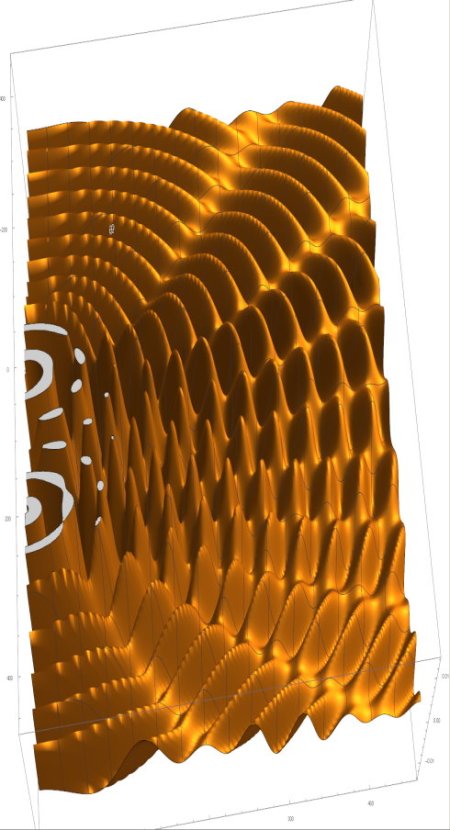
interference_pattern

The big problem with this interpretation is that work is done to move a particle.  If the particle was ordained to go through one opening to a target that is blocked when the second opening is opened, but instead goes to a nearby interference defined location, the Bohm interpretation says that the waves going through the second slit is somehow expending energy via some force being applied to the particle.   There is no evidence for such a force in nature.

There are no forces needed when using the group wave interpretation approach described in my paper.   The particle is merely defined by where the wave components sum to produce a localized group wave delta function or similar construct.  Interfering waves simply change the possible places where the “particle” will appear, and in fact the concept of particle region is set by how a detector absorbs the group wave.  In the region of the barrier, the concept of a particle becomes very ambiguous, but no waves are absorbed by the barrier .  Instead, they all pass through the openings, so a Fourier composition must reform the particle somewhere after the barrier that will eventually hit the target detector region.  No funny or weird alterations to the wave function are needed.

There are many more ideas like this that follow from assuming a group wave interpretation–one of the most important being that group wave particles will appear to be moving at constant speed regardless of the observer’s frame of reference–a foundation for special relativity.  Do you agree why the group wave concept is a cleaner approach than the Bohm interpretation?  I don’t think this is science fiction, but I couldn’t get any journal editors to see things the way I am….  😦

Agemoz

PS:  I use wave and wave functions interchangeably in this post–the concepts shown here are valid for both physical waves and probability distributions.